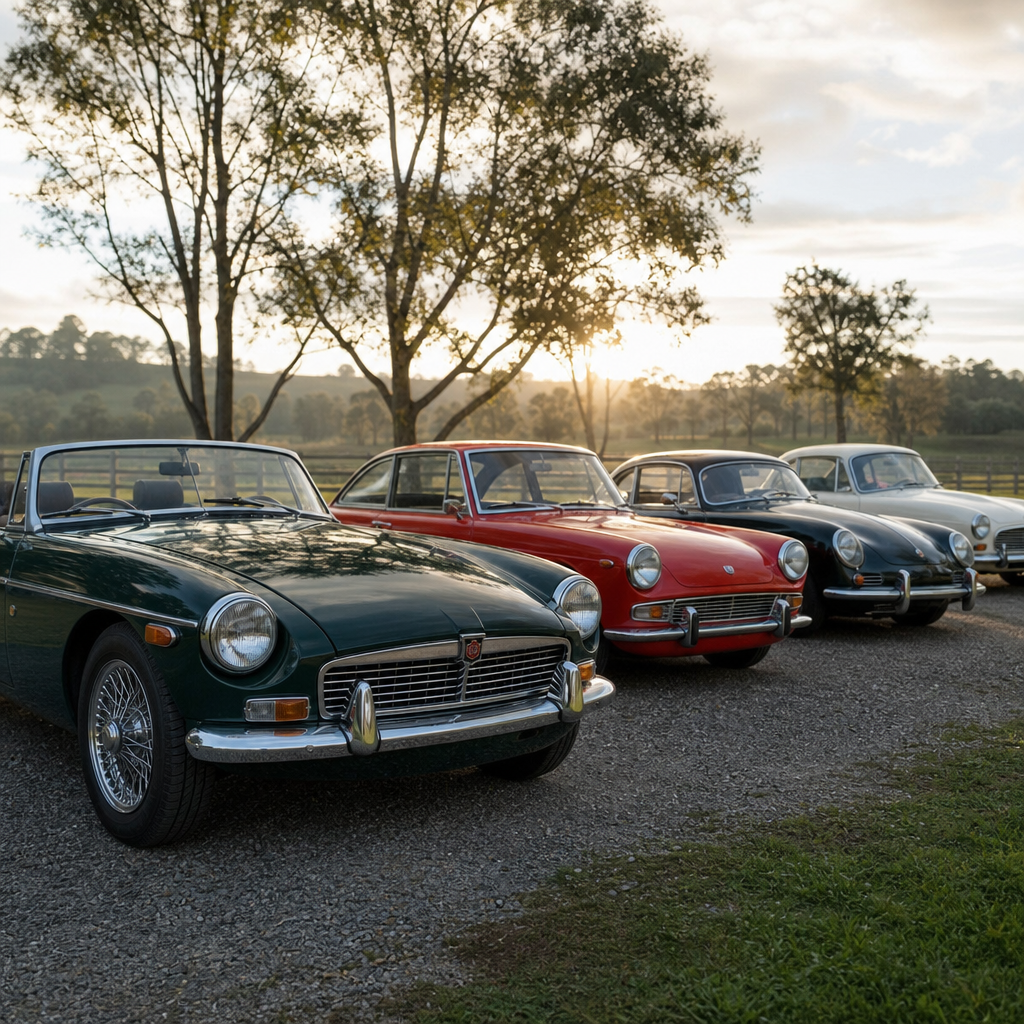
The 1950s are widely considered the peak of classic design because the decade fused postwar optimism, rapid engineering progress, and bold styling into cars that still define what many people picture when they hear the phrase classic car. In the collector world, classic design usually refers to a balance of proportion, ornament, innovation, and cultural influence that gives a vehicle lasting visual authority. A hub page on popular classic car eras has to start here, because the 1950s sit at the center of nearly every conversation about chrome, tailfins, wraparound windshields, and the rise of the American dream on wheels.
When I walk enthusiasts through classic car history, I define the major eras in practical terms. Prewar cars emphasize craftsmanship and coachbuilt variety. The 1940s represent transition, with wartime interruption and carryover styling. The 1950s deliver the breakthrough into modern mass-market glamour. The 1960s push performance and youth culture. The 1970s show regulation, fuel pressure, and changing taste. Looking across those periods, the 1950s stand out because design, technology, and public desire aligned at exactly the right moment.
That matters for anyone studying classic car basics because design is not only about appearance. It influences collector value, restoration decisions, parts demand, media coverage, and which cars become enduring reference points. Models such as the 1955 Chevrolet Bel Air, 1957 Cadillac Eldorado, 1956 Continental Mark II, and 1955 Chrysler C-300 are not remembered simply for being old. They are remembered because they captured a visual language that connected luxury, speed, aerospace imagination, and everyday accessibility in a way no earlier or later decade matched so completely.
The 1950s also work as the hub for understanding popular classic car eras because they borrow from what came before and point directly to what follows. You can see Art Deco influence fading, jet-age influence rising, and the first strong link between annual model changes and consumer identity. In plain terms, the decade taught manufacturers how to make styling a reason to buy a new car. That shift changed Detroit, shaped European responses, and created the collector icons still filling auction catalogs, concours fields, museums, and home garages today.
Why 1950s styling changed the classic car conversation
The strongest argument for the 1950s as the peak of classic design is that the decade made styling central to the product. Before World War II, many cars were handsome, but engineering and coachwork often carried more weight than brand-specific annual styling signatures. In the 1950s, major manufacturers turned design studios into strategic weapons. Harley Earl at General Motors, Virgil Exner at Chrysler, and leaders at Ford transformed visual differentiation into a mass-market expectation. The car was no longer just transportation; it was a personal statement visible from half a block away.
Several design elements became iconic during this period. Tailfins evolved from modest cues on the 1948 Cadillac into dramatic signatures by the late 1950s. Panoramic windshields widened the cabin view and gave bodies a futuristic sweep. Chrome trim outlined fenders, windows, grilles, and side spears with theatrical confidence. Two-tone paint emphasized motion even when a car was parked. Lower beltlines and longer hoods changed the proportion of mainstream sedans and coupes. These were not isolated flourishes. Together, they created a coherent language of optimism and movement.
The annual model cycle amplified the effect. GM in particular had refined planned obsolescence into a practical business system, meaning visible updates appeared frequently enough to make design feel current and competitive. Buyers began to compare grilles, rooflines, and rear-quarter treatments the way later generations would compare horsepower, touchscreen size, or electric range. The result was a golden period in which everyday family cars received a level of aesthetic attention rarely matched before or since.
Importantly, the decade balanced excess with readability. A 1957 Chevrolet, 1955 Buick, or 1958 Plymouth is easy to identify because each has strong proportions and clear brand character. Some later designs became cluttered or compromised by crash standards and emissions packaging. Some earlier designs were beautiful but less instantly legible to the average viewer. The 1950s hit the sweet spot: dramatic enough to be memorable, disciplined enough to remain elegant.
How postwar prosperity and technology shaped the era
Design did not peak in a vacuum. It was supported by economics, manufacturing, and public mood. After World War II, the United States experienced rising incomes, suburban expansion, highway growth, and a powerful consumer culture. Families had more reason to buy cars and more desire to express status through them. Automakers responded with larger lineups, richer trim levels, and more aggressive restyling. The car became part appliance, part sculpture, part social badge.
Technology reinforced that appeal. Overhead-valve V8 engines became mainstream, delivering stronger performance in vehicles that looked as fast as they felt. Automatic transmissions spread quickly, making big stylish cars easier to drive. Power steering, power brakes, power windows, electric seats, air conditioning, and improved radios turned the cabin into a comfort zone rather than a bare mechanical compartment. Tubeless tires improved safety and convenience. Twelve-volt electrical systems supported growing accessory loads. These advances mattered because they gave the bold exterior a matching sense of modernity.
I often tell newcomers that a 1950s classic feels important even before the engine starts because the era mastered occasion. Heavy doors close with authority, dashboards stretch wide, instrument clusters are framed like jewelry, and hood ornaments guide the view forward. While not every 1950s car was technically advanced by European standards, the integrated experience was compelling. Buyers felt they were stepping into the future, and that emotional reaction is a major reason the decade still dominates classic car imagination.
| Era | Design Character | Typical Innovations | Collector Appeal Today |
|---|---|---|---|
| Prewar 1930s | Coachbuilt elegance, upright proportions, flowing fenders | Body-on-frame refinement, luxury craftsmanship | High prestige, specialized ownership |
| 1940s | Transitional styling, carryover forms, limited wartime change | Postwar production ramp-up | Historic interest, narrower mainstream demand |
| 1950s | Tailfins, chrome, panoramic glass, dramatic proportions | OHV V8s, automatics, power accessories | Broadest recognition and strong nostalgia |
| 1960s | Cleaner lines, muscle stance, personal luxury themes | Big-block power, improved suspensions | Huge following, especially performance cars |
| 1970s | Bulkier forms, safety bumpers, formal rooflines | Emissions controls, fuel economy responses | Growing interest, but less universal admiration |
What made 1950s American cars the defining classics
American manufacturers set the public image of the decade, and specific models explain why. The 1955 Chevrolet introduced crisp, modern styling and the small-block V8, a combination that permanently raised Chevrolet’s performance reputation. The 1957 Chevrolet Bel Air added sharper detailing and became an enduring symbol of the era, helped by huge aftermarket support and constant visibility in film, television, and restoration culture. Cadillac pushed visual drama further, especially in 1959, when towering fins and intricate trim turned luxury into spectacle.
Chrysler under Virgil Exner deserves equal attention. The Forward Look program, launched in the mid-1950s, replaced heavier early-decade shapes with lower, longer, more purposeful forms. Cars like the 1957 Chrysler 300C and DeSoto Adventurer looked advanced rather than merely decorated. Ford also captured the era’s energy through models such as the 1955 Thunderbird, which created the personal luxury niche, and the 1957 Fairlane 500 Skyliner, whose retractable hardtop remains one of the boldest production engineering statements of the decade.
These cars matter as a hub topic because they connect design to ownership realities. They are well documented, parts are comparatively available, and buyers can still choose among concours restoration, period-correct cruising, or tasteful preservation. In educational terms, the 1950s are the most approachable starting point for learning trim identification, VIN and cowl tag research, factory color combinations, and the difference between hardtop, sedan, convertible, wagon, and pillarless body styles. The era is visually rich, but it is also teachable.
How European design contributed to the decade’s reputation
Although American cars dominate the popular image of the 1950s, Europe strengthened the decade’s claim to classic design by offering a different expression of excellence. If Detroit represented exuberance, Europe often represented restraint, precision, and coachbuilt beauty carried into series production. Mercedes-Benz created one of the era’s indisputable masterpieces with the 300SL Gullwing, introduced in 1954. Its tubular spaceframe, direct fuel injection, and unforgettable doors made it advanced engineering wrapped in sculptural form. Few cars from any period combine technical significance and visual drama so successfully.
Italy contributed another layer. Pinin Farina, Bertone, Zagato, and Touring Superleggera shaped Alfa Romeo, Ferrari, Lancia, and Maserati into rolling design studies. The Lancia Aurelia B24 Spider and Ferrari 250 GT series showed how the 1950s could be elegant without excess. In Britain, Jaguar’s XK120 and XK150 proved that long-hood sports car proportion could be both athletic and refined. Citroën’s DS, launched in 1955, deserves special mention because it redefined aerodynamic futurism with hydropneumatic suspension, front-wheel drive packaging, and a body unlike anything else on the road.
These European examples are essential when comparing classic car eras because they show the 1950s were not merely a chrome-heavy American phenomenon. The decade produced parallel peaks: exuberant in the United States, sculptural in Italy, technically daring in France, and performance-oriented in Germany and Britain. That breadth is one reason historians consistently rank the era so highly.
Why later eras never fully replaced the 1950s ideal
The 1960s produced many great cars, especially muscle cars, grand tourers, and sharper modernist designs. Yet the decade often refined themes established in the 1950s rather than inventing an entirely new emotional relationship between design and the mainstream buyer. By the 1970s, safety regulations, emissions controls, insurance pressures, and fuel crises changed priorities. Large bumpers, detuned engines, and more conservative forms made many cars less visually pure and less mechanically expressive than their 1950s predecessors.
Earlier eras also struggle to claim the same broad cultural dominance. Prewar luxury design can be breathtaking, but it belongs to a narrower ownership and historical context. The immediate postwar years are significant, though many models were essentially updated prewar cars. The 1950s therefore occupy a rare middle ground: modern enough for mass nostalgia, old enough to feel magical, and varied enough to satisfy collectors interested in style, engineering, sociology, advertising, and restoration craft.
There are tradeoffs, of course. Not every 1950s car handled well, stopped confidently, or protected occupants by modern standards. Rust protection was often poor. Complex trim restoration can be expensive. Fuel economy is modest. But those limitations do not erase the design achievement. In fact, understanding them helps enthusiasts buy smarter and appreciate the decade honestly rather than romantically.
How to use this era as a starting point for exploring classic car history
As a hub within classic car basics and education, the 1950s are the best launch point for exploring other popular classic car eras. Start by identifying which aspect of the decade attracts you most: design language, V8 development, luxury equipment, body style variety, or cultural impact. From there, compare adjacent periods. If you love fins and chrome, study late 1940s roots and early 1960s cleanup. If you value engineering, follow the path from straight-eight and flathead engines into overhead-valve V8s, then into muscle-era big blocks.
Use trusted resources while learning. Factory brochures, marque clubs, the AACA, the Petersen Automotive Museum, the National Motor Museum, auction archives from RM Sotheby’s and Mecum, and restoration guides from publishers such as Motorbooks provide reliable context. I also recommend studying survivor cars, not only restored examples, because original interiors, trim finishes, and assembly details teach lessons that repaint-heavy show cars sometimes hide.
The key takeaway is simple: the 1950s are considered the peak of classic design because no other era combined optimism, styling freedom, technological progress, and cultural reach so effectively. The decade gave us cars that remain instantly recognizable, highly collectible, and historically important across multiple markets. It also provides the clearest framework for understanding how classic car eras evolved before and after.
If you are building your knowledge of popular classic car eras, begin with the 1950s, then branch into prewar elegance, postwar transition, 1960s performance, and 1970s change. That sequence makes the history easier to read and the design differences easier to spot. Explore model-specific guides next, compare landmark cars side by side, and use this foundation to make smarter decisions whether you plan to buy, restore, research, or simply appreciate the classics more deeply.
Frequently Asked Questions
Why are the 1950s so often called the peak of classic car design?
The 1950s are often treated as the high point of classic car design because the decade brought together several forces that rarely align so perfectly: postwar confidence, fast-moving engineering progress, expanding consumer demand, and a willingness from automakers to experiment boldly with form. Designers were no longer building cars simply to meet basic transportation needs. They were creating objects that expressed optimism, status, motion, and national identity. That shift is a major reason 1950s cars still feel so visually important today.
What makes the decade especially significant is balance. The best 1950s cars combined strong proportions, decorative flair, and meaningful technical improvement without losing coherence. You see long hoods, low rooflines, wraparound windshields, generous chrome, two-tone paint, sculpted fenders, and eventually tailfins, but on the strongest designs those features work together instead of competing with each other. The cars feel intentional, not accidental. That visual authority is a major part of why so many enthusiasts think of the 1950s first when they hear the phrase “classic car.”
The decade also left a deep cultural imprint. Cars from the 1950s became symbols of prosperity, freedom, suburbia, and the rise of automobile-centered life. Because they appeared in films, advertisements, music culture, and family memory, they became more than machines. They became icons. In collector terms, that cultural recognition matters. A true classic is not just old or rare; it carries a lasting presence that continues to shape how later generations imagine automotive beauty. The 1950s delivered that in abundance.
What specific design features define 1950s classic cars?
Several signature traits make 1950s cars immediately recognizable. One of the biggest is the emphasis on dramatic silhouette. Automakers pursued lower, longer, and wider shapes that made cars look sleek even when standing still. This gave vehicles a sense of motion and confidence that was very different from the taller, more upright forms common before the war. The profile became a central design statement.
Chrome trim is another defining element. In the 1950s, chrome was used not just as decoration but as a tool to highlight body lines, divide color sections, frame windows, and emphasize scale. When done well, it added sparkle and sophistication rather than clutter. Two-tone paint schemes also played an important role, helping to dramatize body contours and give mainstream cars a more premium, custom feel. These color combinations remain one of the easiest ways to identify the era.
Tailfins, panoramic windshields, jet-age dashboards, hood ornaments, wide grilles, and sculpted rear quarters also became hallmarks of the period. Many of these features reflected the broader fascination with aviation, rockets, and modern technology. Interiors mattered too. Instrument panels became more stylish, steering wheels more expressive, and cabin materials more colorful. In other words, 1950s design was holistic. It was not only about the front end or the side profile. The entire car, inside and out, was treated as a coordinated design experience.
How did postwar optimism and technology influence 1950s automotive styling?
Postwar optimism shaped the 1950s car industry at its core. After the austerity and disruption of World War II, buyers wanted products that felt forward-looking, prosperous, and exciting. Automakers responded by making cars bigger, brighter, and more expressive. Design became a visible way to communicate abundance and confidence. Instead of restrained utility, the market favored glamour, novelty, and the promise of a better future.
Technology amplified that mood. Advances in manufacturing, materials, glass shaping, engine development, automatic transmissions, power steering, and suspension systems gave designers and engineers more freedom. Cars could be made more comfortable, more powerful, and more visually adventurous without feeling entirely impractical. The design language of the era often borrowed from aerospace and industrial modernism because those fields represented progress. Tailfins, turbine-inspired details, wraparound glass, and instrument-style dashboards all reflected a society captivated by speed and innovation.
Importantly, these influences were not just cosmetic. The decade also saw meaningful improvements in drivability, reliability, convenience, and comfort. Buyers could get V8 power, automatic gearboxes, improved heating and ventilation, better road manners, and a more refined overall ownership experience. That combination of visual drama and real-world advancement is a major reason the 1950s stand out. The cars looked futuristic, but they also delivered a sense of modernity that owners could feel every time they drove them.
Were all 1950s cars considered great design, or only certain models and brands?
Not every 1950s car is automatically considered a design masterpiece. The reputation of the decade comes from the overall strength of the era, but within that larger story, some models and brands are more influential than others. The most celebrated 1950s designs usually show a strong sense of proportion, disciplined ornamentation, and clear identity. They feel distinctive without becoming chaotic. In collector circles, that distinction matters a great deal.
For example, brands such as Cadillac, Chevrolet, Buick, Chrysler, Lincoln, and Ford each contributed important design milestones, but not every yearly update was equally successful. Some cars pushed styling themes too far, while others achieved a cleaner and more lasting balance. A well-resolved design from the mid-1950s may be admired for its harmony and elegance, while a more exaggerated late-1950s model may be praised for boldness but debated for excess. That range is part of what makes the decade so fascinating to study.
It is also worth remembering that “great design” is not judged only by luxury brands. Mainstream models can be just as historically important if they defined public taste or introduced styling ideas that spread across the market. In many cases, the most beloved 1950s cars are those that combined accessibility with memorable design. They became familiar, aspirational, and culturally embedded all at once. So while the decade as a whole is highly respected, the strongest reputations belong to specific vehicles that best captured the era’s confidence, craftsmanship, and visual imagination.
Why do 1950s car designs still influence collectors, restorers, and modern automotive culture?
1950s car design still resonates because it established a visual vocabulary that remains powerful decades later. When people imagine a “classic” automobile, they often picture exactly the elements perfected in the 1950s: dramatic proportions, polished trim, expressive color, confident front-end styling, and an unmistakable sense of occasion. These cars do not disappear into the background. They announce themselves. That enduring recognizability is one reason they remain so desirable in the collector market.
Collectors are drawn to the era because the cars represent more than transportation. They embody a moment when design ambition was highly visible and emotionally direct. Restorers appreciate the craftsmanship, trim detail, bodywork complexity, and historical authenticity that these vehicles require. Enthusiasts also value the social meaning attached to them. A 1950s car connects to diners, drive-ins, early interstate travel, postwar family life, and the broader mythology of American motoring. Few other eras carry such an immediate emotional charge.
Modern automotive culture continues to borrow from the 1950s because the decade created symbols that still communicate prestige, nostalgia, excitement, and style. You can see its influence in retro-inspired concept cars, custom builds, advertising imagery, museum curation, and media portrayals of the golden age of driving. Even people who know little about automotive history tend to recognize the forms. That kind of cultural durability is rare. It is the clearest proof that 1950s design did not simply reflect its time; it helped define the lasting idea of what a classic car looks like.