Buying, owning, or selling an older vehicle starts with a basic question: how do you identify a classic car, and what documentation should come with it? I have evaluated enough vintage cars at auctions, private garages, DMV counters, and insurance inspections to know that the answer is never just “check the title.” A true identification process combines paperwork, physical verification, historical context, and legal records. In this guide, “classic car” refers broadly to an older vehicle valued for age, rarity, originality, design, or cultural importance, while “documentation” means the records that prove identity, ownership, specifications, service history, and provenance. This matters because documentation affects registration, insurability, valuation, restoration accuracy, and fraud prevention. A beautiful car with weak paperwork can become a legal and financial headache. A modest car with complete records can be easier to authenticate, protect, and eventually sell. If you want to identify a classic car correctly, you need to know which documents are essential, which are helpful, and how each record confirms that the car in front of you is the car being represented.
Start with Identity Documents: Title, VIN, and Registration Records
The first layer of classic car identification is legal identity. In practical terms, that means matching the car to its title, registration, and vehicle identification markings. For many cars built before the standardized 17-character VIN system introduced for the 1981 model year, the number may be called a serial number, chassis number, commission number, or vehicle number. Whatever the label, it must match the paperwork. On American classics, the identifier may appear on the dashboard, driver door pillar, firewall, cowl tag area, frame rail, or inner fender. On British and European cars, it may be stamped on a chassis plate, bulkhead, or engine bay panel.
The title is the core ownership document. It should show the seller’s legal name, the vehicle number, year, make, and body description. A registration card helps confirm continued legal use and can reveal whether the state recorded the car as antique, historic, collector, or standard passenger. I always compare the title to every visible identification point on the car, because clerical errors and deliberate misrepresentation both happen. A digit transposed decades ago can create headaches when transferring ownership. More serious issues include rebodied cars, stolen identities, and vehicles built from multiple donor cars.
For a buyer asking, “What documents should come with a classic car?” the direct answer is this: at minimum, expect a transferable title where required by law, current or past registration documents, and a readable vehicle identification number that matches both. If the car comes from a no-title state, you may instead see a registration-based ownership trail, bonded title paperwork, or import and customs records. Those alternatives can be legitimate, but they require extra scrutiny before money changes hands.
Understand Build Records, Data Plates, and Factory-Correct Details
Legal identity tells you what the car is on paper. Factory documentation tells you what it was built to be. This is where many classic car buyers make costly mistakes. A seller may advertise an engine, color, trim package, or performance option as original when the car no longer matches its factory build. To identify a classic car accurately, you need records that connect numbers, trim codes, and production specifications to recognized sources.
Useful documents in this category include factory build sheets, window stickers, warranty booklets, Protect-O-Plate cards, heritage certificates, production record extracts, and marque-specific verification letters. General Motors collectors often rely on build sheets and Protect-O-Plate data. Mopar buyers look for fendertag consistency and broadcast sheets. Ford enthusiasts may order a Marti Report for many 1967-and-later vehicles. Porsche owners use a Certificate of Authenticity or production specification record, while British Motor Industry Heritage Trust certificates are important for many MG, Triumph, Austin-Healey, and Jaguar models. For Mercedes-Benz classics, a data card can confirm original delivery details and factory equipment.
These records matter because value in the collector market often depends on matching numbers and factory-correct configuration. “Matching numbers” usually means the engine, transmission, axle, or other major components correspond to the car’s original build record or carry the proper date-coded and serial-stamped identifiers. The exact standard varies by make. On some marques, the engine number should appear on the title or warranty documents; on others, it was never used that way. Authenticity is not all-or-nothing, but every deviation affects how a knowledgeable buyer values the car.
Provenance, Ownership History, and Service Records Build Trust
After confirming legal and factory identity, the next question is whether the car’s life story makes sense. Provenance is the documented history of ownership, use, restoration, and notable events. This is where a classic car becomes more than an object with a serial number. In the real world, buyers pay more for a coherent file because it reduces uncertainty.
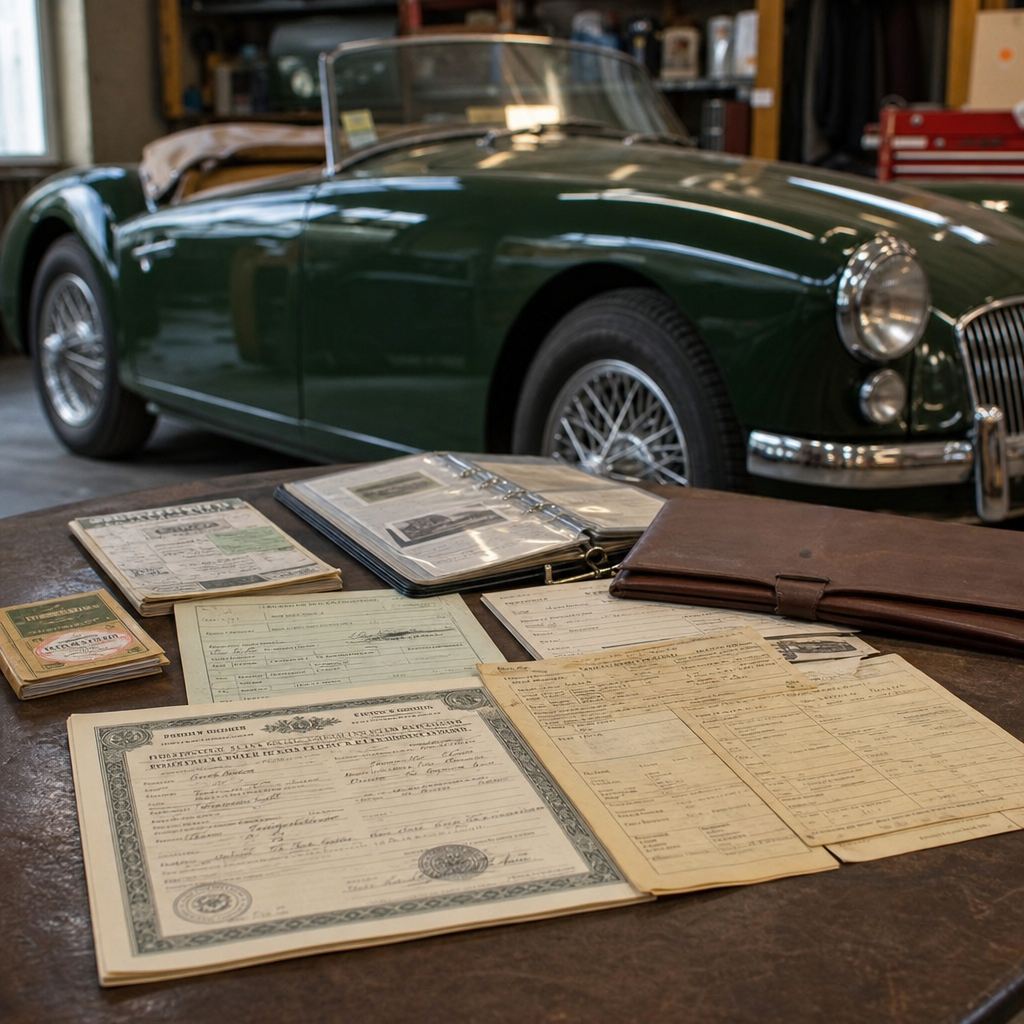
Strong provenance may include prior titles, old registrations, bills of sale, finance paperwork, dealer invoices, original owner correspondence, maintenance receipts, restoration photos, inspection reports, auction listings, and magazine features. Service records are especially valuable because they establish chronology. If a Jaguar E-Type shows invoices from recognized specialists, notes about cylinder head work, cooling system upgrades, and brake rebuilding, that tells you far more than a vague claim that it was “well maintained.” For an air-cooled Porsche 911, records documenting valve adjustments, head stud work, chain tensioner updates, and gearbox service can materially influence value and confidence.
Ownership history also helps identify mileage claims. Many classic cars are exempt from odometer disclosure rules, and five-digit odometers rolled over regularly. A car showing 42,000 miles might actually have 142,000. Old inspection certificates, service invoices, and registration renewals can reveal a believable progression. If mileage cannot be verified, the seller should say so plainly. Clear uncertainty is better than false precision.
When people ask what documentation should come with a classic car, provenance records are not always legally required, but they are commercially important. A car with a binder of fifty years of receipts, photos, and owner transfers is easier to trust than a car with nothing beyond a title and a story.
Use Physical Verification to Confirm the Paper Trail
Documents are only useful if they match the metal. Every classic car identification process should include a hands-on inspection of stampings, plates, casting dates, body tags, and construction details. I treat paperwork and physical evidence as two halves of one answer. If either side conflicts, the burden shifts to the seller to explain why.
Begin by inspecting the main VIN or chassis number for tampering. Look for disturbed rivets, inconsistent fonts, scratched paint around tags, fresh fasteners, or plates attached in the wrong location. Then compare secondary identifiers such as frame stampings, engine numbers, transmission codes, axle tags, body numbers, trim tags, and date codes on glass or major castings. On a 1969 Camaro Z/28, for example, the cowl tag, hidden VIN derivatives, engine suffix code, transmission stamp, and rear axle date should support the build claim. On a split-window Corvette, body details and trim specifics matter just as much as the title because replicas and altered cars exist.
Physical verification also reveals whether a car has been substantially reconstructed. That does not automatically make it undesirable. Many classics survive because rusted shells were repaired using donor panels or replacement frames. The key is disclosure. If the title says one thing but the car contains evidence of a rebody, replacement chassis, or non-original drivetrain, the buyer needs documentation showing how and when those changes happened.
| Document or Evidence | What It Confirms | Why It Matters |
|---|---|---|
| Title | Legal ownership and vehicle identity | Required for transfer in most states |
| Registration history | Prior use, continuity, location | Supports ownership chain and legality |
| Build sheet or factory record | Original engine, color, trim, options | Verifies authenticity and market value |
| Service invoices | Maintenance, mileage, specialist work | Shows care and helps spot hidden problems |
| Restoration photos and receipts | Scope and quality of repairs | Distinguishes proper restoration from cosmetic work |
| Inspection of VINs and tags | Match between documents and car | Reduces fraud and misidentification risk |
Know the Special Cases: Imports, Barn Finds, and Inherited Cars
Not every classic car comes with a neat binder. Some of the most interesting cars arrive with gaps, especially imports, long-stored vehicles, and estate sales. These cases require more diligence, not less. A barn find may be exciting, but excitement does not replace documentation.
Imported classics should include customs entry forms, foreign registration records, shipping documents, and any federal or state compliance paperwork used at the time of entry. U.S. buyers often see EPA and DOT exemption forms for older vehicles, along with a customs release. Without these documents, registering the car can become difficult even if the car itself is legitimate. For vehicles imported from Europe or Japan, chassis numbers may follow different formats, and translation issues can affect titles. It is wise to verify that the number on the foreign registration matches the U.S. title exactly.
Barn finds often lack current registration, but there should still be an ownership path: old plates, insurance cards, tax records, or signed bills of sale. Estate cars may come with probate documents, letters testamentary, or power-of-attorney paperwork authorizing the sale. If a seller says, “The title was lost years ago,” that is not automatically disqualifying, but you should require a legally valid replacement process before completing the purchase. In many states, departments of motor vehicles, title services, and bonded title procedures can solve these issues, but timelines and costs vary widely.
Cars assembled from parts deserve especially careful review. Some states title reconstructed or specially constructed vehicles differently from original classics. That status affects registration, resale, and insurance. If major components came from multiple donor cars, insist on receipts and state inspection records.
Documentation That Supports Insurance, Appraisal, and Future Resale
Once identity is established, documentation continues to matter throughout ownership. Insurers that offer agreed value policies, such as Hagerty, Grundy, or American Collectors Insurance, often ask for photos, appraisals, and details about condition, storage, and originality. The more complete your file, the easier it is to justify an appropriate insured value. An appraiser will look for the same things serious buyers do: title status, matching numbers, restoration evidence, major options, and market comparables.
Documentation also protects you during restoration. Before disassembly, I recommend photographing every serial plate, stamp, and tag; scanning all paperwork; and organizing records by date and category. Keep receipts for labor, parts, machine work, paint materials, and subcontracted services. If you later sell the car, that file will answer the buyer’s biggest questions before they ask them. It also helps if the car is stolen, damaged, or disputed.
For resale, the strongest package usually includes the title, current registration, factory documentation, a chronological receipt file, restoration photos, manuals, warranty booklets, spare keys, and any judging sheets or concours awards. Awards do not replace good records, but they can support the quality of a claimed restoration when paired with invoices and photos. Documentation does not make a bad car good, but it makes a good car easier to prove, price, and sell.
The best way to identify a classic car is to treat documentation as a system, not a single piece of paper. Start with the title and registration, then confirm the VIN or chassis number on the vehicle itself. Add factory records to establish how the car was originally built. Review provenance and service history to see whether the ownership story, mileage, and maintenance claims hold together. Finally, inspect the car physically to ensure the paperwork matches the metal. If you remember one rule, make it this: every important claim about a classic car should be supported by a document, a stamping, or both. That approach protects buyers from fraud, helps owners insure and preserve their cars properly, and makes future resale far easier. Whether you are evaluating a first project car, a family heirloom, or a six-figure collector vehicle, build your checklist before you buy and insist on records that can stand up to scrutiny.
Frequently Asked Questions
What are the most important documents that should come with a classic car?
The single most important document is a valid title, because it establishes legal ownership and is usually required for registration, transfer, financing, and insurance. However, with a classic car, the title is only the starting point. You should also expect to see a current or recent registration, a bill of sale, and any supporting ownership records that help connect the vehicle to the seller. If the car has changed hands multiple times, older bills of sale, previous registrations, and copies of past titles can be extremely useful for confirming a clean paper trail.
Beyond ownership paperwork, strong classic car documentation often includes service records, restoration invoices, parts receipts, factory build information, owner’s manuals, warranty booklets, and historical photos. These records help verify what the car is, how it has been maintained, and whether major components such as the engine, transmission, and body have been repaired, replaced, or restored. For collectible vehicles, documentation that supports originality or provenance can significantly affect value.
You may also want emissions exemptions, antique or historic registration paperwork, appraisal reports, inspection records, and insurance documentation, depending on the state and the intended use of the vehicle. In short, the best-documented classic cars usually come with a folder that tells the complete story: who owned it, how it was maintained, whether it was restored, and how its identity has been verified over time.
Is the title enough to prove a classic car’s identity and legitimacy?
No. A title proves a legal claim to the vehicle, but it does not always prove that the car is exactly what the seller says it is. On older vehicles especially, titles can contain clerical errors, shortened VINs, outdated numbering formats, and even mistakes made decades ago at a DMV office. That is why identification should always combine paperwork with physical inspection.
The title number should match the vehicle identification number, serial number, or chassis number found on the car itself. Depending on the year and manufacturer, that number may appear on a dashboard plate, door jamb tag, firewall plate, frame stamping, engine pad, or body plate. On many classic cars, there may be more than one identifying number, and not all of them serve the same legal purpose. Some confirm the body style or assembly plant, while others identify the chassis or drivetrain. A careful buyer checks all available numbers and compares them to the title, registration, factory data plates, and any decoder information relevant to that make and model.
You should also review the title status. Look for brands such as salvage, rebuilt, flood, junk, or total loss. If the car has a title discrepancy, a missing title, or a recently issued replacement title with little supporting paperwork, that is not necessarily a deal-breaker, but it does call for closer scrutiny. The strongest approach is to treat the title as one piece of a larger verification process, not the entire process by itself.
What paperwork helps verify a classic car’s history, originality, and value?
Service records and restoration receipts are among the most useful documents because they show how the vehicle has been cared for over time. They can reveal engine rebuilds, transmission work, paint jobs, suspension repairs, brake upgrades, and other major expenses. Detailed invoices often list dates, mileage, parts used, and the shop that performed the work. That kind of paper trail gives a buyer confidence and helps separate a genuinely maintained car from one that is simply cleaned up for sale.
Originality and provenance are supported by a different class of documentation. Factory build sheets, window stickers, broadcast sheets, protect-o-plates, dealer invoices, owner manuals, warranty cards, and period registrations can all help establish how the car was originally equipped. For especially collectible cars, marque-specific documentation services, manufacturer archives, and recognized registry reports may confirm production details, color combinations, drivetrain codes, and special-package authenticity.
Historical photos, restoration journals, show awards, magazine features, and correspondence from previous owners can also strengthen a car’s story. Appraisals and auction records may help support value, but they should never be treated as conclusive proof on their own. A high-quality documentation file does not just make the car easier to sell later; it also helps you understand whether you are paying for originality, restoration quality, rarity, or simply presentation.
What should I do if a classic car is missing paperwork or has questionable documentation?
Start by slowing the transaction down. Missing paperwork is common with older vehicles, but that does not mean you should guess your way through the purchase. Ask the seller direct questions: Do they have the title in their name? Is there a lien release? Are there older registrations, prior bills of sale, or service records? Has the car ever been registered out of state? Was it part of an estate, long-term storage situation, or abandoned vehicle process? Clear answers matter as much as the documents themselves.
If the title is missing, find out what your state requires to transfer ownership legally. Some states allow bonded titles, court-ordered titles, or registration-based ownership processes for certain older vehicles, while others are much stricter. Never assume that a handwritten bill of sale is enough. Before money changes hands, verify the VIN or serial number with the DMV or relevant motor vehicle authority and confirm that the vehicle is not stolen, improperly retitled, or tied to unresolved liens. If the seller resists basic verification, consider that a serious warning sign.
Questionable documentation should be cross-checked against the car itself. Mismatched VIN plates, altered rivets, inconsistent fonts, suspiciously fresh tags, or paperwork that does not align with known factory numbering systems all deserve attention. In higher-value transactions, it is wise to involve a qualified appraiser, marque expert, or title service familiar with vintage vehicles. Missing documents can sometimes be resolved; fraudulent documents are a much bigger problem. The key is to know which situation you are dealing with before you buy.
Are there any state or insurance documents a classic car owner should keep after purchase?
Yes. Once you own the car, you should keep a complete file that includes the title, registration, proof of insurance, inspection records if required, tax receipts, and any antique, classic, or historic plate documentation. States vary widely in how they classify older vehicles, and those classifications may affect mileage restrictions, emissions exemptions, inspection requirements, and how the vehicle can legally be used. Keeping these records organized helps avoid problems at renewal time and makes future sale or transfer much easier.
Insurance paperwork is especially important for classic vehicles because many are insured under agreed value or stated value policies rather than standard auto coverage. You should retain the policy declarations page, appraisal reports, photographs submitted to the insurer, and any correspondence describing storage conditions, mileage limits, and usage rules. If you ever need to make a claim, that file can be critical in proving the car’s pre-loss condition and insured value.
It is also smart to keep every new receipt you generate as an owner. Maintenance logs, restoration updates, parts purchases, alignment records, paint invoices, engine work orders, and transport receipts all add to the car’s documented history. Over time, your records become part of the vehicle’s provenance. For a classic car, documentation is not just something you receive at purchase; it is something you continue building throughout ownership.