Modern classics sit in the sweet spot between everyday usability and collector appeal, which is why so many enthusiasts now ask which current or recent cars are becoming future classics. In practical terms, a modern classic is usually a vehicle built late enough to offer decent safety, reliability, and parts support, yet distinctive enough to stand apart from mass-market transport. Within the broader question of what is a classic car, this category matters because it shows that collectibility is not limited to prewar tourers, chrome-laden cruisers, or 1960s sports cars. Cars from the 1980s, 1990s, 2000s, and even the 2010s are already entering classic status, and buyers who understand the signs can make smarter decisions about ownership, preservation, and value.
After years of working around enthusiast cars, auctions, owners’ clubs, and valuation guides, I have seen the same pattern repeat. A car starts as used, then becomes overlooked, then gains a loyal following, and eventually crosses into recognized classic territory. That transition rarely happens by accident. It usually comes from a mix of limited production, strong engineering, motorsport links, cultural impact, design originality, and the shrinking number of unmodified examples. Insurance companies, registration agencies, auction houses, and clubs often define a classic car differently, but in the market, a future classic is a model that is moving from depreciation toward preservation. Understanding that movement is the point of this guide.
So what is a classic car, and how do modern classics fit the definition? There is no single universal rule. Some organizations use age thresholds such as twenty, twenty-five, or thirty years. Others focus on historical interest, rarity, or collector significance. In the United States, many states have special registration categories for historic vehicles, while insurers like Hagerty and major valuation publications assess collectibility using condition, originality, demand, and transaction data. In the United Kingdom, the term often overlaps with tax and MOT exemptions for older vehicles, but enthusiasts still judge classics by desirability, not paperwork alone. A future classic, then, is a car that is not merely old, but increasingly important to buyers, historians, and drivers.
This matters for more than speculation. A genuine future classic can offer emotional value, strong community support, and manageable ownership costs if bought carefully. It can also teach new enthusiasts what makes any classic car special: a clear identity, a story worth preserving, and an ownership experience modern replacements do not replicate. For a hub page under classic car basics and education, modern classics are the ideal bridge topic. They connect first-time buyers with the larger classic car world and explain why some cars age into icons while others simply become old used vehicles.
What Makes a Modern Car a Future Classic?
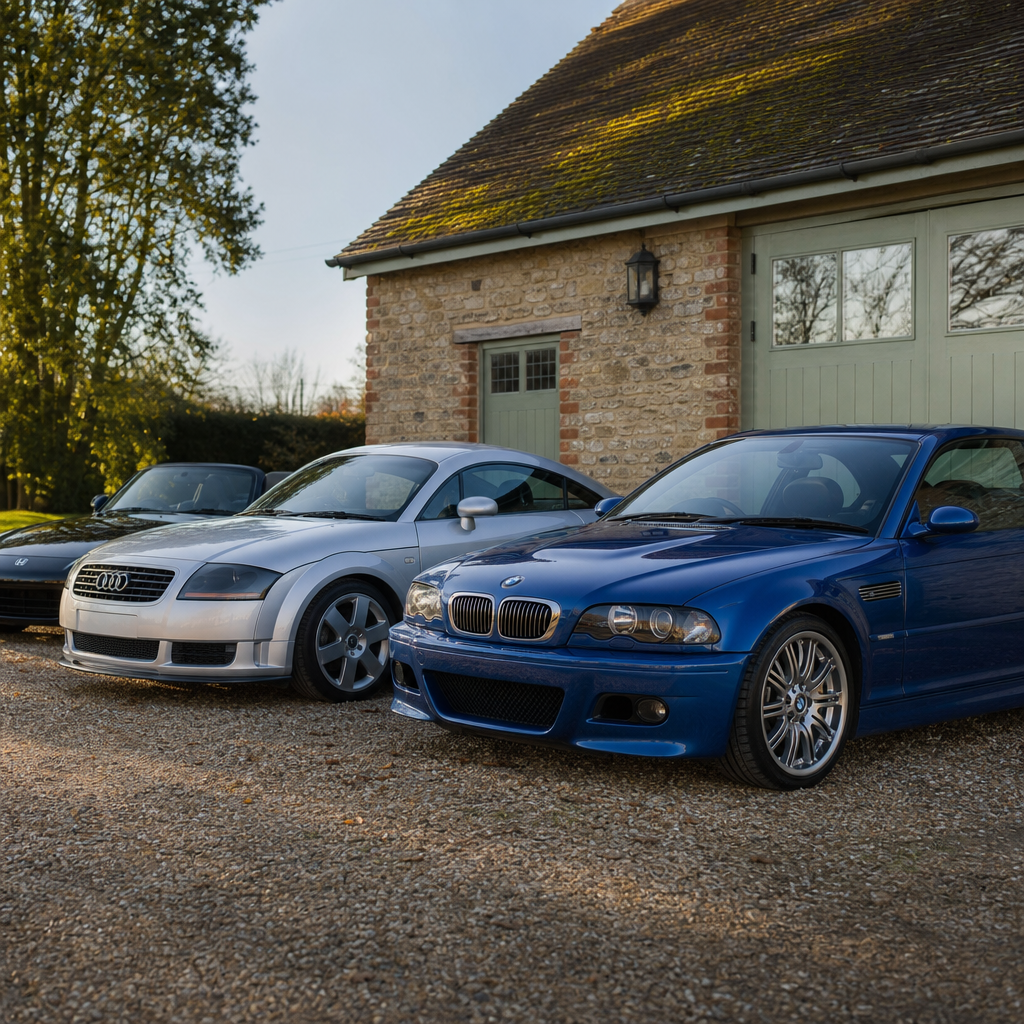
A future classic is defined by a combination of scarcity, significance, and sustained enthusiasm. Age alone does not create collector demand. Millions of ordinary family hatchbacks from the 1990s are now old, but few have become sought-after classics because they lack distinction. By contrast, cars that introduced a new engineering concept, represented the end of an era, carried a landmark engine, or defined a generation’s aspirations often attract lasting attention. Think of the BMW E46 M3 with its S54 straight-six, the Honda S2000 with its 9,000-rpm character, or the Porsche 997.1 as one of the last compact, hydraulic-steering 911s.
Design also matters more than many buyers realize. Cars become collectible when they look and feel unlike what followed them. The original Audi TT, for example, was not just a coupe; it was a Bauhaus-influenced design statement that still feels complete decades later. The first-generation Mazda MX-5 became a classic because it revived the lightweight roadster formula in a way the market instantly understood. Distinctiveness creates memory, and memory drives demand. When owners can immediately explain why a model matters, that model already has one of the building blocks of classic status.
Rarity is important, but it must be the right kind of rarity. A car that sold poorly because it was mediocre does not automatically become collectible. Desirable rarity comes from limited production, special homologation purpose, unusual specification, or high attrition among surviving cars. The Renault Clio V6, Subaru Impreza P1, and Ford Racing Puma are remembered because they were special from the start. Even mainstream performance cars can become scarce if rust, neglect, or modification wipes out original examples. In my experience, originality becomes a major dividing line once a model enters collector consideration. Factory paint colors, stock wheels, documented service history, and untouched interiors all start to command a premium.
How Age, Culture, and Market Cycles Shape Classic Status
The phrase classic car often sounds objective, but collector status is shaped heavily by generational taste. People usually pursue the cars they admired in youth, which is why demand has steadily moved toward 1980s through 2000s machines. Buyers who grew up with Gran Turismo, Top Gear, touring car racing, Japanese imports, and poster supercars now have the income to chase those memories. That emotional shift has lifted values for cars such as the Nissan Skyline GT-R, Toyota Supra Mk4, Peugeot 205 GTI, and Ferrari 360 Modena. Cultural relevance can be as powerful as mechanical excellence.
Market cycles reinforce that pattern. Most cars follow depreciation first, then stabilization, then a divergence where the best examples start rising. The turning point usually comes when a model is no longer plentiful as cheap transport, replacement parts become harder to source, and enthusiasts begin preserving rather than modifying. Auction results, classified listings, insurer data, and club membership numbers often reveal this transition early. When rough examples stop being disposable and clean examples sell quickly, the market is signaling a move toward classic recognition. This is one reason low-mileage, well-documented hot hatches and sports coupes from the 1990s have become so closely watched.
Regulation plays a role too. The shift toward electrification, downsized turbocharged engines, digital interfaces, and increasingly heavy vehicles has increased appreciation for analog cars with manual gearboxes, naturally aspirated engines, and simpler driver controls. The result is not nostalgia alone; it is comparative scarcity of a driving experience that newer cars no longer offer. Models once viewed as merely used performance cars are now prized because they represent the end of a format. The Lotus Elise, for instance, has become more significant as lightweight, unfiltered sports cars grow rarer in the new-car market.
Examples of Cars Already Moving Toward Modern Classic Status
Some models illustrate the future classic formula especially well because they combine engineering credibility, enthusiast following, and proven market movement. The table below highlights representative examples across several segments.
| Model | Why It Matters | Future Classic Signals |
|---|---|---|
| Honda S2000 | High-revving naturally aspirated roadster with precise manual gearbox | Strong club support, rising values, heavy demand for original cars |
| BMW E46 M3 | Balanced chassis, iconic straight-six, everyday usability | Manual coupes and CSL-related interest driving collector attention |
| Porsche 997 | Compact 911 feel, hydraulic steering, broad enthusiast appeal | Growing preference over newer larger generations |
| Ford Focus RS Mk1 | Limited production homologation-flavored hot hatch | Survivor scarcity and strong UK enthusiast demand |
| Audi TT Mk1 | Landmark industrial design with broad cultural recognition | Clean, unmodified examples increasingly hard to find |
| Mazda RX-7 FD | Lightweight chassis and twin-rotor character unlike rivals | Global collector demand and shrinking supply |
Japanese performance cars remain some of the clearest future classic candidates because they unite motorsport history, tuner culture, and strong mechanical identities. The Acura Integra Type R, Mitsubishi Lancer Evolution VI through IX, Subaru Impreza WRX STI, and Nissan 350Z all appeal for different reasons, but each delivers a driving experience that is easy to define. The Integra Type R is celebrated for front-wheel-drive purity and razor-sharp setup. The Evo and STI earned status through rally-derived engineering and huge enthusiast communities. The 350Z represents affordable rear-drive performance and has begun separating clean originals from modified cars in a very visible way.
European cars follow a similar path, though usually with stronger emphasis on trim level, options, and service history. A standard BMW 3 Series may age into respected old-car territory, but an E39 M5, Clio Williams, Alfa Romeo 147 GTA, or Mercedes-Benz 190E 2.3-16 has clearer classic potential because the specification itself tells a story. Special engines, homologation roots, coachbuilt details, or unusual layouts create the narrative collectors want. Even early performance diesels and wagons are beginning to receive more serious attention when they represent a period-correct enthusiast niche.
How to Judge Whether a Car Will Become a Classic
If you want to evaluate a car systematically, start with five questions. Was it notable when new? Does it offer a driving or design experience that has become rare? Is there an active owner community? Are unmodified, well-kept examples getting harder to find? And do transaction prices show a gap between average cars and exceptional ones? When the answer to most of those questions is yes, classic potential is usually real. This approach is more useful than relying on age alone because it focuses on collectibility rather than simple survival.
Documentation is another major clue. Cars with stamped service books, specialist invoices, original manuals, factory brochures, and known ownership history always gain recognition faster than undocumented examples. As cars age, buyers become less willing to accept gaps in maintenance, especially for performance models with expensive failure points. A Porsche with bore scoring concerns, a BMW M car needing rod-bearing work, or a rotary Mazda with uncertain engine history will always be judged through paperwork as much as presentation. In the collector market, evidence builds trust, and trust supports value.
Pay attention to parts support and specialist knowledge as well. A future classic needs to be ownable. Models backed by manufacturers, aftermarket suppliers, and knowledgeable independent workshops tend to develop healthier long-term followings. The Mazda MX-5 is a perfect example: abundant parts, club knowledge, and straightforward mechanicals make preservation realistic. By contrast, obscure luxury cars with limited parts supply may remain interesting but struggle to become broadly collectible. Usability does not diminish classic status; it often strengthens it by keeping cars visible, running, and loved.
Buying, Preserving, and Enjoying a Future Classic
The best way to buy a future classic is to prioritize condition, originality, and maintenance over maximum specification or the cheapest asking price. Enthusiasts often chase the rarest badge first, but in practice a well-kept standard or lightly upgraded example can be a better ownership proposition than a neglected halo version. I have seen buyers spend more correcting poor modifications, rust, accident damage, and deferred servicing than they would have paid for a better car at the start. For future classics, provenance is not a luxury; it is part of the asset.
Preservation does not mean sealing a car away and never driving it. Mechanical cars deteriorate when neglected. Fluids absorb moisture, seals harden, brakes seize, fuel systems gum up, and tires age out even with good tread. The healthiest classics are exercised, serviced on time, cleaned properly, and stored with care. That means using quality parts, keeping corrosion in check, retaining original components where possible, and documenting every repair. Sympathetic maintenance protects both enjoyment and long-term significance.
The core lesson is simple: classic status emerges where age meets meaning. Modern classics matter because they show, in real time, how that process works. The cars becoming future classics are not just old vehicles; they are models with clear identity, dwindling originality, and a driving experience people actively want to preserve. If you are learning what is a classic car, start here, watch the market carefully, join owner communities, and buy the best example you can responsibly maintain.
Frequently Asked Questions
What makes a car a modern classic rather than just a used car?
A modern classic is more than an older vehicle that has simply survived depreciation. The key difference is that it combines genuine enthusiast appeal with lasting usability and growing cultural significance. In most cases, these are cars old enough to have developed a reputation, but recent enough to still offer reasonable reliability, available parts, usable performance, and safety features that make regular driving realistic. They often sit in that ideal middle ground where owners can enjoy them on real roads without the constant compromises associated with much older classics.
What usually separates a modern classic from ordinary second-hand transport is distinctiveness. That can come from styling, engineering, performance, rarity, motorsport links, a memorable engine, or the way a car represents the end of a particular era. A manual sports coupe with a naturally aspirated engine, for example, may become collectible because it embodies a driving experience that newer cars no longer offer. Likewise, a limited-production hot hatch or a halo performance saloon may stand out because it captured a moment in automotive history.
Collector interest also plays a major role. A car starts to become a modern classic when enthusiasts actively seek good examples, values stabilize or begin to rise, and the model develops a reputation that goes beyond simple transportation. In other words, modern classics are desirable because they offer both nostalgia and substance. They remind buyers of an era that still feels familiar, while also providing a driving experience, design identity, or engineering character that is increasingly rare in newer vehicles.
Which types of cars are most likely to become future classics?
The strongest candidates are usually cars with a clear identity and a loyal following. Performance models are often at the front of the queue, especially manual sports cars, hot hatches, lightweight coupes, performance saloons, and limited-run special editions. These vehicles tend to become future classics because they offer a memorable driving experience that may be difficult to replicate in an era of downsizing, electrification, and increasing driver assistance technology. Cars that feel mechanical, engaging, and characterful often age particularly well in enthusiast circles.
That said, future classics are not limited to high-powered halo models. Sometimes a car becomes collectible because it was the best version of an everyday concept. A well-engineered estate, a stylish coupe, a practical but fun hatchback, or a luxury car with a distinctive engine can all earn modern-classic status if they represent the peak of a certain formula. Vehicles associated with a respected badge, a famous design language, or a notable technological milestone can also gain attention over time.
Rarity matters, but it is not the only factor. A car does not need to be ultra-rare if it made a strong impression on buyers and enthusiasts. In fact, some of the most successful future classics are models that were popular enough to be remembered, but not so common that excellent examples remain everywhere. Desirability, significance, and survival rates matter more than production numbers alone. In practical terms, the best candidates are usually cars people loved when new, still talk about today, and are increasingly struggling to find in unmodified, well-kept condition.
How can you tell if a current or recent car is becoming a future classic?
There are several reliable indicators. One of the clearest is when depreciation slows earlier than expected, especially for well-specified, low-mileage, or carefully maintained examples. Another sign is growing enthusiast demand: active owners’ clubs, strong online communities, specialist dealer interest, and rising coverage in motoring media all suggest a model is moving beyond ordinary used-car status. If buyers start prioritizing originality, provenance, service history, and factory options, that is often a strong hint that the market sees the car as collectible.
You should also look at what the car represents in a broader industry context. Vehicles often become future classics when they mark the end of something important, such as the last naturally aspirated engine in a model line, the final manual version, the last rear-wheel-drive platform of its type, or the closing chapter of a particular design philosophy. Cars that preserve a disappearing kind of driving experience tend to gain appreciation as the market shifts toward more standardized technology.
Condition trends are another important clue. When average examples start to disappear due to neglect, modifications, or hard use, surviving original cars often become more desirable. This is particularly true for enthusiast vehicles that were inexpensive for a period and then used heavily. Once collectors realize that clean, standard cars are genuinely hard to find, values can strengthen quickly. In short, a future classic usually reveals itself through a mix of emotional appeal, historical relevance, market behavior, and the increasing scarcity of good examples.
Does rarity alone make a car a future classic?
No, rarity by itself is not enough. A car can be rare simply because few people wanted it, and that does not automatically translate into collector demand. For a vehicle to become a future classic, rarity needs to be paired with desirability. Enthusiasts have to care about the model for reasons that go beyond low production numbers. Those reasons might include attractive design, rewarding performance, brand prestige, technical innovation, motorsport heritage, or cultural relevance.
In fact, some rare cars never become especially collectible because they lack a compelling story or memorable ownership experience. On the other hand, certain cars built in fairly healthy numbers become highly sought-after because they were loved, influential, and difficult to replace in spirit. The market tends to reward significance over obscurity. Buyers want something that feels special, not merely uncommon.
Rarity does become powerful when it reflects a meaningful distinction. A limited-run homologation special, a final-edition performance model, a rare engine option, or a low-volume enthusiast-focused trim can all carry real collector weight because they add context and exclusivity to an already desirable car. The lesson is simple: rarity helps, but only when it enhances a model people already respect. The strongest future classics are the ones that combine scarcity with reputation, character, and emotional pull.
What should buyers look for if they want a modern classic that will hold its appeal?
Start with the best example you can afford, because condition and originality matter enormously in this part of the market. A car with a complete service history, documented maintenance, factory-correct specification, and clean bodywork will almost always be more appealing than a cheaper example with unclear history or extensive modifications. Even if a model is known for reliability, deferred maintenance can quickly undermine both enjoyment and long-term value. Buyers should also pay close attention to common weak points, corrosion issues, specialist parts availability, and whether previous owners have fitted non-standard components that may be difficult to reverse.
It is also wise to focus on models with a clear enthusiast following and a well-defined reason to be remembered. Cars that are admired for their engine, gearbox, chassis balance, styling, or place in a brand’s history generally have a stronger foundation than cars chosen purely on speculation. Manual transmissions, desirable color combinations, higher trims, limited editions, and sought-after factory options can all improve long-term appeal, but they should support an already strong car rather than compensate for a weak one.
Finally, buy with both head and heart. The most satisfying modern classics are cars you would enjoy owning even if values never rose dramatically. The market can be unpredictable, and the strongest position is to own something that offers genuine pleasure, usability, and pride of ownership from day one. If the car is well maintained, correctly stored, sympathetically used, and chosen for its intrinsic qualities, it stands a much better chance of remaining desirable. In that sense, the smartest buyers do not just chase trends; they identify cars with enduring character and preserve them properly.