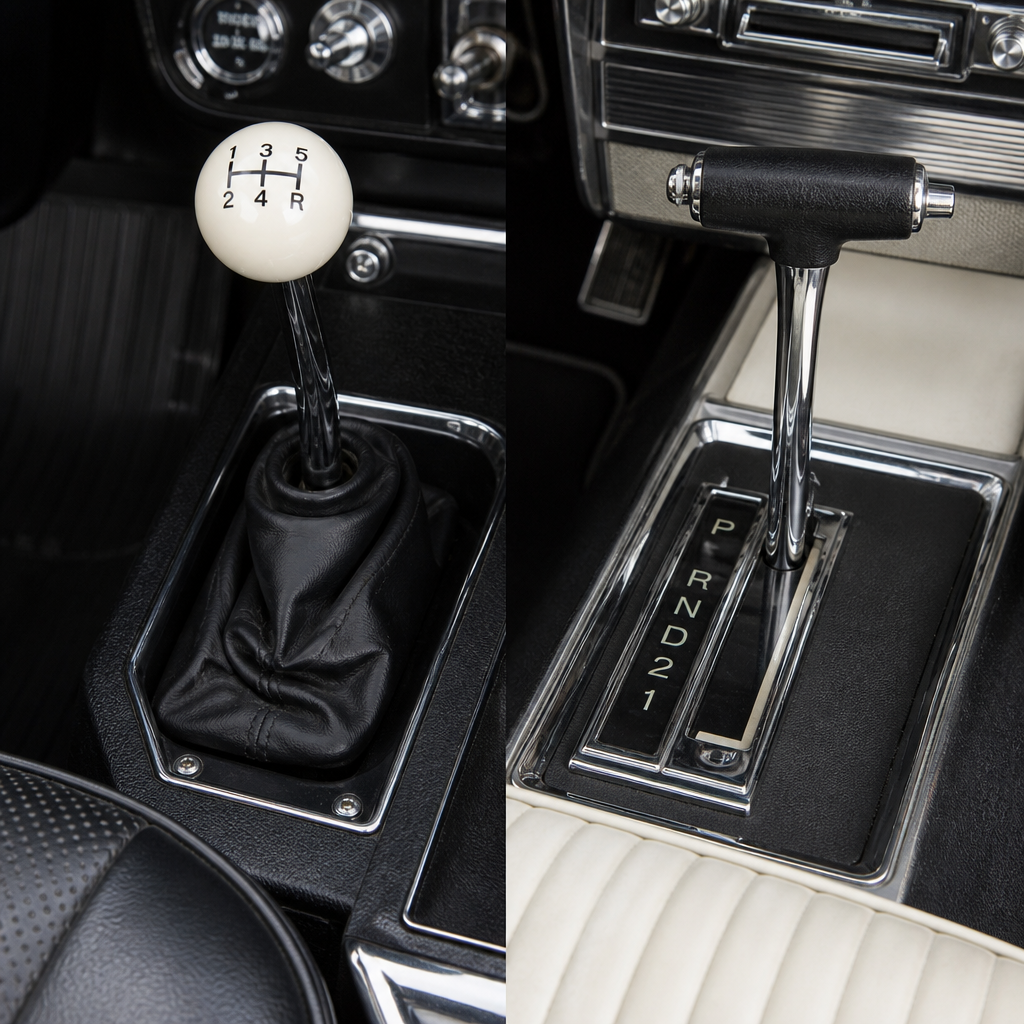
Manual vs automatic transmissions in classic cars is one of the most important decisions any restorer, buyer, or long-term owner will make, because the gearbox affects drivability, originality, maintenance cost, resale value, and the entire character of the vehicle. In classic car terms, a manual transmission uses a driver-operated clutch and gear lever to select ratios, while an automatic transmission changes gears hydraulically or mechanically with minimal driver input. That simple distinction shapes engine behavior, road manners, service requirements, and even how a restoration project is scoped. I have worked on enough vintage drivetrains to know that transmission choice is rarely isolated; it touches the clutch linkage, driveshaft length, rear axle ratio, cooling system, shifter mechanism, transmission tunnel, speedometer gearing, and often the engine itself. For a restoration and maintenance hub focused on engine and mechanical work, this subject matters because the transmission sits at the center of the powertrain. Whether you are preserving a numbers-matching muscle car, reviving a European roadster, or upgrading a weekend cruiser for modern traffic, understanding both systems helps you plan repairs correctly, protect authenticity where it matters, and spend money where it delivers the most usable improvement.
How manual and automatic transmissions work in classic cars
A classic manual transmission is a gearset controlled by the driver through a clutch pedal and shift linkage. In older cars, that can mean a column-shift three-speed, a floor-shift four-speed, or a five-speed added later for highway use. The clutch disconnects engine power so gears can be selected. The transmission then routes torque through chosen ratios, and the rear axle multiplies that torque again before it reaches the wheels. In practice, manual systems are mechanically direct, lighter than many period automatics, and easier to diagnose because symptoms usually point to specific parts such as synchronizers, bushings, throwout bearings, pilot bushings, or clutch pressure plates.
A classic automatic uses a torque converter, valve body, planetary gearsets, bands, and clutch packs to change ratios. Earlier units such as the GM Powerglide, Ford C4 and C6, Chrysler TorqueFlite 727, and GM Turbo Hydra-Matic 350 and 400 are robust, but they rely on fluid pressure, clean passages, and proper cooling. When they fail, the causes can be internal wear, hardened seals, slipping bands, contaminated fluid, or vacuum modulator issues depending on design. Many owners think automatics are mysterious, yet their operating principle is straightforward: hydraulic pressure applies specific components in a programmed sequence to create different gear ratios. That sequence is influenced by throttle input, governor speed, and fluid condition.
From an engine and mechanical work standpoint, the crucial point is that both transmissions are systems, not standalone boxes. A manual depends heavily on linkage geometry, clutch adjustment, and flywheel condition. An automatic depends on line pressure, converter health, cooler efficiency, and correct fluid. If you diagnose only the gearbox and ignore the surrounding mechanical chain, you miss the real source of many problems.
Driving experience, performance, and vehicle character
Manual transmissions usually deliver the most engaged driving experience in a classic car. The driver controls shift points, can hold a gear through a corner, and often feels more connected to the engine’s torque curve. In cars with modest power, such as an MG B, Alfa Romeo Spider, or early Mustang six-cylinder, a manual gearbox can make the engine feel livelier because less power is lost through the drivetrain and the driver can keep revs where the engine works best. In muscle cars, a Muncie four-speed or Toploader changes the personality of the car completely, turning straight-line torque into something interactive and memorable.
Automatic transmissions offer a different kind of strength. In heavy cruisers, full-size sedans, luxury coupes, and many American V8 cars, an automatic matches the engine’s low-end torque and relaxed character. A Cadillac with a Turbo Hydra-Matic or a Chrysler with a TorqueFlite often feels exactly right with two pedals, especially in traffic or on long drives. Torque converters can also multiply torque off the line, helping a large car move smoothly from a stop. In drag racing history, well-built automatics became dominant because they produced consistent launches and repeatable shifts, proving that automatic never meant slow.
The best choice depends on the intended use of the classic. If the goal is weekend back-road driving, a manual often wins for involvement. If the car will see city traffic, family cruising, or frequent shows with long distances between them, an automatic reduces fatigue. Character matters as much as performance numbers, and with classics, character often drives value.
Maintenance demands and common failure points
Manual transmissions are usually cheaper to maintain over time, but that does not mean they are maintenance free. The common wear items are clutch discs, pressure plates, release bearings, pilot bearings, linkage bushings, hydraulic master and slave cylinders where fitted, and synchronizers inside the gearbox. Oil leaks from input or output seals are common on older units. So is noisy operation caused by worn bearings or gear wear. The advantage is that many failures announce themselves gradually. A clutch begins to slip under load. Second gear grinds on downshifts. The shifter feels vague because bushings are worn. These warning signs give owners time to plan repairs.
Classic automatics demand stricter fluid discipline. Burnt fluid, delayed engagement, slipping under acceleration, harsh shifts, and overheating are all warning signs. Heat is the enemy. Automatic transmission fluid breaks down when temperatures stay elevated, and many classic cars did not leave the factory with cooling capacity suited to modern stop-and-go traffic. I regularly advise owners to inspect cooler lines, radiator-integrated coolers, and transmission mounts whenever drivability complaints appear, because a damaged mount or restricted cooler can mimic an internal failure pattern. Automatic rebuilds also require specialized knowledge, clean assembly conditions, and careful measurement of clutch clearances and band adjustment.
As a mechanical work hub, this topic connects naturally to related service areas: clutch and flywheel repair, driveshaft balancing, differential ratio selection, cooling system restoration, engine tune, carburetor or ignition calibration, and leak control. A rough idle or incorrect vacuum signal can affect shift quality on some vintage automatics, while an engine rear main seal leak can contaminate a manual clutch. Transmission maintenance is never isolated from engine maintenance.
Originality, restoration standards, and market value
Originality matters in classic car restoration, but the degree depends on the model, the buyer, and the historical significance of the car. Numbers-matching, factory-correct transmission setups generally command a premium on high-value collector cars. A big-block Corvette, Hemi Mopar, Shelby Mustang, or rare European GT often loses appeal if the original transmission type is changed without documentation. Factory build sheets, Protect-O-Plate records, Jaguar Heritage certificates, and marque registries all influence how transmission authenticity is judged.
That said, originality is not absolute. Many owners install period-correct upgrades or reversible modifications to improve usability. A Tremec five-speed in a 1960s American coupe, for example, can lower highway rpm dramatically and make the car more enjoyable without cutting the floor if the swap is planned well. Likewise, replacing a fragile early automatic with a stronger later unit can make sense in a driver-quality restoration. The key is to preserve original parts, document changes, and understand whether the car is being restored for concours judging, touring, or personal enjoyment.
| Factor | Manual Transmission | Automatic Transmission |
|---|---|---|
| Driver involvement | High; full control of shift timing | Lower; smoother and easier in traffic |
| Typical maintenance | Clutch, linkage, seals, synchronizers | Fluid, seals, bands, clutch packs, cooler |
| Restoration complexity | Moderate; easier diagnosis | Higher; more specialized rebuild work |
| Collector originality impact | Strong for factory manual cars | Strong for factory automatic cars |
| Highway upgrade potential | Excellent with five-speed swaps | Good with overdrive automatics |
| Best fit | Back-road driving, sporty classics | Cruising, traffic, torque-heavy cars |
Engine and mechanical work implications of transmission choice
The transmission decision directly affects engine and mechanical work planning. Manual conversions or restorations require attention to the crankshaft pilot bore, flywheel balance, bellhousing alignment, clutch fork geometry, starter compatibility, and pedal assembly fitment. Bellhousing concentricity is especially important; if the bellhousing is not centered properly, the input shaft can run out of alignment and destroy bearings or cause clutch drag. On some classic builds, scattershield installation without dial-indicating the housing leads to chronic shifting problems that owners mistakenly blame on the gearbox.
Automatic setups bring a different checklist. Converter spacing, flexplate tooth count, kickdown linkage, cooler routing, shift linkage travel, vacuum source quality, and transmission crossmember location all matter. Engine idle speed and tune quality are also more critical than many owners expect. An automatic-equipped classic with a radical camshaft may idle poorly in gear, build excessive heat, or shift unpredictably if vacuum is too low. That means transmission selection must be matched to engine specifications, rear axle ratio, tire diameter, and intended driving speed.
This is why engine and mechanical work should be approached as an integrated system. A 3.89 rear axle with a non-overdrive four-speed may be thrilling around town and tiring at 70 mph. The same car with a five-speed or overdrive automatic becomes more usable without touching engine internals. Likewise, a mild small-block with a highway gear may feel sluggish if paired with the wrong converter stall speed. Smart restorers evaluate torque curve, curb weight, gearing, and intended use before spending on transmission work.
Choosing the right transmission for your classic car project
Start with the car’s mission. If you are restoring for shows, verify the factory transmission code and build the car to documented specification. If you are building a driver, ask how and where the car will actually be used. Frequent stop-and-go commuting favors an automatic. Spirited weekend driving favors a manual. Long-distance touring can work with either, but benefits greatly from overdrive and proper axle gearing.
Budget is the next filter. A manual rebuild may be less expensive, but a full conversion from automatic to manual can require pedals, linkage, bellhousing, flywheel, clutch assembly, transmission, crossmember, driveshaft work, interior trim changes, and sometimes floor modifications. An automatic rebuild can cost more internally, yet retaining the original setup may reduce fabrication and preserve value. Parts availability should also guide the choice. Rebuild components for a Ford Toploader, Muncie M20, C4, TH350, and 727 are widely available. Obscure imports and low-production luxury models can be far harder and more expensive to support.
Finally, choose the shop carefully. Transmission work on classics rewards specialists who understand period parts, factory service manuals, and driveline geometry. Ask whether the shop measures bellhousing runout, inspects driveshaft angles, pressure-tests coolers, resurfaces flywheels, and verifies speedometer calibration after gear changes. Those details separate a durable restoration from a car that is always almost sorted.
Manual vs automatic transmissions in classic cars is not a debate with one universal winner. The right answer depends on originality, driving style, engine characteristics, maintenance expectations, and the mechanical goals of the restoration. Manuals offer direct engagement, simpler diagnosis, and a sporting feel that suits many lightweight and performance-oriented classics. Automatics deliver smoothness, consistency, and relaxed cruising that perfectly match many American V8s, luxury cars, and traffic-heavy use. For anyone working within restoration and maintenance, the bigger lesson is that transmission choice affects the whole engine and mechanical system, from cooling and gearing to clutch setup, converter selection, and driveline alignment.
If you treat the transmission as part of an integrated powertrain plan, you will make better decisions, avoid repeat repairs, and build a classic car that feels right on the road as well as on paper. Review your car’s factory specifications, define how you will drive it, and inspect the supporting mechanical systems before ordering parts. That approach preserves value, improves reliability, and turns transmission choice from a source of confusion into a practical advantage. Use this page as your starting point, then map every related engine and mechanical task around the gearbox your classic truly needs.
Frequently Asked Questions
1. Which is better in a classic car: a manual or an automatic transmission?
There is no universal “better” choice, because the right transmission depends on what you want from the car. A manual transmission usually appeals to owners who want maximum driver involvement, a stronger sense of period character, and more direct control over how the engine delivers power. In many classic cars, a manual can make the vehicle feel more lively, more responsive, and more connected to the road, even if the actual performance difference is modest. It also tends to reinforce the traditional vintage driving experience that many enthusiasts are specifically looking for.
An automatic transmission, on the other hand, often makes a classic car easier and more relaxing to use, especially in traffic, on long cruises, or for owners who prioritize comfort over hands-on engagement. In larger American classics, luxury coupes, and many grand touring cars, the automatic is often an authentic part of the car’s original personality rather than a compromise. Some classics simply feel more “correct” with an automatic because that is how they were commonly ordered, marketed, and enjoyed when new.
The real question is not which transmission is objectively superior, but which one best matches the car’s purpose. If you want a weekend back-road car or a more interactive collector vehicle, a manual may be more satisfying. If you want a car that is easier to share with family, simpler to drive in modern conditions, or more faithful to the specification common for that model, an automatic may be the smarter choice. In the classic car world, suitability, originality, and intended use matter more than blanket rules.
2. How does transmission choice affect the value and originality of a classic car?
Transmission choice can have a major impact on both value and originality, but the effect varies widely by make, model, production year, and collector expectations. In general, originality is extremely important in the classic car market. A vehicle that still retains the transmission type it was born with, or at least the correct type for its factory specification, will usually be more attractive to purists and serious collectors. Matching-numbers or factory-correct drivetrains often command a premium because they preserve the car’s historical integrity.
That said, manual transmissions frequently bring stronger resale value on enthusiast-oriented cars, especially sports cars, muscle cars, and performance models. Buyers in those segments often view a manual as more desirable, more engaging, and sometimes rarer. A factory manual in a sought-after model can significantly increase interest and sale price. However, this is not true across the board. In luxury classics, full-size cruisers, and certain American models from the 1950s through the 1970s, an automatic may actually be the more expected and more desirable configuration.
Conversions complicate the picture. Swapping an original automatic car to a manual may improve enjoyment for some owners, but it can reduce value if the market strongly favors originality. Likewise, changing a factory manual car to an automatic may hurt collector appeal unless there is a very specific practical reason. The most valuable cars are usually those with documentation showing how they were originally built, along with components that are correct for that car. Before buying or modifying a classic, it is wise to research how that exact model is valued in the current market rather than relying on general assumptions.
3. Are manual or automatic transmissions more expensive to maintain in classic cars?
Maintenance costs depend on the specific transmission design, parts availability, the condition of the car, and who is doing the work. Broadly speaking, many classic manual transmissions are mechanically simpler than automatics. They often have fewer internal hydraulic components, fewer specialized adjustments, and less heat-related stress than traditional automatics. Because of that simplicity, manuals can sometimes be less expensive to service or rebuild, especially if the gearbox itself is robust and parts remain available. However, manuals have wear items of their own, including the clutch disc, pressure plate, release bearing, pilot bearing, clutch linkage, and sometimes hydraulic master and slave cylinders.
Classic automatics can be very durable, but when they do need major work, rebuilds are often more specialized and more expensive. They contain valve bodies, seals, bands, clutches, pumps, torque converters, and other components that require transmission-specific knowledge to diagnose and restore correctly. A neglected automatic may also suffer from fluid contamination, hardened seals, slipping under load, delayed engagement, or overheating issues. In addition, some older automatics are less common today, which can make parts sourcing and expert repair more difficult depending on the brand and model.
The practical takeaway is that condition matters more than theory. A well-maintained automatic can be far cheaper to own than a worn-out manual, and vice versa. Service history, leak checks, shift quality, drivetrain noise, clutch operation, and parts support should be evaluated carefully before purchase. For restorers and long-term owners, the best financial strategy is to buy the healthiest example possible and confirm that knowledgeable repair support exists for that transmission type in your area.
4. Is a manual transmission more fun to drive in a classic car?
For many enthusiasts, yes, a manual transmission is more fun because it adds a layer of skill, rhythm, and interaction that becomes part of the classic driving experience. Operating the clutch, choosing gears, rev-matching on downshifts, and feeling the engine respond directly through the drivetrain can make even a modestly powered classic feel involving. Older cars often provide more mechanical feedback than modern vehicles, so a manual transmission can amplify that raw, analog character in a very satisfying way.
But “fun” is subjective, and in classic cars it depends heavily on the vehicle itself. Some cars have excellent manual gearboxes with positive shift action and well-chosen ratios, while others may have heavy clutches, vague linkages, or unsynchronized first gears that become tiring in real-world use. In those cases, an automatic can be more enjoyable simply because it lets you appreciate the engine note, steering feel, styling, and overall presence of the car without constant effort. That is especially true in stop-and-go traffic, on hot days, or when driving a heavier classic with a less refined manual setup.
It is also important to remember that many classic automatics deliver a distinct type of pleasure. They suit relaxed cruising, effortless torque, and period-correct driving in a way that can feel wonderfully authentic. A big V8 classic with a smooth automatic can be just as memorable as a lightweight manual sports car, only in a different way. The best measure of “fun” is not the transmission category alone, but how well the gearbox complements the personality of the car and the kind of driving you actually plan to do.
5. Should you convert a classic car from automatic to manual, or from manual to automatic?
A transmission conversion can make sense, but it should never be treated as a casual decision. Swapping from automatic to manual is a popular modification when owners want more involvement, better driver control, or a sportier feel. Swapping from manual to automatic is less common among enthusiasts, but it can be entirely reasonable for accessibility, comfort, family usability, or preserving enjoyment if the owner no longer wants to manage a clutch. In either case, the key question is whether the conversion supports the long-term purpose of the car without undermining its value or integrity.
From a practical standpoint, a proper conversion is more involved than simply changing the gearbox. It may require a different bellhousing, flywheel or flexplate, clutch system, pedal assembly, transmission crossmember, driveshaft length, shifter linkage, console components, wiring changes, speedometer compatibility, starter arrangement, rear axle ratio considerations, and sometimes tunnel or floor modifications. On some classics, sourcing all the correct parts to make the swap look and function as though it could have been factory-installed is expensive and time-consuming. Poorly executed conversions often create reliability issues, drivability problems, and reduced buyer confidence.
Before converting, owners should weigh originality, reversibility, cost, and market expectations. If the car is rare, highly collectible, or unusually well-preserved, preserving the original setup is often the wiser move. If the car is a driver-quality example and the modification will significantly improve how often and how happily it is used, the conversion may be justified. The best approach is to research the exact model, keep all removed original parts if possible, and carry out the work to a documented, high-quality standard. In the classic car market, thoughtful modifications are respected far more than impulsive ones.