World War II reshaped the automobile more profoundly than any styling trend, fuel crisis, or corporate merger, and its effects still define how historians explain the history of classic cars. To understand how World War II impacted car design and production, you need to look beyond dramatic battlefield imagery and focus on factories, materials, engineering priorities, and consumer expectations. The war redirected assembly lines from civilian sedans to tanks, trucks, aircraft engines, ambulances, and munitions. It also changed what engineers valued: durability over ornament, interchangeability over hand-finishing, and efficiency over excess weight. When peace returned, those wartime lessons did not disappear. They flowed directly into postwar classic cars, influencing body construction, manufacturing scale, safety thinking, aerodynamics, independent suspension experiments, and even the public’s taste for modern styling.
In my experience working through factory histories, restoration documentation, and period trade publications, the clearest pattern is that the war compressed decades of industrial change into a few intense years. Before 1940, many automakers still treated styling updates as annual theater while engineering evolved more slowly. During the war, survival demanded rapid technical adaptation, strict standardization, and unprecedented coordination between government and industry. In the United States, civilian car production largely stopped in early 1942 and did not fully resume until late 1945. In Britain, Germany, Italy, France, Japan, and the Soviet Union, automotive firms were similarly redirected or disrupted. For anyone studying classic car history, this period is the hinge point between prewar coachbuilt traditions and the high-volume, technology-driven postwar era. This hub article explains the shift by tracing what changed in design, manufacturing, materials, labor, and market demand.
Why wartime production changed the car industry forever
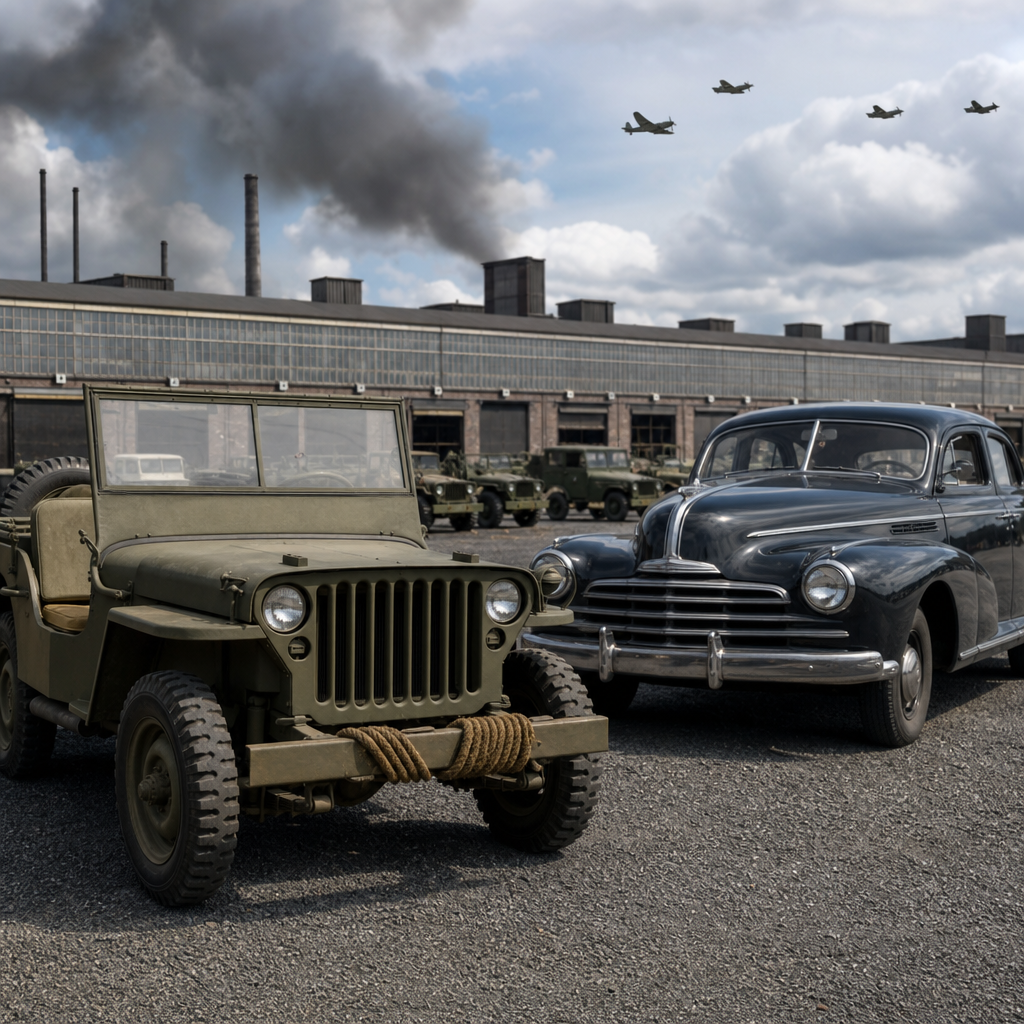
The most immediate impact of World War II was the suspension or severe reduction of civilian automobile production in major manufacturing nations. In the United States, Ford, General Motors, Chrysler, Packard, Studebaker, Willys, and others converted plants to military output under federal direction. Ford’s Willow Run plant became famous for B-24 Liberator bomber production, while Chrysler built tanks and military trucks, and Willys-Overland produced the Jeep, one of the war’s defining utility vehicles. In Britain, companies such as Austin, Morris, Rootes, and Vauxhall shifted to war work. German firms including Volkswagen’s precursor operations, Opel, Mercedes-Benz, and BMW were absorbed into the Nazi war economy. The result was a vast interruption in the normal rhythm of model development.
That interruption mattered because it froze many 1941 and 1942 passenger-car designs in place. When peace returned, automakers initially sold mildly updated versions of prewar bodies because tooling new cars required time, capital, and raw materials. This is why many immediate postwar classics, such as the 1946–1948 Ford, Chevrolet Fleetmaster, and Plymouth Special DeLuxe, look like refined continuations of prewar cars. Yet under the surface, the war had changed the production philosophy. Manufacturers had learned to manage huge procurement networks, train labor quickly, simplify maintenance, and produce complex machines at previously unimaginable scale. Those capabilities became competitive advantages in the late 1940s and 1950s.
Another permanent shift was the acceptance of government influence over industrial priorities. Wartime boards controlled steel, aluminum, rubber, copper, fuel, and transportation. Carmakers discovered that supply chains could determine engineering choices as much as design ambition. That lesson carried into peacetime planning, especially during later shortages and regulatory changes. In practical terms, World War II taught automakers that successful cars needed not only good styling but also manufacturability, serviceability, and resilience under constrained resources.
Materials shortages and military engineering transformed design priorities
Materials scarcity drove some of the most important changes. Natural rubber shortages, especially after Japan seized key Southeast Asian sources, forced synthetic rubber development in the United States. Lightweight metals were reserved for military needs, and steel allocation was tightly controlled. Engineers had to think differently about what could be built, repaired, and supplied at scale. Wartime design emphasized function. Components were simplified, finishes were reduced, and decorative excess lost priority. Although chrome-heavy postwar styling eventually returned, the engineering culture behind those cars had become more disciplined.
Military vehicles also served as laboratories for practical automotive solutions. The Jeep demonstrated the value of compact packaging, four-wheel-drive capability, flat body panels for ease of manufacture, and field serviceability. Military trucks highlighted modular parts usage and standard fasteners. These ideas did not turn passenger cars into military machines, but they influenced expectations around dependability and repair. Utility became respectable in a way it had not been in the most ornament-focused years of the 1930s.
A related change was the accelerated development of better engines, cooling systems, filtration, and lubrication practices. War is an unforgiving test environment. Engines had to run in dust, cold, mud, and heat. Cooling systems had to survive sustained use. Air filtration became more serious. Oil quality, maintenance intervals, and component wear all received closer study. After the war, these lessons improved civilian reliability. Buyers might notice styling first, but classic car durability increasingly reflected wartime engineering discipline rather than solely prewar craftsmanship.
| Wartime pressure | Immediate effect | Postwar impact on classic cars |
|---|---|---|
| Steel, rubber, and aluminum rationing | Simplified parts and strict material allocation | Greater emphasis on efficient design and manufacturability |
| Military vehicle demand | Production of Jeeps, trucks, tanks, and aircraft components | Improved durability, serviceability, and modular engineering |
| Factory conversion | Civilian car production paused or delayed | Postwar cars initially reused prewar platforms and tooling |
| Mass training of workers | Standardized assembly processes and documentation | Higher-volume peacetime automobile production |
| Battlefield operating conditions | Better testing of engines, suspensions, and filters | More reliable postwar drivetrains and chassis systems |
Factory conversion created the blueprint for postwar mass production
One of the least romantic but most important aspects of the history of classic cars is factory management. During the war, automakers became experts in production conversion. Assembly plants were reconfigured for radically different products, often under severe time pressure. Tooling had to be adapted, workforces retrained, and quality control tightened. Statistical process control, detailed documentation, and repeatable procedures gained greater importance. While some of these methods existed earlier, wartime urgency normalized them across the industry.
Ford offers a strong example. Its prewar mastery of mass production was redirected into aircraft manufacturing at Willow Run, where the company confronted the challenge of building highly complex bombers using assembly-line logic. Chrysler’s tank production required precision, supplier coordination, and heavy industrial planning on a scale beyond ordinary passenger-car work. General Motors divisions handled engines, transmissions, weapon systems, and transport equipment. This experience strengthened managerial confidence in large integrated manufacturing systems, which later supported the explosive growth of postwar car output.
For classic car historians, this helps explain why the late 1940s and 1950s saw such rapid volume expansion alongside broader model ranges. Manufacturers emerged from the war with deeper expertise in scheduling, materials handling, standardization, and workforce organization. They also had improved relationships with machine-tool suppliers and a clearer understanding of interchangeable production. The postwar car boom was not simply pent-up demand. It was pent-up demand meeting an industry that had learned to build faster, bigger, and more systematically than before.
Aerodynamics, packaging, and body construction moved toward modern forms
World War II did not instantly invent streamlined postwar styling, but it accelerated the shift toward cleaner, more integrated forms. Aircraft engineering elevated public and industrial interest in aerodynamics. At the same time, wartime efficiency concerns discouraged unnecessary complexity. The visual language of modernity after 1945 drew partly from aviation, industrial design, and the idea that the future should look sleek, unified, and technical. This helps explain the move away from upright bodies, separate fenders, and heavily exposed running gear.
Prewar streamlining experiments had already appeared in cars like the Chrysler Airflow and certain Peugeot and Tatra models, but those ideas were ahead of the market. After the war, integrated ponton styling became far more acceptable. Bodies grew smoother, fenders blended into the main shell, and interiors were packaged more efficiently. Cars such as the 1949 Ford, 1949 Cadillac, 1949 Oldsmobile, and 1948 Kaiser showed how quickly mainstream design moved toward slab-sided, envelope-body forms. In Europe, the Volkswagen Beetle, Saab 92, and postwar Fiat and Renault models embodied compact, aerodynamic thinking shaped by prewar experimentation and wartime necessity.
Body construction also evolved. All-steel bodies became more refined, and monocoque or unitized construction gained momentum in several markets because it reduced weight and improved packaging. Not every postwar classic adopted unit construction immediately, especially in the United States, where body-on-frame remained common for years. Still, the war strengthened the engineering case for structural efficiency. Better use of space, lower drag, and lighter weight became central postwar goals, even when wrapped in chrome and tailfins.
The war changed labor, skills, and the social meaning of car production
Another major effect of World War II was the transformation of the automotive workforce. With millions of men serving in the military, factories recruited women and workers from backgrounds previously excluded from many industrial roles. In the United States, “Rosie the Riveter” became the best-known symbol of this shift, but the broader reality was a large-scale redefinition of who could build complex machinery. Training systems had to become clearer and faster. Jobs were broken into standardized tasks. Documentation improved because plants could not rely only on long-serving specialists.
These changes carried into the postwar auto industry. Although many women were pushed out after demobilization, the precedent had been set: modern vehicle production could be organized around teachable processes rather than solely inherited shop-floor craft. That mattered for volume growth, labor mobility, and union negotiations. It also affected quality, because consistent methods allowed tighter control across multiple plants and product lines.
The social meaning of the car changed too. Before the war, a car was often marketed as a status object or symbol of personal freedom. After the war, it also represented industrial recovery, national strength, and family stability. Veterans returned with mechanical familiarity from military service, especially with trucks, motorcycles, and utility vehicles. They were comfortable with maintenance and increasingly interested in performance, durability, and practical value. This mindset fed the culture that later produced hot rodding, sports car enthusiasm, and a deeper appreciation for engineering among classic car buyers.
Postwar demand, delayed redesigns, and the birth of many classic icons
When civilian production resumed, demand was enormous. Consumers had deferred purchases for years, and many prewar cars were worn out from extended use during rationing. Automakers rushed to supply the market, often restarting updated prewar models while preparing all-new designs. That is why the immediate postwar period can seem visually conservative at first and revolutionary a few years later. The gap between 1946 and 1949 is especially important in the history of classic cars.
Manufacturers that adapted quickly defined the new era. In the United States, General Motors introduced genuinely modern postwar designs at a strong pace, while Ford’s 1949 lineup marked a major break from prewar forms and helped restore competitiveness. Chrysler continued emphasizing engineering solidity. In Europe, austerity conditions pushed smaller, more efficient cars to the foreground. The Volkswagen Beetle expanded from wartime-disrupted origins into one of history’s most influential automobiles. The Citroën 2CV, conceived before the war but delayed by it, answered rural transportation needs with extreme simplicity. The Land Rover, launched in 1948, drew directly from Jeep logic and wartime utility culture.
Luxury and performance segments were shaped as well. Jaguar’s postwar rise, including the XK120, depended on engineering and production conditions forged during wartime disruption and recovery. Mercedes-Benz rebuilt under difficult circumstances and later reestablished technical leadership. Italian firms such as Ferrari, Alfa Romeo, and Maserati emerged into a world where lightweight engineering, aerodynamic awareness, and racing development had new importance. Many of the classic cars enthusiasts celebrate today were either delayed, enabled, or fundamentally redirected by wartime conditions.
Why World War II remains central to understanding classic car history
If you are building a foundation in classic car basics and education, World War II is not a side chapter. It is the dividing line that explains why prewar and postwar cars feel like products of different civilizations. The war interrupted civilian production, redirected engineering talent, accelerated manufacturing science, and reset consumer expectations. It helped move the industry from decorative coachbuilt traditions toward standardized, integrated, high-volume industrial design. It also created a practical bridge between military necessity and peacetime innovation, visible in reliability improvements, utility thinking, and modern body forms.
The biggest takeaway is simple: classic cars after 1945 were shaped as much by wartime factories and logistics as by stylists in design studios. When you look at a 1949 Ford, a Volkswagen Beetle, a Land Rover Series I, a Jaguar XK120, or a 1948 Cadillac, you are seeing peace-time products built with lessons learned under extreme pressure. Understanding that connection makes the history of classic cars clearer and richer. It explains why design changed, why production scaled, and why the automobile became such a powerful symbol of recovery and modern life.
Use this hub as your starting point for deeper study into prewar styling, postwar manufacturing, military vehicle influence, and the evolution of specific classic models. The more closely you examine the war years, the easier it becomes to understand every major automotive trend that followed.
Frequently Asked Questions
How did World War II change automobile production in the United States and other major manufacturing countries?
World War II transformed car production almost overnight by shifting factories away from civilian automobiles and into military manufacturing. In the United States, automakers such as Ford, General Motors, and Chrysler stopped building new consumer cars early in the war and converted their plants to produce tanks, trucks, jeeps, aircraft engines, munitions, and other essential wartime equipment. Similar changes took place in Britain, Germany, and other industrial nations, where automotive companies became critical parts of the military supply chain. This was not a minor adjustment in product mix; it was a complete restructuring of industrial priorities. Assembly lines, tooling, labor allocation, and supply contracts were all redirected toward the war effort.
The scale of this conversion had lasting consequences for the car industry. Manufacturers learned how to manage production on an enormous scale, how to standardize parts more efficiently, and how to coordinate complex supply networks under intense pressure. Even though civilian car buyers had to wait years for new models, the war accelerated industrial techniques that later benefited postwar automobile manufacturing. When peace returned, automakers brought back with them greater expertise in mass production, logistics, quality control, and engineering discipline. In that sense, the war interrupted civilian car production in the short term, but it also laid the groundwork for the highly organized, high-volume automotive industry that dominated the postwar era.
What impact did wartime material shortages have on car design and engineering?
Material shortages had a major influence on how cars were designed, engineered, and eventually marketed after the war. During World War II, essential raw materials such as steel, aluminum, rubber, copper, and chromium were heavily controlled or rationed because they were needed for military equipment. Carmakers and engineers had to work within strict limits, often substituting materials, simplifying components, and rethinking how parts could be produced with less waste. These constraints taught manufacturers to place a much stronger emphasis on efficiency, durability, and practical engineering rather than purely decorative features.
That experience reshaped postwar automobiles in several ways. Designers became more aware of production realities, and engineers gave more attention to weight, structural strength, serviceability, and material efficiency. Even when decorative chrome and styling flair returned in the late 1940s and 1950s, the industry had already absorbed wartime lessons about conservation and functional design. Wartime shortages also encouraged advances in synthetic materials, coatings, and rubber substitutes, which influenced future vehicle manufacturing. In simple terms, the war forced the industry to become more disciplined. Cars built after the conflict were still sold with style and optimism, but underneath that styling was an engineering culture that had been hardened by scarcity and necessity.
Did military vehicle production influence the design of postwar civilian cars?
Yes, military vehicle production influenced postwar civilian cars both directly and indirectly. During the war, automakers gained extensive experience building machines for rough conditions, easy field maintenance, and reliable performance under stress. Vehicles such as jeeps, transport trucks, staff cars, and ambulances had to be mechanically dependable, relatively simple to repair, and designed with function first. That mindset carried into postwar automotive engineering, where reliability, rugged suspension systems, stronger drivetrains, and improved manufacturing consistency became more important selling points.
The influence was not always obvious in outward appearance, but it was present in the way cars were built and discussed. Automakers emerged from the war with new respect for standardized components, proven mechanical systems, and engineering tested under extreme circumstances. In some cases, military technology and production knowledge contributed to improvements in engines, transmissions, braking systems, and chassis design. Consumer expectations also changed. After years of wartime sacrifice, buyers wanted modern cars that felt dependable and technically advanced. So while postwar sedans and coupes often looked stylish and optimistic, many of their underlying production methods and engineering philosophies had roots in wartime experience. The war did not simply pause the car industry; it changed what manufacturers believed a well-designed automobile should be.
Why do historians say World War II changed consumer expectations about cars?
Historians say World War II changed consumer expectations because the war altered how people thought about technology, utility, and modern living. Before the conflict, many buyers evaluated cars largely through brand reputation, styling, comfort, and status. During the war, civilians became accustomed to rationing, delayed purchases, and the idea that industry existed to serve practical national needs. At the same time, military machinery, aircraft, and transport vehicles showcased the power of engineering, efficiency, and standardized production on a scale the public had never seen before. By the time the war ended, consumers were ready for automobiles that represented progress, reliability, and a better future.
This shift mattered because returning buyers were not simply looking for prewar cars to reappear unchanged. They wanted newer, better, more advanced vehicles. They expected improvements in performance, convenience, safety, and durability. Automakers responded by promoting postwar cars as products of modern engineering and industrial achievement, even when some early models were heavily based on prewar designs. Over time, the war helped create a market in which technological progress became central to automotive appeal. Consumers increasingly expected cars to reflect the latest production methods and engineering knowledge, not just attractive styling. That change in mindset was one of the war’s most important long-term effects on the automotive world.
How did World War II help shape the long-term history of classic cars?
World War II helped shape the long-term history of classic cars by creating a clear dividing line between prewar and postwar automotive development. Prewar cars are often remembered for handcrafted details, separate fenders, tall bodies, and styling traditions rooted in the 1920s and 1930s. Postwar cars, even when they initially reused older platforms, emerged into a world changed by industrial mobilization, engineering standardization, and rising consumer demand for modernity. The war accelerated the move toward higher-volume production, more integrated body design, and a broader belief that cars should embody technological progress.
For historians, this matters because classic cars are not just judged by looks; they are also understood through the industrial and cultural systems that produced them. A car built after World War II reflects lessons learned from military manufacturing, wartime logistics, material shortages, and the reorganization of labor and factory management. The war also affected which models survived, how companies recovered, and which national industries gained strength in the postwar market. In that sense, World War II is not a side note in automotive history. It is a central event that explains why classic cars from the late 1940s and 1950s feel so different from those of the late 1930s. The shapes, engineering priorities, production methods, and consumer meanings of automobiles were all redefined by the war’s immense industrial impact.