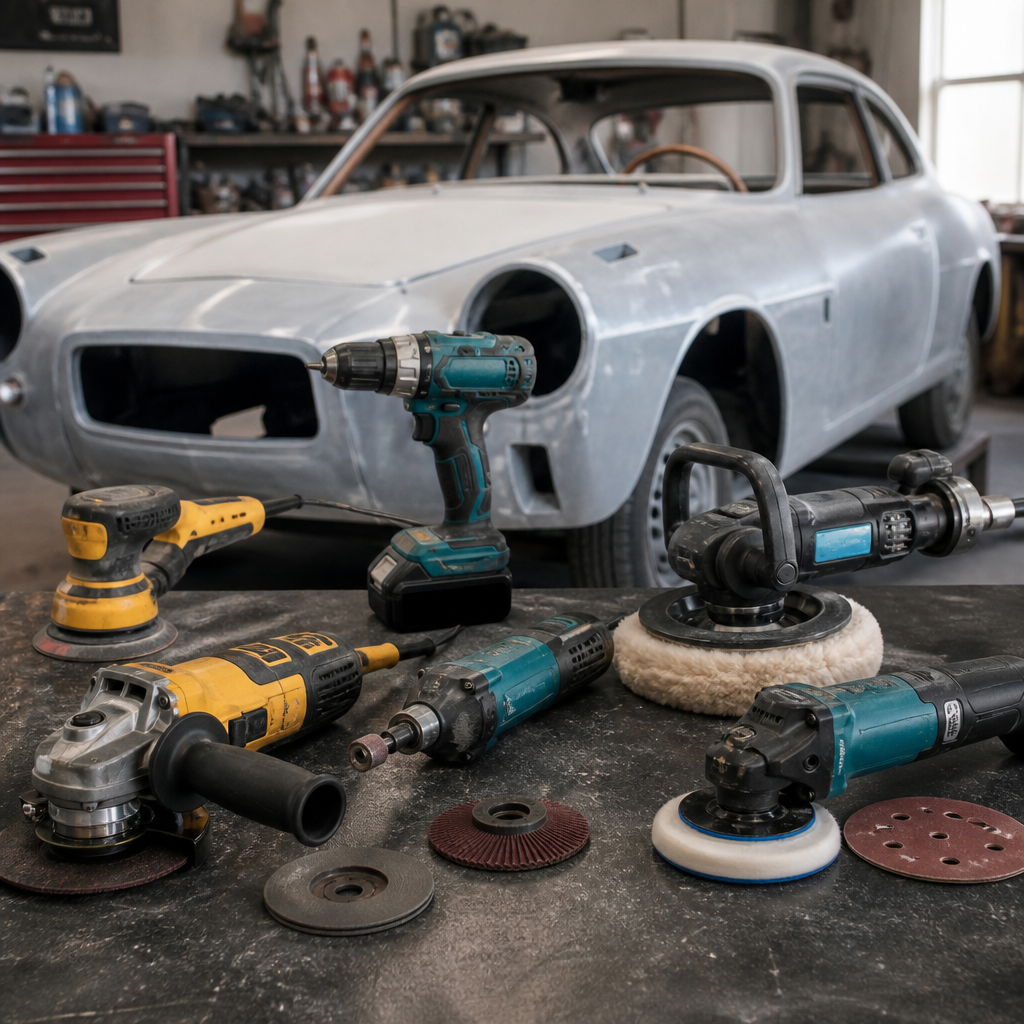
Car restoration rises or falls on tool choice, because every phase of the job, from cutting rust to polishing fresh paint, depends on power tools that are accurate, controllable, and durable under repeated use. When people search for the best power tools for car restoration, they usually want more than a shopping list; they want to know which tools matter most, which ones can wait, and how each one fits into metal repair, mechanical work, body preparation, paint correction, and final assembly. In restoration shops I have worked in, the wrong tool rarely saves money. It wastes panels, slows disassembly, overheats fasteners, and leaves rework that costs more than buying the correct equipment in the first place.
Power tools for car restoration include corded electric tools, cordless battery tools, and air-powered equipment driven by a compressor. Each category has strengths. Corded tools deliver steady output for long sanding or polishing sessions. Cordless tools are unmatched when maneuvering around a shell on a rotisserie or working in a driveway without air lines. Pneumatic tools remain dominant for many body and paint preparation tasks because they are light, compact, and tolerant of continuous duty. Understanding those differences is essential if you are building a home garage, expanding a restoration business, or simply planning your first classic car project.
This hub article covers the full tools and equipment landscape for restoration and maintenance, with emphasis on the power tools that deliver the greatest return. It explains what each tool does, where it fits in the workflow, and what specifications actually matter when comparing brands. The goal is practical guidance: if you are stripping a 1968 Mustang, rebuilding suspension on a Land Cruiser, or reviving a rusty square-body truck, these are the tools that move the project forward safely and efficiently.
Core Power Tools Every Car Restoration Needs First
If you are starting from zero, buy for the jobs you will perform most often: disassembly, rust removal, surface prep, drilling, and fastening. The most useful starting point is a quality 18V or 20V-class cordless drill and impact driver set. A drill handles pilot holes, spot weld cutter setup, wire wheels, and light abrasive attachments. An impact driver removes interior screws, trim hardware, and many machine screws without cam-out. For restoration work, brushless motors, variable speed triggers, and compact head length matter more than peak marketing torque.
The next essential is a 4.5-inch or 5-inch angle grinder. This is the single most versatile restoration power tool. With the right disc, it cuts seized bolts, slices patch panels, grinds welds, strips paint, and cleans corrosion. Look for a model with electronic speed control, tool-free guard adjustment, a paddle switch or secure slide switch, and low vibration. Grinders are inherently aggressive, so control matters more than raw power. Thin cutoff wheels remove metal quickly, flap discs shape welds, and strip discs lift coatings with less gouging than hard grinding wheels.
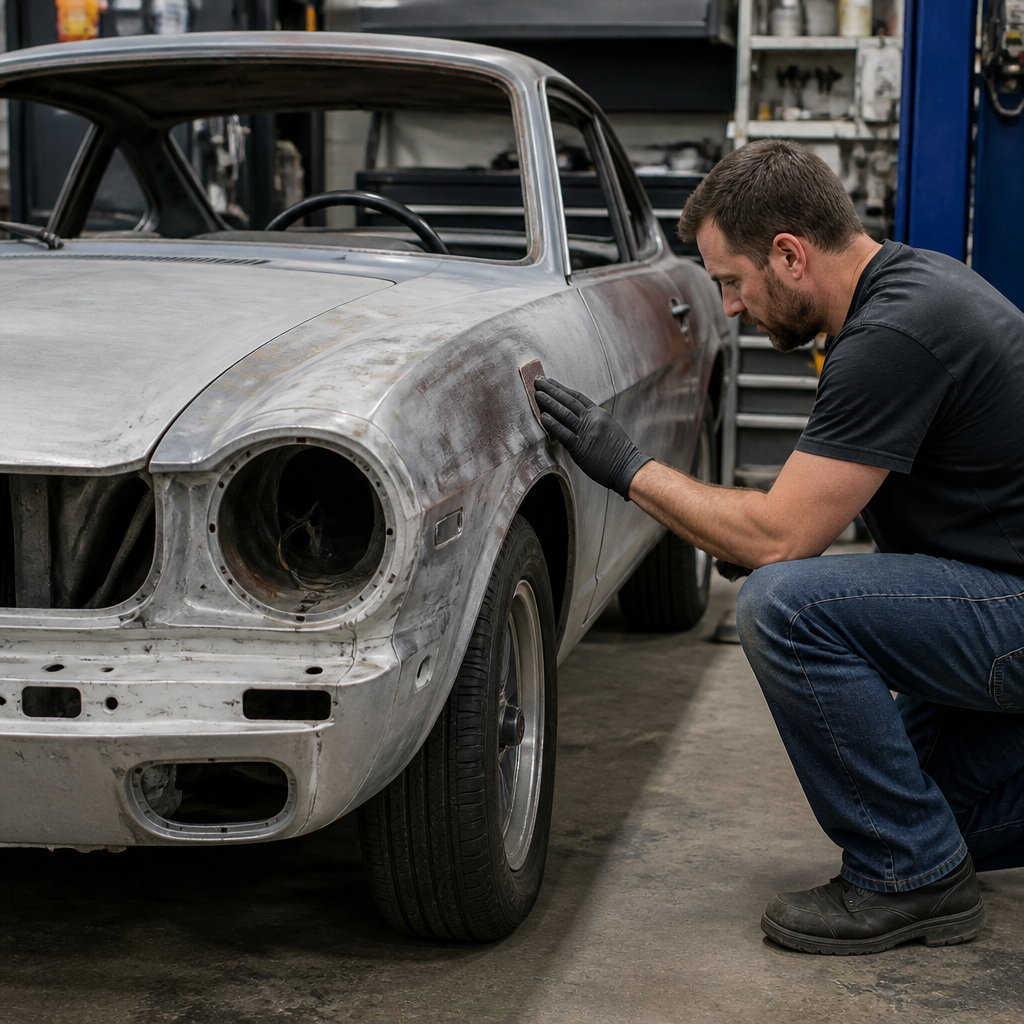
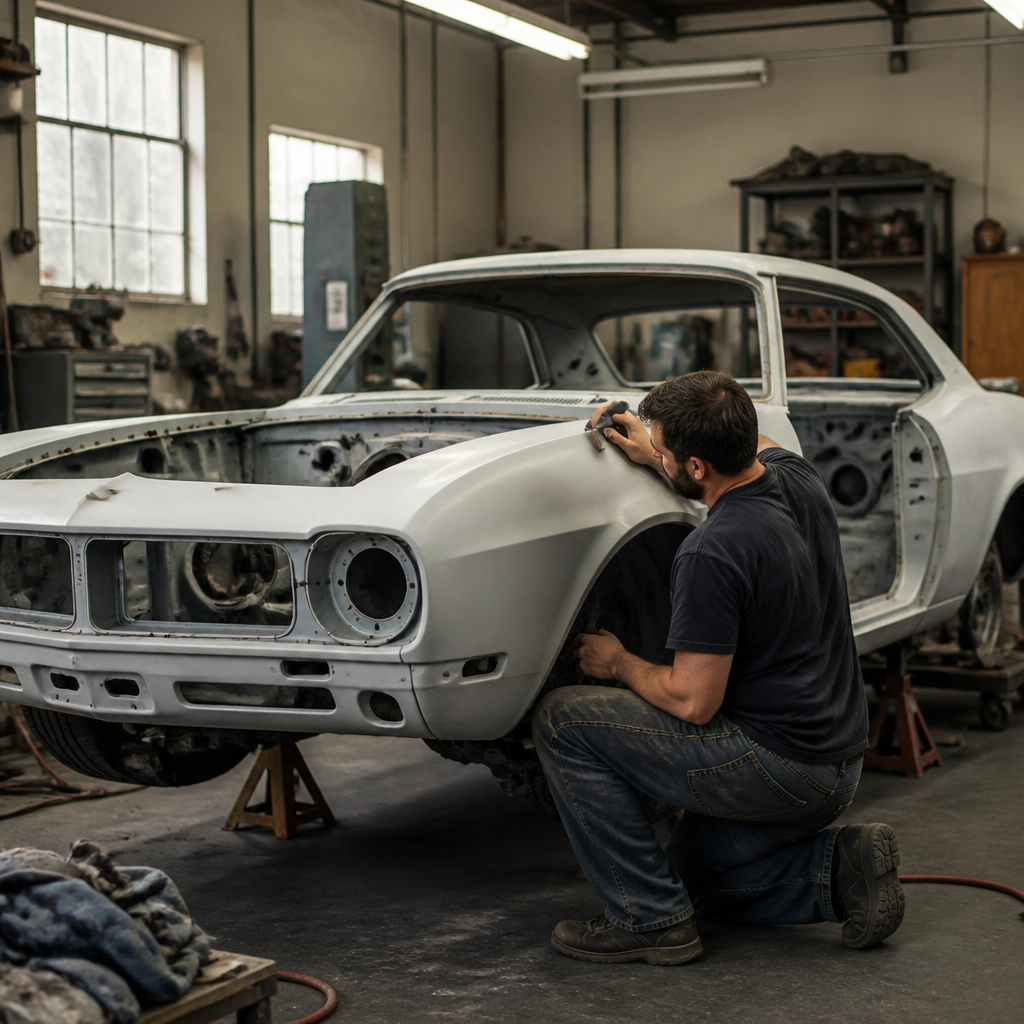
A random orbital sander belongs in the first wave of purchases because restoration is surface preparation intensive. Whether you are feathering repairs, shaping filler, or keying primer, a dual-action sander saves enormous labor. For bodywork, a 5-inch or 6-inch variable-speed unit with good dust extraction is the standard. Air sanders remain common in body shops, but high-end electric models from Festool, Mirka, and Bosch have earned a place in serious garages because they reduce air demand and improve dust collection when paired with a vacuum.
One more foundational tool is a compact work light system, ideally cordless. Restoration quality depends on what you can see. Strong directional LED lights reveal sanding scratches, low spots, pinholes, and paint defects that overhead lighting hides. While not a cutting tool, lighting is core equipment in any realistic discussion of the best power tools for car restoration because poor visibility leads directly to poor workmanship.
Bodywork and Rust Repair Tools That Save the Most Time
Rust repair is where restoration projects either gain momentum or become stalled for months. The best tools for this stage are those that remove damaged metal cleanly, allow precise fabrication, and keep heat under control. An angle grinder does much of the heavy lifting, but it works best when supported by a dedicated cut-off tool or compact band saw for cleaner, narrower cuts in confined spaces. Cordless compact band saws are excellent for exhaust, brackets, and thicker steel because they create fewer sparks and less collateral damage than a grinder.
For drilled spot welds, use a variable-speed drill with spot weld cutters rather than ordinary twist bits whenever possible. Spot weld cutters preserve the lower panel and reduce cleanup. On older unibody cars, this matters when replacing floors, trunk pans, and quarter sections. A right-angle drill attachment also proves useful around firewall seams, inner fenders, and under-dash areas where a standard drill body will not fit.
Die grinders, especially pneumatic right-angle versions, are among the most effective metal-finishing tools in restoration. They access tight corners, dress plug welds, clean pinch welds, and refine edges after patch fabrication. Carbide burrs, Roloc surface-conditioning discs, and small flap wheels turn a die grinder into a precision instrument. In my experience, restorers who skip the die grinder spend far longer trying to make large tools do small, exact work.
Reciprocating air saws and electric body saws are also valuable for panel surgery. They are slower than grinders but easier to control when preserving a cut line is critical. When replacing a quarter panel or roof skin, that control can prevent accidental damage to adjacent structures. Pair these tools with a pneumatic belt file, which is ideal for dressing seams in channels and around wheel arches where standard sanders cannot reach.
| Tool | Best Restoration Use | Why It Matters |
|---|---|---|
| Angle grinder | Cutting, stripping, weld cleanup | Most versatile tool for metalwork and corrosion removal |
| Drill with spot weld cutter | Panel removal | Separates factory welds with minimal damage to underlying metal |
| Die grinder | Tight-area finishing | Reaches seams, corners, and localized welds efficiently |
| Body saw | Controlled panel cuts | Improves accuracy where grinder access is risky |
| Belt file | Narrow seam finishing | Shapes hard-to-reach edges and flange areas cleanly |
Best Power Tools for Mechanical Restoration and Fastener Removal
Mechanical restoration introduces a different set of demands: torque, access, and reliability around old hardware. A cordless impact wrench is the first serious upgrade for anyone removing suspension, drivetrain, or chassis parts. A mid-torque model in the 400 to 650 foot-pound fastening class handles lug nuts, crossmembers, and many rusty bolts without the weight of a full high-torque gun. High-torque impacts are useful for axle nuts and severe corrosion, but they are tiring overhead and can easily overdo reassembly if used carelessly.
Electric ratchets have become genuinely useful in restoration. They are not substitutes for breaker bars, yet they speed repeated fastener removal on dashboards, engine accessories, undertrays, seat brackets, and HVAC housings. Choose one with a slim head and moderate speed, then crack fasteners loose manually before using the motor. This avoids overloading the mechanism and preserves battery life. In cramped engine bays, that combination of access and speed is difficult to beat.
A corded drill still earns its keep for heavy-duty wire brushing, hole saws, and sustained operation where cordless tools overheat or drain packs too quickly. When cleaning threads, mounting a cup brush or abrasive wheel in a robust drill can make short work of brackets and small parts. For restoration and maintenance hubs, this matters because projects do not end at major bodywork; they continue through suspension refreshes, brake overhauls, and engine bay detailing where durable rotational power remains indispensable.
Heat guns also deserve inclusion. They loosen seam sealer, soften undercoating, release decals, and help remove interior adhesive without open flame. A variable-temperature heat gun is safer around painted surfaces, wiring looms, and classic trim than improvising with torches. Used carefully alongside plastic scrapers, it can save original finishes and reduce damage during disassembly.
Sanding, Surface Preparation, and Paint Correction Equipment
Surface preparation determines how good the final car looks and how long that finish lasts. For that reason, sanding tools are not optional upgrades; they are central to restoration quality. Random orbital sanders are the general-purpose standard, but long-board air sanders, inline sanders, and mini sanders each solve specific problems. Long-board sanders bridge highs and lows across doors, quarter panels, and hoods, helping create straight reflections. Mini orbitals are ideal for jambs, pillars, and localized repairs.
Dust extraction should influence your buying decision as much as motor power. Fine sanding dust contaminates primers, shortens abrasive life, and creates health risks. Systems from Mirka, Festool, and 3M that combine net abrasives, multi-hole pads, and extractors are expensive upfront but noticeably cleaner and faster in use. On restorations involving epoxy primer, polyester filler, and urethane surfacer, cleaner sanding is not a luxury; it improves adhesion and inspection accuracy.
For stripping paint, many beginners reach for the most aggressive grinder disc available. That often warps panels or creates deep gouges. A better approach is to match the tool to the panel and coating. Surface-conditioning discs, poly strip discs, dual-action sanders with coarse abrasives, and chemical stripping on removable panels usually produce a more controlled result. Hood skins, roof panels, and long quarter sections especially benefit from lower heat methods.
After paint, polishing tools take over. A dual-action polisher is the safest starting point for removing haze, compounding fresh clear coat, and correcting oxidation on preserved paint. Rotary polishers cut faster, which is why experienced painters still use them, but they can burn edges and induce holograms. A modern long-throw dual-action machine from Rupes, Flex, or Milwaukee gives restorers excellent correction with lower risk. Combine it with proper pad selection, measured paint thickness checks, and compound systems matched to the hardness of the finish.
Air Tools, Compressors, and When Pneumatic Still Wins
Many home restorers ask whether air tools are still worth buying now that cordless platforms are so strong. The answer is yes, especially for sanding, grinding, spraying, and continuous-duty work. Pneumatic tools remain lighter than equivalent cordless units, which reduces fatigue during long sessions. They also tolerate sustained use without battery swaps and often cost less per tool once a suitable compressor is in place.
The limiting factor is air supply. Small consumer compressors struggle with dual-action sanders, die grinders, and spray guns because these tools require consistent cubic feet per minute, not just tank pressure. For a serious restoration setup, a 60-gallon compressor with around 10 to 15 CFM at 90 PSI is a practical baseline, though exact demand depends on your tools. Add a regulator, water separator, and proper hose diameter, because moisture and pressure drop can ruin both tool performance and paint quality.
Pneumatic tools still dominate in several tasks. Air die grinders are compact and powerful for their size. Air sanders remain excellent for bodywork because they are smooth and easy to control. HVLP or compliant spray guns obviously require compressed air unless you move to turbine systems. If your restoration plans include regular panel replacement, filler work, and full repainting, building around a compressor is still a sound decision. If your work is mostly bolt-on maintenance and occasional rust cleanup, a modern cordless platform may cover more ground with less setup.
How to Choose the Right Brand, Specifications, and Safety Setup
The best power tools for car restoration are not always the most expensive, but they should meet professional standards in three areas: controllability, service life, and accessory support. Brand ecosystems matter because batteries, chargers, backing pads, abrasives, and replacement parts affect long-term cost more than the sticker price of one tool. Milwaukee, DeWalt, Makita, Bosch, Metabo HPT, and Flex all make strong cordless options. For body and finishing specialties, Mirka, Festool, 3M, Rupes, Ingersoll Rand, Chicago Pneumatic, and Astro Pneumatic are common names for good reason.
Read specifications with skepticism. Torque figures on impacts can be inflated or measured under favorable conditions. Motor wattage alone does not predict cut quality. Instead, prioritize ergonomics, variable speed control, vibration management, spindle compatibility, and real accessory availability. A grinder that accepts common 5/8-inch arbor wheels, or a sander with easy-to-find hook-and-loop pads, will be easier to keep in service during a long build.
Safety equipment is inseparable from tool selection. Use ANSI-rated eye protection, hearing protection, gloves appropriate to the task, and a respirator suited to dust or fumes. Grinding and sanding create fine particulate; paint work introduces isocyanate hazards that demand far more than a paper mask. Stable power supply, proper extension cords, guarded wheels, and disciplined battery charging practices also belong in any restoration tool plan. Good tools speed work, but safe systems finish projects.
Build your kit in phases. Start with a drill, impact driver, angle grinder, orbital sander, quality lighting, and an impact wrench. Add a die grinder, body saw, polisher, and compressor-backed air tools as the project scope expands. That approach keeps spending aligned with actual work while ensuring you own the tools that matter most. If you are planning a restoration and maintenance workspace, map your next jobs, compare tool ecosystems, and invest first in the power tools that remove the biggest bottlenecks.
Frequently Asked Questions
What are the most essential power tools for car restoration if I am just getting started?
If you are building a starter tool kit for car restoration, focus first on the power tools that support the widest range of jobs. In most cases, that means an angle grinder, a dual-action sander, a cordless drill and impact driver, and a quality polisher. These tools cover the major stages of a restoration project, including rust removal, metal cutting, fastener removal, surface preparation, panel finishing, paint correction, and final detailing. They are useful on almost every build, whether you are reviving a driver-quality classic or completing a more serious body-off restoration.
An angle grinder is usually the first must-have because it handles multiple tasks with the right attachments. It can cut rusted metal, clean welds, strip paint, remove seized bolts, and smooth repaired areas. A dual-action sander is just as important because it gives you better control during body prep and helps create a more even surface before primer and paint. A cordless drill and impact driver save enormous time on disassembly and reassembly, especially when you are dealing with old hardware, brackets, interior trim, and underbody fasteners. A polisher becomes essential later in the process for correcting paint, refining clear coat, and bringing out a finished shine without hand-buffing for hours.
If your budget is limited, buy fewer tools but buy dependable ones. Restoration work is demanding, and low-quality tools often struggle with heat, vibration, battery life, or inconsistent speed control. Those shortcomings matter when you need precision on thin sheet metal or a stable finish on fresh paint. Start with versatile, durable tools from reputable brands, then expand into specialty equipment such as die grinders, air sanders, spot weld cutters, or rotary polishers as your projects become more advanced. A smart starter setup is not about having every tool immediately. It is about owning the right core tools that can do accurate, repeatable work from teardown to final finish.
Which power tool is best for removing rust, cutting metal, and handling body repair work?
For rust removal, metal cutting, and general body repair, the angle grinder is usually the most valuable power tool in the shop. It is one of the few tools that can move from aggressive material removal to finer cleanup work simply by changing discs or wheels. With a cutoff wheel, it can remove rusted sections of sheet metal or trim away damaged panels. With a flap disc, it can smooth welds and refine repair areas. With a wire cup brush or strip disc, it can remove scale, paint, seam sealer, and corrosion from steel surfaces quickly and efficiently.
That said, the best results in body repair often come from pairing the angle grinder with more precise tools. A die grinder is excellent for tight spaces, spot repairs, edge cleanup, and working around wheel arches, door jambs, and patch panel seams. An electric or pneumatic cut-off tool can also offer better control than a full-size grinder when you need cleaner cuts in confined areas. For removing factory spot welds, a dedicated spot weld drill or cutter is far safer and more accurate than trying to force the job with a general-purpose abrasive tool.
The key is control. Car restoration involves thin metal, and it is easy to warp panels or remove too much material if the tool is too aggressive or poorly balanced. Look for a grinder with manageable weight, good ergonomics, and variable speed if possible. Variable speed is especially helpful because not every task needs full power. Slowing the tool down can reduce heat buildup and improve precision. For body repair, the best power tool is not simply the strongest one. It is the one that gives you enough cutting and grinding capability while still allowing you to work carefully on delicate automotive panels.
Do I really need a dual-action sander for car restoration, or can I sand everything by hand?
Hand sanding still has an important place in restoration, but a dual-action sander is one of the most worthwhile power tool investments you can make. It saves a tremendous amount of time, creates more uniform results, and reduces fatigue during long bodywork and paint-prep sessions. On a full restoration, there may be dozens of hours spent leveling filler, feathering primer edges, stripping old finishes, and preparing panels for sealer and paint. Doing all of that by hand is possible, but it is slower, less consistent, and much harder on your hands, wrists, and shoulders.
A dual-action sander is preferred because it combines rotation and oscillation, which helps minimize deep swirl marks and uneven sanding patterns. That makes it much more forgiving than a straight rotary sander, especially for hobbyists. It is excellent for stripping panels, smoothing filler, blocking primer in certain stages, and preparing surfaces before paint. Different grit progressions allow you to move from more aggressive material removal to fine finishing, and dust extraction models can keep the work area cleaner while improving visibility and air quality.
That does not mean hand sanding becomes unnecessary. Tight curves, body lines, edges, and final finish work often still require sanding blocks or hand techniques to maintain panel shape and avoid overcutting. In restoration, the smartest approach is not choosing one method over the other. It is using a DA sander for speed and consistency on broad surfaces, then hand sanding where finesse matters most. If you plan to do more than minor cosmetic work, a dual-action sander is not just convenient. It is one of the tools that can noticeably improve the quality and efficiency of the entire restoration process.
Are cordless power tools good enough for car restoration, or should I choose corded tools?
Modern cordless power tools are absolutely good enough for many parts of car restoration, and in some cases they are the better choice. Cordless drills, impact drivers, ratchets, and compact grinders are extremely useful during teardown, mechanical repair, interior work, and assembly because they let you move freely around the vehicle without dragging cords or hunting for outlets. They are especially handy when working under a car, inside an engine bay, or around doors, fenders, and suspension components where access is awkward and mobility matters.
However, corded tools still have major advantages for continuous-duty work. Jobs like heavy grinding, sustained sanding, polishing large panels, or cutting multiple sections of steel can drain batteries quickly and generate enough heat that lower-tier cordless tools begin to lose performance. Corded tools deliver steady power for long sessions, which is important when consistency affects the quality of the work. A corded polisher, for example, is often preferred by serious restorers because it can maintain stable speed under load during paint correction. The same logic applies to sanders and larger grinders used for repeated bodywork tasks.
For most restorers, the best answer is a mixed setup. Use cordless tools where speed, portability, and convenience improve workflow, and use corded tools where endurance and uninterrupted power are more important. Battery platform also matters. If you invest in cordless tools, choose a system with strong battery support, reliable brushless motors, and a broad tool lineup so you can expand over time. In practical terms, cordless is excellent for fasteners and mobile work, while corded often remains the better choice for high-demand shop tasks. The right choice depends less on trend and more on how long the tool will run, how much precision the job requires, and whether power consistency affects the finished result.
What should I look for when choosing a power tool for paint correction and final finishing on a restored car?
When choosing a power tool for paint correction and final finishing, the most important factor is control. A restored vehicle often represents hundreds of hours of labor in bodywork and paint, so the finishing stage is not where you want a tool that is overly aggressive, unstable, or difficult to manage. For most people, a dual-action polisher is the best choice because it is safer and more forgiving than a rotary buffer. It reduces the risk of burning edges, creating severe holograms, or overheating fresh paint, while still providing excellent correction and gloss when paired with the right pads and compounds.
Look for a polisher with variable speed control, smooth power delivery, comfortable ergonomics, and enough motor strength to maintain pad rotation under pressure. These characteristics matter because paint correction is rarely a one-speed job. You may need lower speeds for spreading product, moderate speeds for correcting defects, and higher speeds for refining the finish depending on pad type and paint hardness. A well-balanced machine also reduces operator fatigue, which becomes important when polishing large hoods, roofs, quarter panels, and trunk lids. If the tool vibrates excessively or feels awkward in the hand, your precision usually suffers.
Pad and compound compatibility are just as important as the tool itself. A quality machine can only perform well if the pad size suits the panel and the polish system matches the defect level. Softer foam pads are commonly used for refining and finishing, while more aggressive foam, microfiber, or wool options help remove oxidation, sanding haze, or moderate defects. On restored paint, especially fresh clear coat, patience matters. The goal is not simply maximum cut. It is achieving clarity, depth, and gloss without introducing new marks. A good paint-correction tool should help you work accurately, consistently, and safely, because final finishing is where the quality of the entire restoration becomes visible.