Pre-war automobiles created the foundation of classic car culture by transforming the motorcar from a noisy experiment into a practical machine, a luxury object, and eventually a symbol of personal freedom. In the collector world, “pre-war” usually refers to vehicles built before the United States entered World War II in 1941, though historians sometimes use 1939 as the cutoff because global conflict had already disrupted European production. These cars matter because nearly every concept that defines later classic vehicles—coachbuilt styling, brand identity, performance engineering, mass production, and enthusiast ownership—was established during this formative period. I have spent years around early Fords, Packards, and pre-war British roadsters at auctions, restoration shops, and marque events, and one lesson is always clear: understanding pre-war automobiles makes the entire history of classic cars easier to read. The era contains the first practical gasoline cars, the rise of assembly-line manufacturing, the birth of luxury marques, the spread of motoring to the middle class, and the design breakthroughs that still shape collector preferences today. As a hub topic under classic car basics and education, this history of classic cars begins with pre-war automobiles because they set the technical, cultural, and aesthetic template for everything that followed.
The phrase classic car era often brings to mind chrome-heavy postwar icons, but the real birth of the classic car era happened earlier, when inventors, industrialists, racers, and coachbuilders established what a desirable automobile could be. In the 1890s and early 1900s, steam, electric, and gasoline cars all competed for attention. By the 1910s, gasoline power had won through range, fuel availability, and improving reliability. During the 1920s and 1930s, manufacturers refined engines, transmissions, brakes, suspension systems, and body construction while creating emotional appeal through design and status. Collectors value these vehicles not just for age but for significance. A Ford Model T represents democratized mobility. A Duesenberg Model J represents peak American prestige. A Bugatti Type 35 represents motorsport brilliance. A Rolls-Royce Silver Ghost represents engineering smoothness and durability. Each one tells a specific chapter in the history of classic cars, and together they explain how automobiles evolved from utilitarian transport into enduring cultural artifacts.
From Experiment to Industry: How Early Motorcars Took Shape
The earliest pre-war automobiles emerged from late nineteenth-century engineering experimentation. Karl Benz’s 1886 Patent-Motorwagen is widely recognized as the first practical gasoline automobile, while Gottlieb Daimler and Wilhelm Maybach developed related high-speed engine concepts that accelerated progress in Germany. In France, Panhard et Levassor helped standardize the front-engine, rear-drive layout that became the dominant template for decades. In the United States, pioneers such as Ransom E. Olds and the Duryea brothers moved the automobile from workshop curiosity toward commercial production.
These first vehicles were crude by later standards. Steering systems were basic, braking performance was weak, and engines required frequent attention. Yet they established the core mechanical vocabulary enthusiasts still use when discussing classic cars: carburetion, ignition timing, leaf springs, chassis, wheelbase, and coachwork. Early buyers were often wealthy hobbyists willing to tolerate inconvenience for novelty. Roads were poor, fuel stations were scarce, and many towns lacked mechanics. Even so, demand grew because the automobile solved a timeless problem: independent travel on demand. That practical value turned engineering experiments into an industry.
One reason pre-war automobiles occupy such an important place in the history of classic cars is that the period saw dozens of competing solutions before standards settled. Chain drive competed with shaft drive. Tillers gave way to steering wheels. Right-hand drive remained common in some markets long after left-hand drive spread elsewhere. Air-cooled and water-cooled engines both had supporters. This variation is why early collector cars feel so educational. When you inspect a brass-era car from 1905, you are seeing an industry still inventing itself.
The Brass Era and the Rise of Recognizable Automobile Design
The brass era, generally spanning about 1905 to 1915, takes its name from the polished brass lamps, radiators, and trim found on many cars of the period. It was also the era when automobiles became visibly more sophisticated. Bodies grew more integrated, hoods lengthened as engines became more powerful, and marques began forming identities through radiator shapes and styling details. This mattered for the birth of the classic car era because desirability was no longer based only on function. Appearance, craftsmanship, and brand distinction became part of the buying decision.
Manufacturers such as Cadillac, Packard, Pierce-Arrow, Renault, Mercedes, and Fiat gained reputations for quality and innovation. Cadillac became famous for precision manufacturing and parts interchangeability, a milestone publicly demonstrated in 1908 in a British Royal Automobile Club test. That achievement built consumer trust in the idea that a car could be repaired with standardized components rather than hand-fitted improvisation. Packard earned loyalty through refinement and the memorable slogan “Ask the Man Who Owns One,” one of the earliest examples of automotive brand authority. These developments showed that the history of classic cars is also a history of marketing, reputation, and consumer confidence.
In practical terms, brass-era cars were still demanding to operate. Starting often required hand cranking, which could be dangerous if the engine kicked back. Weather protection was limited. Tires punctured frequently on rough roads. Yet for collectors today, these challenges are part of the appeal. Brass cars reveal the raw transition from carriage thinking to automobile thinking, and they preserve details that disappeared once the industry matured.
Mass Production Changed Everything
No discussion of pre-war automobiles is complete without Henry Ford and the Model T. Introduced in 1908, the Model T did not invent the car, but it transformed car ownership by making automobiles affordable, durable, and easy to repair. Ford’s moving assembly line, implemented in stages from 1913, dramatically reduced production time and labor cost. As efficiency improved, prices fell. A Model T that cost around $850 at launch dropped to less than $300 by the 1920s in some configurations. That price compression changed society. Farmers, shopkeepers, teachers, and factory workers could now own cars.
The Model T’s impact on the history of classic cars goes beyond sales volume. It changed road building, tourism, suburban growth, fuel distribution, and service infrastructure. Repair garages, parts suppliers, roadside businesses, and driver education all expanded because millions of ordinary people now depended on automobiles. In my experience, even seasoned collectors who prefer luxury marques respect the Model T because it created the broad motoring culture that later sustained every enthusiast segment.
| Model | Years Introduced | Why It Matters | Classic Car Legacy |
|---|---|---|---|
| Ford Model T | 1908 | Affordable mass mobility through assembly-line production | Made car ownership mainstream |
| Cadillac Type 51 | 1915 | Popularized the modern V8 in American luxury cars | Linked engineering innovation with prestige |
| Rolls-Royce Silver Ghost | 1906 | Benchmark for smoothness, reliability, and long-distance durability | Defined luxury-car standards |
| Duesenberg Model J | 1928 | Elite performance and bespoke coachwork | Became a symbol of pre-war American grandeur |
| Volkswagen Beetle prototype | 1938 | People’s car concept emphasizing simplicity and efficiency | Influenced postwar global motoring |
Mass production also created a countertrend. As Ford standardized output, luxury and specialty manufacturers leaned harder into exclusivity. That split between accessible transportation and aspirational craftsmanship remains central to classic car history. Some collectors chase the universal story of the Model T or Model A; others seek the rarity of a Hispano-Suiza or Auburn Speedster. Both impulses were born in the pre-war market.
Luxury, Coachbuilding, and the Prestige Automobile
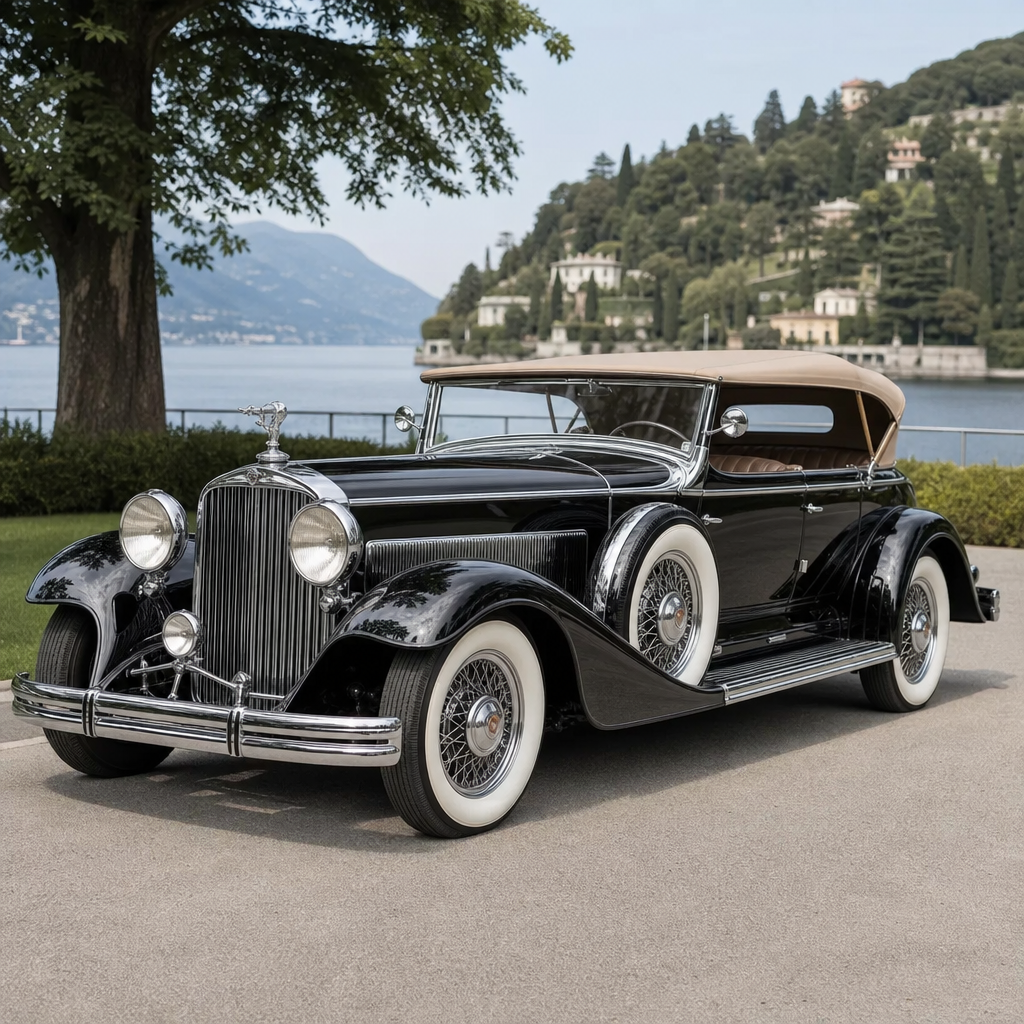
While Ford put the world on wheels, luxury manufacturers turned automobiles into works of art and statements of power. In the 1920s and 1930s, top-tier brands including Rolls-Royce, Bentley, Hispano-Suiza, Packard, Pierce-Arrow, Isotta Fraschini, Delage, Mercedes-Benz, and Duesenberg sold chassis that wealthy customers sent to coachbuilders for bespoke bodies. Firms such as Mulliner, Park Ward, Saoutchik, Figoni et Falaschi, LeBaron, Fleetwood, and Murphy shaped fenders, rooflines, and interiors to suit personal taste.
This coachbuilt tradition is essential to understanding why classic cars are often judged as rolling design objects rather than just machines. A Duesenberg Model J with a Murphy convertible coupe body is not merely different from another Model J; it can be a fundamentally different aesthetic statement. The same applies to Bentley Derby cars bodied by Vanden Plas or Rolls-Royce Phantoms bodied by Hooper. In restoration circles, this individuality creates both value and complexity. Original body documentation, trim materials, and body numbers can be as important as engine authenticity.
Luxury pre-war automobiles also pioneered features later taken for granted. Straight-eight, V12, and V16 engines delivered smoothness and power. Vacuum-assisted and then hydraulic brakes improved stopping. Synchromesh gearboxes reduced driver effort. Better sound insulation and full weather protection increased comfort. Cadillac’s 1930 V16 remains one of the great engineering statements of the era, while Packard’s Twin Six helped normalize multi-cylinder refinement in the American prestige market. These were not gimmicks. They set benchmarks that influenced mainstream cars over time.
Racing, Speed, and the Performance Tradition
Performance became part of the history of classic cars almost as soon as cars existed. Competition tested reliability, promoted brands, and accelerated technical development. Pre-war racing included city-to-city trials, endurance runs, hill climbs, Grand Prix events, and American oval racing at venues such as Indianapolis. Victories translated into showroom credibility because early buyers wanted proof that a machine could survive real stress.
Bugatti, Alfa Romeo, Bentley, Mercedes-Benz, Auto Union, Delahaye, and Maserati all built legends before the war. The Bugatti Type 35, introduced in 1924, is often cited as one of the most successful racing cars ever, with thousands of victories across varied events. Bentley’s wins at Le Mans in the 1920s created the “Bentley Boys” mythos and established endurance racing as a branding tool. In Germany, the supercharged Mercedes-Benz SSK and later the Silver Arrows demonstrated how state-backed engineering and lightweight construction could redefine speed.
These racing programs mattered beyond trophies. Overhead camshafts, supercharging, improved metallurgy, aerodynamic thinking, and better chassis balance filtered into road cars. When enthusiasts today celebrate sports cars, grand tourers, or homologation specials, they are continuing a pattern established in the pre-war years: motorsport proving the desirability of performance engineering. Even collectors who never plan to race value sporting provenance because it places a car within a documented narrative of achievement.
Art Deco Styling and the Mature Pre-War Automobile
By the 1930s, pre-war automobiles entered a mature design phase that many historians consider the visual beginning of the classic car era. Separate fenders remained common, but proportions became longer, lower, and more streamlined. The influence of Art Deco appeared in grille shapes, instrument design, hood louvers, wheel covers, and interior materials. Cars from Cord, Chrysler, Peugeot, Delahaye, Talbot-Lago, and Lincoln Zephyr showed that modern styling could be as compelling as raw mechanical specification.
The 1936 Cord 810 is a landmark example. It featured front-wheel drive, hidden headlights, and clean, coffin-nose styling unlike anything else on American roads. It was not a mass-market success, but it proved that innovation and visual drama could define a car’s legacy. Likewise, the Lincoln Zephyr used aerodynamic principles and a V12 engine to present streamlined luxury at a lower price point than ultra-exclusive rivals. In France, Figoni et Falaschi-bodied Delahayes turned flowing fenders into sculpture. These cars remain concours stars because they capture the moment when automotive design became undeniably artistic.
At the same time, all-steel bodies, integrated trunks, safer cabins, and better suspension tuning made cars more usable. This blend of beauty and practicality is why late pre-war cars often appeal strongly to first-time collectors. They retain old-world craftsmanship while offering more approachable driving manners than earlier brass-era machines.
Why Pre-War Cars Still Matter to Collectors and Historians
Pre-war automobiles remain central to classic car education because they explain origins. They show where major brands came from, why certain technologies prevailed, and how class, geography, and industry shaped motoring. A history of classic cars that skips pre-war development misses the roots of muscle cars, luxury sedans, sports cars, and even economy cars. The categories were already forming before 1940.
Collectors also value pre-war cars for rarity and craftsmanship. Survival rates are low, especially for cars used hard during wartime scrap drives and resource shortages. Documentation can be fragmented, making provenance research crucial. Organizations such as the Antique Automobile Club of America, the Classic Car Club of America, and marque-specific registries play a major role in authenticating and preserving these vehicles. Auction houses including RM Sotheby’s, Gooding Christie’s, and Bonhams regularly demonstrate that historically important pre-war cars command strong prices when originality, coachwork, and ownership history align.
For newcomers, the main lesson is simple: pre-war automobiles are not merely old cars. They are the blueprint of the classic car era. If you want to understand restoration standards, concours judging, coachbuilt terminology, early motorsport heritage, or the rise of global automotive culture, start here. Explore individual marques, compare early engineering solutions, and study how social change shaped the machines. That context will make every later chapter in classic car history clearer, richer, and more rewarding.
Frequently Asked Questions
What qualifies as a pre-war automobile?
A pre-war automobile is generally defined as a vehicle built before the United States entered World War II in 1941. In many collector and enthusiast circles, that is the most common cutoff because American production remained active longer than in much of Europe. Historians, however, often use 1939 as the dividing line, since the outbreak of war in Europe had already begun to disrupt manufacturing, design priorities, and exports across major automotive nations. Both dates are valid depending on the context, which is why you will sometimes see the term used a little differently in museums, auction catalogs, and car club discussions.
What makes the category important is not just the date, but the era itself. Pre-war cars come from the formative decades of automobile history, when engineers and manufacturers were still inventing the standards that later became normal. During this period, the automobile evolved from an unreliable mechanical novelty into a practical transportation tool, a statement of status, and a source of personal independence. When people refer to pre-war automobiles today, they are usually talking about cars built in that pioneering age, before wartime production redirected industrial capacity and before postwar styling, safety, and mass manufacturing reshaped the industry.
Why are pre-war automobiles considered the foundation of classic car culture?
Pre-war automobiles are viewed as the foundation of classic car culture because they established nearly every idea that collectors and enthusiasts still celebrate today. This was the era when automakers defined brand identity, developed recognizable styling themes, experimented with body designs, improved engine performance, and created the emotional connection between driver and machine. Long before the postwar collector market took shape, pre-war cars had already turned the automobile into something more than transportation. They could be elegant, fast, luxurious, innovative, or adventurous, and that broad appeal still shapes how people think about classic cars now.
Just as importantly, pre-war cars represent the birth of automotive aspiration. Early motorcars began as rough, noisy, and often temperamental machines, but by the 1920s and 1930s they had become increasingly refined. Closed bodies became more comfortable, mechanical systems more dependable, and styling more intentional. Owning a car no longer meant simply having a machine; it meant participating in a modern lifestyle. That transition is central to classic car culture. Enthusiasts treasure pre-war vehicles not only for their rarity, but because they capture the moment when the automobile first became an object of beauty, craftsmanship, and personal identity.
What innovations from pre-war cars still influence automobiles today?
Many of the core concepts found in modern automobiles either originated in or were significantly advanced during the pre-war era. Manufacturers experimented rapidly with engine layouts, transmissions, braking systems, suspension design, electrical systems, and body construction. Features that now seem basic, such as enclosed cabins, standardized controls, more effective brakes, improved steering, and stronger chassis engineering, were developed and refined during these decades. Even the idea that a car should balance performance, comfort, style, and reliability became a central design goal before the war.
Pre-war innovation also shaped the business side of the industry. Automakers learned how to segment the market by offering economy cars, family cars, luxury cars, and performance-oriented models. Branding became more meaningful, and consumers began associating certain manufacturers with prestige, engineering excellence, or value. Streamlined styling in the 1930s introduced the idea that aerodynamics and visual sophistication could go hand in hand. Coachbuilding demonstrated the importance of craftsmanship and customization, while large-scale production methods proved that cars could be made more accessible to the public. In that sense, pre-war automobiles did not just contribute technical ideas; they created the basic blueprint for how the entire automotive world operates today.
Why do collectors and historians place such high value on pre-war automobiles?
Collectors and historians prize pre-war automobiles because they combine historical significance, mechanical character, and artistic value in a way few other vehicles can. These cars come from a period of extraordinary change, when the automobile industry was still young and every decade brought major leaps in design and engineering. A pre-war car is often appreciated not only as a vehicle, but as a cultural artifact that reflects the technology, taste, social structure, and industrial ambition of its time. For historians, it helps tell the story of how mobility changed everyday life. For collectors, it offers a direct connection to that transformational period.
There is also a strong craftsmanship element. Many pre-war cars feature hand-finished details, elegant proportions, distinctive materials, and engineering solutions that feel far more individual than what came later in mass-produced postwar vehicles. Luxury marques and custom-bodied models are especially admired because they show the automobile as a designed object, not just a factory product. Even more modest pre-war cars have a mechanical honesty that appeals to enthusiasts who enjoy visible linkages, simple systems, and the tactile nature of early motoring. Add in scarcity, survival rates, provenance, and concours-level desirability, and it becomes easy to see why these machines occupy such an important place in the collector world.
What was it like to drive and own a pre-war automobile compared with a modern car?
Driving and owning a pre-war automobile is a far more involved experience than operating a modern car. These vehicles demand attention, patience, and mechanical sympathy. Controls may be heavier, starting procedures more complicated, and road manners less forgiving. Depending on the model and year, drivers may encounter manual spark advance, non-synchronized transmissions, mechanical brakes, slower steering, and suspension systems that communicate every imperfection in the road. Speeds are generally lower, but the sense of engagement is much higher. You do not simply sit in a pre-war car and point it down the road; you actively manage it, listen to it, and work with its limitations.
Ownership is equally distinctive. Pre-war automobiles often require specialized maintenance, careful storage, and a willingness to source rare parts or rely on expert restorers and marque specialists. At the same time, many enthusiasts find that challenge deeply rewarding. These cars offer a level of personality and presence that modern vehicles rarely match. Their styling turns heads, their engineering invites conversation, and their operation creates a tangible link to the earliest age of motoring. For many owners, that is the real appeal. A pre-war automobile does not just transport you physically; it transports you historically, back to the moment when driving first became an adventure and freedom on the road began to define modern life.