Diagnosing engine problems in classic cars starts with understanding that older engines communicate differently than modern ones. They rarely store fault codes, they tolerate less neglect, and they reveal issues through sound, smell, vibration, exhaust color, plug condition, vacuum readings, and mechanical measurements. In the workshop, I treat diagnosis as a sequence, not a guessing game: verify the complaint, inspect the basics, test systems one by one, and only then replace parts. That approach saves time, protects hard-to-find components, and prevents a minor tuning issue from turning into an expensive rebuild.
For classic car owners, engine diagnosis matters because these vehicles use carburetors, distributor ignition, mechanical fuel pumps, vacuum-operated accessories, and age-sensitive gaskets and wiring. A rough idle in a 1967 small-block Chevrolet, a hot-start problem in an MG B, or low oil pressure in a flathead Ford can each have several causes, but the clues are usually visible if you know where to look. This guide covers engine and mechanical work as a complete hub topic: symptom tracking, ignition checks, fuel and air testing, compression and leak-down procedures, cooling faults, lubrication problems, and the tools that make diagnosis reliable.
Key terms matter. “No-start” means the engine cranks but does not fire, or does not crank at all; those are two different problems. “Misfire” is incomplete combustion in one or more cylinders. “Lean” means too much air or too little fuel, while “rich” means excess fuel. “Blow-by” is combustion gas leaking past piston rings into the crankcase. “Detonation” is uncontrolled combustion pressure, often heard as pinging. “Vacuum leak” refers to unmetered air entering the intake path. Once these terms are clear, troubleshooting becomes organized instead of reactive, and every inspection has a purpose.
Start with symptoms, history, and a baseline inspection
The first step in diagnosing engine problems in classic cars is documenting exactly what the engine does, when it does it, and under what conditions. I always ask whether the problem appears cold, hot, under load, during idle, or after highway driving. A carbureted V8 that stumbles only after a heat soak points toward fuel percolation, weak coil performance, or vapor lock. An inline-six that misses only at idle often suggests a vacuum leak, weak compression on one cylinder, or ignition timing instability caused by distributor wear.
History matters as much as symptoms. Many classic engines run poorly because of recent work, not catastrophic failure. If the plugs, points, condenser, wires, carburetor, or timing were changed just before the issue appeared, inspect that work first. I have seen perfectly healthy engines develop backfiring because plug wires were crossed after a tune-up, and severe hesitation caused by a float level set too low during a carburetor rebuild. Always verify firing order, distributor rotation, timing mark accuracy, vacuum hose routing, and fuel line integrity before assuming internal damage.
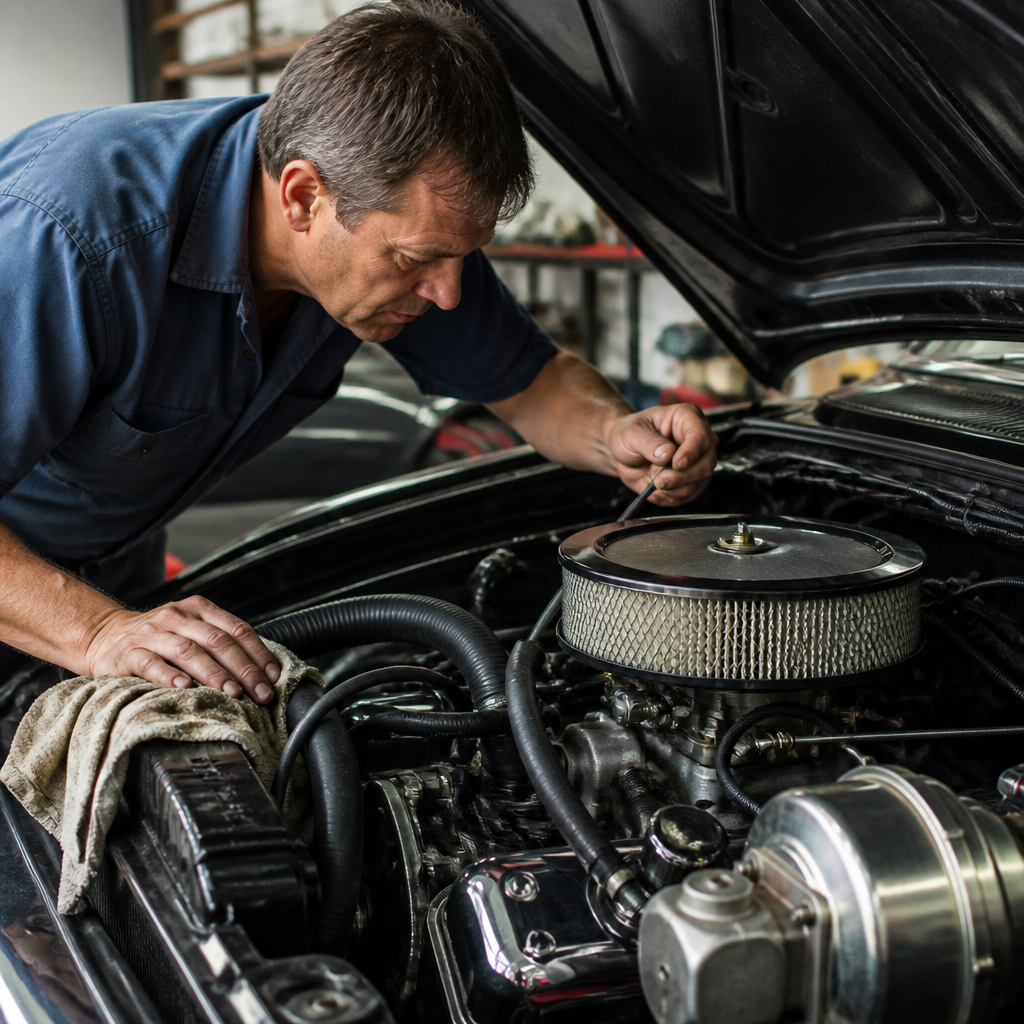
A baseline visual inspection catches a surprising number of faults. Look for brittle vacuum hoses, cracked plug wires, loose battery grounds, leaking valve cover gaskets, fuel stains around the carburetor, and missing heat riser hardware. Check engine oil for fuel dilution or coolant contamination. Inspect coolant for rust, oil sheen, or combustion bubbles. Examine belts, fan clutch operation where fitted, and radiator fin condition. On many classics, rodent damage, corroded fuse holders, and poor engine-to-chassis grounds cause intermittent running faults that mimic major engine trouble.
Diagnose no-start and hard-start problems methodically
A classic engine needs adequate cranking speed, spark at the right time, the correct fuel supply, and sufficient compression. Separate “crank-no-start” from “no-crank” immediately. If the starter barely turns, check battery state of charge, cable gauge, terminal corrosion, ground straps, and starter draw before chasing ignition or carburetor issues. Six-volt systems are especially sensitive to cable resistance; using thin modern cables on a six-volt car commonly causes slow cranking and hot-start complaints.
For a crank-no-start, confirm spark first with a proper spark tester, not by holding a loose wire near ground. On breaker-point systems, inspect point gap or dwell, condenser condition, coil polarity, and voltage at the coil during cranking. A worn distributor bushing can change point gap dynamically and create random misfire or no-start conditions. If spark is present, verify fuel delivery by checking accelerator pump shot at the carburetor and measuring pump pressure. Many carbureted engines want around 4 to 6 psi; excessive pressure can overpower the needle and seat and flood the engine.
Flooding has distinct signs: strong fuel smell, wet spark plugs, black smoke when it briefly catches, and fuel dripping from boosters after shutdown. Hard cold starts may indicate a choke that does not close sufficiently, while hard hot starts often involve boiling fuel in the bowls, weak ignition components, or an over-advanced initial timing setting. Compression still matters. An engine with severely washed cylinders, stuck valves, or a slipped timing chain may have spark and fuel yet fail to start cleanly.
Use ignition system testing to isolate misfires, hesitation, and pinging
Ignition faults cause a large share of classic car drivability complaints. Points ignition demands periodic service, and even electronic conversions still rely on healthy plugs, leads, cap, rotor, advance mechanisms, and coil output. Start with spark plugs because they record combustion history. Dry black soot points toward rich mixture or weak spark. Oily deposits suggest oil control issues such as valve guides or rings. White blistering can indicate overheating, lean mixture, or over-advanced timing. Compare all plugs, because one odd cylinder tells you where to focus.
Set point gap with a feeler gauge, then verify dwell with a meter because distributor cam wear affects actual operation. On many V8s, dwell angle stability is as important as the number itself; a wandering reading often means bushing wear. Then check initial timing with a timing light, followed by mechanical and vacuum advance operation. I regularly find sluggish advance weights causing lazy throttle response, and ruptured vacuum advance diaphragms causing part-throttle surge and poor fuel economy. Pinging under load usually means too much advance, low-octane fuel, excessive combustion chamber deposits, or lean mixture.
Resistance checks on plug wires and coil primary and secondary circuits can reveal hidden weakness, but dynamic testing is better. An adjustable spark tester shows whether the ignition can jump a consistent gap under load-like conditions. Night inspections also help. In a dark bay, compromised wires may arc to ground, especially around exhaust manifolds. Distributor caps should be checked for carbon tracking, moisture intrusion, and cracked towers. On dual-point or performance setups, verify that the system is configured correctly rather than assuming previous modifications were done properly.
Check fuel, air, and carburetion before blaming the engine itself
Fuel delivery on classic cars is simple in design but sensitive to contamination, heat, and adjustment. Old fuel turns to varnish, rubber hoses shed debris, and tanks rust internally. Before rebuilding a carburetor, confirm that clean fuel reaches it at the correct pressure and volume. A mechanical pump can produce pressure yet still fail a volume test. Restricted pickup socks, clogged filters, collapsing hoses, or sediment in the tank often cause high-speed starvation that owners mistake for ignition breakdown.
Carburetor diagnosis begins with fundamentals: float level, needle-and-seat sealing, idle mixture setting, accelerator pump action, power valve or metering rod function, and choke operation. A hesitation just off idle is often an accelerator pump issue. A lean surge at cruise may trace to vacuum leaks at the carb base, intake manifold, PCV hose, brake booster hose, or throttle shaft bores. Vacuum leaks usually raise idle speed on warm engines and make mixture screws less responsive. Spraying a combustible aerosol around a running engine can locate leaks, but a smoke machine is safer and more precise.
| Symptom | Likely causes | Best confirming test |
|---|---|---|
| Black smoke, fuel smell | High float level, stuck choke, excessive fuel pressure, leaking needle and seat | Inspect choke position, measure fuel pressure, check booster drip after shutdown |
| Stumble on tip-in | Weak accelerator pump shot, lean transition circuit, vacuum leak | Visual pump discharge check, vacuum gauge reading, smoke test |
| Cuts out at sustained speed | Restricted tank pickup, clogged filter, weak pump, venting problem | Fuel volume test, temporary remote fuel supply, tank cap vent check |
| Rough idle only | Vacuum leak, low compression on one cylinder, incorrect idle mixture, worn distributor | Vacuum gauge, cylinder balance test, compression test, dwell stability check |
Airflow restrictions are less common than fuel issues but still important. Oil-bath or paper-element air cleaners can clog, heat riser valves can stick, and collapsed exhaust pipes or blocked mufflers can mimic carburetor trouble. A vacuum gauge that drops steadily as rpm is held can indicate exhaust restriction. On emissions-era classics, failed air injection plumbing, EGR faults, or thermal vacuum switches also affect drivability, so the under-hood decal and factory service manual remain essential references.
Measure engine health with compression, leak-down, vacuum, and oil pressure
Mechanical testing separates tune-up issues from internal engine wear. A compression test gives a quick snapshot, but the pattern matters more than a single headline number. Uniform readings within roughly 10 percent are usually more important than absolute pressure, since camshaft design, altitude, and gauge variation affect results. If one cylinder is low, add a small amount of oil and retest. Pressure that rises significantly suggests ring wear; no change points more toward valves or head gasket sealing.
A leak-down test is more precise because it reveals where pressure escapes. Air heard at the carburetor indicates intake valve leakage. Noise at the tailpipe points to exhaust valve leakage. Air from the oil filler suggests ring blow-by, and bubbles in the radiator indicate head gasket or crack issues. On long-stored engines, stuck rings and carboned valves are common, so low numbers do not always mean immediate overhaul. I have recovered compression on dormant engines after careful lubrication, heat cycles, and running time, but cracked pistons and burned valves will not heal through wishful thinking.
Vacuum gauges remain one of the best diagnostic tools for classic engines. A steady low reading may indicate late ignition timing, vacuum leak, or wear. A fluctuating needle can suggest a valve problem. Rapid vibration may point to ignition instability. Slow oscillation can indicate mixture imbalance. Oil pressure deserves equal attention. Verify readings with a known-good mechanical gauge before condemning the engine or sender. Low hot idle pressure may be acceptable on some older designs, but falling pressure at cruise, bearing knock, or metallic debris in the oil demands immediate investigation.
Investigate overheating, smoke, noise, and vibration with system-level thinking
Overheating in classic cars is often blamed on the radiator alone, but the real cause may be timing, mixture, scale buildup, fan efficiency, water pump clearance, or head gasket leakage. Retarded timing raises exhaust heat, while lean mixtures increase combustion temperature. A thermostat stuck closed is obvious, but a missing thermostat can also create problems by reducing coolant dwell time and disrupting intended flow. Verify cap pressure, hose integrity, lower hose spring support, and whether the ignition timing advances correctly under load.
Exhaust smoke color gives direct clues. Blue smoke means oil burning, commonly from valve guides, worn rings, or poor crankcase ventilation. White steam with coolant loss suggests coolant entering the combustion chamber. Black smoke means rich fueling. Engine noises must be categorized accurately. A light rhythmic tick may be valvetrain lash, exhaust leak, or injector-like manifold leak near a port. A deep knock that worsens under load points toward rod bearing clearance. Piston slap is often loudest cold, while timing chain rattle may appear briefly on start-up or during deceleration.
Vibration diagnosis requires separating engine speed from vehicle speed. If the vibration appears in neutral when revving, suspect engine balance, mounts, misfire, or accessory drive issues. If it changes with road speed, look downstream at driveline and wheels. Perform a cylinder balance test by disabling one cylinder at a time where safe and appropriate; a dead cylinder that changes nothing helps localize the fault. On manually adjusted valvetrains, incorrect lash can cause rough running, burned valves, and noise, so always set clearance hot or cold exactly as the manufacturer specifies.
Build a dependable workflow and know when engine removal is justified
The best diagnostic process for classic car engine problems follows a repeatable order: verify the complaint, inspect visually, check battery and cranking, confirm spark quality, confirm fuel pressure and volume, test for vacuum leaks, set timing and dwell, then measure compression, leak-down, vacuum, and oil pressure. Record every reading. Trends matter more than memory, especially when tuning a car over several weekends. Factory service manuals, Motors manuals, and period tune-up specifications are indispensable because many classics differ in timing method, dwell angle, plug gap, and hot idle speed.
Engine removal should be the last conclusion, not the first impulse. Pull the engine when tests show severe leakage past valves or rings, bearing failure, cracked castings, persistent coolant contamination, or timing set wear that cannot be addressed in chassis. Until then, careful diagnosis usually solves the problem with targeted repairs. If you maintain a classic regularly, create a baseline file with compression numbers, vacuum at idle, hot oil pressure, timing settings, and plug photographs. That record turns future troubleshooting from guesswork into comparison.
Classic engines reward patience and punish random parts swapping. Most problems can be traced to fundamentals: spark, fuel, air, compression, cooling, and lubrication. When you test each system in order, symptoms become evidence, and evidence leads to accurate repairs. Use this hub as your starting point for all engine and mechanical work under restoration and maintenance, then go deeper into tune-ups, carburetor rebuilding, ignition timing, cooling service, and compression testing on your own car. Start with one symptom, one gauge, and one verified reading, and the diagnosis will usually reveal itself.
Frequently Asked Questions
What is the first step in diagnosing engine problems in a classic car?
The first step is always to verify the complaint and slow the process down. In classic cars, it is very easy to chase the wrong problem if you start replacing parts before confirming exactly what the engine is doing. Ask whether the issue happens cold, hot, under load, at idle, during acceleration, or only after the car has been driven for a while. Then perform a careful visual and sensory inspection before touching anything else. Look for loose wires, cracked vacuum hoses, fuel leaks, coolant loss, oil contamination, broken mounts, and signs of overheating. Listen for unusual knocking, ticking, hissing, or backfiring. Notice smells such as raw fuel, burning oil, or coolant. Observe the exhaust color and engine vibration. From there, check the basics in order: battery condition, ignition components, fuel delivery, air supply, timing, compression, and vacuum. The key is to treat diagnosis as a sequence, not a guessing game. Older engines usually tell you what is wrong, but they do it through mechanical symptoms rather than electronic fault codes. A disciplined first inspection often saves hours of unnecessary work.
How can engine sounds, smells, and exhaust smoke help identify classic car engine problems?
These are some of the most valuable clues you have on an older engine because classic cars often communicate problems physically instead of electronically. Sounds can point you in specific directions. A deep knocking noise may suggest bottom-end wear such as rod or main bearing issues. A lighter ticking sound may come from valve lash, rocker gear, lifters, or exhaust leaks. Pinging under load can indicate incorrect ignition timing, poor fuel quality, overheating, or excessive carbon buildup. Hissing often points to a vacuum leak, while popping through the carburetor can suggest a lean mixture, valve issue, or ignition timing problem. Popping through the exhaust may indicate unburned fuel, ignition misfire, or poor valve sealing.
Smells are equally useful. Raw fuel can mean flooding, leaking fuel lines, a sticking float, or an overly rich carburetor condition. Burning oil often suggests worn rings, valve guides, or oil leaking onto hot engine parts. A sweet smell may indicate coolant entering the combustion chamber or leaking externally. Exhaust smoke color can narrow the diagnosis quickly. Blue smoke usually means the engine is burning oil. Black smoke typically indicates an overly rich air-fuel mixture. White smoke can be harmless condensation on startup, but persistent white smoke may point to coolant entering the cylinders. None of these clues should be used in isolation, but together they create a strong diagnostic picture. On a classic engine, what you hear, smell, and see often leads you to the right test long before a wrench comes out.
Why are spark plugs, compression tests, and vacuum readings so important when diagnosing a classic car engine?
Because they reveal the internal condition of the engine in a direct, mechanical way. Spark plugs act like little inspection windows into each cylinder. When you remove and compare them, you can often spot patterns that tell you whether the engine is running rich, lean, oily, overheated, or misfiring. A dry, black, sooty plug usually points to a rich mixture or weak ignition. An oily plug may indicate worn rings or valve guides. A white, blistered plug can suggest overheating, a lean condition, or timing that is too far advanced. If one plug looks very different from the others, that cylinder deserves special attention.
A compression test helps you determine whether the engine can seal and build pressure properly. Low compression in one cylinder may indicate a burned valve, stuck ring, head gasket issue, or cylinder wall problem. Low compression across all cylinders can suggest a worn engine, incorrect valve timing, or an issue with how the test was performed. A wet compression test, where a small amount of oil is added to the cylinder, can help distinguish between ring wear and valve sealing problems. Vacuum readings add another layer of insight. A steady, healthy vacuum reading usually points to a sound engine. Low steady vacuum can indicate late timing, vacuum leaks, or general wear. A fluctuating needle may suggest valve problems, ignition irregularities, or intake leaks. Together, plug readings, compression numbers, and vacuum behavior give you a reliable picture of combustion quality, sealing ability, and overall engine health without relying on guesswork.
What common mistakes should be avoided when troubleshooting classic car engine issues?
The biggest mistake is replacing parts before testing the system involved. Classic cars often suffer from simple issues such as poor grounds, corroded terminals, vacuum leaks, stale fuel, weak coils, dirty points, sticking carburetor components, or incorrect timing adjustments. If you start swapping expensive parts without proving they are faulty, you can waste money and create new problems at the same time. Another common mistake is ignoring the basics. Many drivability complaints come down to battery voltage, fuel quality, spark plug condition, firing order errors, vacuum hose routing, or a clogged filter. These should be checked before assuming the engine has a serious internal failure.
It is also a mistake to diagnose based on only one symptom. For example, rough running does not automatically mean a carburetor problem, and smoke does not always mean the engine needs a rebuild. Classic engines require pattern recognition and confirmation through testing. Another issue is failing to diagnose the engine in the condition where the problem occurs. Some faults only appear when the engine is fully warm, under load, or after extended idle time. Finally, many people overlook service history and previous repairs. An engine that ran poorly right after a tune-up may have incorrect point gap, timing, plug gap, or crossed ignition wires rather than a major mechanical defect. Good diagnosis is methodical. You verify the symptom, inspect carefully, test one system at a time, and only replace parts after you have evidence.
When should a classic car owner suspect a serious internal engine problem instead of a tune-up issue?
You should begin to suspect an internal engine problem when the evidence points beyond ignition, fuel, and adjustment-related faults. Persistent low compression, major differences between cylinders, excessive crankcase blow-by, constant blue smoke, coolant contamination in the oil, unexplained coolant loss, metallic knocking, and heavy oil consumption are all warning signs that the issue may be mechanical inside the engine. If the engine still runs poorly after confirming spark quality, fuel delivery, timing, valve adjustment, and vacuum integrity, the next step is to assess the engine’s mechanical condition more deeply.
There are also certain patterns that deserve immediate attention. A rhythmic knock that gets louder under load can indicate connecting rod bearing wear. A dead cylinder that does not respond to ignition or fuel checks may have a valve sealing issue, broken ring, or head gasket failure. Bubbles in the radiator, milky oil, or steam-cleaned spark plugs can point to coolant entering the combustion chamber. Very low vacuum combined with poor idle quality and weak power may suggest worn rings, incorrect cam timing, or significant valve problems. That said, it is important not to jump straight to overhaul conclusions. Many classic engines feel tired because they are out of tune, not because they are worn out. The right approach is to confirm the basics first, then use compression testing, leak-down testing, vacuum analysis, and careful inspection to decide whether the engine needs repair, adjustment, or full mechanical rebuilding.