Japanese cars have firmly entered the classic market, reshaping how collectors, insurers, auction houses, and enthusiasts define automotive heritage. For decades, the phrase “classic car” usually meant prewar coachbuilt machinery, 1950s American chrome, or European sports cars from marques such as Jaguar, Porsche, Ferrari, and Alfa Romeo. Today, however, Japanese classics command headline auction results, fill museum galleries, and anchor serious private collections. This shift did not happen overnight. It grew from postwar industrial rebuilding, export-led engineering discipline, motorsport credibility, and a generation of buyers reaching peak earning years with deep nostalgia for the cars they admired in youth.
In practical terms, a classic car is not a fixed category. Age thresholds vary by jurisdiction, insurer, and club, often beginning around twenty-five years, while “antique,” “historic,” and “collector” can mean different things in registration and valuation. Within that flexible framework, Japanese cars moved from used performance bargains to recognized cultural artifacts. Models such as the Toyota 2000GT, Datsun 240Z, Mazda Cosmo Sport, Nissan Skyline GT-R, Acura NSX, and Toyota Supra now occupy conversations once reserved for long-established European and American icons. As someone who has tracked this market through auction catalogs, restoration shops, and enthusiast circles, I have watched values rise not simply because of rarity, but because the historical case for these cars became impossible to ignore.
This article serves as a hub for the history of classic cars through the Japanese lens. It explains how Japanese manufacturers built credibility, why certain models became milestones, how regulation and import rules accelerated collecting, and what separates truly historic vehicles from short-lived hype. Understanding that arc matters for anyone studying classic car history because Japanese classics did more than join the market; they broadened the definition of what automotive history includes.
From Postwar Recovery to Global Credibility
The modern Japanese classic story begins after 1945, when manufacturers faced devastated infrastructure, limited domestic demand, and urgent pressure to rebuild industrial capability. Companies including Toyota, Nissan, Isuzu, Prince, Hino, and later Honda and Mazda first concentrated on practical transportation: compact trucks, small sedans, and economical city cars. Their early strengths were durability, fuel efficiency, and manufacturing consistency rather than glamour. Yet those qualities mattered historically. They created the production discipline that later enabled sophisticated sports cars and high-performance engines.
By the late 1950s and 1960s, Japan’s domestic market expanded rapidly. Government policy, road development, and rising middle-class incomes gave automakers room to innovate. At the same time, exports became central. To succeed in North America and Europe, Japanese cars had to overcome perceptions that they were merely cheap alternatives. They did so through reliability and engineering honesty. Datsun sedans and Toyota compacts won buyers with low running costs, but halo models established prestige. The Mazda Cosmo Sport of 1967 showcased rotary-engine ambition. The Toyota 2000GT, developed with Yamaha, demonstrated that Japan could build a world-class grand tourer with advanced engineering, elegant proportions, and genuine exclusivity. Fewer than four hundred were built, and that scarcity now underpins its blue-chip status.
Classic car history is full of moments when a nation’s auto industry earns symbolic legitimacy. For Italy, it was racing and coachbuilding. For Germany, engineering rigor. For the United States, scale and style. Japan’s legitimacy came from combining precision manufacturing with daily usability. That formula became especially powerful in the 1970s, when emissions regulation, fuel crises, and changing consumer habits weakened some traditional performance brands while Japanese companies adapted faster.
The 1970s: The Z Car and the Democratization of Desire
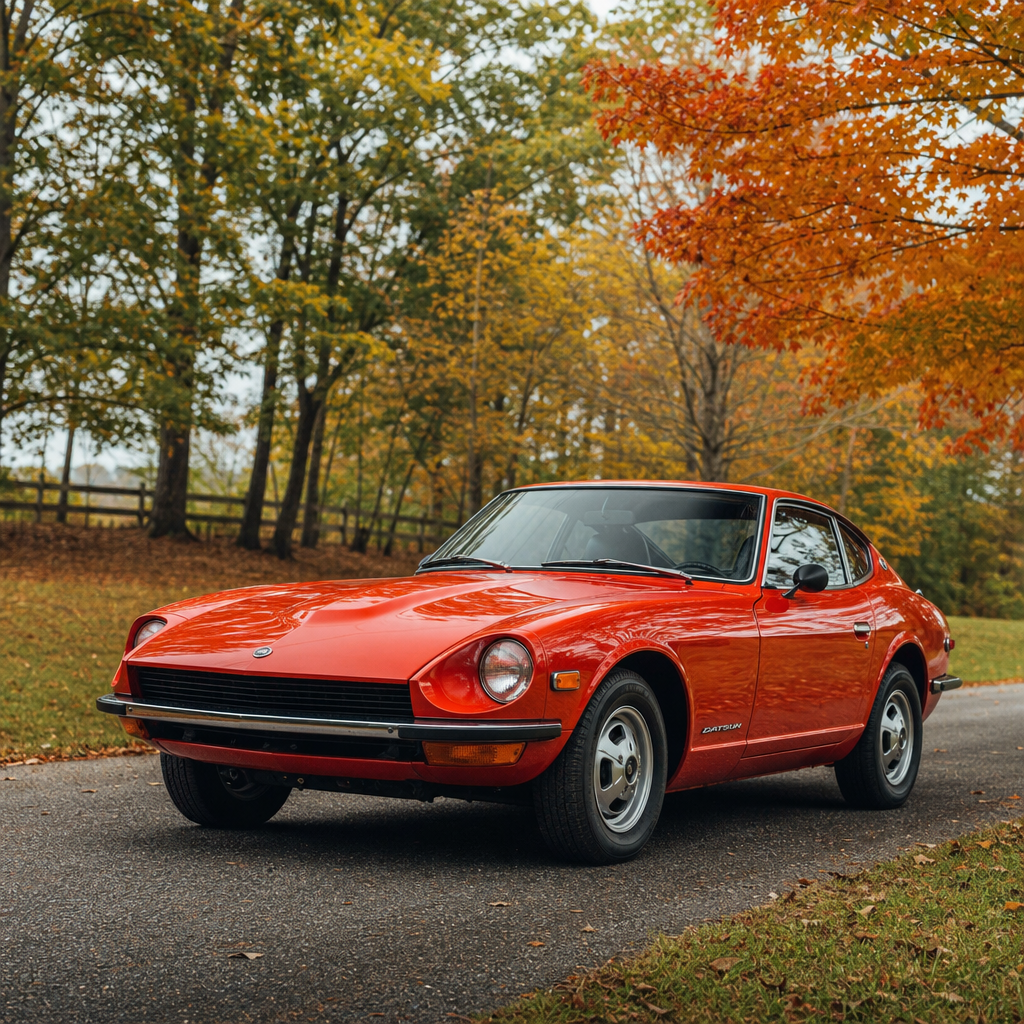
If one car changed the Western perception of Japanese classics more than any other, it was the Datsun 240Z launched for the 1970 model year. In historical terms, the 240Z mattered because it made the sports-car experience accessible without feeling stripped down or disposable. It offered a smooth inline-six, independent rear suspension, handsome long-hood styling, and dependable cold-start behavior at a price that undercut many European rivals. In the United States, where British roadsters and Italian coupes often delivered charm mixed with fragile electrics and expensive maintenance, the Z felt transformative.
I have spoken with collectors who bought 240Zs new and still describe the same revelation: here was a car that looked exotic, drove with real balance, and started every morning. That combination built emotional loyalty, and emotional loyalty is a key driver of classic status. The Z also established a pattern repeated across Japanese collector history. A model wins mainstream admiration first, develops motorsport credibility second, survives in enthusiast communities third, and only later gets broad institutional recognition from concours events, major insurers, and top-tier auction firms.
Other 1970s Japanese models also laid foundations. The first-generation Honda Civic changed small-car expectations worldwide. The Toyota Celica gave buyers sporty style on a practical platform. The Mazda RX series sustained rotary performance identity. Nissan’s Skyline GT-R, though initially a domestic-market legend, built the mythology that later generations would inherit. These were not all immediate classics, but they mattered because they created model lineages. In collector markets, continuity increases historical significance. Buyers do not just purchase a single car; they buy into a story that can be traced across decades.
Motorsport, Technology, and the Growth of Respect
Classic status rarely comes from sales numbers alone. Motorsport achievement, technical innovation, and enthusiast culture all amplify a car’s historical weight. Japanese manufacturers understood this early. Prince and later Nissan used racing to sharpen the Skyline identity. Mazda committed to rotary development with unusual persistence, culminating decades later in the 1991 Le Mans victory by the 787B, a landmark that cast retrospective prestige on earlier rotary road cars. Honda built its reputation through motorcycles, Formula One participation, and sophisticated road-car engineering. Toyota leveraged rallying, endurance racing, and engineering partnerships to support both mainstream and aspirational models.
Technology also mattered. Japanese classics entered the market at a time when buyers increasingly appreciated not just design, but engineering philosophy. The Acura NSX is the clearest example. Introduced in 1990, it combined aluminum construction, variable valve timing, mid-engine balance, and everyday reliability in a package benchmarked against Ferrari. The NSX did not merely become collectible because it was fast. It became collectible because it changed expectations for what a supercar could be. Many now view it as one of the most important performance cars of the late twentieth century.
Likewise, the Nissan GT-R, Mazda RX-7 FD, Toyota Supra Turbo, and Mitsubishi Lancer Evolution gained status through a mix of measurable capability and cultural reach. Twin-turbocharging, all-wheel drive, active aerodynamics, lightweight rotary packaging, and highly tunable inline-six engines gave these cars technical distinction. In classic car history, distinctiveness matters more than simple age. A car enters the canon when it captures a turning point in design, regulation, engineering, or popular imagination.
| Model | Era | Historical significance | Why collectors care now |
|---|---|---|---|
| Toyota 2000GT | 1967–1970 | Japan’s first globally respected grand tourer | Extreme rarity, design pedigree, museum-level importance |
| Datsun 240Z | 1969–1973 | Made reliable sports cars mainstream | Strong enthusiast base, parts support, landmark status |
| Honda/Acura NSX | 1990s | Redefined the supercar with usability and precision | Engineering influence, analog feel, low-production appeal |
| Nissan Skyline GT-R | 1960s, 1990s | Built Japanese performance mythology through racing and technology | Global demand, import eligibility, iconic drivetrain |
| Toyota Supra Mk4 | 1993–2002 | Symbol of the tuner era and Japanese peak performance | 2JZ reputation, media influence, scarce unmodified cars |
The 1980s and 1990s: From Used Cars to Cultural Icons
The largest shift in perception came during the 1980s and 1990s, when Japanese automakers reached extraordinary technical maturity. This was the era of the bubble economy, intensive domestic competition, and performance escalation. Manufacturers built cars that often exceeded what global buyers expected from their price points. The result was a golden age now central to classic car education. Nissan produced sophisticated turbocharged and all-wheel-drive machines. Toyota refined performance coupes while maintaining quality control. Honda turned front-wheel-drive packaging into an art and simultaneously developed the NSX. Mazda balanced lightweight dynamics with rotary identity. Subaru and Mitsubishi transformed homologation-inspired sedans into rally legends.
At first, many of these cars were not treated as future classics. They were modified, raced, crashed, stolen, and daily driven. Insurance companies often valued them like ordinary used vehicles. Traditional collectors dismissed them as too modern, too electronic, or too mass produced. Yet collector history often rewards what an earlier generation overlooks. As attrition reduced supply, originality became scarce. As enthusiasts aged into higher incomes, nostalgia converted to purchasing power. As auction houses such as RM Sotheby’s, Bonhams, and Broad Arrow expanded their catalogs, Japanese halo cars gained formal validation. Once major sales established comparable values, the wider market followed.
Popular media accelerated the process. Video games introduced young enthusiasts worldwide to models never officially sold in their home markets. Manga, anime, tuning magazines, and films embedded cars like the AE86, RX-7, Skyline, and Supra into global culture. This cultural familiarity proved unusually durable. A buyer in Britain, Australia, Germany, or the United States could recognize and desire a Japanese performance car before ever seeing one in person. Few classic segments benefited so strongly from transnational media.
Import Rules, Preservation, and What Makes a Japanese Car a True Classic
Regulation played an unexpectedly large role in turning Japanese cars into collectibles. In the United States, the twenty-five-year import exemption under federal rules created a steady release schedule for previously forbidden Japanese domestic-market models. When cars such as the R32 Skyline GT-R became legally importable, pent-up demand met limited supply. Similar age-based historic registration systems in other countries encouraged preservation by reducing taxes or easing inspection requirements for older vehicles. Suddenly, enthusiasts had a legal and financial framework for collecting cars once considered niche.
Not every old Japanese car is a classic, and the distinction matters. True classic status usually depends on some combination of rarity, historical firsts, motorsport significance, design influence, engineering innovation, and documented cultural impact. Condition and originality matter more now than they did ten years ago. A low-mile, unmodified Integra Type R or RX-7 FD often commands far stronger prices than a heavily tuned example because collectors increasingly want reference cars that show how these machines were built, not just how they were raced on the street. Documentation, matching chassis and engine numbers where applicable, service history, factory paint codes, and period-correct components all support long-term value.
Preservation also introduces tradeoffs. Japanese classics from the 1980s and 1990s often contain plastics, electronic modules, digital displays, and trim materials that are harder to restore than the simpler mechanical parts of earlier classics. Rust remains a serious issue for many models, especially imports from humid or salted-road regions. Parts support varies dramatically. A Datsun Z enjoys strong aftermarket help; a low-volume domestic-market special may require specialist brokers, owner forums, and painstaking fabrication. Buyers entering this field should study production numbers, homologation details, option codes, and known weak points before chasing market trends.
Why Japanese Classics Matter to the Broader History of Classic Cars
Japanese cars matter to classic car history because they changed the standard narrative from one centered on Europe and America to one that reflects the real global development of the automobile. They proved that industrial excellence, motorsport success, and emotional design were not confined to traditional luxury nations. They also expanded the collector base. Many people who felt excluded from older classic circles entered the hobby through Japanese cars because the community was often younger, more technically collaborative, and more willing to value cars with cultural significance beyond concours tradition.
That broader perspective is important for anyone studying the history of classic cars comprehensively. A complete history now includes kei cars, homologation specials, rotary experiments, luxury flagships such as the Toyota Century, and export staples that shaped daily life around the world. Japanese classics remind us that a collector car can be historically important because it transformed manufacturing standards, because it redefined reliability, because it represented a technological leap, or because it became the icon of a generation. If you are building knowledge in this area, use this article as your starting point, then explore model-specific histories, restoration guides, auction trends, and preservation resources to understand how the Japanese classic market continues to mature.
Frequently Asked Questions
Why are Japanese cars now considered true classics rather than just used enthusiast cars?
Japanese cars are now widely recognized as true classics because the market no longer judges automotive significance only by age, country of origin, or old prestige hierarchies. For many years, the classic label was reserved for prewar luxury cars, postwar American icons, and European sports and grand touring machines. Japanese vehicles, even highly respected ones, were often treated as practical, modern alternatives rather than cultural artifacts. That view has changed as collectors, historians, auction houses, insurers, and museums have taken a broader and more accurate view of automotive heritage.
A major reason is historical impact. Japanese manufacturers transformed the global car industry through engineering reliability, motorsport innovation, performance tuning culture, and mass-market quality. Cars such as the Toyota 2000GT, Datsun 240Z, Mazda Cosmo, Mazda RX-7, Acura NSX, Nissan Skyline GT-R, Toyota Supra, and Honda NSX did not merely sell well or gain fan followings; they changed expectations about what performance, technology, and value could look like. As a result, these models now occupy the same historical conversations once dominated by European and American brands.
Another factor is generational change. The collectors who grew up in the 1980s, 1990s, and early 2000s now have the financial means to pursue the cars they admired when they were younger. Nostalgia has become buying power, and that has brought serious attention to Japanese performance cars, luxury sedans, homologation specials, and even standout everyday models. Once collectors begin chasing original, low-mileage, well-documented examples, the classic market usually follows.
The market itself has also validated Japanese classics. Headline auction sales, concours entries, factory heritage programs, and museum exhibitions have all signaled that these cars are no longer niche interests. They are increasingly viewed as historically important machines with lasting collector value. In other words, Japanese cars entered the classic market not because standards were lowered, but because the market finally caught up with their significance.
Which Japanese models helped establish Japan’s place in the classic car market?
Several landmark models helped establish Japan’s legitimacy in the classic space, and they did so in different ways. The Toyota 2000GT is often one of the first cars mentioned because it proved that Japan could produce a world-class grand touring car with beauty, rarity, and engineering sophistication. It was never a mass-market machine, and its scarcity and historical prestige made it one of the earliest Japanese models to gain true blue-chip collector status.
The Datsun 240Z played a different but equally important role. It brought style, performance, and reliability together in a sports car that was accessible and globally influential. It did not rely on exotic pricing or low-volume exclusivity to matter. Instead, it showed that a Japanese sports car could be aspirational, competitive, and beloved across markets. That broad popularity laid the groundwork for later collector appreciation.
Mazda also played a critical part, particularly with rotary-powered cars such as the Cosmo and the RX-7. These vehicles represented technical distinctiveness, motorsport credibility, and a design identity separate from European templates. Honda’s NSX was another watershed model, widely admired for blending supercar performance with usability and advanced engineering. It earned respect not just from buyers, but from competing manufacturers and the global automotive press.
Nissan’s Skyline GT-R range, especially later generations, became central to the rise of modern Japanese classics because of their motorsport pedigree, advanced all-wheel-drive technology, and almost mythic enthusiast reputation. The Toyota Supra, especially the A80 generation, followed a similar trajectory, moving from tuner icon to globally recognized collectible. Beyond those headline names, cars like the Honda S800, Toyota Celica GT-Four, Mitsubishi Lancer Evolution, Subaru Impreza WRX STI, and first-generation Lexus models also contributed to Japan’s classic identity by showing depth, diversity, and lasting influence across multiple segments.
What caused values for Japanese classic cars to rise so dramatically?
The increase in values for Japanese classic cars came from a combination of cultural recognition, limited supply, international demand, and market maturity. At first, many significant Japanese cars remained relatively affordable because the broader collector world did not fully appreciate them. Enthusiasts knew their importance, but institutional recognition lagged behind. Once auction houses, insurers, specialist dealers, and restorers began treating these cars as serious collectibles, prices began to move upward quickly.
Supply is a major part of the story. Many Japanese cars were driven hard, modified extensively, raced, exported, neglected, or simply used up in ordinary daily service. That means truly original, rust-free, low-mileage, and well-preserved examples are much rarer than casual observers assume. As demand increased, the best cars became fiercely contested. This is especially true for limited-production models, homologation specials, and cars with documented provenance.
Globalization also played an enormous role. The internet made it easier for enthusiasts around the world to learn about Japanese domestic market models, compare production figures, track auction prices, and source cars internationally. Import law changes in some countries further opened access to previously unavailable models. As a result, collectors were no longer shopping only within local markets. They were competing globally for a finite number of top-tier examples.
Cultural influence mattered as well. Japanese cars benefited from decades of exposure through motorsport, magazines, tuning culture, video games, film, and online communities. By the time traditional collectors began paying closer attention, a deep emotional market already existed. Once nostalgia combined with scarcity and recognition, price growth followed naturally. In short, values rose dramatically because the market stopped overlooking these cars at the same moment that the best examples became increasingly hard to find.
How have auction houses, insurers, and collectors changed their view of Japanese classics?
The shift has been profound. Auction houses once treated Japanese cars as specialty lots aimed at younger enthusiasts or as interesting outliers among more established European and American offerings. Today, leading auction firms regularly feature important Japanese models in prime catalog positions, and some have delivered headline results that would have seemed unlikely a generation ago. This change reflects not only stronger sale prices, but also confidence that buyers see these cars as historically important and investment-worthy.
Insurers have evolved as well. Classic and collector-car insurance depends heavily on agreed values, rarity, documented condition, usage patterns, and market comparables. As Japanese classics developed stronger price histories and clearer collector demand, insurers became more willing to write serious policies that reflected real market values rather than depreciated used-car assumptions. That matters because insurance recognition often reinforces legitimacy in the collector market. Once a car is appraised, insured, and preserved as a collectible, the market treats it differently.
Collectors themselves have perhaps changed the most. Traditional collectors once tended to prioritize established marques and conventional definitions of prestige. Newer buyers, and many experienced ones, now view significance more broadly. They are willing to collect cars based on innovation, cultural impact, racing pedigree, design excellence, or generational importance. That shift has opened the door to Japanese cars not as novelties, but as essential parts of a serious collection.
This acceptance has also influenced restoration standards, documentation practices, and event eligibility. More Japanese models now appear at concours events, marque gatherings, curated exhibitions, and private collections known for historical quality. Specialists have emerged to restore and authenticate these vehicles properly, which further strengthens buyer confidence. Altogether, auction houses, insurers, and collectors have moved from skepticism to active validation, and that institutional support is one of the clearest signs that Japanese cars have fully entered the classic market.
What should enthusiasts look for when buying a Japanese car as a future or current classic?
Enthusiasts should start with the same fundamentals that matter in any collector market: originality, condition, documentation, rarity, and historical importance. The best Japanese classics are not simply the most famous badge or the most modified example. In many cases, originality carries tremendous weight. Factory paint colors, correct interior materials, matching drivetrains, period-correct components, and unaltered bodywork can significantly affect long-term desirability and value. Cars that escaped heavy modification are often much harder to find than people expect.
Documentation is equally important. Buyers should look for service records, ownership history, import paperwork where relevant, auction listings, factory literature, and evidence of authentic specification. This is especially crucial for Japanese domestic market cars, limited-production variants, and performance models that are frequently cloned or altered. Verification of trim level, chassis code, engine type, and production details can protect a buyer from overpaying for a car that only appears to be rare.
Condition deserves especially close attention because many older Japanese cars suffer from rust, accident repair, or poorly executed restoration work. Rust can be severe even on cars that look presentable in photographs, and replacement panels for some models are difficult or expensive to source. Mechanical inspection also matters, particularly on cars with turbocharged engines, sophisticated drivetrains, four-wheel steering systems, or rotary powerplants. A specialist familiar with the exact model is often essential.
Finally, buyers should think beyond short-term hype. The strongest classics usually combine significance with authenticity. That can mean a halo model like a 2000GT or NSX, but it can also mean an early Celica