JDM culture has transformed the way enthusiasts collect, restore, and drive classic cars, turning Japanese classics from overlooked used imports into some of the most studied and sought-after vehicles in the global collector market. In practical terms, JDM stands for Japanese Domestic Market, meaning cars and parts originally built for sale in Japan, but the culture around it now reaches far beyond that narrow definition. Today, buyers use the phrase to describe a wider ecosystem of Japanese classics, performance engineering, motorsport heritage, tuning philosophy, period-correct parts, and the community that preserves these machines. As someone who has spent years around auctions, restoration shops, and owner forums, I have watched attitudes shift dramatically: models once parked cheaply behind workshops now headline sales catalogs and dominate enthusiast media. That rise matters because Japanese classics sit at the intersection of usability, engineering quality, and historical significance. They represent the postwar industrial ascent of Japan, the influence of endurance racing and rally competition, and a design language that blended efficiency with character. For readers exploring classic car models and brands, Japanese classics are no longer a niche side story. They are a core chapter in collector car history, and understanding their rise explains where the broader classic market has been and where it is going.
The appeal of Japanese classics is built on substance. Brands such as Toyota, Nissan, Mazda, Honda, Mitsubishi, Subaru, Isuzu, and Datsun developed cars that were technically ambitious, reliable under hard use, and often more affordable to own than comparable European alternatives. Some emphasized lightweight balance, like the Toyota Corolla AE86 and first-generation Mazda MX-5’s predecessors in spirit. Others pursued outright speed, including the Nissan Skyline GT-R lineage, Mazda RX-7, and Toyota Supra. Many earned loyalty through motorsport: the Datsun 240Z in rally and SCCA competition, the Skyline GT-R in touring cars, and Subaru and Mitsubishi in the World Rally Championship. Even non-halo models matter. Boxy sedans, kei cars, sport compacts, luxury coupes, and homologation specials all contribute to the depth of the category. This hub article explains how JDM culture rose, which models define Japanese classics, why values have climbed, what buyers should inspect, and how authenticity, import rules, parts support, and restoration standards shape ownership. If you want a clear map of Japanese classics, this is the foundation.
How JDM Culture Moved From Subculture to Mainstream
The modern rise of JDM culture happened in stages. In the 1970s and 1980s, Japanese manufacturers earned credibility by building dependable, efficient cars during a period when global buyers were increasingly sensitive to fuel costs and quality control. By the late 1980s and 1990s, Japan’s domestic market produced performance cars packed with advanced features: turbocharging, electronically controlled all-wheel drive, variable valve timing, four-wheel steering, and high-revving naturally aspirated engines. Enthusiasts in North America, Europe, and Australia began learning about these cars through magazines, racing footage, imported videos, and early internet forums. What was once insider knowledge became visible culture.
The 2000s accelerated that shift. Video games like Gran Turismo introduced a generation of drivers to the Nissan Silvia, Mazda RX-7 Spirit R, Honda NSX, and Mitsubishi Lancer Evolution long before many saw one in person. Film and tuner media pushed Japanese performance aesthetics into popular culture, but the deeper reason interest endured was mechanical credibility. These cars were not style exercises alone. The RB26DETT, 2JZ-GTE, 13B-REW, B16 and K-series Honda engines, and Subaru’s EJ platform all built reputations for serious engineering headroom. As 25-year import rules opened access to more models in the United States, demand increased again. Cars that had been legends on screens became legal to own, register, and preserve.
Mainstream recognition also came from the collector world finally accepting that Japanese cars deserved the same historical respect long given to air-cooled Porsches, muscle cars, and British roadsters. Auction houses including Bring a Trailer, Bonhams, RM Sotheby’s, and Mecum now regularly feature Japanese classics with detailed provenance and restoration notes. Insurance providers such as Hagerty track values and market trends. That institutional attention matters because it signals a mature segment, not a fad. JDM culture rose because the cars earned it through competition history, engineering distinction, and a generation of owners willing to document every production code, trim variation, and factory option.
Defining Japanese Classics: Brands, Eras, and Benchmark Models
Japanese classics cover more than the obvious halo cars. The category generally spans vehicles from the 1960s through the early 2000s, with the strongest collector focus on the 1970s, 1980s, and 1990s. Early landmarks include the Toyota 2000GT, now firmly blue-chip, and the Datsun 240Z, which proved Japan could build a world-class sports car with style, durability, and competitive pricing. The 1970s also gave collectors rotary Mazdas, Celicas, Skylines, and a wide range of compact coupes and sedans that reflected Japan’s fast-evolving domestic industry.
The 1980s introduced many of the cars that still anchor enthusiast culture today. Toyota produced the AE86 Corolla Levin and Sprinter Trueno, a lightweight rear-wheel-drive platform celebrated for balance and grassroots motorsport. Nissan offered the Z31 300ZX and continued evolving the Skyline. Mazda sharpened the RX-7 formula with the FC generation, while Honda defined naturally aspirated precision with models such as the CR-X, Civic Si, and Prelude. This decade also normalized technology that would shape the 1990s peak era: turbo power, electronic controls, and increasingly specialized homologation thinking.
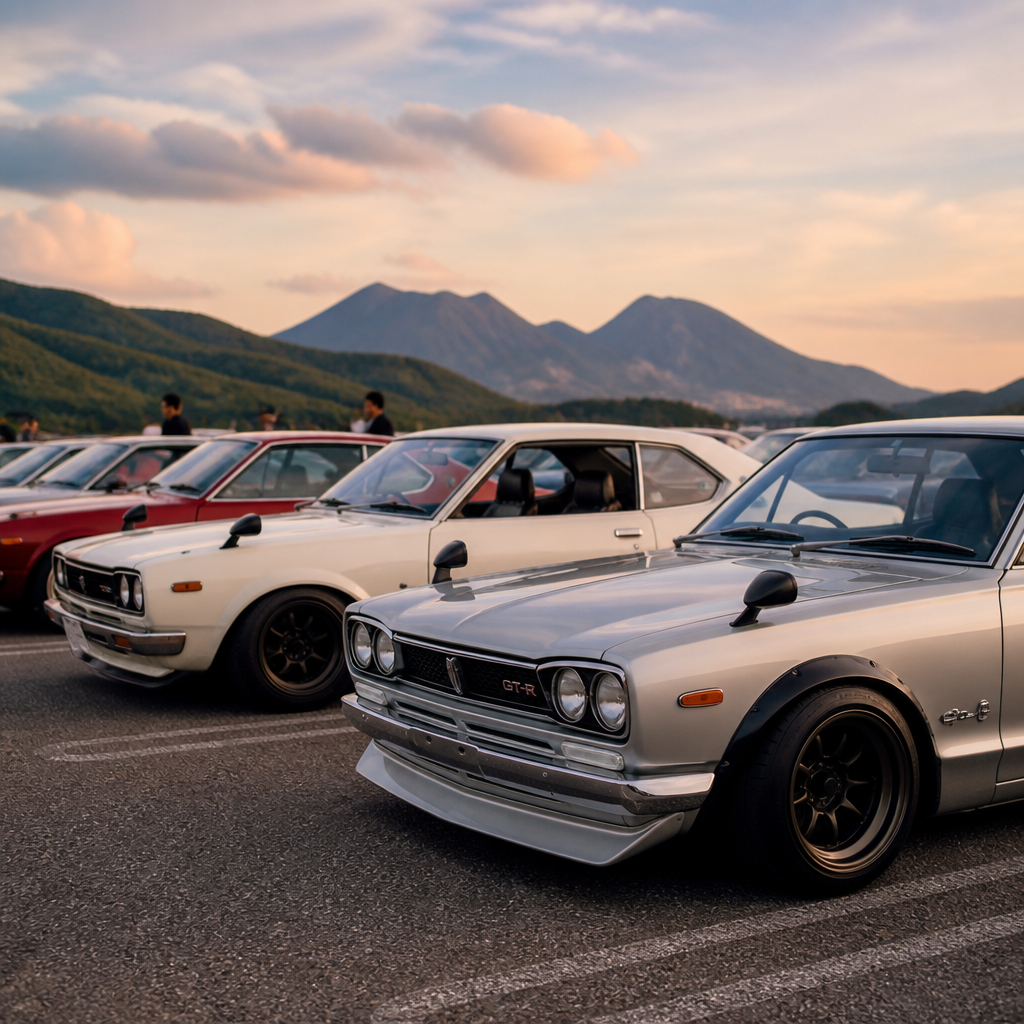
The 1990s remain the center of gravity for many buyers. This is the era of the R32, R33, and R34 Skyline GT-R; the A80 Toyota Supra; the FD Mazda RX-7; the Acura and Honda NSX; the fourth-generation Toyota MR2; the Mitsubishi 3000GT and GTO; the Silvia and 180SX family; the Integra Type R; the EK9 Civic Type R; the Subaru Impreza WRX STI; and the Mitsubishi Lancer Evolution series. Luxury also matters. The Toyota Century, Nissan President, and early Lexus models showed Japan could compete at the top end with refinement and craftsmanship. For a hub page on Japanese classics, the key point is breadth: the story includes sports cars, family sedans, luxury flagships, rally homologation specials, and even kei cars that express Japanese engineering in miniature.
| Model | Brand | Era | Why It Matters |
|---|---|---|---|
| Datsun 240Z | Nissan | 1970s | Global breakthrough sports car combining performance, value, and reliability |
| AE86 Corolla | Toyota | 1980s | Lightweight rear-wheel-drive icon of drifting and grassroots motorsport |
| RX-7 FD | Mazda | 1990s | Rotary engineering flagship with exceptional chassis balance |
| Skyline GT-R R32 | Nissan | 1990s | Touring car legend nicknamed Godzilla for dominant racing success |
| Integra Type R | Honda | 1990s | Benchmark front-wheel-drive driver’s car with meticulous weight reduction |
| Supra A80 | Toyota | 1990s | High-output 2JZ platform with major tuning potential and enduring media presence |
Engineering Philosophy Behind the Appeal
Japanese classics became important because they delivered distinct engineering answers to the same problems faced by European and American manufacturers. Instead of chasing displacement alone, many Japanese brands pursued efficiency, packaging, reliability, and repeatable performance. Honda perfected small-displacement engines that rewarded revs and precise assembly. Toyota mastered robust mass production while still producing enthusiast platforms with strong aftermarket support. Nissan explored sophisticated drivetrains and turbo systems. Mazda committed to the rotary engine despite its complexity because it offered compact packaging and a unique power delivery. Subaru and Mitsubishi refined all-wheel-drive performance into road cars shaped directly by rally competition.
That engineering philosophy is visible in the details owners notice during restoration and use. Factory seam sealer patterns, lightweight aluminum components, multi-link rear suspension, close-ratio gearboxes, and electronically managed torque distribution are not abstract concepts; they determine how these cars feel and why they age differently from domestic peers. The Honda NSX is a perfect example. It used an all-aluminum body and benefited from development input associated with Ayrton Senna, but its importance is broader than celebrity linkage. It showed a supercar could be exotic, usable, and durable. The R32 GT-R’s ATTESA E-TS all-wheel-drive system and Super-HICAS rear steering showed Nissan’s willingness to bring advanced control systems into production performance cars. These features make Japanese classics rewarding for technically minded owners because there is always more to learn beneath the surface.
Motorsport, Media, and the Community Effect
Racing gave Japanese classics legitimacy, and community gave them staying power. The phrase “win on Sunday, sell on Monday” applies here. Nissan’s Skyline GT-R dominance in Group A touring car competition, Mazda’s victory at the 1991 24 Hours of Le Mans with the 787B, Toyota’s rally programs, and Honda’s circuit success all fed showroom credibility. Even when road cars were not direct race replicas, the connection was clear enough for buyers to believe they were buying into a proven engineering culture.
Media then magnified that story. Specialty magazines, Option videos, Best Motoring tests, online forums like GT-R Registry and model-specific communities, and later YouTube channels turned ownership knowledge into shared infrastructure. That mattered because many Japanese classics were imported without full local dealer support. Owners learned to decode chassis numbers, identify Series 1 versus Series 2 changes, source trim clips from Japan, and distinguish authentic NISMO, TRD, Mugen, Mazdaspeed, and TOM’S parts from replicas. In my experience, the community around Japanese classics is unusually documentation-driven. Factory brochures, EPC databases, auction sheets, service manuals, and period road tests are treated almost like archival records. This culture of verification has helped protect values and raise standards.
Why Values Have Risen and What Drives Demand
Japanese classic values have climbed because supply is finite, nostalgia is powerful, and global access has improved. Many sought-after models were produced in limited numbers, modified heavily, raced, neglected, or exported in small volumes. Clean, unmodified examples are simply hard to find. At the same time, the generation that grew up admiring these cars now has more disposable income. This pattern mirrors earlier waves in the muscle car and air-cooled Porsche markets, where childhood aspiration matured into collector demand.
Import eligibility has been one of the clearest triggers. In the United States, the 25-year exemption under federal rules allows certain nonconforming vehicles to be imported once they reach the threshold age, subject to state registration requirements and customs compliance. When a desirable model crosses that line, awareness and prices often jump. The R34 Skyline GT-R is the obvious example, but it is not alone. Special-edition Evos, Type Rs, kei sports cars, and obscure homologation variants all attract attention as they become easier to register legally.
Condition, originality, and documentation drive the biggest premiums. A verified low-mileage RX-7 with original paint, matching VIN tags, stock airbox, factory wheels, and complete maintenance records will outperform a heavily modified car in the collector market, even if the modified car makes more power. That does not mean modified cars lack value; many period-correct builds are historically interesting. But the market consistently rewards authenticity, especially when import paperwork, auction history, and service evidence support the story.
Buying, Restoring, and Owning Japanese Classics Wisely
Buying a Japanese classic starts with research, not emotion. The first question is what kind of ownership you want: concours originality, weekend driving, period-correct tuning, or long-term investment. That decision affects everything from budget to parts sourcing. Mechanical inspections should focus on known weak points by model. On an FD RX-7, cooling health, vacuum line condition, compression, and evidence of proper rotary maintenance are critical. On a Skyline GT-R, check rust, drivetrain noise, turbo condition, and signs of hard tuning. On Hondas, inspect for theft recovery history, rust in hidden seams, and poor-quality engine swaps. On 1970s Z cars, corrosion can consume floors, rails, hatch areas, and suspension pickup points.
Rust remains the most expensive threat across the category. Japan’s climate, coastal storage, and winter road use in export markets can all leave serious corrosion hidden beneath underseal or recent paint. Always inspect the underside, inner arches, jacking points, and trunk wells. Documentation matters just as much. Verify chassis codes, engine numbers where applicable, import forms, title status, and maintenance records. If a seller claims a limited trim or special edition, confirm it against factory references and owner registry data.
Restoration standards have improved significantly. Reproduction weatherstripping, interior fabrics, decals, and trim pieces are more available than they were a decade ago, though support varies by brand and model. Nissan Heritage, Toyota Gazoo Racing heritage initiatives, Mazda’s restoration support for the first-generation MX-5, and specialist suppliers worldwide have made proper work easier. Still, some items remain difficult: digital dashboards, climate-control modules, OEM wheels, and model-specific plastics often require patient sourcing or professional refurbishment. The best ownership strategy is to buy the most complete, honest car you can afford, then preserve it carefully rather than rescuing a cheap but incomplete example.
The Future of Japanese Classics as a Collector Category
Japanese classics are now established, but the category is still evolving. Values for halo cars may fluctuate, yet the broader trend is durable because enthusiasm is no longer limited to a few famous models. Interest is spreading into luxury sedans, wagons, homologation oddities, kei performance cars, and early hybrids that mark technical turning points. Collectors are also becoming more selective. Originality, provenance, and high-quality restoration will matter even more as weaker examples are filtered out.
For anyone building knowledge in classic car models and brands, Japanese classics deserve sustained attention because they combine history you can trace, engineering you can understand, and communities that actively preserve expertise. Start with the landmark cars, then follow the links outward to lesser-known coupes, sedans, and specialty trims that complete the picture. Study production codes, motorsport roots, ownership costs, and authenticity markers. The rise of JDM culture in classic cars is not just about popularity. It is about recognition. These vehicles have earned a permanent place in collector history, and the best time to learn them well is now.
Frequently Asked Questions
What does JDM mean, and why has the term become so important in classic car culture?
JDM stands for Japanese Domestic Market, which originally referred to vehicles, parts, and specifications built specifically for sale in Japan. In the strictest sense, a JDM car is not just a Japanese-brand vehicle, but one that was actually intended for the Japanese market rather than export. That distinction matters because many Japan-market classics featured different engines, trim levels, technology, and performance tuning than their counterparts sold in North America, Europe, or Australia. Over time, though, the term has grown beyond a technical classification and now describes an entire enthusiast culture centered around Japanese classics, period-correct modifications, rare factory options, and the history behind these cars.
Its importance in classic car culture comes from the way it reshaped collecting. For years, many Japanese vehicles were dismissed as disposable used cars rather than future collectibles. JDM culture challenged that idea by spotlighting craftsmanship, engineering innovation, motorsport heritage, and the unique personality of models like the Nissan Skyline GT-R, Toyota Supra, Mazda RX-7, Honda NSX, and numerous lesser-known sedans, coupes, and kei cars. Enthusiasts began documenting production differences, decoding chassis and option codes, sourcing original literature, and preserving cars with the same seriousness once reserved mainly for European exotics or American muscle. As a result, JDM is now both a market category and a historical lens through which collectors evaluate authenticity, rarity, and cultural significance.
Why have Japanese classic cars become so desirable to collectors around the world?
Japanese classic cars have become highly desirable because they offer a rare combination of usability, performance, engineering depth, and cultural cachet. Many of these cars were built during a period when Japanese manufacturers were pushing hard to prove themselves through racing, technology, and design innovation. That produced vehicles with advanced engines, lightweight construction, sophisticated drivetrains, and a driver-focused feel that still holds up today. Models once seen as affordable enthusiast cars are now being appreciated as milestones in automotive history, especially as collectors recognize how influential Japan was in shaping performance culture from the 1980s through the early 2000s.
Another major reason is accessibility of passion. Compared with some traditional classic segments, Japanese classics often feel more approachable. They were featured prominently in motorsports, magazines, video games, film, and tuning culture, which helped create deep emotional connections for an entire generation of buyers. That nostalgia now has real market influence. Collectors are not just purchasing a machine; they are buying into a story tied to street racing lore, track performance, and an era when Japanese automakers were experimenting boldly. Add in limited-production variants, import restrictions that created anticipation, and a growing appreciation for originality, and it becomes clear why demand has increased so sharply. What was once niche is now firmly established in the mainstream collector market.
How has JDM culture changed the way people restore and preserve classic Japanese cars?
JDM culture has had a profound effect on restoration standards by encouraging enthusiasts to pay close attention to specification, provenance, and period correctness. Earlier restorations of Japanese cars were often casual, with little emphasis on original-market details or historically accurate components. Today, serious collectors frequently research factory brochures, chassis tags, trim codes, dealer accessories, and market-specific equipment to determine exactly how a car would have appeared when new in Japan. That means restorations increasingly focus on authentic paint colors, correct wheels, interior materials, badging, and mechanical setups rather than simply making a car look clean or perform better.
At the same time, JDM culture has also legitimized preservation and tasteful modification as parallel approaches. Because so much of Japanese car history is linked to tuning culture, some owners aim to preserve a car as a period-correct street or track build using era-appropriate parts from trusted Japanese brands. Others prioritize completely stock restoration, especially for rare homologation specials or low-production trims. In both cases, the overall standard has risen. Documentation now matters more, original parts command stronger prices, and buyers often value a car’s story nearly as much as its condition. This shift has elevated Japanese classics from hobbyist projects to historically significant vehicles worthy of museum-grade care and serious archival research.
Are all Japanese classic cars considered JDM, or is there a difference between Japanese classics and true JDM vehicles?
There is definitely a difference. Not every Japanese classic is technically a JDM vehicle. A Japanese classic simply means a classic car built by a Japanese manufacturer, while a true JDM car was produced specifically for the domestic Japanese market. For example, a Nissan 300ZX sold new in the United States is a Japanese classic, but it is not a JDM car in the strict sense. A Nissan Fairlady Z built to Japanese-market specifications, on the other hand, would qualify as JDM. That distinction can affect value, collectibility, and enthusiast interest because Japan-market versions often included features or performance options unavailable elsewhere.
That said, in everyday enthusiast language, the term JDM is often used more broadly to describe the style, culture, and automotive ecosystem surrounding Japanese performance and collector cars. People may refer to Japanese wheels, tuning parts, aesthetics, and even export-market cars as part of JDM culture if they reflect that scene. For collectors, the key is understanding the context. If you are discussing authenticity, import history, or investment-grade originality, the technical definition matters. If you are talking about the broader influence of Japanese car enthusiasm, the cultural definition is often what people mean. Knowing the difference helps buyers avoid confusion and make smarter decisions about restoration goals, sourcing parts, and evaluating market value.
What should new collectors know before buying a classic car associated with JDM culture?
New collectors should start by understanding that popularity does not automatically equal quality or authenticity. The rise of JDM culture has increased values for many Japanese classics, but it has also created a market where hype, incomplete histories, and poorly executed modifications can complicate purchases. A buyer should research the exact model, chassis code, engine family, trim level, and market origin before making an offer. It is especially important to verify whether a car is a true Japanese-market example, a domestic-market equivalent from another country, or a replica built to resemble a more valuable version. Maintenance records, import paperwork, auction sheets, VIN or chassis verification, and evidence of rust repair all deserve close attention.
It is also wise to think beyond the purchase price. Parts availability varies widely, and while some models enjoy excellent aftermarket support, others rely on hard-to-find factory components or specialized import channels. Buyers should also decide early whether they want a stock collector car, a usable driver, or a period-style modified build, because that choice affects everything from insurance and maintenance to long-term value. The best purchases usually come from patience, not urgency. A well-documented, honest car with a clear identity is almost always a better investment than a flashy one with uncertain history. In a market shaped by passion and nostalgia, discipline still matters, and informed buyers tend to enjoy these cars more while protecting their value over time.