Concept cars are the auto industry’s wildest thought experiments, rolling prototypes built to test styling, technology, and public reaction long before any production model is approved. In the world of classic car models and brands, concept and rare cars occupy a special place because they reveal what designers, engineers, and executives believed the future could look like at a given moment. Some concepts preview practical ideas that later become mainstream, such as aerodynamic bodies, digital dashboards, or gullwing doors. Others are gloriously strange dead ends, remembered precisely because they ignored convention and embraced spectacle.
The most bizarre concept cars in history matter for more than novelty. They document changing cultural priorities, from Jet Age optimism in the 1950s to wedge-shaped futurism in the 1970s and sustainability themes in the 2000s. I have spent years reviewing historic auto show archives, factory design studies, and coachbuilt one-offs, and the same pattern appears repeatedly: the strangest cars often tell us the most about their era. They expose how brands tried to stand apart, how safety and emissions rules reshaped imagination, and how experimental packaging sometimes solved real problems even when the styling looked absurd.
For readers exploring concept and rare cars as a subtopic within classic car models and brands, this hub article maps the territory clearly. It defines what makes a concept car different from a prototype, a show car, and a limited-production halo model. A concept car is usually created to explore a design language, engineering layout, or market direction rather than to enter immediate volume production. A rare car may be a one-off concept, a coachbuilt special, a homologation oddity, or an ultra-low-volume experimental model. The overlap is significant, but not every rare car is a concept, and not every concept survives beyond the auto show circuit.
Bizarre concept cars sit at the far edge of that spectrum. They may use unusual wheel arrangements, aircraft-inspired canopies, modular cabins, swiveling seats, asymmetrical doors, transparent roofs, joystick controls, turbine engines, or body shapes that challenge any standard definition of a car. What makes them compelling is not mere weirdness. The best examples combine visual shock with a serious design brief. GM’s Firebird gas turbine concepts explored alternative propulsion. Lancia’s Stratos Zero compressed the supercar into an extreme wedge to rethink aerodynamics and access. The Stout Scarab reimagined interior space decades before the minivan became normal.
What Makes a Concept Car Truly Bizarre
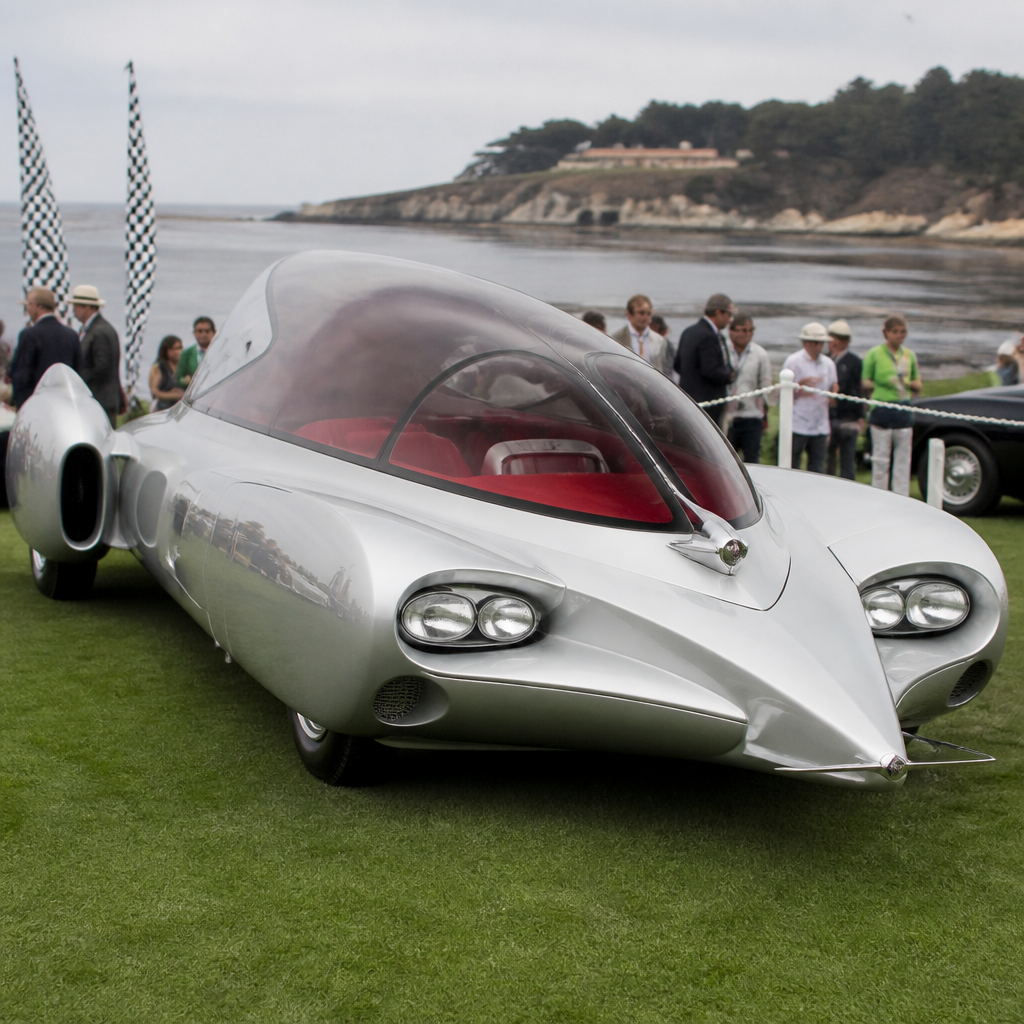
A bizarre concept car usually breaks one or more expectations at the same time: appearance, packaging, propulsion, materials, or user interface. In practice, the truly unforgettable cars do all five. Designers have long known that auto shows reward first impressions, so exaggerated forms are common, but lasting significance comes from a coherent idea. The 1956 Buick Centurion looked dramatic with its bubble top, yet it also introduced a rearview camera concept at a time when production cars still relied entirely on mirrors. That pairing of fantasy and function is the hallmark of a meaningful oddity.
Another marker is whether the car challenged assumptions that consumers did not yet know they held. The 1935 Stout Scarab looked ungainly compared with long-hood sedans of its day, but its rear engine, flat floor, movable seating, and lounge-like cabin anticipated modern people carriers. Likewise, the 1986 Italdesign Machimoto was bizarre because it treated a car like a fully enclosed motorcycle, using tandem-inspired seating and a visor-like canopy. Strange proportions often emerge when designers optimize for a different use case than the rest of the market.
Rarity intensifies the mystique. Many bizarre concepts were built as single examples, appeared briefly on motor show stands, then vanished into storage, private collections, or destruction. Because they were not constrained by dealership serviceability, crash legislation, or tooling budgets, they could be more radical than production-bound studies. That freedom explains why hubcaps disappeared, instrument panels migrated into pods, and doors became sliding, gullwing, or nonexistent. When you study these vehicles across decades, the bizarre details stop looking random and start reading like design arguments made in steel, fiberglass, plexiglass, and aluminum.
Landmark Bizarre Concept Cars and Why They Endure
Several concept cars define the category because they are both visually outrageous and historically influential. The Stout Scarab, introduced in the 1930s, remains one of the earliest and most important examples. Built by aviation engineer William Bushnell Stout, it had a beetle-like profile, rear-mounted Ford V8, and highly flexible interior. It looked alien beside contemporary Packards and Cadillacs, yet its packaging logic would later surface in vans, MPVs, and modern cabin-first electric concepts. In collector circles, the Scarab is discussed less as a curiosity and more as a lost branch of mainstream automotive evolution.
General Motors pushed the genre further with the Firebird I, II, and III in the 1950s. These were not Pontiac Firebirds but gas turbine dream machines shaped by aircraft thinking. Tail fins, central driving positions, twin bubble canopies, and dramatic intakes made them look ready for a runway rather than a highway. The engineering was equally ambitious. Turbine power promised smooth operation and multi-fuel capability, though heat, cost, throttle response, and efficiency under real-world conditions prevented mass adoption. Even so, the Firebird series set a template for concept cars as corporate theater backed by genuine research.
Europe answered with some of the boldest forms ever created. Bertone’s 1970 Lancia Stratos Zero was astonishingly low, about 33 inches tall, with a razor wedge profile that looked more spacecraft than sports car. Entry was through the hinged windshield because conventional doors were almost irrelevant at that height. The Zero did not become a production car in that form, but it directly influenced the later Lancia Stratos HF and helped define 1970s wedge design. In design studios, it is still cited as proof that proportion alone can make a concept unforgettable.
One of the most charmingly odd American examples is the 1959 Cadillac Cyclone. Styled by Harley Earl’s team, it featured a clear bubble canopy, missile-like cones at the front, and radar-based collision warning sensors housed in the nose. The styling reflected Cold War fascination with rockets, but the sensors were serious. They demonstrated how safety technology could be dramatized for the public decades before driver assistance systems became common. The car looked flamboyant, yet its underlying message about obstacle detection was unusually prescient.
| Concept car | Year | Bizarre feature | Lasting significance |
|---|---|---|---|
| Stout Scarab | 1935 | Rear engine and lounge cabin | Previewed MPV packaging |
| GM Firebird I | 1953 | Gas turbine and fighter-jet body | Showed alternative propulsion research |
| Cadillac Cyclone | 1959 | Bubble top and radar sensors | Early vision of collision warning |
| Lancia Stratos Zero | 1970 | Ultra-low wedge with windshield entry | Defined radical 1970s styling |
| Italdesign Machimoto | 1986 | Car-motorcycle hybrid layout | Explored niche mobility concepts |
Design Themes Behind the Weirdest Show Cars
When bizarre concept cars are compared across eras, clear themes emerge. The first is aerospace influence. In the 1940s and 1950s, jet aircraft, rockets, and radar transformed industrial design. Tailfins, canopies, afterburner-like taillights, and turbine experiments migrated directly into car studios. Harley Earl at GM understood that consumers associated aerospace aesthetics with progress, so dramatic show cars became emotional proof that a brand was future-facing. Even when the engineering remained impractical, the styling helped shape buyer expectations for mainstream models.
The second theme is packaging rebellion. Some concepts look odd because they place passengers, engine, luggage, and controls in an unfamiliar relationship. The Scarab, the Citroën Karin, and later mono-volume studies all challenged the three-box formula of hood, cabin, and trunk. The 1980 Citroën Karin, for example, used a pyramid-like roofline with a single central driver’s seat ahead of two rear passengers. It was theatrical, but it also explored visibility, width management, and the social choreography of the cabin. Bizarre packaging often becomes normal once technology catches up.
A third theme is interface experimentation. Before touchscreens became routine, concept cars tried everything from joystick steering to pod-mounted gauges and movable dashboards. Some ideas were plainly unworkable. Others foreshadowed genuine trends. Digital instrumentation appeared in concepts years before production cars of the 1980s embraced it. Camera systems, voice prompts, and adaptive seating often debuted in speculative forms. In my experience reviewing these cars, the strangest interfaces are often where designers reveal the most honest thinking about the future, because controls can change faster than body architecture.
Concept Cars That Predicted Real Innovation
Not every bizarre concept was fantasy. Many introduced technologies that now define modern driving. The Buick Centurion’s rearview camera concept from 1956 is a classic example. Instead of a traditional rear mirror, a camera fed an image to a screen in the dashboard. The hardware of the era was too bulky and expensive for production, but the principle was sound. Today, rearview cameras are mandatory on new passenger vehicles in the United States, demonstrating how a flamboyant show car can forecast a safety standard by decades.
Another case is the survival of aerodynamic thinking. Extreme wedge concepts from Bertone, Italdesign, and Pininfarina often looked excessive, yet they pushed manufacturers to reduce drag, lower frontal area, and integrate bumpers and lighting more cleanly. The production cars that followed were usually toned down, but the wind tunnel lessons remained. You can trace a line from dramatic concept wedges to efficient hatchbacks, sports coupes, and electric vehicles that prioritize airflow management for range and stability. What seemed bizarre on a rotating turntable often became rational engineering on the road.
Interior flexibility is another concept-to-production bridge. The Scarab treated seating as furniture, not fixed structure. Later show cars explored swivel seats, folding worktables, flat floors, and modular storage. Those ideas appeared in Chrysler minivans, Renault Espace variants, and today’s EV skateboard platforms, where battery placement frees cabin design from traditional drivetrain packaging. Rare concept cars matter because they expose this timeline clearly: first a strange one-off, then a toned-down niche vehicle, and finally a mass-market feature everyone accepts as obvious.
Why So Many Bizarre Concepts Never Reached Production
The simplest reason is regulation. Crash safety, pedestrian protection, lighting height, rollover strength, and emissions compliance can kill a daring idea quickly. Bubble canopies look spectacular, but they create heat, glare, structural challenges, and emergency egress concerns. Ultra-low wedges may sacrifice visibility, suspension travel, and bumper compatibility. Central driving positions can complicate homologation for multiple markets. Once a concept leaves the show stand and enters engineering review, the number of practical compromises grows fast.
Cost is equally decisive. Hand-formed bodies, exotic materials, custom glass, turbine engines, and bespoke interiors are manageable for one vehicle but not for a profitable production run. Tooling for complex panels can cost millions, and service networks dislike unusual components that require specialized repair training. Automakers use concept cars partly because they are cheaper than launching a doomed full-scale model line. A one-off can test reaction, influence brand perception, and generate press without requiring factories, supply chains, and warranty reserves.
Consumer behavior also matters. People admire daring design at shows yet buy conservative transportation with proven reliability, comfortable access, and predictable resale value. I have seen this gap repeatedly in the historical record. Cars praised by journalists for bravery often scared ordinary buyers once parking, weather, maintenance, and family use entered the conversation. The bizarre concept survives because it did not have to satisfy every daily requirement. Its job was to expand possibility, not to handle school runs, potholes, or dealer service appointments gracefully.
Collecting, Preserving, and Studying Rare Concept Cars Today
For historians and collectors, concept and rare cars present unusual challenges. Provenance matters more than with ordinary classics because one-offs are often modified, repainted, restored inaccurately, or separated from factory documentation. Museums such as the Petersen Automotive Museum, the Mullin collection during its active years, and manufacturer heritage centers have played a major role in preserving these vehicles with contextual records. When a concept survives with design sketches, engineering notes, and period photographs, its historical value rises sharply because interpretation becomes more reliable.
Restoration is especially complicated. Many concepts were built from fragile materials, nonstandard hardware, and incomplete mechanical systems never intended for years of operation. Replacement glass, trim, switchgear, and interior fabrics may not exist. Conservators must decide whether to stabilize the vehicle as an artifact or restore it to operating condition, which can require sympathetic substitutions. That decision affects authenticity. A running concept attracts crowds, but an over-restored one can erase evidence of how the car was originally constructed for the show circuit.
For enthusiasts using this page as a hub within concept and rare cars, the key takeaway is simple: bizarre concept cars are not sideshows to automotive history. They are compressed case studies in design ambition, engineering risk, and cultural change. They explain where familiar features came from, why some brilliant ideas failed, and how brands built identity through imagination. Explore individual models, compare eras, and follow the lineage from strange prototype to accepted norm. The most bizarre concept cars in history reward that deeper look, because today’s curiosity can become tomorrow’s classic reference point.
Frequently Asked Questions
What makes a concept car “bizarre” instead of simply futuristic?
A bizarre concept car goes beyond looking modern or advanced. It usually combines radical styling, unusual proportions, experimental engineering, or strange features that feel disconnected from what drivers expect a car to be. In many cases, these vehicles were designed to provoke a reaction rather than prepare for immediate production. That could mean bubble canopies instead of conventional roofs, joystick steering instead of a wheel, multi-directional seating layouts, dramatic tailfins, transparent body sections, or interiors that looked more like science-fiction lounges than practical cabins.
What often makes these cars so memorable is context. A design that may seem normal today could have looked almost unbelievable when it debuted decades ago. Automakers used concept cars to showcase bold ideas at world’s fairs, motor shows, and press events, and some deliberately pushed design to extremes to signal innovation. In that sense, “bizarre” does not mean pointless. It often means a car represented a dramatic break from established norms in styling, safety, aerodynamics, materials, or driver experience.
Many of the most bizarre concept cars also reflected cultural moods of their eras. In the jet age, designers borrowed cues from aircraft and rockets. During the space race, concepts leaned into futuristic pods, domes, and control-panel dashboards. Later, digital-era prototypes imagined electronic interfaces long before they were practical. So while these cars can appear outrageous, they are often valuable historical documents that reveal how the industry once imagined the future.
Why do automakers build bizarre concept cars if they never intend to sell them?
Automakers build unusual concept cars for several strategic reasons, even when there is little or no chance of direct production. One major purpose is experimentation. A concept gives designers and engineers freedom to test ideas without the cost, regulations, and compromises that come with a mass-market vehicle. That freedom allows companies to explore new body shapes, interior layouts, materials, lighting systems, and mechanical technologies in a highly visible format.
Another reason is brand positioning. A truly unforgettable concept can generate headlines, attract crowds at auto shows, and create an image of technological leadership. Even if the exact car never reaches dealerships, it can influence how the public perceives the manufacturer. A brand known for conservative sedans can suddenly appear daring and visionary by unveiling a wild prototype. That kind of attention is especially useful when a company wants to redefine itself or signal a new design direction.
Concept cars also function as research tools. Public and media reactions help automakers gauge which ideas inspire excitement and which ones feel too extreme. Designers watch how people respond to everything from door designs to dashboard controls. The result may not be a production version of the same car, but fragments of the concept can carry forward into future models. In that way, bizarre concept cars act as rolling laboratories, publicity machines, and forecasting devices all at once.
Do any bizarre concept car ideas eventually make it into production vehicles?
Yes, and that is one of the most fascinating parts of concept car history. While the wildest concept cars often look too impractical to survive real-world engineering and regulation, many of their underlying ideas eventually become mainstream. Features that once seemed outrageous have later appeared, in refined form, on everyday vehicles. Aerodynamic shaping, wraparound windshields, digital instrument displays, advanced driver-assistance systems, lightweight composite materials, and futuristic lighting concepts all spent time in the concept stage before becoming more common.
The key is that production cars rarely adopt the full theatrical package. Instead, automakers extract the useful parts. A concept might debut with an extreme low-slung body and a dramatic canopy roof, but what reaches production may be a more efficient roofline, better visibility, or a new approach to cabin packaging. Likewise, a strange digital dashboard shown decades ago may evolve into the touchscreens, driver displays, and software-based controls that are now normal in modern vehicles.
This is why bizarre concepts matter historically. They are not merely oddities for collectors and enthusiasts to admire. They often reveal the first public appearance of ideas that the market, technology, and regulations were not yet ready to support. Looking back, some of the most bizarre concept cars seem less ridiculous and more prophetic, especially when their once-unrealistic features become accepted parts of automotive design.
Which eras produced the most bizarre concept cars in history?
Several periods stand out, but the 1950s, 1960s, and 1970s are especially famous for producing the strangest and most theatrical concept cars. In the 1950s, the postwar boom and fascination with aviation inspired dramatic fins, chrome-heavy bodies, cockpit-style interiors, and dream-car proportions. Manufacturers were eager to showcase optimism, luxury, and technological progress, and concept cars became symbols of that ambition.
The 1960s pushed things even further, especially under the influence of the space race and changing industrial design trends. This era produced some of the most unconventional shapes ever seen on four wheels, including wedge profiles, bubble tops, modular cabins, and experimental powertrains. Cars from this period often looked like rolling visions of tomorrow, with little concern for practicality. They were intended to captivate audiences and redefine what a car could look like.
The 1970s also contributed its share of bizarre concepts, but with a different flavor. Designers explored sharper geometries, integrated technology, and new responses to concerns about fuel economy, safety, and urban mobility. Later decades continued the tradition, especially as digital electronics and alternative propulsion opened up fresh possibilities. Still, the mid-20th century remains the high-water mark for extravagant concept-car imagination because styling studios were often encouraged to dream big in public and without the production constraints that dominate today.
Why are bizarre concept cars important to classic car enthusiasts and automotive history?
Bizarre concept cars hold a special place in automotive history because they capture the imagination of an industry at a specific moment in time. Production cars show what companies were able to build and sell. Concept cars show what they wanted to explore, advertise, or believe in. For enthusiasts of classic car models and brands, these vehicles provide a deeper understanding of a manufacturer’s design language, engineering priorities, and long-term vision.
They are also important because they connect dream and reality. A rare production model may make more sense once you see the concept that inspired it. A famous styling cue, dashboard layout, or body proportion often has roots in an earlier prototype. Studying bizarre concepts can help explain how automotive trends developed, why some innovations succeeded, and why others disappeared. In many cases, these cars reveal paths the industry almost took but ultimately abandoned.
For collectors, historians, and fans, the appeal is not only aesthetic. These vehicles embody experimentation, risk-taking, and the cultural optimism of their eras. Even when they failed as practical transportation, they succeeded as ideas. They remind us that the auto industry has always balanced commerce with imagination, and that some of the most unusual machines ever created have had an outsized influence on how future cars were designed, marketed, and understood.