The history of Porsche classic cars is the story of how a small German sports car maker turned engineering discipline, racing success, and unmistakable design into one of the most respected legacies in the European classics world. In the collector market, a Porsche classic car usually refers to air-cooled road and race models built from the late 1940s through the 1990s, though many enthusiasts also include important transaxle cars and early water-cooled performance models. As someone who has spent years around restoration shops, auction catalogs, and owner registries, I have seen one consistent pattern: buyers may enter the hobby for the badge, but they stay because Porsche classics deliver a rare blend of drivability, parts support, and historical depth.
That combination matters because European classics can be intimidating. Some marques offer elegance but fragile mechanicals. Others have racing pedigree but thin parts availability. Porsche sits in a useful middle ground. The company’s best-known classic models, especially the 356 and 911, are deeply collectible, yet they were engineered to be used. Factory records, chassis documentation, and specialist networks are unusually strong. Clubs such as Porsche Club of America and the Porsche Club Great Britain have helped preserve knowledge at scale, while Porsche Classic itself supports older vehicles with heritage parts, technical literature, and restoration guidance. For anyone exploring European classics broadly, Porsche is not a side note. It is a central reference point.
Understanding Porsche history also helps explain larger trends across European classic cars. Ferdinand Porsche’s prewar engineering work, Ferry Porsche’s postwar entrepreneurship, the rise of lightweight sports cars, the importance of homologation, and the shift from air cooling to modern performance engineering all show up clearly in the brand’s timeline. Porsche’s classic era is also rich with cautionary lessons. Originality affects value dramatically. Matching numbers matter, but condition and documented restoration often matter just as much. Rare does not always mean desirable, and the most expensive model is not always the best first classic to own. Those realities make a broad historical guide useful, especially for readers using this page as a hub for deeper research into European classics.
Origins: From Gmünd to the 356
Porsche’s classic story begins in the difficult years after World War II. Ferry Porsche, son of Ferdinand Porsche, wanted to build a sports car that reflected the engineering principles his father valued: low weight, efficiency, and intelligent packaging. In 1948, the first Porsche-badged car, the 356 “No. 1” Roadster, appeared in Gmünd, Austria. It used a mid-engine layout in prototype form, but the production 356 that followed adopted a rear-engine design using many Volkswagen-derived components. That practical choice was crucial. It allowed Porsche to get cars on the road quickly while refining its own identity.
Early Gmünd-built 356 models were produced in small numbers with aluminum bodies and are now among the most valuable early Porsches. When production moved to Stuttgart in 1950, steel-bodied 356 coupes and cabriolets became the core of the business. The 356 evolved through several major phases: 356 “pre-A,” 356 A, 356 B, and 356 C. Across these generations, Porsche improved braking, steering, engine output, synchronization, and weather sealing without abandoning the model’s compact proportions. Four-cylinder flat engines grew from modest power levels to stronger Super and Carrera variants, while body suppliers such as Reutter helped establish the clean shape now recognized worldwide.
The 356 matters beyond collectibility because it established Porsche’s formula. It was light, communicative, and surprisingly competitive in motorsport. Privateers raced 356s successfully in events ranging from local hill climbs to international endurance competitions. The Carrera versions, powered by the sophisticated four-cam Type 547 engine developed under Ernst Fuhrmann, showed that Porsche was not merely assembling tuned Volkswagen derivatives. It was becoming a serious engineering company. For collectors today, the 356 remains one of the most approachable blue-chip European classics, combining strong club support with excellent parts availability and a driving experience that still feels precise rather than ceremonial.
The 911 Redefined the Sports Car
If the 356 created Porsche’s identity, the 911 made it permanent. Introduced in 1963 and reaching customers in 1964, the 911 was originally conceived as a larger, more powerful successor to the 356. Designed by Ferdinand Alexander “Butzi” Porsche, it carried over the rear-engine concept but introduced a six-cylinder air-cooled boxer engine, a longer wheelbase, and a shape that became one of the most durable designs in automotive history. The earliest cars, later nicknamed the 901 before Peugeot objected to the name, are important because they established the visual and mechanical language every later 911 would refine.
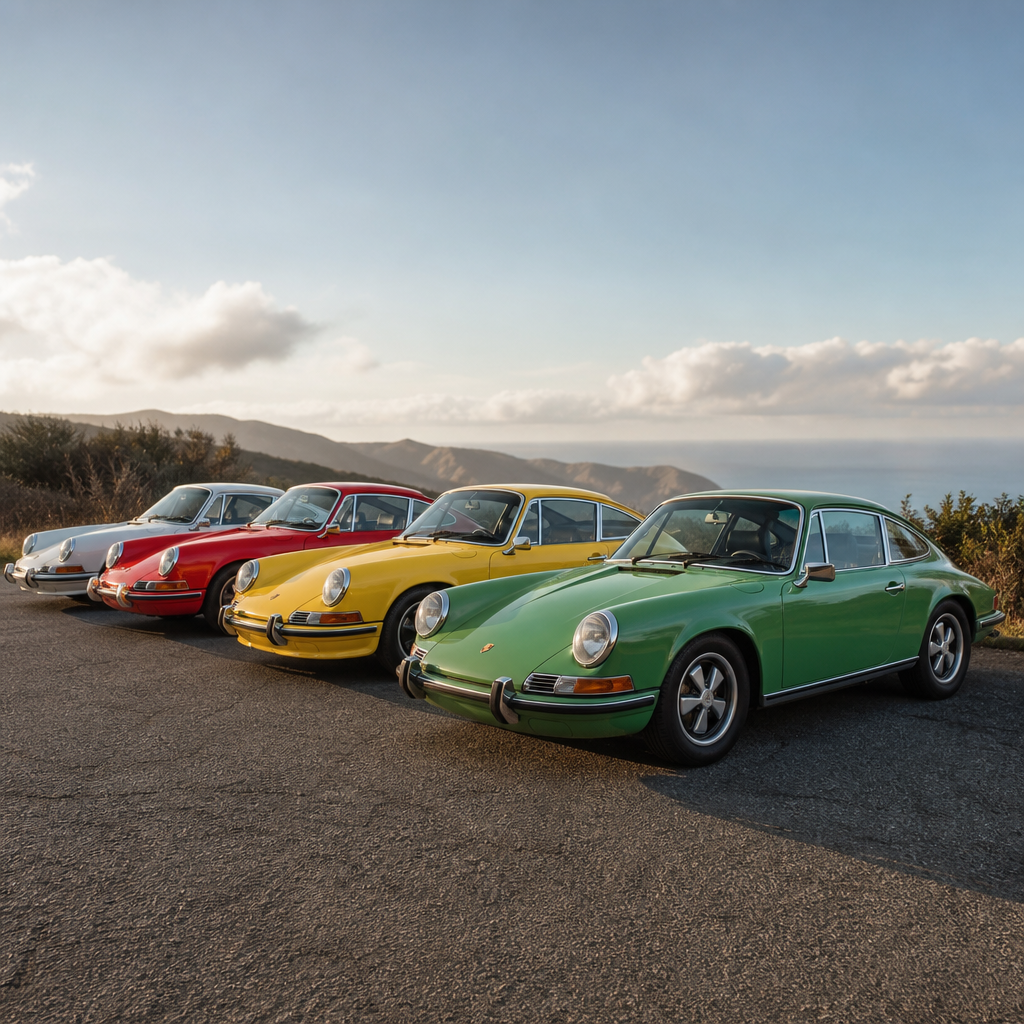
Over time, classic 911 development can be understood in distinct eras. The long-hood cars from 1964 to 1973 are especially prized for their light weight and purity. Within that group, models such as the 911S, 911E, and 911T offered different balances of performance and usability. The 1973 Carrera RS 2.7 became a landmark not only for Porsche but for all European classics. Built for homologation, it combined a 2.7-liter engine, reduced weight, wider rear arches, and the famous ducktail spoiler. It is one of the clearest examples of how motorsport requirements can create a road car icon.
The impact-bumper 911 generation from 1974 through 1989 broadened Porsche’s appeal. U.S. safety regulations changed appearance, but continual engineering upgrades improved reliability and day-to-day usability. The 911 SC and later 3.2 Carrera became durable enthusiast favorites. Then came the 930 Turbo, first released in 1975, which defined the image of the high-performance turbocharged road car. Its boost delivery, wide bodywork, and demanding handling made it thrilling and sometimes unforgiving. In the workshop, I have seen how even experienced owners underestimate the importance of correct suspension setup and tire choice on these cars. When sorted properly, though, they feel alive in a way few modern performance cars can replicate.
The final air-cooled chapters, the 964 and 993, deserve classic status in their own right. The 964 introduced major modernization, including available all-wheel drive, power steering, ABS, and revised suspension. The 993, built from 1994 to 1998, was the last air-cooled 911 and remains a market benchmark because it blends traditional character with real usability. For many buyers entering European classics, the 993 is the gateway model: expensive, yes, but still practical enough to drive often.
Racing Built the Legend
Porsche’s reputation cannot be separated from racing. Many European brands have competition histories, but Porsche turned motorsport into a development laboratory and a marketing engine. The company earned class wins at Le Mans as early as 1951 with the 356 SL. That mattered because endurance racing rewarded efficiency, reliability, and braking as much as top speed, areas where Porsche excelled. Through the 1950s and 1960s, Porsche race cars such as the 550 Spyder, 718 RSK, and 904 Carrera GTS gave the brand credibility far beyond its production volume.
The 550 Spyder remains central to the myth. Lightweight, low, and purpose-built, it helped define Porsche as a maker of serious competition machines. The later 906, 907, 908, and 910 advanced the company’s aerodynamic and chassis knowledge, leading ultimately to the 917. Introduced for the 1969 season, the 917 transformed Porsche’s standing by delivering the company’s first outright Le Mans victory in 1970, followed by another in 1971. In collector culture, that win matters because it connects road cars to a clear line of racing achievement rather than vague brand storytelling.
Turbocharging also moved from race experimentation to showroom reality through Porsche’s competition program. The 934 and 935 dominated categories in the 1970s, while the 936 succeeded at Le Mans. Later, the 956 and 962 became two of the most successful endurance prototypes ever built. These cars influenced road-going engineering, from forced induction confidence to aerodynamic thinking and brake development. Even if a classic Porsche owner never drives on track, the steering feel, engine response, and cooling solutions in many road models reflect lessons learned under race conditions. That direct transfer is one reason Porsche classics hold such authority in the wider European market.
Beyond the 911: 914, 924, 928, 944, and 968
A complete Porsche history must cover the models once dismissed by purists and now increasingly valued by informed collectors. The mid-engine 914, developed with Volkswagen and launched in 1969, was long treated as an outsider because four-cylinder versions carried VW-Porsche branding in many markets. Yet the 914 offered superb balance, removable-roof enjoyment, and impressive practicality. The rare 914/6, powered by a 911-derived flat-six, has become especially collectible, but well-sorted four-cylinder cars increasingly attract buyers who want an affordable entry into classic Porsche ownership.
The transaxle era changed the brand’s engineering direction. The 924, introduced in 1976, used a front-engine, rear-transaxle layout to improve weight distribution. While early 924s borrowed an Audi-sourced engine and once suffered from snobbery, they were well packaged and efficient. Porsche developed the concept further with the 944, adding flared arches and a more distinctly Porsche inline-four derived in architecture from the 928’s V8 bank design. The 944 is one of the smartest buys in European classics when purchased carefully. It offers excellent steering, dependable road manners, and a usable hatchback body. Turbo versions add serious pace, while the 944 S2 and 968 deliver mature, balanced performance.
The 928 deserves special attention. Launched in 1977 with a front-mounted V8 and luxurious grand touring brief, it was intended in part to secure Porsche’s future beyond the 911. It won the 1978 European Car of the Year award, still a rare achievement for a sports-oriented GT. Although it never replaced the 911, the 928 showcased Porsche’s willingness to challenge its own traditions. Its Weissach rear axle was an important stability innovation, and its aluminum-intensive engineering was advanced for the time. Today, a good 928 is not a bargain restoration project; neglected examples can become extremely expensive. But a maintained car offers one of the most complete long-distance classic driving experiences in the segment.
How Porsche Classics Compare Within European Classics
Collectors often compare Porsche with Jaguar, Alfa Romeo, Mercedes-Benz, Ferrari, BMW, and Lotus. Those comparisons are useful because they clarify where Porsche classics sit in the broader European landscape.
| Brand | Typical Strength | Typical Ownership Challenge | Where Porsche Differs |
|---|---|---|---|
| Jaguar | Style, six-cylinder character, value in saloons | Electrical and corrosion issues on some models | Usually stronger parts infrastructure and wider daily usability |
| Alfa Romeo | Engaging twin-cam engines, light handling | Rust, originality concerns, variable restoration quality | More standardized documentation and stronger global specialist support |
| Ferrari | Exotic status, competition heritage | High service costs and thinner accessibility for entry buyers | Broader ownership base and more drivable options below six figures |
| Mercedes-Benz | Durability, comfort, build quality | Less sports-car intimacy in many classics | Sharper feedback and stronger club-racing connection |
| BMW | Balanced chassis, enthusiast appeal | Some rare parts pricing and model-specific complexity | Deeper rear-engine identity and stronger halo effect from motorsport |
In practical terms, Porsche classics tend to reward disciplined buying. Pre-purchase inspections, compression and leak-down testing on air-cooled engines, rust evaluation around suspension pickup points, and verification of chassis and engine numbers are essential. Service records carry real weight because many expensive failures begin as ignored maintenance. Compared with some Italian exotics, a classic Porsche is often easier to own. Compared with robust Mercedes classics, it may be more sensitive to incorrect setup and deferred engine work. That balance is why Porsche occupies such a strong position in the European classics hub: it connects emotional appeal with measurable engineering credibility.
Collectibility, Restoration, and the Future of Porsche Classics
Not every old Porsche is equally collectible, and the market has matured. Original specification, documented provenance, rare factory options, desirable colors, and limited-production variants all influence value. However, the best buying strategy is usually to purchase the best-cared-for example you can afford, not the cheapest entry point. I have watched owners spend more reviving poor cars than they would have spent buying sorted examples from the start. Rust repair on early 356 and 911 bodies can be extensive. Rebuilding mechanical fuel injection, four-cam engines, or turbocharged flat-sixes requires specialists, not generic classic car shops.
At the same time, Porsche remains unusually well supported. Porsche Classic supplies thousands of parts for older models and has expanded remanufacturing using original drawings and modern methods. Independent specialists rebuild Fuchs wheels, restore Bosch fuel injection systems, retrim interiors to factory patterns, and source period-correct glass, fasteners, and finishes. Auction houses such as RM Sotheby’s, Gooding Christie’s, and Bonhams have also increased market transparency by documenting sale histories and specifications. That visibility helps buyers separate truly exceptional cars from average examples presented with ambitious asking prices.
The future of Porsche classic cars looks strong because the brand spans multiple enthusiast generations. Some buyers want pre-1973 purity. Others grew up admiring 930 Turbos, 944s, or 993s. Younger enthusiasts increasingly recognize the value of analog driving, manual transmissions, and compact dimensions. As regulations reshape modern cars, classic Porsches stand out for mechanical honesty. They are not perfect. Air-cooled cabins can be noisy, vintage crash protection is limited, and restoration costs continue to rise. But as centerpieces within European classics, Porsche models offer one of the clearest routes to meaningful ownership, driving involvement, and historical connection. If you are building your knowledge of classic car models and brands, start here, then use this hub to explore individual Porsche generations and their European peers in greater detail.
Frequently Asked Questions
What makes a Porsche a “classic” in the eyes of enthusiasts and collectors?
A Porsche is usually considered a classic when it represents an important chapter in the brand’s engineering, design, or motorsport history and has reached an age where its character is clearly distinct from modern production cars. In practice, that often means air-cooled models built from the late 1940s through the 1990s, including early 356 variants, long-hood and impact-bumper 911s, 912s, and significant competition cars. Many collectors also extend that definition to notable transaxle models such as the 924, 944, 968, and 928, especially as the market has become more appreciative of the broader Porsche story.
What separates Porsche from many other classic marques is the consistency of its identity. Even as the company evolved, its cars retained a strong engineering logic, a driver-focused cockpit, and a design language that was unmistakably Porsche. That continuity is why collectors often talk about classic Porsches as a lineage rather than a random group of old cars. A 356, an early 911, and a later air-cooled Carrera all feel connected by the same philosophy: lightweight efficiency, precision, and performance developed with real purpose.
Age alone, however, is not the only factor. Provenance, originality, rarity, competition history, and cultural significance all influence whether a specific Porsche is regarded as a true classic. A standard road car in excellent original condition may be more desirable than a modified example of a rarer model. Likewise, a limited-production homologation car, an RS variant, or a Porsche with documented racing pedigree may occupy a special place in the collector world regardless of production numbers. In short, “classic Porsche” is both a time period and a standard of significance.
Why is the Porsche 356 so important in the history of Porsche classic cars?
The Porsche 356 is important because it is the car that established Porsche’s identity. Introduced in the late 1940s, it was the first production model to carry the Porsche name and the first full expression of the company’s approach to sports car design. Lightweight construction, compact dimensions, efficient aerodynamics, rear-engine layout, and a strong emphasis on balance over brute force all appeared here in formative form. The 356 was not just Porsche’s beginning; it was the blueprint for much of what followed.
Its significance also comes from the way it transformed a small manufacturer into a respected performance brand. Early 356s proved themselves in competition, rallies, endurance events, and on demanding European roads. Those motorsport successes gave Porsche credibility well beyond what its size would have suggested. The car’s reputation grew because it was quick, durable, and engaging to drive, and because it delivered that performance through intelligent engineering rather than excess. That combination became central to the Porsche mythos.
From a collector standpoint, the 356 remains foundational because it captures the purity of the earliest Porsche era. The split between Pre-A, A, B, and C cars gives enthusiasts plenty of detail to study, while body styles such as Coupe, Cabriolet, Speedster, Roadster, and Convertible D each have their own following. Values, restoration standards, and historical interest all reflect the 356’s status as the origin point of the marque. For many collectors, owning a 356 means owning the first chapter of the Porsche story in its most direct and elegant form.
How did the Porsche 911 become the defining classic Porsche model?
The Porsche 911 became the defining classic Porsche because it took the ideas introduced by the 356 and developed them into a platform with extraordinary longevity, recognizability, and performance range. Launched in the 1960s, the 911 preserved the rear-engine concept and the compact, sloping silhouette, but it added more power, more sophistication, and greater day-to-day usability. Its design evolved over decades without losing its essential shape, which helped make it one of the most recognizable sports cars ever built.
Just as important, the 911 continuously proved itself in racing and on the road. From early 2.0-liter cars to S models, Carreras, Turbos, RS variants, and competition machines such as the RSR, the 911 earned a reputation for being both versatile and capable. It could be a practical grand tourer, a weekend back-road car, or a serious race winner. Few classic cars have such a broad and credible range. That competition record, especially in endurance racing and rallying, gave the 911 a legitimacy that went far beyond styling appeal.
Collectors are especially drawn to the 911 because every era offers something distinct. Early long-hood cars are prized for purity and lightness. The 1970s brought iconic impact-bumper cars and the game-changing 930 Turbo. The 1980s refined the formula with the SC and 3.2 Carrera, while the 1990s closed the air-cooled era with the 964 and 993. Because of this continuous development, enthusiasts can trace Porsche’s history through the 911 alone. It is not just the most famous classic Porsche; it is arguably the model that best explains the brand’s entire legacy.
Are air-cooled Porsche models always the most collectible, or do transaxle and early water-cooled cars matter too?
Air-cooled Porsche models remain the emotional center of the classic market because they represent the traditional Porsche formula many enthusiasts idealize: mechanical simplicity, distinctive engine sound, tactile driving feel, and direct historical links to the company’s formative decades. Cars such as the 356, early 911, 930 Turbo, 964, and 993 often command the most attention because they combine iconic design with strong enthusiast demand and deep historical significance. For many buyers, air-cooled ownership is about preserving a specific kind of analog driving experience that modern cars cannot replicate.
That said, the collector world has broadened considerably, and transaxle Porsches now matter much more than they once did. Models like the 924, 944, 968, and 928 were long underrated, but they are increasingly appreciated for their engineering sophistication, usability, and importance in Porsche’s corporate history. These cars showed that Porsche was willing to explore different layouts and technologies while still pursuing balance, performance, and build quality. The front-engine, rear-transaxle arrangement in particular delivered excellent weight distribution and a very different but still distinctly Porsche driving experience.
Early water-cooled performance cars are also becoming more accepted within the wider classic conversation, especially rare, influential, or landmark examples. Collectibility always depends on context: production numbers, originality, maintenance history, specification, and cultural significance all matter. While air-cooled cars still dominate the romance and prestige side of the market, it is a mistake to view the classic Porsche story too narrowly. A serious understanding of Porsche history includes the 356 and 911, but it also includes the experimental, transitional, and once-overlooked models that helped the company survive, adapt, and expand its identity.
What should collectors and enthusiasts look for when evaluating a classic Porsche today?
The first thing to look for is authenticity. On a classic Porsche, matching numbers, original colors, factory equipment, documented ownership history, and correct restoration details can have a major effect on both value and long-term desirability. Porsche buyers tend to be well informed, and the market rewards cars that are properly documented and honestly represented. A certificate, service records, old registrations, restoration invoices, and photos of past work can all help establish confidence. If a car has been modified, the quality and reversibility of those changes matter a great deal.
Condition is equally critical, but it should be judged carefully and model by model. Rust remains one of the biggest concerns on older Porsches, especially early 356 and 911 cars, and poor body repairs can be far more serious than cosmetic wear. Mechanical health matters too, including engine rebuild quality, gearbox condition, suspension wear, brake performance, and evidence of proper maintenance. On later classics, electrical systems, fuel injection components, seals, and age-related deterioration also deserve close inspection. A seemingly cheaper car can quickly become more expensive than a stronger original example if restoration needs are underestimated.
Finally, buyers should think beyond market trends and consider historical fit and personal purpose. The best classic Porsche is not always the rarest or the most expensive; it is the one that aligns with the owner’s interests, whether that means concours originality, vintage touring, club events, or spirited road driving. Some collectors want a landmark 356 or a long-hood 911 with maximum period correctness. Others may prefer the value, comfort, and dynamic balance of a 944 S2 or 928 GTS. Understanding where a specific model sits in Porsche history makes ownership far more rewarding. In the end, a great classic Porsche should offer both a strong place in the marque’s legacy and a driving experience that still feels special today.