The best 1980s Japanese classic cars combine engineering ambition, everyday usability, and a level of driver involvement that still feels fresh decades later. The decade was a turning point for Japan’s auto industry: manufacturers moved beyond building economical alternatives and began defining global benchmarks in reliability, technology, and performance. When enthusiasts talk about “Japanese classics,” they usually mean vehicles from brands such as Toyota, Nissan, Honda, Mazda, Mitsubishi, Subaru, and Isuzu that now carry historic importance, collector interest, and strong aftermarket support. In practical terms, a classic Japanese car from the 1980s is one that represents the era’s design language, mechanical character, and cultural impact while remaining desirable enough to preserve, restore, and drive today.
This category matters because the 1980s created many of the cars that shaped modern enthusiast culture. Turbocharging became mainstream, double overhead cam engines spread across model ranges, fuel injection replaced carburetors in many markets, and computer-controlled systems began to influence drivability and emissions. At the same time, Japanese manufacturers proved they could build everything from lightweight sports coupes to rally-bred all-wheel-drive machines and luxury grand tourers. I have spent years around these cars at auctions, club meets, and restoration shops, and the pattern is clear: the best examples are not just nostalgic curiosities. They are usable classics with robust parts networks, deep owner communities, and engineering that rewards careful maintenance rather than endless compromise.
For buyers, restorers, and readers exploring Japanese classics as a broader topic, 1980s models are the natural hub. They bridge older, simpler machines of the 1970s and the high-tech icons of the 1990s. Many remain attainable compared with later halo cars, yet they already show the traits collectors value most: named engines, motorsport lineage, strong design identity, and documented cultural influence. Understanding the best 1980s Japanese classic cars means looking at more than auction headlines. You need to weigh drivetrain layout, rust vulnerability, homologation history, trim-level differences, originality, and how a car performs in real ownership. The strongest cars from this period earned their reputation on the road first and in the market later.
What defines the best 1980s Japanese classic cars
The best 1980s Japanese classic cars share several qualities. First, they marked a technical or cultural milestone. Second, they remain engaging to drive, whether through balanced handling, engine character, or innovative packaging. Third, they have enough documentation and enthusiast support to make ownership realistic. A car can be rare, but rarity alone does not make it great. I always look for a model that changed expectations in its segment, has identifiable strengths, and can still be serviced without inventing every solution from scratch.
That standard immediately highlights cars like the Toyota AE86 Corolla Levin and Sprinter Trueno, Nissan Skyline RS and early GT-R predecessors in spirit, Mazda RX-7 FB and FC, Honda CR-X and Prelude, and the first-generation Toyota MR2. Some are famous because of motorsport, some because of anime and pop culture, and some because they delivered advanced engineering to ordinary buyers. The 1980s also produced serious executive machines such as the Toyota Soarer and Nissan Leopard, which previewed the Japanese luxury boom that later reached the United States through Lexus, Acura, and Infiniti.
Condition matters more than badge prestige. Rust is the central issue across nearly every 1980s Japanese car, especially in sills, arches, floorpans, strut towers, hatch areas, and around windscreens. Mechanical parts are often easier to solve than corrosion. A tidy, honest MR2 with complete service records is usually a better buy than a neglected turbo coupe with missing trim and old modifications. Originality also affects value, but tasteful period-correct upgrades can improve reliability and drivability without harming the car’s identity.
Iconic rear-wheel-drive coupes and hatchbacks
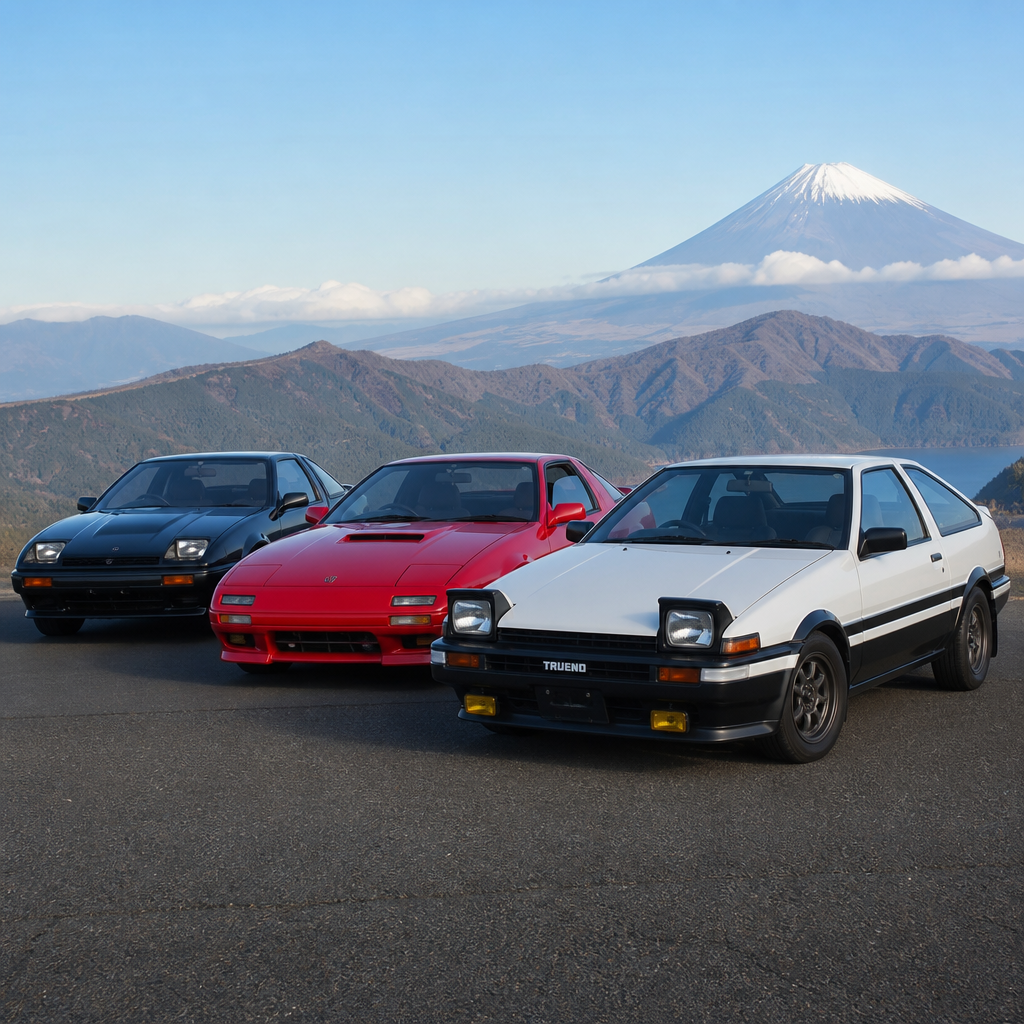
If one model defines accessible 1980s Japanese driving purity, it is the Toyota AE86. Built on the E80 Corolla platform and powered in top versions by the 1.6-liter twin-cam 4A-GE, the AE86 kept rear-wheel drive alive in a market shifting toward front-wheel drive. It was light, mechanically simple, and wonderfully adjustable at the limit. In stock form it was not especially fast, but speed was never the point. The appeal came from steering feel, rev-happy character, and balance. That is why the AE86 remains central to drifting history, club motorsport, and collector demand today.
Nissan answered the enthusiast brief in several ways during the decade. The Silvia lineage, especially the S12, deserves more respect than it usually gets. It offered rear-wheel drive, sharp styling, and engine options including the CA18ET turbo in some markets. It was overshadowed by the later S13, but the S12 captures the transitional feel of the 1980s perfectly. Another important car is the DR30 Skyline RS, associated with the FJ20 engine, a tough twin-cam four-cylinder that became legendary for tuning potential. Before the R32 GT-R redefined Nissan performance in 1989, the RS models kept the Skyline performance image alive with real motorsport credibility.
Mazda’s first-generation RX-7, known as the FB or SA22C depending on market and year, is another essential rear-drive classic. Its compact rotary engine sat low and far back, helping weight distribution and steering response. The car felt different from piston-engined rivals: smooth, eager, and willing to rev. Rotary ownership requires discipline, especially regarding cooling, ignition health, and apex seal awareness, but a properly maintained RX-7 is one of the most distinctive Japanese classics of the decade. The later FC RX-7 added more power, sharper aerodynamics, and available turbocharging, moving the model upmarket while retaining the rotary identity.
Mid-engine, front-wheel-drive, and lightweight innovation
The 1980s were not only about rear-wheel drive. Japan also produced some of the smartest front-wheel-drive and mid-engine enthusiast cars of the era. The first-generation Toyota MR2, launched in 1984, brought affordable mid-engine handling to a wide audience. With compact dimensions, crisp steering, and the 4A-GE engine in many versions, the AW11 MR2 delivered a driving experience usually reserved for more expensive European cars. It could be twitchy at the limit, especially on old tires or with poor alignment, but that sensitivity is part of its character. Well-sorted examples feel alive in a way modern cars often do not.
Honda’s CR-X is the definitive argument for why low weight matters more than headline horsepower. Whether in HF, Si, or later fuel-injected trims depending on market, the CR-X offered outstanding packaging, strong fuel economy, and nimble responses. It became a benchmark for practical performance because it was inexpensive to run and genuinely fun on a back road. The Prelude also deserves inclusion, particularly later third-generation development in the decade, because it showed Honda’s ability to combine refinement with advanced chassis engineering. Features such as four-wheel steering, where fitted, were not gimmicks. They improved low-speed maneuverability and high-speed stability in measurable ways.
Mazda’s BF Familia GT-X and related turbocharged hot hatches are less famous globally but important in context. They demonstrated that Japanese manufacturers could engineer compact cars with serious traction and rally potential. Meanwhile, the Honda Civic Si and related performance-oriented Civics established a formula that would influence sport compact culture for decades: lightweight shell, willing engine, precise manual gearbox, and broad aftermarket support. Not every great 1980s Japanese classic was expensive or rare when new. Many were brilliant precisely because they made engineering excellence accessible.
Turbocharged performance and homologation heroes
By the late 1980s, Japan had become a powerhouse in turbocharged performance. The road cars enthusiasts seek today often trace their significance to touring car racing, rallying, or homologation rules. The Mitsubishi Starion and Chrysler Conquest, its export-market relative, are prime examples. Rear-wheel drive, aggressive box-flared styling, and turbocharged four-cylinder power made the Starion a serious rival to contemporary European and American coupes. Widebody versions are especially collectible because they captured the period’s visual drama without sacrificing usability.
Subaru’s Leone RX Turbo and early performance sedans and wagons also matter, even if they are less celebrated than the later Impreza WRX. These cars introduced enthusiasts to the practical strengths of turbocharged flat-four engines and four-wheel-drive systems before Subaru became a rally household name. In similar fashion, the Mazda 323 GTX proved that a compact hatchback could deliver all-weather speed with genuine competition potential. When one appears in solid condition today, experienced collectors pay attention because the survival rate is low.
Toyota’s Supra, especially the A70 generation introduced in the second half of the decade, marked a major shift toward sophisticated grand touring performance. With independent rear suspension, available turbocharging, and engines from the M-series family, the A70 blended straight-line capability with comfort and high-speed stability. It is often overshadowed by the 1990s A80, but the A70 is crucial to understanding the evolution of Japanese performance cars. Nissan’s Z31 300ZX occupies a similar position. It brought wedge-era styling, available VG30ET turbo power, digital dashboard options in some trims, and a more mature grand touring personality than the lighter Z cars that came before.
| Model | Layout | Why it matters | Watch points |
|---|---|---|---|
| Toyota AE86 | Front-engine, rear-wheel drive | Lightweight balance, 4A-GE, drifting and club racing icon | Rust, accident damage, inflated prices |
| Mazda RX-7 FC Turbo | Front-mid engine, rear-wheel drive | Rotary character, turbo performance, strong chassis | Compression health, cooling, vacuum lines |
| Toyota MR2 AW11 | Mid-engine, rear-wheel drive | Affordable mid-engine handling, compact and sharp | Snap oversteer reputation, rust, tired suspension |
| Mitsubishi Starion | Front-engine, rear-wheel drive | Turbo coupe with homologation-era attitude | Trim scarcity, neglected electronics, rust |
| Toyota Supra A70 | Front-engine, rear-wheel drive | Refined turbo GT, key step toward later Supra legend | Head gasket history, weight, old modifications |
Luxury, GT cars, and overlooked collector picks
Not every important 1980s Japanese classic was built for track days or mountain roads. Some of the decade’s best cars were luxury coupes and executive sedans that showcased Japan’s emerging confidence. The Toyota Soarer is a perfect example. In Z10 and Z20 forms, it combined pillarless coupe styling, smooth six-cylinder power, digital instrumentation in some trims, and an interior quality that rivaled established European brands. It was not merely a domestic curiosity. It previewed the standards of fit, finish, and technology that would soon define Japanese premium cars worldwide.
The Nissan Leopard filled a similar role, especially in top-spec turbocharged V6 versions. It offered restrained luxury, advanced electronics for the period, and unmistakable 1980s proportions. Today, these cars attract buyers who want something rarer than the obvious sports models while still benefiting from strong brand heritage. The same can be said for the Toyota Cressida and Nissan Laurel in enthusiast trims. They were sold as sensible sedans, yet rear-wheel-drive layouts and available six-cylinder engines make them rewarding classics with discreet appeal.
Another overlooked area is specialty and niche performance. Isuzu’s Piazza, sold in some markets as the Impulse, featured Giugiaro styling and unusual dashboard design, while the second-generation Honda Accord Aerodeck showed how adventurous Japanese manufacturers could be with body styles. Even kei and compact cars deserve mention within a true Japanese classics hub, although most buyers start with export-recognized models. The point is simple: the best 1980s Japanese classic cars are not limited to headline heroes. The decade produced breadth as well as icons, and savvy collectors often find more value in cars that have not yet become social-media cliches.
How to buy, restore, and own a 1980s Japanese classic today
Buying well is more important than buying famous. Start with rust inspection, then confirm engine health, gearbox condition, cooling-system integrity, and electrical function. Compression tests matter on rotary engines, while timing-belt history matters on many piston engines. Check for model-specific weak points using factory workshop manuals, owner forums, and marque specialists. Documentation adds real value because many of these cars have changed hands repeatedly and accumulated modifications of varying quality.
Parts support is uneven but far better than many newcomers expect. Mechanical service parts for popular cars like the AE86, MR2, RX-7, CR-X, Supra, and Z31 are generally manageable through specialist suppliers, club networks, reproduction manufacturers, and cross-referenced components. Trim, weather seals, and interior plastics are usually harder than engines or brakes. I advise buyers to price the missing small parts before committing. A cheap project with unavailable lights, moldings, or electronic modules can cost more than a complete car bought at the right price.
For long-term ownership, preserve originality where it matters and upgrade where it improves reliability. Modern tires, refreshed bushings, stainless exhaust components, quality ignition parts, and proper cooling maintenance usually make these cars better without erasing period character. Keep records, drive the car regularly, and avoid shortcuts. That approach protects value and makes ownership enjoyable rather than exhausting. If you are building a broader knowledge base around classic car models and brands, 1980s Japanese classics are one of the smartest places to begin. They offer history, engineering depth, and real road enjoyment in equal measure. Start with the model that matches your budget, mechanical confidence, and intended use, then learn the details that separate a good example from a costly lesson.
Frequently Asked Questions
What makes 1980s Japanese classic cars so special compared with classics from other eras?
1980s Japanese classic cars stand out because they represent the moment when Japan’s automakers fully combined reliability, innovation, and genuine enthusiast appeal in a way the global market could not ignore. During this decade, companies like Toyota, Nissan, Honda, Mazda, Mitsubishi, and Subaru were no longer seen only as makers of sensible transportation. They were producing cars with advanced engine designs, sharper chassis tuning, better aerodynamics, and a level of build quality that helped redefine buyer expectations around the world.
What makes these cars especially compelling today is their balance. Many classics from earlier eras are charming but demanding, while many newer performance cars are fast but heavily insulated. The best 1980s Japanese cars sit in a sweet spot between those extremes. They often deliver light-to-moderate curb weights, direct steering, clear sightlines, manual transmissions, and mechanical simplicity that still rewards driver skill. At the same time, they tend to be more usable, dependable, and approachable than many European or American classics of similar age.
Another major reason they matter is cultural influence. The 1980s laid the groundwork for legendary nameplates that would explode in popularity in the 1990s and beyond. Cars such as the Toyota Supra, Nissan Z, Mazda RX-7, and Honda Prelude evolved significantly during this decade, building reputations that still shape enthusiast culture today. In other words, 1980s Japanese classics are not just old cars with nostalgia value; they are pivotal machines from a transformative period in automotive history.
Which 1980s Japanese classic cars are usually considered the best or most collectible?
The “best” 1980s Japanese classic cars depend on whether you value performance, rarity, motorsport heritage, daily usability, or long-term collectibility, but several models consistently rise to the top. The Mazda RX-7, especially the first- and second-generation cars, is widely respected for its lightweight feel, balanced handling, and unique rotary engine character. The Toyota Supra, particularly the A70 generation introduced at the end of the decade, helped establish Toyota as a serious performance player with strong straight-line speed and grand-touring capability.
Nissan’s 300ZX Z31 also deserves a place on any serious list. It brought futuristic styling, turbocharged performance in certain trims, and a distinctly 1980s blend of technology and attitude. The Toyota Corolla AE86 remains one of the most beloved driver’s cars of the era thanks to its rear-wheel-drive layout, tossable dynamics, and enormous influence on grassroots motorsport and car culture. Honda’s CRX and Prelude are also important, especially for buyers who appreciate rev-happy engines, clever packaging, and front-wheel-drive cars that genuinely reward enthusiastic driving.
For those interested in homologation specials and rally-bred machinery, models from Mitsubishi and Subaru are increasingly appreciated, although some of the most famous all-wheel-drive legends became more prominent in the 1990s. Even so, the 1980s were crucial in building the engineering identity those brands would later become famous for. Collectibility often follows a mix of originality, trim level, drivetrain, condition, and historical significance. Turbocharged variants, limited-production editions, and well-preserved manual-transmission examples typically attract the strongest demand.
Are 1980s Japanese classic cars still reliable enough to own and drive regularly?
In many cases, yes, and that is one of the biggest reasons these cars remain so appealing. The best 1980s Japanese classics were engineered with durability and real-world use in mind, and many have reputations for lasting far longer than their contemporaries if maintained properly. Toyota, Honda, and Nissan in particular built strong reputations during this period for mechanical dependability, logical engineering, and parts commonality across models. That said, reliability today has less to do with original factory quality alone and more to do with age, maintenance history, and prior ownership.
Any vehicle from the 1980s is now decades old, so buyers should expect age-related issues even on well-built cars. Rubber hoses, seals, suspension bushings, fuel system components, cooling systems, and electrical connections can all deteriorate with time. Rust is another major factor, especially on cars from wet or snowy climates. Some specialty engines also come with model-specific considerations. For example, rotary-powered Mazdas can be rewarding but require informed ownership, while turbocharged cars may need extra attention to heat-related wear and proper servicing.
If your goal is regular use, the smartest approach is to buy the best-maintained example you can afford rather than the cheapest one available. A clean, documented, largely original car is often far less expensive in the long run than a neglected “project” with hidden problems. Many owners successfully use 1980s Japanese classics for weekend drives, cars-and-coffee events, and even occasional commuting. With preventative maintenance, sensible expectations, and access to knowledgeable mechanics or enthusiast communities, these cars can still be surprisingly enjoyable and dependable companions.
What should buyers look for when shopping for a 1980s Japanese classic car?
The first thing to prioritize is overall condition and originality. On these cars, body integrity usually matters more than cosmetic shine or flashy modifications. Rust repair can become far more expensive and complicated than mechanical work, so buyers should carefully inspect the underbody, wheel arches, rocker panels, floor pans, strut towers, hatch areas, and lower door sections. Evidence of previous accidents, poor-quality bodywork, or hidden corrosion should be taken very seriously, because structural issues can undermine both safety and value.
Next, look at maintenance records and ownership history. A car with receipts for timing belt service, cooling system work, suspension refreshes, brake maintenance, and regular fluid changes is generally a much safer bet than one with a vague story and a recent respray. Cold-start behavior, idle quality, transmission feel, clutch engagement, smoke from the exhaust, and signs of overheating are all worth checking during a test drive. On fuel-injected 1980s cars, you should also be aware that aging sensors, vacuum leaks, and electrical gremlins can affect drivability if they have not been properly sorted.
It is also wise to think carefully about modifications. Some upgrades are sensible and period-appropriate, but heavily altered examples can be risky unless the work was done to a high standard. Amateur wiring, cut interiors, questionable turbo setups, and lowered suspensions with poor geometry can turn a promising car into a frustrating project. Ideally, buyers should target examples that are stock or tastefully maintained, especially if collectibility matters. Finally, research parts availability before buying. Ownership becomes much easier when you know whether trim pieces, engine components, and model-specific parts are still obtainable through specialists, enthusiast forums, or reproduction suppliers.
Are 1980s Japanese classic cars a good investment, or should they be bought mainly for enjoyment?
They can be both, but enjoyment should come first. The market for 1980s Japanese classics has grown substantially because enthusiasts now recognize how important these cars were to automotive history, and many models that were once overlooked are gaining real collector interest. Cars with strong enthusiast followings, iconic drivetrains, low production numbers, or ties to racing and tuner culture have shown especially strong appreciation. Clean, unmodified examples of cars like the AE86, RX-7, Supra, and certain Nissan performance models can command serious money compared with where they sat a decade ago.
However, not every 1980s Japanese car is a guaranteed investment, and values can vary sharply based on condition, originality, trim, mileage, and documentation. A rare performance variant in excellent shape may appreciate steadily, while a common model with poor history or heavy modifications may lag behind. The market also tends to reward authenticity. Factory-correct paint colors, original interiors, matching drivetrains, and period documentation often matter just as much as the badge on the hood.
The best ownership strategy is to buy a car you genuinely want to drive, learn, and preserve. If values continue to rise, that is a bonus. If they stabilize, you still own a machine that delivers analog feedback, historical significance, and a driving experience that modern cars often struggle to replicate. In that sense, 1980s Japanese classic cars are among the most satisfying enthusiast purchases available: they offer nostalgia, engineering substance, and the kind of real connection that makes ownership rewarding even beyond market trends.