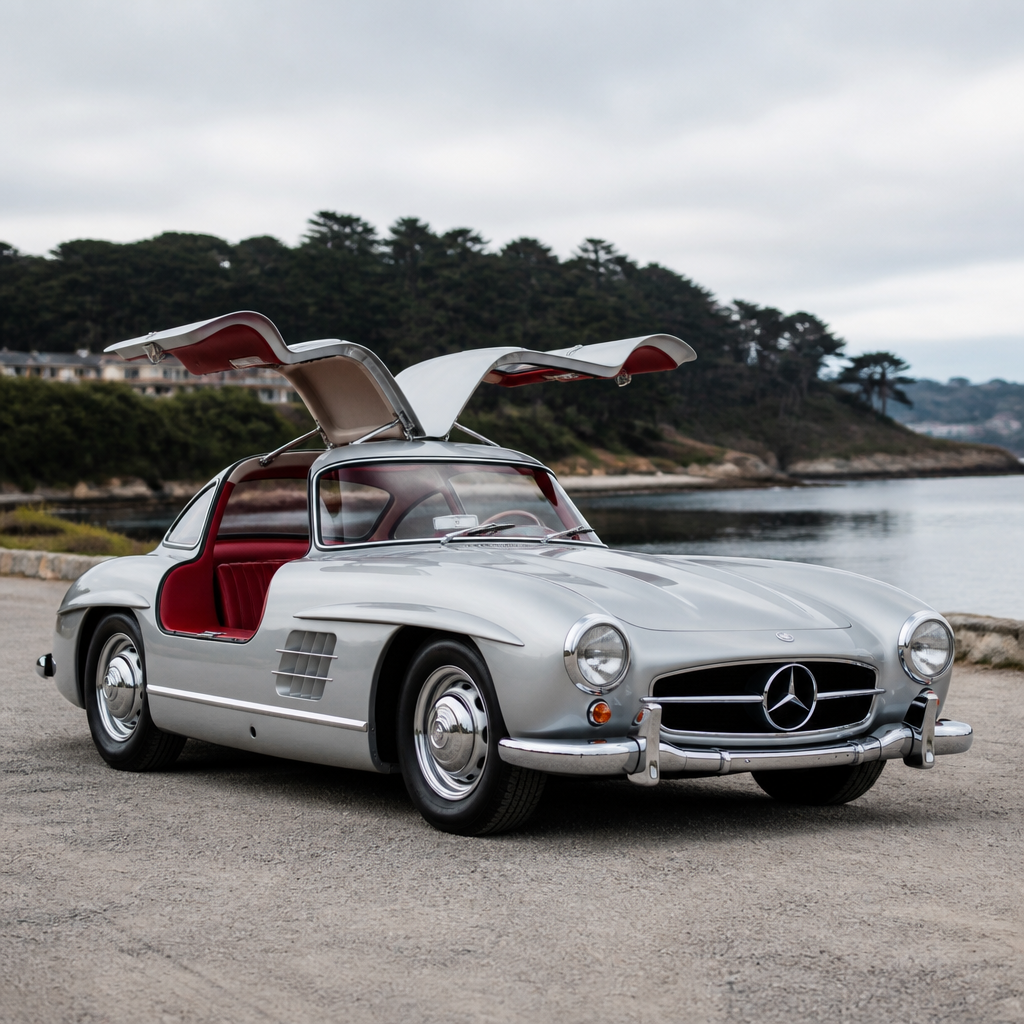
The Mercedes-Benz 300SL Gullwing stands at the center of any serious discussion about iconic classic car models because it combines race-bred engineering, unmistakable design, and enduring brand prestige in one machine. Introduced in 1954, the coupe known internally as the W198 was not merely a beautiful grand tourer; it was a technological statement derived from Mercedes-Benz competition success after World War II. When enthusiasts use the phrase “iconic model,” they usually mean a car that changed expectations for performance, styling, and cultural relevance at the same time. The 300SL Gullwing meets that standard completely.
Understanding why the 300SL matters begins with a few key terms. “SL” stands for “Super Leicht,” or super light, reflecting Mercedes-Benz’s focus on weight reduction through a tubular spaceframe chassis. “Gullwing” refers to the roof-hinged doors, created not for spectacle alone but because the high side sills of that lightweight frame made conventional doors impractical. “Direct fuel injection” describes the mechanical system that delivered fuel more precisely than carburetors, helping the 300SL become the fastest production car of its era. In practical terms, this model sits where engineering necessity became visual theater.
As a hub within the broader world of classic car models and brands, the 300SL Gullwing also helps explain how iconic models are evaluated today. Collectors, restorers, auction houses, and historians look at originality, racing lineage, engineering firsts, limited production, and cultural influence. I have worked through enough classic car valuations and restoration discussions to know that few vehicles score as highly across all five categories. The 300SL is rare, mechanically advanced, visually unforgettable, and supported by excellent archival documentation from Mercedes-Benz itself, which makes it a benchmark for comparing other blue-chip classics.
Its importance reaches beyond Mercedes-Benz. To understand Ferrari road cars, Jaguar’s postwar sports cars, Porsche’s early performance identity, or even Chevrolet Corvette development, it helps to understand the standard set by the 300SL. This article examines the Gullwing as both a singular automobile and a gateway model for the entire iconic-models category: how it was born, what made it innovative, why it drove differently from its rivals, how it shaped collector markets, and what lessons it offers anyone exploring classic car brands today.
Origins: From Racing Program to Road Car Legend
The 300SL Gullwing did not emerge from a styling studio chasing headlines. Its roots lie in Mercedes-Benz’s early 1950s racing comeback, especially the W194 competition car that won the 1952 24 Hours of Le Mans, the Carrera Panamericana, and other major events. Mercedes engineers needed a stiff but light frame, so they developed a welded tubular structure with small-diameter tubes arranged in triangles. That frame sat high along the sides, which improved rigidity but restricted entry. The unusual doors were the rational answer. This detail matters because the Gullwing’s most famous feature began as engineering, not ornament.
Another critical figure was U.S. importer Max Hoffman, who recognized growing American demand for high-performance European cars. Hoffman pushed Mercedes-Benz to produce a road-going version of its race-derived coupe for the American market. That commercial insight was decisive. Many iconic models owe their existence to a similar intersection of motorsport credibility and market timing, but the 300SL is one of the clearest examples. Without Hoffman’s confidence that affluent U.S. buyers would pay for an advanced halo car, the Gullwing might have remained a racing footnote.
Production began in 1954, and the model immediately occupied a rare space: expensive, technically sophisticated, and visibly unlike anything else on the road. Mercedes-Benz built the coupe until 1957, followed by the 300SL Roadster from 1957 to 1963. For hub-level understanding, that distinction is important. The Gullwing coupe is the purist icon, but the Roadster broadened the nameplate’s reach and improved practicality with conventional doors and a revised rear suspension. Together, they formed one of the most influential sports-car lines of the decade.
Engineering Innovations That Made the 300SL Revolutionary
The strongest case for the 300SL’s greatness is mechanical. Its 3.0-liter inline-six, canted over to fit beneath the low hood, used Bosch mechanical direct fuel injection adapted from aviation practice. That system raised output to roughly 215 horsepower in road trim, a major figure for the mid-1950s. Depending on axle ratio, contemporary tests recorded top speeds around 160 mph, making the 300SL the fastest production car available. This was not brochure exaggeration. On open roads and test tracks, the Gullwing delivered performance that rivaled purpose-built competition machines.
The spaceframe deserves equal attention. Weighing only about 82 kilograms, it gave the car strength without excessive mass, contributing to a curb weight near 1,295 kilograms. Lightweight construction is now a standard performance principle, but in the 1950s it was exceptional in a road car sold with trim, glass, and luggage capacity. The layout also shaped the car’s ergonomics. Owners learned to sit first on the sill, then swing their legs inside, often aided by a steering wheel that tilted downward for access. Living with a Gullwing meant adapting to engineering priorities.
Suspension and braking reveal both brilliance and period compromise. Front double wishbones provided sound control, but the low-pivot swing axle at the rear could produce abrupt handling changes near the limit, especially if tire pressures or damping settings were wrong. Drum brakes, while large and effective for the era, demanded respect during repeated hard use. This nuance is essential when discussing iconic models honestly. The 300SL was revolutionary, but it was not effortless. It rewarded skilled drivers and punished careless inputs, which is part of why seasoned collectors still describe it with admiration rather than casual nostalgia.
| Feature | Mercedes-Benz 300SL Gullwing | Why It Mattered |
|---|---|---|
| Engine | 3.0-liter inline-six with mechanical direct fuel injection | Higher power, sharper throttle response, and a major production-car first |
| Chassis | Tubular spaceframe | Exceptional rigidity with low weight, derived from racing practice |
| Doors | Roof-hinged Gullwing design | Necessary due to high sills, later became an iconic styling signature |
| Top speed | Up to roughly 160 mph depending on gearing | Established the car as the fastest production model of its time |
| Production coupe years | 1954–1957 | Short production run increased rarity and collector appeal |
Style, Interior Design, and the Power of the Gullwing Doors
Many classic cars are attractive, but few are immediately identifiable in silhouette from across a field or auction tent. The 300SL is. Its long hood, compact cabin, smooth fenders, and purposeful stance communicate speed before the engine starts. The doors complete the effect, yet they are only one part of a carefully resolved shape. Aerodynamics mattered, as did visibility, cooling, and packaging. The result was elegant without becoming decorative. In my experience, that is a hallmark of enduring automotive design: every dramatic line also has a functional explanation.
The cabin reflects Mercedes-Benz priorities of the period. Instruments are large and legible, materials are substantial, and the sense of craftsmanship is unmistakable. Plaid luggage sets and color-matched interiors may attract attention today, but the real story is usability within a high-performance machine. The dash is logical, the seats supportive for the era, and the driving position surprisingly businesslike. Because of the sills, cabin entry is theatrical, but once inside, the 300SL feels less like an exotic fantasy and more like a serious driver’s car designed for high-speed continental travel.
Culturally, the doors gave the car an image advantage that competitors could not replicate. Hollywood celebrities, racing drivers, industrialists, and magazine photographers all gravitated to it. That visibility reinforced Mercedes-Benz as a maker of engineering-led luxury rather than mere prestige goods. For anyone mapping iconic car brands, this is a key lesson: one model can crystallize an entire corporate identity. The Gullwing told the world that Mercedes-Benz could build a machine as glamorous as an Italian exotic and as technically disciplined as a race car, while retaining German solidity.
Driving Experience, Ownership Reality, and Restoration Priorities
People often ask whether the 300SL drives as dramatically as it looks. The honest answer is yes, but not in the simplified way many expect. The engine pulls with a hard, mechanical urgency, especially above midrange, and the car settles into high-speed cruising with remarkable composure for its age. Steering effort is significant at low speeds, the gearbox rewards deliberate inputs, and the cabin grows warm. This is not a soft concours ornament. Even restored examples feel alive, textured, and demanding in a way many later grand tourers do not.
Ownership, however, requires expertise and budget. Mechanical fuel injection must be set up correctly; poor tuning can cause drivability issues and expensive damage. Spaceframe integrity is critical, because improper repairs or corrosion can compromise value and safety. Matching-numbers verification matters, as do body-panel fit, original materials, and documentation from factory records or recognized historians. Specialists such as HK-Engineering, Kienle, and the Mercedes-Benz Classic Center have built reputations around these cars because restoration quality varies enormously. On a 300SL, a beautiful paint finish cannot compensate for incorrect mechanical work.
When advising buyers on iconic classics, I emphasize intended use. A museum-grade Gullwing with impeccable provenance may suit a major collection, while a well-restored driver can offer a more rewarding ownership experience. Market values have climbed into seven figures for top examples, which changes behavior. Insurance, storage humidity, parts sourcing, and regular exercise all become serious considerations. Yet the best owners still drive them. A static 300SL is valuable; a properly maintained 300SL in motion explains its legend far better than any catalog description.
The 300SL in the Collector Market and the Wider Iconic Models Landscape
Within the collector market, the 300SL occupies the top tier alongside names such as the Ferrari 250 series, Jaguar XKSS, Porsche 356 Carrera variants, and select Aston Martin DB models. What distinguishes it is the balance of rarity, usability, and global recognition. Around 1,400 Gullwing coupes were built, enough to sustain active specialist knowledge yet few enough to preserve exclusivity. Auction results from RM Sotheby’s, Gooding Christie’s, and Bonhams consistently show that exceptional provenance, original colors, and documented history can swing value dramatically, sometimes by hundreds of thousands of dollars.
As a hub model for iconic classics, the 300SL also helps organize comparison across brands. If you are studying postwar German icons, it sits above the 190SL in performance significance. If you are comparing halo sports cars, it belongs beside Ferrari’s early V12 road cars and Jaguar’s Le Mans-inspired offerings. If your interest is technological milestones, it links naturally to articles on fuel injection history, lightweight chassis design, and racing homologation influences. In other words, the Gullwing is not an isolated legend. It is a reference point that connects multiple strands of automotive history.
Its influence within Mercedes-Benz continued through later SL generations and through modern supercars that revived the door concept, most notably the Mercedes-Benz SLS AMG. But the original remains unmatched because it earned its form through engineering necessity and competition pedigree. That authenticity is why the 300SL appears so often in museum exhibitions, design retrospectives, and serious classic car scholarship. It is also why this model deserves hub-page status within any “Iconic Models” collection: once you understand the Gullwing, you understand how lasting automotive icons are made.
The Mercedes-Benz 300SL Gullwing endures because it solves the hardest challenge in automotive history: being technically important, visually unforgettable, and culturally influential at the same time. Its racing-derived spaceframe, pioneering direct fuel injection, and extraordinary speed made it a landmark when new. Its proportions, cabin character, and unmistakable doors turned that landmark into a universal symbol. Few classic cars combine measurable innovation with emotional impact so completely, and fewer still remain as authoritative more than seventy years after launch.
For readers exploring classic car models and brands, the 300SL provides a practical framework for judging any iconic model. Ask what problem the car solved, what engineering standard it introduced, how it shaped its brand, and whether its reputation is supported by real performance and documented history. On those terms, the Gullwing remains elite. It is not simply a collectible Mercedes-Benz or a glamorous 1950s sports car. It is a masterclass in how motorsport, design discipline, and market insight can create a lasting benchmark.
If you are building knowledge in the iconic-models category, start here and use the 300SL as your comparison point for every major classic that follows. Study the coupe and the Roadster, review period road tests, examine factory records, and compare restored examples with preserved originals. The more closely you look, the clearer its significance becomes. Explore the related classic car model profiles in this hub, and you will see why the Mercedes-Benz 300SL Gullwing remains one of the defining cars of the twentieth century.
Frequently Asked Questions
Why is the Mercedes-Benz 300SL Gullwing considered such an iconic classic car?
The Mercedes-Benz 300SL Gullwing is widely regarded as iconic because it brought together advanced engineering, motorsport credibility, and unforgettable design in a way few cars ever have. Introduced in 1954 as the W198 coupe, it emerged from Mercedes-Benz’s postwar racing success and translated competition ideas into a road-going automobile that looked and felt unlike anything else on the market. Its lightweight tubular spaceframe chassis, direct fuel-injected inline-six engine, and high-performance character made it far more than a stylish grand tourer. It was a technological showcase that proved Mercedes-Benz could lead in both innovation and luxury.
Just as important was its visual identity. The upward-opening doors were not created merely for drama; they were a practical solution to the chassis design, yet they became one of the most recognizable features in automotive history. The long hood, compact cabin, and purposeful stance gave the car a sculptural quality that still feels modern today. When people describe the 300SL Gullwing as an icon, they are usually responding to this rare combination of beauty, speed, engineering significance, and cultural prestige. It is a car that defined an era while remaining timeless far beyond it.
What made the 300SL Gullwing technologically advanced for its time?
The 300SL Gullwing was remarkably advanced by 1950s standards, and much of that sophistication came directly from Mercedes-Benz racing development. One of its most important features was the lightweight tubular spaceframe. This chassis design was extremely rigid and helped reduce overall weight, which improved both performance and handling. However, because the frame’s side sections were relatively high, conventional doors were not practical. That challenge led to the creation of the now-famous gullwing doors, turning an engineering necessity into a design legend.
Another major innovation was its mechanical direct fuel injection system, a feature rarely seen in production road cars at the time. Adapted from aviation and racing knowledge, this system helped the 3.0-liter inline-six engine produce impressive power and responsiveness. The result was a car capable of extraordinary speed for its era, including top-end performance that placed it among the fastest production automobiles in the world. Combined with independent front suspension, advanced construction techniques, and a race-inspired layout, the 300SL was not just stylish or fast; it represented genuine technical progress in a period when many road cars were still relatively conventional.
Were the gullwing doors purely a styling feature, or did they serve a practical purpose?
The gullwing doors were absolutely functional before they became symbolic. Their shape was dictated by the 300SL’s tubular spaceframe chassis, which had tall side sills that added strength but made standard side-opening doors difficult to use. Engineers needed a way to allow driver and passenger access without compromising the structural design, and the solution was to hinge the doors at the roof. In that sense, the Gullwing’s most famous visual feature was born from engineering logic rather than styling excess.
That said, the doors quickly took on a life of their own in the public imagination. They gave the car a theatrical presence that matched its performance and made every arrival or departure memorable. Even people with limited knowledge of automotive history often recognize the Gullwing by its doors alone. While entering and exiting the cabin could require a bit of practice due to the wide sills and low seating position, owners and enthusiasts generally accepted this as part of the car’s character. The doors are a perfect example of how necessity, innovation, and style can converge to create something enduringly distinctive.
How did the Mercedes-Benz 300SL Gullwing influence later sports cars and the Mercedes-Benz brand?
The 300SL Gullwing had a profound effect on both sports car development and the image of Mercedes-Benz. It established the idea that a road car could be a direct expression of racing technology while still offering craftsmanship, refinement, and prestige. In doing so, it helped shape the blueprint for the high-performance grand touring car: fast, technically ambitious, visually striking, and suitable for real road use. Many later manufacturers pursued this same formula, but few matched the 300SL’s balance of innovation and elegance.
For Mercedes-Benz specifically, the Gullwing became one of the brand’s definitive halo models. It reinforced a reputation for engineering excellence and gave the company a performance legend that still influences product storytelling today. Later Mercedes-Benz performance vehicles, including SL models and other flagship cars, have often been measured against the standard set by the 300SL. Its legacy also extends into branding and collector culture, where it symbolizes the company’s ability to produce machines that are both technically groundbreaking and emotionally compelling. Simply put, the Gullwing did not just succeed in its own time; it helped define what automotive excellence could look like for generations.
Why is the 300SL Gullwing still so valuable and admired by collectors today?
The 300SL Gullwing remains highly desirable because it checks nearly every box that serious collectors care about. It has rarity, historical significance, innovative engineering, motorsport lineage, unmistakable styling, and strong brand prestige. Unlike some classics that are valued mainly for nostalgia, the Gullwing offers substance behind the image. It was genuinely advanced when new, and that authenticity matters in the collector world. Buyers are not just acquiring a beautiful old Mercedes-Benz; they are acquiring a landmark in automotive history.
Its continued admiration also comes from how well it represents the ideal of the classic performance car. The 300SL feels special from every angle, whether you focus on the fuel-injected engine, the spaceframe construction, the dramatic doors, or the elegant proportions. It appeals to design enthusiasts, engineering purists, motorsport historians, and investors alike. Because so few cars unite these audiences so effectively, demand has remained strong over time. As a result, the Gullwing is often seen not only as a collectible automobile, but as a blue-chip classic whose reputation is anchored by genuine importance rather than short-term market fashion.