Overheating is one of the fastest ways to turn an enjoyable drive in a classic car into an expensive roadside failure. In practical terms, overheating means the engine is producing more heat than the cooling system can remove, causing coolant temperature to climb beyond the safe operating range designed by the manufacturer. For owners of older vehicles, that risk is higher because radiators corrode internally, hoses harden, fan clutches weaken, and original gauges are not always precise. I have seen cars run perfectly at 55 mph, then spike toward the red in slow traffic simply because one aging component could no longer keep up. Learning how to avoid overheating while driving matters because sustained high temperatures can warp cylinder heads, blow head gaskets, damage pistons, thin engine oil, and leave you stranded in conditions that are unsafe for both driver and passengers.
For a classic car owner, preventing overheating is not a single fix. It is a system-level discipline that includes maintenance, driving technique, route planning, instrument awareness, and emergency response. The cooling system itself includes the radiator, water pump, thermostat, pressure cap, hoses, heater core, coolant passages, fan, shroud, and in many vehicles a clutch or electric control strategy. Heat management also depends on ignition timing, air-fuel ratio, belt condition, engine oil, transmission load, and even underhood airflow. This page serves as the main hub for driving and safety tips within classic car ownership, so the goal is broader than listing parts. The goal is to explain how to drive in a way that reduces thermal stress, how to spot warning signs early, and how to make sensible decisions before a minor temperature rise becomes major engine damage.
Many owners assume overheating only happens on very hot days or in neglected cars. In real use, the pattern is more nuanced. A car can overheat in mild weather while climbing a grade, idling in parade traffic, towing a small trailer, running retarded ignition timing, or pushing against a partially blocked radiator core. Likewise, a car that stays cool in town may run hot at highway speed if timing is too advanced, coolant flow is restricted, or the lower radiator hose collapses under sustained rpm. The best prevention strategy combines inspection and informed driving. If you understand why heat builds, when the cooling system is under maximum load, and what actions lower engine demand immediately, you can avoid many overheating events entirely and limit damage when one does start.
Know the warning signs before the gauge reaches the red
The safest way to avoid overheating while driving is to recognize the early signals, not the final signal. An accurate temperature gauge is the first line of defense, but many classic cars also communicate through smell, sound, and behavior. A sweet coolant odor, light pinging under load, a heater that suddenly blows cooler air, a rising idle speed, steam from the overflow tube, or coolant pushed into the recovery tank are all meaningful warnings. In older cars, a factory gauge may be damped or vague, so I often verify real operating temperature with an infrared thermometer at the thermostat housing and radiator tanks. That gives a baseline. Once you know what is normal for your specific car in city traffic, open-road cruising, and warm-weather idling, any deviation becomes easier to catch early.
Watch how temperature changes relative to conditions. If the gauge creeps up only in stop-and-go traffic, suspect airflow problems such as a weak fan clutch, missing shroud, incorrect fan spacing, or debris blocking the radiator fins. If it climbs mostly at highway speed, think about coolant circulation, lean mixture, restricted exhaust, slipping belts, or ignition timing. If temperature rises rapidly right after a long hill or hard acceleration, the engine may be producing more heat than the system can reject under load. Early diagnosis while driving lets you respond rationally. Turn off the air conditioning if equipped, reduce speed, increase following distance so you can keep moving, and switch the heater on high if necessary to shed additional heat through the heater core. Those actions are uncomfortable, but they often stabilize temperatures enough to get the car somewhere safe.
Build a cooling system that can actually handle modern driving
Classic cars were engineered for the fuels, traffic patterns, and maintenance habits of their time. Modern congestion, higher ambient temperatures in some regions, and decades of wear expose weaknesses that were not obvious when the car was new. A sound cooling system starts with a clean radiator of adequate capacity. On original copper-brass units, internal scaling can reduce heat transfer dramatically even when the exterior looks fine. A radiator flow test or professional rod-out often reveals the truth. Aluminum replacement radiators can improve efficiency, but only if the rest of the system is matched properly. More rows do not automatically mean better cooling; fin density, tube width, airflow, and shroud design all matter.
The thermostat must be the correct temperature rating and, more importantly, the correct flow design. Removing the thermostat altogether is not a smart workaround. Without it, coolant can circulate too quickly to shed heat effectively, and some engines develop hot spots because flow control is disrupted. The pressure cap also matters because pressure raises the coolant boiling point. A 50/50 ethylene glycol mix with a functioning pressure cap provides a much greater safety margin than plain water, though water transfers heat slightly better. For most street-driven classics, a tested 50/50 mix or climate-appropriate premix remains the balanced choice because it protects against corrosion, lubricates seals, and resists boiling.
Hoses, belts, and the water pump deserve the same attention as the radiator. A soft lower hose can collapse at speed without an internal spring, starving the pump. A glazed V-belt can slip under load and reduce fan and pump speed. Some remanufactured water pumps use impellers that do not match original vane depth or clearance, which can hurt performance at idle. Fan shrouds are especially important. A mechanical fan without a proper shroud moves far less air through the core at low road speed. I have seen owners spend heavily on radiators and still fight heat because the fan sat too far inside or outside the shroud opening. Proper component geometry often solves what expensive parts alone do not.
Use driving technique to reduce heat load in real time
How you drive has a direct effect on coolant temperature, especially in a classic car with modest cooling reserves. Overheating prevention starts with smooth inputs. Rapid acceleration, long uphill pulls in a high gear, and extended idling all increase thermal load. On carbureted engines, lugging the engine is particularly harmful because cylinder pressure rises while airflow and fan speed stay relatively low. Downshifting early on climbs keeps engine speed in a more efficient range, improves water pump and fan output on belt-driven systems, and reduces the strain that builds heat. The correct move is often counterintuitive to drivers used to modern overdrive transmissions and electric fans.
Traffic management matters too. Leave enough space to keep rolling rather than creeping and stopping every few seconds. Even 10 to 15 mph can improve airflow through the radiator dramatically compared with a dead stop. If you are in a parade, construction zone, or border crossing, monitor the gauge more often than usual and be willing to pull out of line before temperature becomes critical. Route planning is a safety technique, not just a convenience. Avoid known bottlenecks on the hottest days, and schedule mountain grades or urban congestion for cooler morning or evening hours when possible.
| Driving situation | Why temperature rises | Best driver response |
|---|---|---|
| Stop-and-go traffic | Low airflow through radiator and high underhood heat soak | Keep moving when possible, turn off A/C, use heater if needed, watch gauge constantly |
| Long uphill climb | High engine load creates sustained heat | Downshift early, reduce speed slightly, avoid full-throttle pulls |
| Highway overheating | Possible circulation restriction or timing/fuel issue | Back off speed, check gauges, exit safely, inspect for hose collapse or coolant loss |
| Extended idling | Minimal road-speed airflow and rising engine-bay temperature | Shut engine off if safe, restart when traffic moves, avoid unnecessary idle time |
One technique that consistently helps is using momentum intelligently. If you can crest a hill with moderate throttle instead of trying to maintain exact speed at wide-open throttle, you reduce peak heat input. Likewise, on very hot days, there is no shame in cruising five or ten miles per hour slower in an older car. Heat generation rises with load, and aerodynamic drag increases quickly with speed. Small speed reductions often produce disproportionately helpful temperature reductions. The purpose of a classic car drive is to arrive with the engine healthy, not to force the car to behave like a modern commuter sedan.
Address tune, fuel, and lubrication issues that trigger overheating
Not all overheating starts in the radiator. Many cases begin with combustion problems. Incorrect ignition timing is a common example. Excessively retarded timing can send more heat into the exhaust and cooling system, while too much advance can cause detonation and sharp temperature spikes under load. Vacuum advance that does not function, stuck mechanical advance weights, or a slipped harmonic balancer can make timing marks misleading. On carbureted engines, a lean mixture also raises combustion temperature. Vacuum leaks, partially clogged jets, low fuel pressure, or an improperly adjusted metering rod system can all contribute.
Exhaust restriction is another overlooked cause. A collapsed muffler, damaged pipe, or plugged catalytic converter on later classics increases pumping losses and heat. Engine oil matters as well because oil removes heat from internal components in addition to lubricating them. Low oil level, diluted oil, or an unsuitable viscosity for climate and bearing clearance can worsen temperature control. Transmission condition influences engine heat too. An automatic transmission that slips excessively creates extra load and, if routed through the radiator tank, adds heat to the cooling system. These cross-system effects are why overheating diagnosis must be holistic. If the gauge climbs, do not assume the thermostat is always to blame.
Owners who modify engines need to be especially honest about heat balance. Higher compression, more ignition advance, taller rear gearing, air conditioning retrofits, or a camshaft that reduces idle vacuum can all change cooling behavior. Upgrades can be beneficial, but they must be matched with sufficient radiator capacity, proper fan strategy, and careful tuning. In my experience, many drivability complaints called “cooling issues” are really calibration problems showing up as heat.
Prepare for weather, passengers, and trip length
Environmental conditions can push a marginal cooling system over the edge. High ambient temperature reduces the radiator’s ability to reject heat because the temperature difference between coolant and outside air shrinks. Humidity does not directly raise coolant temperature much, but it makes driver discomfort worse, which can delay good decisions. Headwinds, steep grades, full passenger loads, luggage, and trailer towing all increase demand. If your classic car normally runs at the upper end of acceptable temperature, these factors should change how you plan the trip.
Before a long drive, inspect coolant level only when the engine is cold, verify belt tension, and check for staining around hose connections, freeze plugs, the water pump weep hole, and radiator seams. Carry distilled water, premixed coolant if space allows, basic hand tools, gloves, rags, and a flashlight. A compact infrared thermometer and a spare belt are worth having. If your car uses electric fans, add relays and fuses to the pre-trip checklist. If it uses a mechanical fan, inspect the clutch for resistance and look for silicone fluid leakage. These are simple habits, but they prevent a large percentage of roadside overheating incidents.
For hub-level driving and safety guidance, the broader lesson is consistency. Pre-drive inspection, route selection, weather awareness, and realistic pacing are not separate topics from overheating prevention; they are the operating system for safe classic car use. A well-prepared owner notices patterns before parts fail and adapts driving style before the engine protests.
Know exactly what to do if the car starts running hot
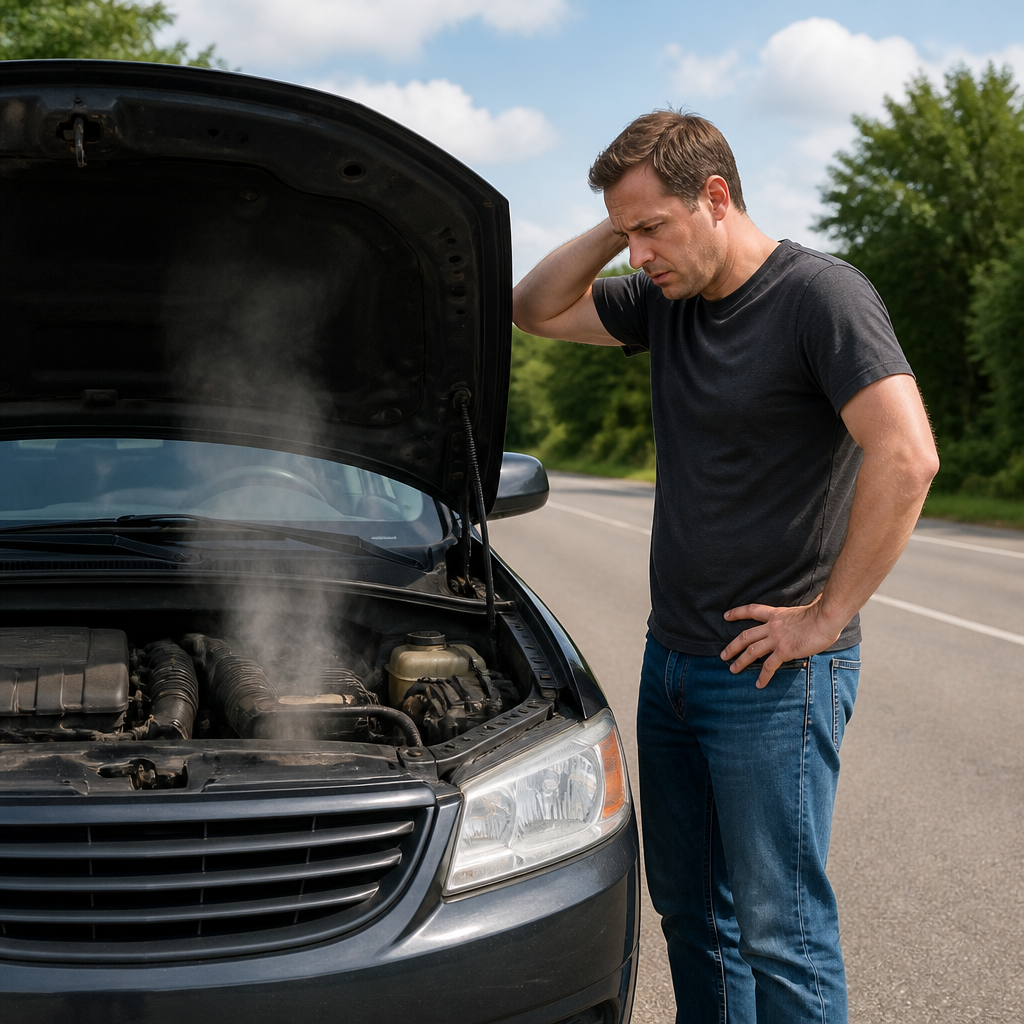
If the temperature gauge starts rising beyond its normal range, act early. Turn off air conditioning, reduce speed, and increase cabin heat to pull thermal energy away from the engine. If traffic allows, keep the car moving rather than idling. Do not continue a hard climb at the same throttle setting just to maintain pace with modern traffic. If the gauge approaches the danger zone or you see steam, pull over safely and shut the engine off. Do not remove the radiator cap when hot. Pressurized coolant can erupt violently and cause severe burns. Wait until the system cools substantially before inspecting anything.
Once stopped, look for obvious leaks, a thrown belt, split hose, collapsed hose, coolant on the ground, or signs that the fan is not operating. If coolant level is low and the engine has cooled enough, top up carefully with the correct fluid or clean water in an emergency, then monitor temperature closely as you proceed. If overheating returns quickly, do not keep driving in hope. Repeated overheating causes cumulative damage. Towing is cheaper than a cracked head, warped deck surface, or destroyed bearings. That is the safety mindset every classic car owner should adopt.
Avoiding overheating while driving comes down to three principles: maintain the cooling system as a complete system, drive with mechanical sympathy, and respond early to changes. Classic cars give clear warnings when you know how to read them. A stable gauge, a properly shrouded fan, correct timing, sound hoses, and smart route choices work together to keep temperatures controlled. The payoff is reliability, safety, and confidence on every trip, whether you are heading to a local show or taking a long summer tour. Use this hub as your foundation for driving and safety tips, then apply these checks before your next outing so your classic stays enjoyable instead of overheated.
Frequently Asked Questions
What are the most common reasons a classic car overheats while driving?
The most common cause of overheating in a classic car is a cooling system that can no longer shed heat as efficiently as it should. In older vehicles, radiators often corrode internally and gradually become restricted, which reduces coolant flow and limits the radiator’s ability to transfer heat. Hoses can soften internally or harden with age, water pumps may lose efficiency, thermostats can stick, and fan clutches or mechanical fans may not pull enough air through the radiator at low speeds. Even something as simple as a worn radiator cap can lower system pressure and allow coolant to boil sooner than intended.
Driving conditions matter just as much as the hardware. Long idling periods, stop-and-go traffic, steep grades, hot weather, and sustained highway speeds can all push marginal cooling systems past their limit. Timing that is too far advanced or retarded, lean fuel mixtures, dragging brakes, and slipping transmissions can also increase engine heat. In many classic cars, the problem is not one dramatic failure but several small weaknesses stacking up at once. That is why preventing overheating starts with looking at the entire system rather than replacing only the first part that appears suspicious.
How can I prevent my car from overheating before I head out on a drive?
The best prevention is a thorough pre-drive inspection and regular cooling system maintenance. Start by checking the coolant level when the engine is fully cool, and make sure the mixture is appropriate for your climate and the type of coolant your vehicle requires. Inspect the radiator core for blocked fins, external debris, or signs of leakage, and look over all hoses for cracking, swelling, soft spots, or loose clamps. If your car uses a belt-driven fan and water pump, verify that the belts are properly tensioned and not glazed or frayed. Also check for seepage around the thermostat housing, water pump, heater core connections, and freeze plugs.
It is also wise to confirm that the system is actually working as intended. A thermostat that opens at the correct temperature, a fan clutch that engages when hot, a shroud that is correctly positioned, and a radiator cap that holds proper pressure all make a major difference. On classic cars especially, gauge accuracy should not be taken for granted. If the factory temperature gauge is vague or inconsistent, installing a reliable mechanical or high-quality electric gauge can help you catch a problem early. Before a long trip, many experienced owners also flush old coolant, inspect ignition timing, and make sure the engine is tuned properly, because a poorly tuned engine often runs hotter than one that is dialed in correctly.
What warning signs suggest my engine is getting too hot while I am driving?
The obvious sign is a rising temperature gauge, but in older vehicles you should also pay attention to more subtle clues. If the gauge starts reading higher than normal for the same weather and driving conditions, that alone deserves attention. You may also notice a hot coolant smell, steam from under the hood, pinging or spark knock under load, reduced power, rough running, or coolant pushing into or out of the overflow area. In severe cases, the heater may suddenly blow cooler air because coolant is no longer circulating properly, or you may see signs of boiling in the radiator or recovery tank after stopping.
One important point for classic car owners is that factory gauges are not always highly accurate, and some senders or wiring circuits can drift with age. That means you should learn what “normal” looks like for your specific car rather than relying only on a generic midpoint on the dial. If a car usually runs steadily at one mark and suddenly climbs beyond that without an obvious reason, treat it seriously. Catching an overheating issue early can prevent warped cylinder heads, blown head gaskets, damaged pistons, and other expensive engine repairs that often happen when drivers keep going too long.
What should I do if my car starts overheating during a trip?
If you notice the temperature climbing, reduce the engine’s heat load immediately. Turn off the air conditioning, ease off the throttle, and if traffic allows, drive at a steady moderate speed rather than idling in stop-and-go conditions. In many cases, turning the heater on full hot with the blower running can help pull extra heat away from the engine, uncomfortable as it may be. Watch the gauge closely. If the temperature continues rising or steam appears, pull over safely and shut the engine off before serious damage occurs.
Do not remove the radiator cap while the engine is hot. A pressurized cooling system can release scalding coolant violently. Let the engine cool completely before inspecting anything. Once safe, check for obvious causes such as a broken belt, burst hose, leaking radiator, loose clamp, or coolant loss. If the coolant level is low and you have the proper fluid or clean water for an emergency top-off, add it only after the engine has cooled. If there is a major leak, repeated overheating, or signs of internal engine trouble such as oil in the coolant or persistent bubbling, do not continue driving. At that point, towing is far cheaper than risking catastrophic engine damage.
Are there upgrades that help classic cars avoid overheating more reliably?
Yes, and in many classic cars thoughtful upgrades can improve reliability without changing the character of the vehicle. A high-efficiency radiator, whether a properly restored original-style unit or a quality modern replacement, is one of the most effective improvements. Pairing that with fresh hoses, a correct thermostat, a properly rated radiator cap, and a well-sealed shroud can dramatically improve cooling performance. If the original fan setup is marginal, a heavy-duty fan clutch, improved mechanical fan, or carefully selected electric fan system can help, especially in traffic and warm climates.
That said, upgrades work best when they solve a real weakness instead of masking a deeper problem. For example, adding a bigger fan will not fully compensate for incorrect ignition timing, a clogged radiator, or a water pump with poor circulation. Many owners also benefit from adding a coolant recovery tank, upgrading to a more accurate temperature gauge, and ensuring the engine bay airflow is not blocked by missing seals or poorly routed components. The goal is not simply to make the car run cooler at all times, but to keep it operating within its intended safe range under the conditions you actually drive. A well-maintained and intelligently upgraded cooling system gives a classic car the best chance of staying dependable on modern roads.