European rare classics occupy a special place in automotive history because they combine scarcity, engineering ambition, cultural prestige, and extraordinary auction performance. In the classic car market, a rare classic usually means a low-production or one-off vehicle with documented provenance, original mechanical specification, and significance tied to design, racing, or technical innovation. Record-breaking, in this context, refers not only to headline auction prices, but also to benchmark private sales, concours recognition, and enduring influence on collectors and restorers. I have worked around cataloging, valuation, and restoration research for collector cars long enough to see one pattern repeated: the European models that break records are almost never random trophies. They sit at the intersection of brand mythology, historical importance, and surviving authenticity.
This matters because the market for concept and rare cars shapes the broader classic car landscape. When a Ferrari 250 GTO sets a new ceiling, values and interest ripple into coachbuilt Ferraris, competition Maseratis, lightweight Jaguars, and homologation specials from Porsche and Mercedes-Benz. Buyers, historians, and enthusiasts use these benchmark sales to judge rarity, originality, and long-term significance across the entire Classic Car Models & Brands category. As a hub for concept and rare cars, this article explains which European classics broke records, why they did, how the market evaluates them, and what lessons collectors can apply when researching the next great acquisition or restoration project.
What makes a European rare classic record breaking
A European rare classic breaks records when four factors align: extreme scarcity, verified provenance, technical or stylistic importance, and buyer confidence. Scarcity alone is not enough. A car can be one of ten and still underperform if it lacks factory documentation, notable ownership, or relevance to a larger story. Provenance covers build sheets, matching-numbers drivetrains, racing entries, period photos, and chain of ownership. Importance can stem from motorsport success, a first-use technology, celebrated coachwork, or a pivotal role in a brand’s development. Buyer confidence depends on authenticity, restoration quality, and how well specialists can substantiate every claim.
In practice, the biggest prices usually follow recognizable templates. Ferrari dominates because its competition history, limited production, and archival support create strong narratives. Mercedes-Benz reaches similar heights when a car represents a technical landmark, as seen with the 300 SLR Uhlenhaut Coupe. Aston Martin, Jaguar, Bugatti, Alfa Romeo, and Porsche also command exceptional results when they combine race pedigree with low production. Concept cars and prototypes occupy a narrower lane. They can be immensely valuable when they preview production-defining design language or survive as singular factory experiments, but the market treats them more cautiously because usability, homologation, and legal registration can complicate ownership.
Record-setting European classics that defined the market
The strongest example of a European rare classic that broke records is the Mercedes-Benz 300 SLR Uhlenhaut Coupe. In 2022, one of two examples sold in a private transaction brokered through RM Sotheby’s for roughly 135 million euros, making it the most expensive car publicly acknowledged as sold. Its value came from unmatched rarity, direct ties to Rudolf Uhlenhaut, and its status as an engineering icon derived from the W196 and 300 SLR racing program. This was not simply a rare Mercedes. It was a rolling summary of postwar German engineering leadership, combining magnesium-alloy construction, advanced fuel injection, and motorsport lineage that few cars can equal.
The Ferrari 250 GTO remains the most consistent benchmark for auction and private-sale records among classic cars. Built from 1962 to 1964 in very limited numbers, the GTO blended Colombo V12 performance with a competition chassis eligible for GT racing. Several transactions have exceeded 40 million dollars, and private sales have reportedly climbed far higher. Why does the 250 GTO sustain that level? Because it checks every criterion: elite racing history, beautiful Scaglietti-influenced form, tiny production, broad eligibility for top concours and historic events, and near-universal recognition even outside specialist circles. Few cars are as liquid at the top end because demand is global and the supply is fixed forever.
Another landmark is the 1955 Jaguar D-Type, particularly Le Mans-winning or works-connected examples. The D-Type introduced monocoque construction principles to Jaguar’s competition cars and used aerodynamic thinking inspired by aviation, including its famous stabilizing fin. When a Le Mans-winning D-Type crossed the block for more than 21 million dollars, it proved that British racing legends could compete with Italian blue-chip values. The same principle applies to the Aston Martin DBR1, one of the brand’s most important race cars. A DBR1 sold for over 22 million dollars, reflecting not only rarity but also its role in Aston Martin’s 1959 Le Mans victory and its connection to drivers such as Carroll Shelby and Roy Salvadori.
| Model | Brand | Why It Set Records | Market Significance |
|---|---|---|---|
| 300 SLR Uhlenhaut Coupe | Mercedes-Benz | Two built, direct factory significance, race-derived engineering | Established the highest publicly confirmed car sale level |
| 250 GTO | Ferrari | Ultra-low production, race pedigree, universal collector demand | Defined the top tier of classic Ferrari valuations |
| D-Type | Jaguar | Le Mans history, advanced construction, works provenance | Elevated British competition cars in the global market |
| DBR1 | Aston Martin | Le Mans-winning era significance, elite driver history | Proved Aston Martin’s top competition cars are blue-chip assets |
Concept cars, prototypes, and coachbuilt rarities
Within the Concept & Rare Cars subtopic, pure concepts and one-off coachbuilt machines deserve separate treatment because their value drivers differ from those of standard production classics. A concept car is usually a design or engineering exercise created by a manufacturer or coachbuilder to test styling, packaging, materials, or technology. A prototype may be mechanically closer to production but built before official series manufacture. Coachbuilt rarities include chassis sent to firms such as Zagato, Bertone, Pininfarina, Touring, Ghia, Chapron, or Figoni et Falaschi for bespoke bodies. These cars can break records when they represent a turning point in design language or survive as singular examples with complete documentation.
Think of the Alfa Romeo 8C coachbuilt specials, prewar Bugatti Atlantics, and unique Aston Martin Zagato variants. A Bugatti Type 57SC Atlantic has been associated with values around the 40 million dollar range in private transactions because it is not merely scarce; it is one of the most celebrated designs in automobile history. Its riveted body construction, Jean Bugatti lineage, and tiny surviving population make it a museum-level object. Similarly, Ferrari and Maserati prototypes from the 1950s and 1960s can command enormous prices when they preview later competition developments. In my experience, collectors approach these cars like industrial sculpture backed by chassis numbers, period race entries, and archive files, not just transport.
Concept cars that remain in factory collections rarely trade, which limits price transparency. When they do emerge, condition and operability matter more than many buyers expect. A static show car with a nonfunctional drivetrain appeals differently from a running prototype that can be demonstrated at Villa d’Este or the Goodwood Festival of Speed. Registration rules can also affect liquidity. Some one-offs are difficult to register for road use, which narrows the buyer pool. That does not prevent record prices, but it shifts the market toward institutions and ultra-established collectors who value significance above usability.
Why provenance, originality, and restoration decide value
Collectors often ask the simplest question first: what makes one rare classic worth ten times another? The answer is usually provenance plus originality. Matching numbers still matter because they connect the engine, gearbox, chassis, and body to the car’s original factory identity. On high-value European classics, specialists verify stampings, casting dates, weld patterns, trim materials, and component finishes against marque records. Ferrari Classiche, Porsche Classic, Jaguar Daimler Heritage Trust records, Mercedes-Benz Classic archives, and British Motor Industry Heritage certificates all help confirm history, though each source has limits and should be read critically.
Restoration quality can add or destroy millions in perceived value. An over-restored car finished to a glossy standard that never existed in period may score points with casual observers but lose credibility with experienced judges and buyers. I have seen market enthusiasm cool quickly when a supposedly untouched car turned out to have replacement stampings or undocumented body reconstruction. The best restorations preserve original material where possible, document every intervention, and use period-correct techniques. For race cars, patina can be valuable if it is honest and traceable. For coachbuilt cars, craftsmanship must reflect how Touring Superleggera, Zagato, or Pininfarina actually built bodies in that era.
Ownership history also shapes premiums. A car driven by Stirling Moss, Juan Manuel Fangio, Peter Collins, or a royal patron carries a wider cultural story. Even non-celebrity provenance matters if the ownership chain is short, stable, and documented. The market rewards confidence. Every invoice, photograph, race program, and factory letter reduces uncertainty, and reducing uncertainty is one of the surest ways a rare classic moves toward record territory.
How auctions, private sales, and events create new benchmarks
Record prices do not appear in a vacuum. They are produced by a network of auctions, dealer relationships, factory heritage programs, concours events, registries, and media exposure. RM Sotheby’s, Gooding Christie’s, Bonhams, Broad Arrow, and Artcurial dominate many top-tier European classic sales because they combine marketing reach with specialist cataloging. Their descriptions often function as research documents, outlining chassis chronology, race entries, restoration work, and archival sources. A well-run auction can compress years of reputation-building into one visible transaction, giving the market a fresh comparable sale.
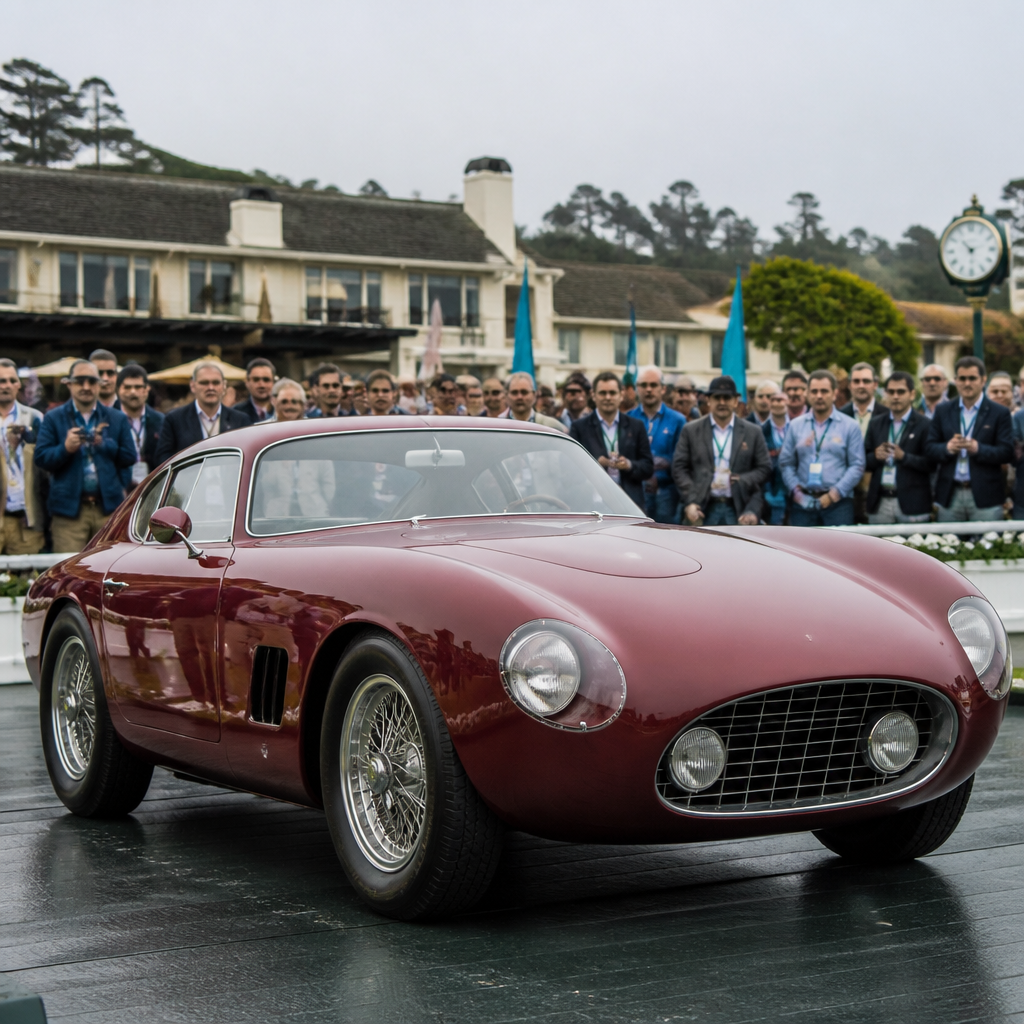
Private sales remain just as important, especially above the public auction spotlight. Many exceptional Ferraris, Mercedes competition cars, and coachbuilt Alfa Romeos change hands quietly through marque experts. Privacy appeals to buyers and sellers, but it also means reported prices should be treated carefully unless corroborated. Concours events like Pebble Beach and Concorso d’Eleganza Villa d’Este add another layer. A class win or Best of Show title does not automatically create a record, yet it can validate restoration quality and historical importance. The same is true for invitations to the Mille Miglia, Le Mans Classic, or the Monterey Motorsports Reunion, where eligibility itself can strengthen value.
For readers exploring the wider Classic Car Models & Brands landscape, this hub connects naturally to deeper studies of Ferrari legends, homologation specials, iconic coachbuilders, and competition-bred road cars. Those related subjects matter because record-breaking rare classics are rarely isolated stories. They sit within broader brand histories and model families that explain why certain chassis become cultural and financial landmarks.
What collectors should learn from Europe’s record breakers
The main lesson from Europe’s record-breaking rare classics is that the best cars tell a verifiable story. Price follows meaning. If you are evaluating a concept car, a homologation special, or a coachbuilt grand tourer, start with significance before cosmetics. Ask what problem the car solved, what design language it introduced, what races it entered, and how clearly its paperwork supports those claims. Use marque specialists, inspect archives, commission forensic examinations, and compare the car against known reference examples. Serious collectors never rely on seller enthusiasm alone.
Another lesson is that rarity must be qualified. A low-production 1970s special with little support network is not automatically stronger than a better-documented 1950s sports racer from a major brand. The market repeatedly rewards cars backed by recognized factories, event eligibility, and strong parts and knowledge ecosystems. Finally, buy the best documented example you can afford. European rare classics that broke records did so because they united scarcity with proof, beauty, and historic weight. Use this hub as your starting point for deeper research into concept cars, coachbuilt one-offs, and landmark competition machines, then follow the brand-specific paths that fit your interests and collecting goals.
Frequently Asked Questions
What makes a European rare classic “record-breaking” in the collector car world?
A European rare classic becomes record-breaking when it sets a new benchmark for value, desirability, or market influence within its category. That can certainly mean a headline auction result, but the definition goes further than a single high sale price. In practice, collectors and market analysts look at whether a car reset expectations for its marque, model, coachbuilder, era, or condition level. For example, a rare Ferrari, Bugatti, Mercedes-Benz, Alfa Romeo, or Aston Martin may be considered record-breaking if it becomes the most expensive example of that model ever sold, if it outperforms previous valuation ceilings for pre-war European sports cars, or if it establishes a new standard for how provenance and originality are rewarded.
Record-breaking status is also tied to context. A sale can be especially important if it confirms a broader shift in the market toward historically significant, low-production European cars with documented ownership history, original drivetrains, period competition links, or factory-backed engineering milestones. In other words, the record is not just about money; it is about recognition. When a rare classic sells for an extraordinary figure, it often validates its place in automotive history as a design icon, a motorsport legend, or a technical landmark. That is why certain European classics continue to attract global attention even decades after they were built.
Why do provenance and originality have such a major impact on the value of rare European classics?
Provenance and originality are two of the most powerful drivers of value because they help establish authenticity, historical importance, and collector confidence. Provenance refers to the documented life story of the vehicle: who owned it, where it was delivered, how it was used, whether it competed in notable races, and how completely that history can be verified through factory records, registration documents, service files, period photographs, and expert research. A European classic with a traceable chain of ownership, especially one connected to royalty, prominent collectors, racing teams, or influential cultural figures, tends to command a substantial premium because its story is both credible and compelling.
Originality matters just as much because it protects the car’s identity. Collectors typically place the highest value on cars that retain their original engine, chassis, gearbox, body configuration, and factory-correct specifications. Matching-numbers examples are prized because they represent continuity with the car’s original build and reduce uncertainty about authenticity. Even details such as original color combinations, period-correct interiors, factory equipment, and minimally altered mechanical components can significantly influence desirability. In the highest end of the market, buyers are not simply purchasing a beautiful vehicle; they are acquiring an artifact. The closer that artifact remains to its original form, the stronger its position in record-setting territory.
Which qualities tend to separate an ordinary classic from a rare European classic that achieves exceptional auction results?
The difference usually comes down to a combination of scarcity, significance, condition, and market narrative. An ordinary classic may be attractive, enjoyable to own, and historically interesting, but a rare European classic that breaks records usually offers something much harder to replicate. Low production numbers are a major factor, especially when only a small number of cars were built to begin with and even fewer survive in correct specification. One-off coachbuilt examples, homologation specials, factory competition cars, and limited-run grand tourers often draw the most intense attention because their rarity is structural rather than temporary.
Historical significance is equally important. Cars tied to major racing events, pioneering engineering developments, celebrated designers, or defining moments for a manufacturer tend to rise above the broader market. A European classic can also achieve exceptional results if it represents the best surviving example of its type, has won major concours events, or has been restored to the highest standards by recognized specialists. Timing matters as well. When a car enters the market with strong documentation, wide international exposure, and a compelling story that resonates with serious collectors, bidding can move beyond conventional estimates. In those moments, the vehicle is no longer judged solely as a car, but as a rare historical object with prestige, scarcity, and cultural weight.
Are record-breaking European classics valuable only because they are rare, or does engineering and design matter too?
Engineering and design matter enormously. Rarity may attract initial attention, but it rarely sustains top-tier values on its own. The European classics that set records are often celebrated because they embody ambitious engineering, advanced performance for their era, and design language that influenced the industry. Whether it is a lightweight competition chassis, an early fuel-injection system, an innovative suspension layout, a high-revving multi-cam engine, or a body shaped by one of Europe’s great design houses, technical and aesthetic achievements help explain why certain models remain so desirable across generations.
Design also contributes to emotional appeal, which is a major force in the upper end of the collector market. A car that is instantly recognizable, beautifully proportioned, and linked to a legendary coachbuilder or stylist often enjoys broader demand than a merely scarce car with little visual or technical distinction. The strongest record-setters usually combine multiple layers of importance: they are rare, they are mechanically interesting, they are visually iconic, and they represent a peak moment for their maker. That blend of form, function, and historical relevance is why so many European classics continue to set benchmarks long after their production ended.
How should collectors evaluate whether a European rare classic is likely to hold or increase its value over time?
Collectors should start by looking beyond short-term auction excitement and focusing on fundamentals. The strongest long-term candidates usually have clear and durable qualities: genuine rarity, documented provenance, original mechanical identity, recognized historical importance, and broad international appeal. Cars that sit at the intersection of these factors tend to be more resilient because demand is rooted in substance rather than temporary fashion. A rare classic associated with motorsport success, a famous coachbuilder, a milestone engineering achievement, or a major luxury or performance marque generally has a stronger chance of maintaining relevance over time.
Condition and documentation should also be examined closely. Buyers should assess whether the car retains matching numbers, whether restorations were completed to authentic standards, whether factory records support the claimed specification, and whether the vehicle has any gaps in ownership history. Liquidity matters too. Some extremely rare cars are so specialized that they appeal only to a narrow circle of buyers, while others benefit from a global collector base. In the end, value retention usually favors examples with the fewest compromises and the strongest stories. In the world of European rare classics, the cars that continue to hold or increase their value are typically those that can stand up to expert scrutiny while still capturing the imagination of the market.