The most unique classic car designs ever built stand apart not simply because they are old, rare, or expensive, but because they changed how people imagined the automobile. In the classic car world, design means far more than styling. It includes body proportions, engineering layout, coachbuilding technique, interior packaging, aerodynamics, and the cultural message a car sends at first glance. Rare cars add another layer: low production numbers, experimental features, unusual origins, or one-off craftsmanship that makes them reference points for collectors and historians. When I evaluate concept and rare cars, I look for the same qualities judges, restorers, and marque specialists use: originality, influence, execution, and historical context. A dramatic shape alone is not enough. The truly exceptional cars combined daring form with a meaningful technical or cultural leap.
This matters because classic car design remains one of the clearest windows into twentieth-century innovation. Before computer simulation and corporate platform sharing narrowed visual differences, automakers and coachbuilders had room to take real risks. That freedom produced streamliners, coachbuilt grand tourers, early supercars, postwar microcars, radical concepts, and hand-formed prototypes that still shape automotive taste today. It also produced commercial failures that became design legends precisely because they were too advanced, too strange, or too expensive for their moment. For enthusiasts researching concept and rare cars, this subject is more than a list of beautiful machines. It explains how design ideas travel from concours lawns and museum galleries into mainstream road cars. This hub explores the standout models, the themes that connect them, and what makes a classic design genuinely unique rather than merely uncommon.
What makes a classic car design truly unique
A unique classic car design solves a problem in a fresh visual and mechanical way. That can mean an unfamiliar silhouette, like the teardrop bodies inspired by aviation and record cars in the 1930s. It can mean an unconventional layout, such as rear engines, mid engines, gullwing doors, wraparound glass, or hidden headlamps used before they became widely accepted. It can also mean a coachbuilder taking a standard chassis from Alfa Romeo, Bugatti, Delahaye, or Ferrari and clothing it in a body no major manufacturer would have risked. In my experience reviewing surviving examples, the cars that endure in memory usually unite proportion and purpose. Their details are strange, but never random. Even the wildest concept car tends to express the era’s priorities, whether speed, luxury, space efficiency, jet-age futurism, or safety.
Rarity alone does not create significance. A low-volume car built in tiny numbers may still be derivative. By contrast, a relatively better-known model can qualify as rare in influence because it introduced an idea first or crystallized a design language everyone copied later. The Citroen DS is a good example. It was not obscure, yet its aerodynamic profile, covered rear wheels, hydropneumatic suspension, and minimalist cabin redefined modernity in 1955. Likewise, the Mercedes-Benz 300SL Gullwing remains unique not only because of its doors, but because its tubular spaceframe required them, linking engineering necessity with unforgettable appearance. When people ask which classic cars were ahead of their time, these are the standards worth applying.
Prewar masterpieces and streamlining experiments
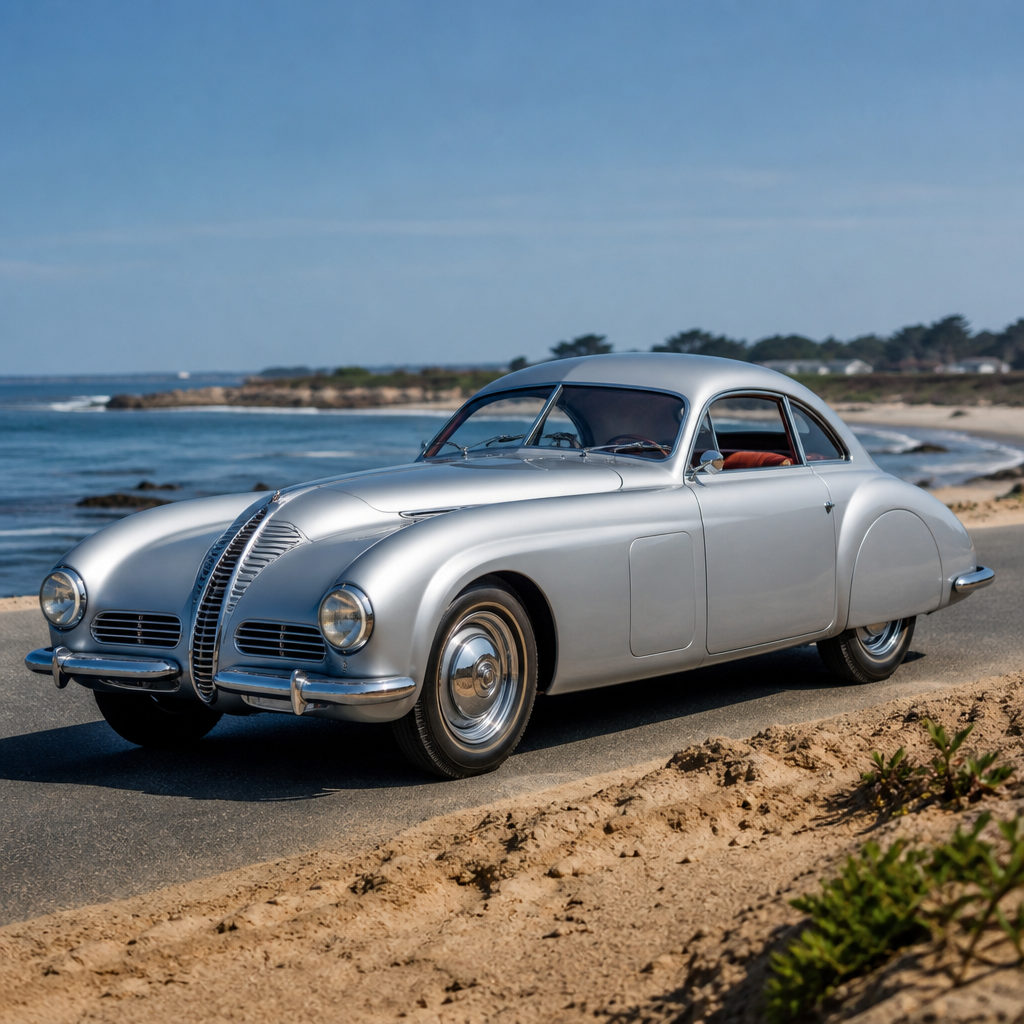
The prewar period produced some of the most unusual classic cars ever built because wealthy buyers often ordered bodies from independent coachbuilders. This system encouraged experimentation. Brands such as Bugatti, Hispano-Suiza, Talbot-Lago, Delage, and Alfa Romeo sold rolling chassis, while houses like Figoni et Falaschi, Saoutchik, Touring, and Graber translated performance and status into sculpture. The 1937 Talbot-Lago T150 C SS “Teardrop” by Figoni et Falaschi is one of the clearest examples of unique classic car design. Its flowing fenders, enveloped wheels, tapering tail, and low roofline turned aerodynamic theory into rolling art. Few cars of any era balance ornament and speed so effectively.
Another landmark is the Bugatti Type 57SC Atlantic. Built from Jean Bugatti’s aviation-influenced thinking, the Atlantic used a riveted dorsal seam and elongated coupe proportions that still look otherworldly. Only a handful were made, but the car’s impact on design history is enormous. The same applies to the Phantom Corsair, Rust Heinz’s 1938 prototype, with slab sides, skirted wheels, integrated lighting, and a profile closer to a science-fiction object than a conventional luxury car. It was not a production success, yet it forecast postwar streamlining and integrated bodywork. These cars matter because they prove that rare prewar automobiles were not decorative side notes. They were laboratories for ideas that later appeared in sports cars, luxury coupes, and even family sedans.
Postwar icons that redefined the road car
After World War II, unique car design shifted from elite coachbuilt commissions toward production models bold enough to challenge public expectations. The 1948 Tucker 48 is essential here. Its central “Cyclops” headlamp, rear-engine layout, padded dashboard, pop-out windshield, and attention to occupant protection made it one of the most advanced American cars of its day. Production collapsed amid financial and legal turmoil, but the design remains important because it treated safety and engineering integration as visual identity. The car looked different because it was trying to function differently.
The 1955 Citroen DS changed the conversation in Europe. Designed by Flaminio Bertoni and engineered with hydropneumatic suspension, front-wheel drive, inboard brakes, and an exceptionally clean body, the DS arrived like a machine from a later decade. Contemporary observers were stunned, and with good reason. It combined aerodynamic efficiency, ride comfort, and a futuristic cabin in a package ordinary buyers could actually own. The same decade delivered the BMW Isetta and Fiat 600 Multipla, reminders that uniqueness can mean inventive packaging rather than glamour. Both answered postwar urban needs with compact dimensions and unconventional access or seating arrangements. They show that rare and concept-adjacent thinking can influence mass mobility just as much as halo cars do.
Coachbuilt exotics and limited-run grand tourers
Some of the most distinctive classic car models came from the tension between a manufacturer’s mechanical platform and an independent designer’s imagination. Italian carrozzerie were especially influential. Bertone, Pininfarina, Zagato, Ghia, and Touring each developed signatures that made otherwise related cars visually and functionally different. The Alfa Romeo BAT series, created by Bertone in the 1950s, remains one of the best examples of concept thinking applied to real automotive engineering. BAT 5, BAT 7, and BAT 9 used dramatic fins and low-drag forms to explore aerodynamics long before wind tunnel optimization became standard marketing language.
Ferrari’s limited-production road cars also illustrate how rare classics become design benchmarks. The 250 GT SWB Breadvan, commissioned for racing and clothed by Drogo, turned practical aerodynamic reasoning into one of the oddest and most celebrated Ferrari profiles ever created. The 1962 Ferrari 250 GTO, though more famous than obscure, remains a masterclass in how competition requirements can produce a shape that is both beautiful and brutally functional. On the more eccentric side, the Iso Grifo, Bizzarrini 5300 GT, and Lamborghini Miura each stretched expectations of proportion and stance. The Miura in particular changed supercar design by making the transversely mounted mid-engine layout a visual event. Low, wide, and impossibly dramatic, it established a template still visible in exotic cars today.
Concept cars that previewed the future
Concept cars deserve special attention in any hub on rare classic cars because they often reveal the industry’s ambitions before those ideas reach showrooms. The 1951 General Motors Le Sabre translated aircraft inspiration into a fully running test car with a wraparound windshield, jet-age bodywork, and advanced features including a rain sensor for the convertible top. In the 1950s and 1960s, Motorama concepts such as the Buick Y-Job, Cadillac Cyclone, and Firebird series demonstrated how American manufacturers used design studies to test public reaction to features, forms, and technologies. Some details were fantasy, but many ideas, from integrated bumpers to panoramic glass and driver-focused instrumentation, influenced production.
European concepts often felt more restrained yet no less important. The Lancia Stratos Zero, unveiled by Bertone in 1970, pushed wedge design to an extreme with an extraordinarily low height and a shape that looked almost two-dimensional from the side. It was outrageous, but not irrelevant. Wedge themes soon spread across sports cars from Lotus, Maserati, and Lamborghini. The Alfa Romeo Carabo, also by Bertone, introduced scissor doors and a sharply folded profile that became visual shorthand for exotic performance. When evaluating historic concept cars, the key question is simple: did the idea stay on the stand, or did it migrate into the market? The best classic concepts did both, first shocking audiences, then quietly rewriting the design brief for future models.
Design themes that define concept and rare cars
Across decades, the most unusual classic car designs tend to cluster around a few recurring themes. These patterns help enthusiasts identify why one rare car feels historically important while another feels merely odd.
| Theme | What it means | Representative classics |
|---|---|---|
| Aerodynamic streamlining | Bodies shaped to reduce drag and express speed | Talbot-Lago Teardrop, Bugatti Atlantic, Alfa Romeo BAT 7 |
| Radical packaging | Unusual layouts that improve space, balance, or usability | Tucker 48, BMW Isetta, Fiat 600 Multipla |
| Futurist show-car styling | Concept-led forms meant to preview tomorrow’s tastes | GM Le Sabre, Cadillac Cyclone, Lancia Stratos Zero |
| Coachbuilt exclusivity | Custom or semi-custom bodies on proven mechanical bases | Ferrari Breadvan, Bizzarrini 5300 GT, many Zagato coupes |
| Engineering-driven identity | Appearance shaped directly by chassis or powertrain decisions | Mercedes-Benz 300SL Gullwing, Lamborghini Miura, Citroen DS |
These themes are useful for collectors because they provide a framework for comparing cars from very different eras. A prewar Delahaye and a 1970s wedge concept may share little mechanically, yet both can be historically important if they capture a turning point in design thinking. Museums, concours events, and major auctions increasingly interpret rare cars this way, grouping them by innovation as much as by brand. That broader view helps explain why vehicles once dismissed as curiosities now receive serious scholarly and market attention.
How collectors judge rarity, originality, and lasting significance
In the collector market, rarity is measured carefully. Production totals matter, but provenance, originality, period modifications, and documentation matter just as much. A one-off show car with complete factory records can be more historically valuable than a low-production road car with uncertain history. When I assess rare classics, I start with three questions. Was the design influential? Is the surviving example authentic in body, chassis, and specification? Does the car represent a meaningful moment in automotive development? Auction houses such as RM Sotheby’s, Gooding Christie’s, and Bonhams evaluate these same factors because buyers at the top of the market are purchasing significance, not just scarcity.
Condition also requires nuance. Over-restoration can erase the very qualities that make a rare car important, especially on hand-built bodies where asymmetry, aluminum shaping marks, and period materials tell the truth of how the car was made. Standards from organizations like the Pebble Beach Concours d’Elegance and the Fédération Internationale des Véhicules Anciens emphasize authenticity for good reason. A concept car repainted in the wrong finish or a coachbuilt coupe retrimmed in non-period materials may look impressive while becoming less historically trustworthy. For readers exploring concept and rare cars, the central lesson is clear: the most unique classic car designs are valuable not just because they are hard to find, but because they preserve a design idea that changed the language of the automobile.
The most unique classic car designs ever built deserve attention because they reveal how boldly manufacturers, coachbuilders, and individual visionaries once thought about mobility. From the prewar elegance of the Talbot-Lago Teardrop and Bugatti Atlantic to the engineering-led forms of the Tucker 48, Citroen DS, Mercedes-Benz 300SL, and Lamborghini Miura, these cars did more than stand out at launch. They introduced new shapes, new layouts, and new expectations that influenced generations of production vehicles. Concept cars such as the GM Le Sabre, Alfa Romeo Carabo, and Lancia Stratos Zero extended that legacy by turning experimental ideas into future design vocabulary.
As a hub for concept and rare cars within classic car models and brands, this topic works best when you study each vehicle in context: who built it, what problem it aimed to solve, why it looked the way it did, and how its ideas spread. That approach separates novelty from true innovation. It also makes collecting, restoring, or simply admiring these automobiles far more rewarding. If you want to understand classic car design at its highest level, start with the rare cars that changed the rules, then follow their influence across the wider history of the automobile.
Frequently Asked Questions
What makes a classic car design truly unique rather than just rare or expensive?
A truly unique classic car design stands out because it introduced a new way of thinking about what an automobile could be. Rarity and price can make a car desirable, but they do not automatically make its design important. Unique design usually combines visual identity with engineering originality. That can mean unusual proportions, a breakthrough aerodynamic shape, an unconventional engine layout, innovative coachbuilding methods, or a cabin arranged in a way that challenged industry norms. In other words, the car does more than look different—it changes expectations.
Many of the most memorable classics became icons because they carried a strong idea from every angle. Some used flowing bodywork to reduce drag long before aerodynamics became mainstream. Others used rear engines, mid-engine layouts, wraparound glass, tailfins, monocoque construction, or dramatic hand-formed aluminum bodies to create something that felt futuristic for its time. A unique classic also tends to send a cultural message instantly. It may represent optimism, speed, luxury, space-age experimentation, or handcrafted exclusivity. That emotional impact is a major part of what separates a merely collectible old car from one that genuinely altered automotive design history.
Why are coachbuilt and low-production classics often considered some of the most distinctive cars ever made?
Coachbuilt and low-production classics are often the most distinctive because they were less constrained by mass-market demands. In the early and mid-20th century, many prestigious chassis were sent to independent coachbuilders who created custom or semi-custom bodies for wealthy clients. That process allowed for artistic freedom that is rarely possible in large-scale manufacturing. Designers could experiment with rooflines, fender shapes, door configurations, windshield angles, and interior materials in ways that would have been too expensive or impractical for mainstream brands.
Low production numbers also meant manufacturers could take bigger risks. Experimental design ideas, unusual technical layouts, and highly specialized bodywork were more feasible when a company only planned to build a handful of cars. Some were grand touring machines with dramatic fastback silhouettes, others were avant-garde luxury sedans, and some were road-going engineering statements meant to showcase national pride or technical leadership. Because they were not designed for broad commercial appeal, these cars often feel more daring today. Their scarcity adds intrigue, but the real reason they matter is that they preserve moments when design was personal, ambitious, and sometimes beautifully eccentric.
How did engineering influence the most unusual classic car designs?
Engineering played a central role in many of the most unusual classic car designs. Some of the boldest shapes in automotive history were not created for style alone—they were direct responses to mechanical choices. A rear-mounted engine could free up cabin space and change the car’s stance. A mid-engine layout could create a low nose and balanced proportions that looked radically different from front-engine competitors. Unitary construction, lightweight materials, independent suspension, and new aerodynamic research all gave designers opportunities to rethink the body itself.
In many classic cars, the engineering and the styling are inseparable. Streamlined prewar automobiles, for example, often reflected serious interest in airflow efficiency, not just visual drama. Postwar GT cars used lower hoods, wider tracks, and sleeker cabins because performance and handling were improving. Even interior packaging was affected by engineering. Flat floors, panoramic glass, unusual seating arrangements, and innovative dashboards all came from technical decisions as much as aesthetic ones. That is why the most unique classic designs still feel so compelling: they are not random acts of styling, but complete ideas where form followed innovation, and innovation reshaped form.
Which design elements tend to define the most iconic and unconventional classic cars?
The most iconic and unconventional classic cars often share a few design traits, although they express them in very different ways. Proportion is usually the first one. Long hoods, short decks, cab-forward cabins, teardrop silhouettes, pontoon fenders, chopped roofs, and dramatic wheel placement can instantly make a car memorable. Surface treatment matters too. Some classics rely on sculpted curves and flowing lines, while others use crisp edges, formal symmetry, or jet-age ornamentation. Even small features such as hidden headlights, reverse-opening doors, wraparound rear windows, bubble canopies, exposed spare wheels, or dramatic grille treatments can define a car’s identity.
Interior design is equally important. Truly distinctive classics often introduced unusual dashboards, advanced instrumentation, luxurious handcrafted materials, or seating layouts that made the cabin feel different from anything else on the road. Color, trim, and glass area also contributed heavily to a car’s personality. In some cases, the unconventional element was not flamboyant at all, but exceptionally clean and modern compared with its contemporaries. What makes these elements iconic is not simply that they are strange, but that they are integrated into a complete vision. The greatest designs feel intentional, balanced, and confident, even when they break every rule of their era.
Why do unique classic car designs still influence collectors, designers, and enthusiasts today?
Unique classic car designs continue to influence people because they represent moments when the automobile was treated as both a machine and a statement of imagination. Collectors value these cars not just for rarity, but for the originality they embody. A design that challenged convention decades ago still carries prestige because it reflects courage, craftsmanship, and a willingness to experiment. Enthusiasts are drawn to them because they tell stories—about technological progress, social trends, national identity, luxury culture, motorsport ambition, and the dreams of the era that produced them.
Modern car designers also study these classics closely. Many contemporary themes—fastback rooflines, minimalist surfaces, panoramic cabins, integrated aerodynamics, and dramatic GT proportions—have roots in historic cars that first explored those ideas. The most unusual classics remind the industry that memorable design comes from coherence, not excess. They prove that a car becomes timeless when engineering, aesthetics, and cultural meaning all support one another. That is why these automobiles remain so important today. They are not just artifacts from the past; they are reference points for how bold, inventive, and emotionally powerful automotive design can be.