Classic car wall decor ideas can turn an ordinary garage, workshop, or man cave into a space that feels personal, curated, and deeply connected to automotive history. In practical terms, wall decor includes everything mounted, framed, painted, hung, or displayed vertically to express a theme. In the context of classic car culture, that means vintage signs, framed photography, dealership memorabilia, grille displays, license plates, blueprints, neon, posters, shelving, and purpose-built feature walls. I have helped organize several collector garages, and the difference between a room with random automotive items and one with a clear wall decor plan is dramatic: the second feels larger, cleaner, and far more valuable.
This matters because garage and man cave design is not just about appearance. The right classic car wall decor improves organization, protects collectibles, supports better lighting, and creates a stronger connection between the owner and the vehicles. A well-designed wall can celebrate a 1967 Mustang restoration, showcase Porsche racing heritage, or preserve family memories around a grandfather’s pickup. It also supports the wider goals of a classic car space: better storage, better storytelling, and better use of square footage. Whether the room is a detached garage, basement lounge, showroom-style outbuilding, or a two-car bay with limited wall room, the same principle applies. Decor works best when it combines theme, scale, function, and authenticity. This hub covers the essential approaches, the best materials to display, layout strategies, lighting considerations, and common mistakes, so readers can confidently build a garage or man cave that looks intentional rather than cluttered.
Choose a theme before buying anything
The best classic car wall decor starts with a theme, not a shopping cart. Most disappointing garage makeovers happen because owners buy attractive signs and posters individually without a system for how they fit together. A theme gives the room a point of view. It can be brand-specific, era-specific, motorsport-focused, regionally rooted, or based on a particular use case such as restoration, racing, road trips, or service station nostalgia. For example, a Chevrolet enthusiast may build a wall around bowtie dealership signage, period ads, Bel Air photos, and parts manuals from the 1950s. A broader Americana garage may mix Sinclair, Texaco, Route 66, and chrome-heavy art from multiple makes.
Scale matters as much as subject matter. In a one-car garage, a giant porcelain sign can anchor the room, while ten small pieces may look busy. In a larger outbuilding, small framed prints can disappear unless grouped salon-style. Start by identifying one hero item for each major wall. That could be a restored metal sign, a large black-and-white photo of Le Mans, a framed assembly manual, or a display of original license plates. Then support that hero item with secondary pieces that repeat color, era, or brand. This creates visual rhythm and makes even diverse collections feel coherent. If you plan future articles or project pages within a larger classic car lifestyle site, this theme-first approach also acts like a hub, helping related decor, storage, and lighting choices connect naturally.
Use authentic automotive memorabilia strategically
Authentic memorabilia usually has more impact than mass-produced decor because age, wear, typography, and manufacturing methods give it credibility. Good examples include porcelain gas and oil signs, dealership emblems, metal service boards, original brochures, framed magazine covers, hubcaps, clocks, and tin tacker signs. Original pieces often show the design language of their time: hand-painted logos, enamel finishes, stamped steel, and color palettes associated with brands like Ford, Cadillac, Alfa Romeo, or MG. In a collector garage, one real item often outperforms five reproductions.
That said, authenticity should be balanced with budget and risk. Original porcelain signs from brands such as Mobilgas, Gulf, or Shell can cost hundreds or thousands of dollars depending on size, condition, rarity, and whether both sides survive. Reproductions are useful when you want the look without exposing valuable collectibles to humidity, UV light, or accidental damage. The smart approach is to place reproductions in higher-risk zones near doors, lifts, or workbenches, and reserve originals for climate-controlled walls or lounge areas. Provenance matters too. If an item is presented as original, check mounting holes, backing, edge wear, gloss consistency, and known reproduction patterns. Reputable auction houses, automobilia dealers, and marque-specific forums are better sources than anonymous marketplace listings with vague descriptions.
Create focal walls that tell a story
A focal wall is the anchor of a garage or man cave. It should immediately communicate what the room is about. In most successful spaces I have seen, the focal wall tells a story rather than simply displaying objects. A story can center on one vehicle, one racing era, one road trip tradition, or one family legacy. For example, if the room celebrates a first-generation Bronco, the wall might combine a framed photo of the vehicle in use, a reproduction sales brochure, a period-correct dealership sign, and trail maps from places where the truck was driven. That arrangement says more than a random collection of generic truck posters.
Storytelling is especially effective when walls mix flat art with dimensional objects. A framed blueprint of a Jaguar E-Type can sit above a narrow shelf holding model cars in the correct colorway. A drag racing wall may pair event posters with timing tags, pit passes, and a retired number panel. If the room doubles as a gathering space, keep the focal wall readable from across the room. Large typography, high contrast, and clean spacing help. Avoid overfilling every inch. Empty wall space is not wasted space; it frames important pieces and gives the eye somewhere to rest. The goal is curation, not storage disguised as decoration.
Best wall decor formats for garages and man caves
Different wall decor formats solve different design problems. Framed prints are ideal for preserving ephemera such as advertisements, racing photos, and build sheets. Metal signs add texture and work well in workshops because they are durable and easy to wipe down. Neon and LED signs contribute color and atmosphere, especially in lounge sections where fluorescent shop lighting would feel harsh. Mounted parts, such as steering wheels, valve covers, grilles, wheels, or hood ornaments, add sculptural interest and signal true enthusiast ownership. Slatwall or French cleat systems can also blur the line between display and utility by allowing helmets, tools, and accessories to be arranged neatly.
The right format depends on the room’s conditions. Paper pieces need UV-filtering glass or acrylic if sunlight reaches the wall. Heavy cast or steel parts require studs, proper anchors, and often a plywood backer behind drywall. In damp garages, powder-coated shelving and aluminum frames hold up better than untreated wood. Here is a practical comparison of common options.
| Decor format | Best use | Main advantage | Limitation |
|---|---|---|---|
| Framed posters and photos | Lounge walls, focal displays | Easy to personalize and rotate | Needs protection from moisture and UV |
| Vintage metal or porcelain signs | Garage bays, entry walls | Durable and visually bold | Originals can be expensive |
| Neon or LED automotive signs | Bars, seating areas, evening ambiance | Strong mood lighting and branding | Requires power and careful placement |
| Mounted car parts | Feature walls, workshop displays | Adds depth and authenticity | Heavy and harder to install safely |
| License plate and badge collections | Narrow walls, columns, transitions | Flexible layout and easy expansion | Can look cluttered without a grid |
Incorporate functional decor to save space
In a real garage, walls often need to work hard. The strongest designs use decor that is also functional. Open shelves can display oil cans, trophies, manuals, and scale models while storing frequently used supplies. A shadow box can protect small automobilia such as spark plugs, shift knobs, and emblems while acting as art. Pegboards and slatwalls, when painted in a restrained palette, can look far better than people expect. I have seen matte black slatwall panels with polished aluminum hooks turn a chaotic detailing station into a display-worthy backdrop.
Mirrors are another underused tool. In smaller garages, a large industrial-style mirror reflects light, makes the room feel deeper, and can echo the chrome and glass of the cars themselves. Wall-mounted cabinets with metal mesh or glass fronts allow collections to be visible but protected from dust. Even a coat rack made from old wrenches or a shelf bracket fabricated from connecting rods can support the classic car theme without becoming gimmicky, if the craftsmanship is strong. The principle is simple: every object on the wall should either tell the story, improve function, or ideally do both.
Match decor to the era and architecture of the space
Classic car wall decor works best when it respects both the cars and the building. A mid-century collection of signs and ads feels at home in a garage with painted block walls, exposed steel, and simple enamel lighting. A polished modern showroom with epoxy floors, flush cabinetry, and glass doors may suit cleaner framed photography, factory blueprints, monochrome prints, and restrained neon instead of rustic service-station clutter. Problems arise when the architectural language and decor language fight each other.
Era matching also sharpens credibility. Art Deco-inspired graphics fit prewar luxury marques such as Packard or Delahaye. Weathered gas station imagery pairs naturally with 1940s through 1960s American drivers. Group B rally photos, Bosch posters, and period maps support a 1980s European theme better than generic pin-up signs. Color is a useful guide. If the room houses British classics, racing green, cream, and black often look more intentional than bright red and yellow gas brand signage. If the collection centers on muscle cars, stronger saturated colors may be completely appropriate. Good design is not about following one style formula; it is about making the wall look like it belongs with the vehicles parked in front of it.
Light the walls like a gallery, not a storage unit
Lighting determines whether wall decor looks premium or forgotten. Many garages rely on overhead fixtures alone, which flatten artwork and leave shadows under shelves or signs. Better results come from layered lighting. Use bright, high-color-rendering task lighting for work areas, then add accent lighting for feature walls. Track heads, directional LED spots, picture lights, and under-shelf strips can make vintage signs, framed posters, and chrome parts stand out without overwhelming the space. A color rendering index above 90 helps paint tones, enamel finishes, and photographs appear accurate.
There are practical limitations. Neon looks excellent, but it should not be the only light source. Direct sunlight fades paper quickly, especially older inks. Warm lighting can flatter wood and leather seating areas, while neutral white often suits display walls with metal and glass. In garages where vehicles are photographed, avoid mixing too many color temperatures, or walls will look inconsistent in pictures. One of the easiest upgrades is putting accent lights on separate switches. That allows the space to move from workshop mode to social mode without changing the decor itself. Good wall lighting is not decoration after the fact; it is part of the display design from the beginning.
Common mistakes that make automotive walls look cluttered
The most common mistake is hanging items too high. Many garage walls end up arranged around parked vehicles rather than human sightlines, so signs float near the ceiling where details are lost. In lounge areas, center framed art roughly at eye level. In active bays, use lower zones only where car doors will not strike the wall. Another mistake is ignoring spacing. Collections need consistent margins, especially license plates, framed posters, and small signs. Uneven gaps create visual noise.
A second major problem is mixing too many styles without hierarchy. A serious Ferrari photography print can clash with novelty bar signs and cartoon artwork unless each has its own zone. Poor framing also weakens good content. Thin bargain frames make valuable prints look disposable, while proper mats, metal frames, and museum acrylic elevate them. Finally, many owners underestimate climate issues. Adhesives fail in hot garages, paper curls in humidity, and heavy parts pull out of drywall when mounted carelessly. The fix is straightforward: plan the layout on paper, choose a dominant style, measure twice, and mount for the environment you actually have, not the one you wish you had.
Building a wall decor hub that evolves with your collection
The best classic car wall decor ideas are flexible enough to grow as your interests change. Very few enthusiasts stop at one car, one brand, or one era forever. A wall system that allows rotation prevents expensive redesigns. Standardized frames, modular shelves, cleat-mounted panels, and designated collection zones make it easy to add a concours poster, a newly found badge, or photos from a fresh restoration. Think of the room as a living archive. Each wall can connect to a larger subtopic within garage and man cave design: storage, lighting, seating, flooring, display cases, and workshop organization all influence how decor performs.
Start with one wall, one story, and one quality benchmark. Choose pieces that mean something, mount them correctly, and light them well. Authenticity matters, but thoughtful presentation matters just as much. When the decor fits the cars, the architecture, and the way you actually use the room, the result feels timeless instead of trendy. If you are building out a classic car garage or man cave, review your walls first. They offer the fastest path to creating a space that celebrates car culture every day.
Frequently Asked Questions
What are the best types of classic car wall decor for a garage, workshop, or man cave?
The best classic car wall decor usually combines personality, scale, and authenticity. A strong starting point is vintage automotive signs, especially old dealership signs, gas and oil branding, service station plaques, and metal advertising pieces that instantly establish a nostalgic atmosphere. Framed photography is another excellent option, particularly black-and-white racing images, factory shots, restoration photography, or portraits of iconic vehicles from the 1950s, 1960s, and 1970s. These pieces add visual depth and help the room feel curated rather than random.
Many enthusiasts also use original or reproduction license plates, classic car blueprints, framed brochures, and neon signs to build a layered look. If you want a more distinctive display, mounted grilles, hubcaps, steering wheels, hood ornaments, and dealership emblems can turn the wall into a true automotive feature. Shelving can also become part of the decor when it is used to display scale models, manuals, trophies, or collectible parts. In a workshop, practical decor often works best, while in a man cave or lounge area, statement pieces such as oversized signs, murals, or illuminated displays tend to have the strongest impact.
Ultimately, the best decor depends on the kind of classic car story you want the room to tell. Some spaces focus on American muscle, others on vintage European racing, hot rods, pickups, or a specific brand such as Ford, Chevrolet, Porsche, or Cadillac. When the wall decor reflects a clear theme, the entire room feels more intentional, immersive, and memorable.
How do I choose a theme for classic car wall decor without making the space feel cluttered?
The key to choosing a theme is to narrow your focus before you start hanging anything. Rather than collecting every interesting automotive item you find, define the personality of the room first. You might center the space around a single era, such as 1950s Americana or 1960s muscle cars. You could also base it on a vehicle type, such as vintage trucks, race cars, convertibles, or garage service culture. Another effective approach is to build around a specific marque, color palette, or motorsport history. Once you have that direction, selecting decor becomes much easier because each piece either supports the theme or it does not.
To avoid clutter, mix statement pieces with breathing room. One large sign, framed print, or mounted grille can often do more for the room than ten small unrelated items. Group similar items together so they read as a collection instead of visual noise. For example, a grid of vintage license plates looks organized and intentional, while scattered plates across multiple walls can feel chaotic. The same is true for framed posters, dealership memorabilia, and photographs. Consistent framing, spacing, and alignment go a long way toward making the display feel polished.
It also helps to think in zones. One wall might feature signs and lighting, another could display framed artwork, and a smaller section might showcase tools, badges, or mechanical parts. This keeps the room from feeling overloaded. Good classic car wall decor should feel like a curated gallery of automotive passion, not a storage wall. Editing is just as important as collecting, and the spaces that look best are usually the ones where every item has a purpose.
What are some creative ways to display authentic classic car parts on a wall?
Authentic car parts can become some of the most memorable wall decor in the room because they bring real automotive history into the space. Grilles are especially popular because they have strong shapes, instantly recognizable styling, and enough visual presence to anchor a wall. Mounted hubcaps can be arranged in symmetrical patterns, while old license plates can be grouped by state, decade, brand affiliation, or color for a more design-driven presentation. Hood ornaments, badges, emblems, and trim pieces also work well when framed in shadow boxes, which protects them while giving them a museum-style look.
For a more dramatic effect, some collectors mount doors, trunk emblems, steering wheels, old dashboards, or even partial front-end clips as sculptural features. These displays work best on reinforced walls and in larger spaces where they have room to be appreciated. If the decor is meant for a refined man cave rather than a purely functional workshop, pairing these parts with lighting can elevate the presentation considerably. Backlighting a grille, spotlighting a badge collection, or placing neon near a mounted sign creates depth and gives the room a finished look.
Safety and installation matter just as much as aesthetics. Heavier parts should always be mounted securely into studs or supported with proper hardware rated for the weight. Clean the parts thoroughly, stabilize any rust if needed, and decide whether you want a preserved patina or a restored finish. That choice will affect the mood of the room. Patina tends to feel more authentic and rugged, while restored chrome and painted parts create a cleaner, more polished display. Either approach can work beautifully as long as it suits the overall style of the space.
Should I use original vintage automotive memorabilia or reproductions for wall decor?
Both original memorabilia and reproductions have value, and the best choice depends on your budget, goals, and how the space will be used. Original vintage items carry real history, which is a major part of their appeal. An authentic dealership sign, service station advertisement, factory brochure, or period license plate often has character that reproductions simply cannot replicate. The wear, patina, fading, and age marks tell a story, and for many collectors that authenticity is the point. Original pieces can also become conversation starters and, in some cases, retain or increase their value over time.
Reproductions, however, offer practical advantages. They are typically more affordable, easier to source, and available in a wider variety of sizes and styles. If you are trying to fill a large wall, create a coordinated design, or decorate a high-traffic garage where dust, temperature swings, and accidental damage are concerns, reproductions can be the smarter choice. They also let you enjoy iconic branding and imagery without the pressure of preserving rare collectibles. For many people, a well-made reproduction still captures the spirit of classic car culture while being more accessible and easier to maintain.
In most cases, a mix of both works best. Use original pieces as focal points and support them with high-quality reproductions that reinforce the theme. For example, an authentic porcelain sign can serve as the centerpiece, while reproduction posters, framed prints, and newer neon accents help complete the surrounding display. This approach gives the room credibility and visual richness without requiring every item to be a rare collector’s piece. The result feels balanced, thoughtful, and true to the enthusiast lifestyle.
How can I arrange classic car wall decor so it looks professionally designed?
A professional-looking arrangement starts with planning the wall as a full composition rather than adding items one at a time. First, identify your focal point. This could be a large vintage sign, an oversized framed photo, a neon piece, or a mounted grille. Once that central element is chosen, build outward with supporting decor that varies in size but still feels cohesive. Think about balance, spacing, and repetition. If one side of the wall has a heavy visual element, the other side should feel equally intentional, even if it is not perfectly symmetrical.
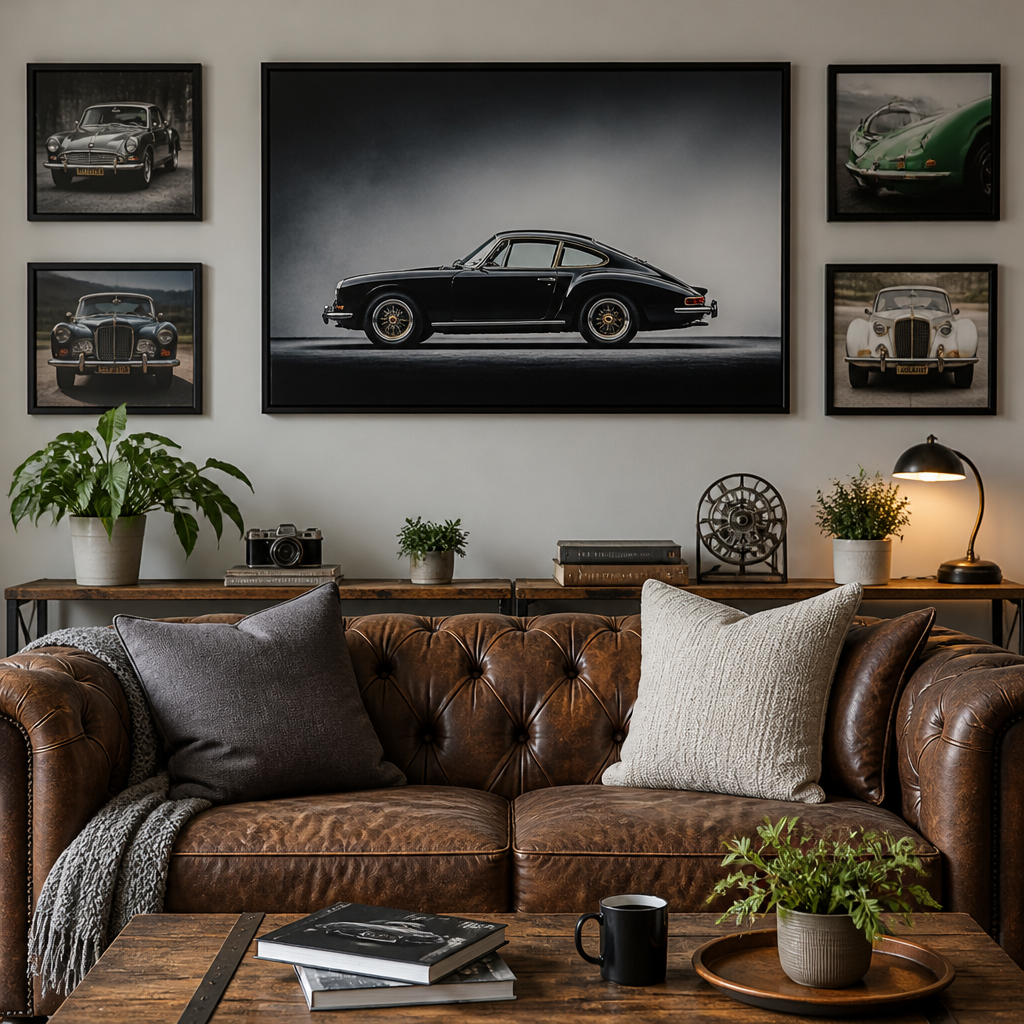
Scale is one of the biggest factors in making wall decor look designed instead of improvised. Large walls often need larger anchor pieces, while small items work best when grouped together into organized collections. A gallery wall of framed automotive photography can look sophisticated when the frames share a consistent finish and spacing. Likewise, rows of license plates, aligned signs, or neatly mounted blueprints create order and rhythm. Lighting also makes a major difference. Directional spotlights, LED strips behind shelves, or accent lighting around feature pieces can transform a basic display into a showroom-inspired wall.
It is also important to coordinate the decor with the room itself. Wall color, flooring, furniture, tool cabinets, and shelving should all support the automotive theme rather than compete with it. Industrial finishes, wood accents, black metal, polished concrete, and vintage-inspired furniture often pair especially well with classic car decor. If possible, lay out the arrangement on the floor first or use paper templates on the wall before mounting anything permanently. That extra step helps you refine spacing and proportions. The most successful classic car wall displays feel collected over time, but they are usually arranged with a clear design strategy behind them.