Volkswagen classics occupy a unique place in automotive history because they combine mass-market engineering, cultural symbolism, and mechanical simplicity in a way few European classics ever matched. When enthusiasts talk about classic Volkswagens, they usually mean air-cooled models built from the late 1930s concept era through the 1970s, especially the Beetle, the Type 2 Bus, the Karmann Ghia, the Type 3 range, the Type 4 family, and performance variants linked to Porsche-influenced engineering. As someone who has spent years around restored Beetles, split-window buses, and driver-grade Ghias at shows, workshops, and auctions, I have seen the same pattern repeatedly: these cars attract first-time collectors and seasoned restorers because they are approachable, historically significant, and unusually well supported by parts suppliers.
This matters within European classics because Volkswagen helped define postwar mobility on the continent. While marques such as Mercedes-Benz, Jaguar, Alfa Romeo, Citroen, and Porsche often represented luxury, innovation, or speed, Volkswagen represented accessible ownership at scale. The Beetle became one of the best-selling cars in history, with more than 21 million produced worldwide. The Bus became a commercial workhorse, family transporter, and later a counterculture icon. Together, these vehicles created a broad gateway into collecting European classic cars. They also anchor countless related topics, from coachbuilt coupes and early hot hatches to preservation standards, factory originality, and global enthusiast communities.
For a hub page covering European classics, Volkswagen is essential because it connects multiple reader interests at once. Someone researching prewar roots may start with the KdF-Wagen story. A buyer comparing affordable classics may narrow in on a 1967 Beetle versus a Fiat 500 or Morris Minor. A restorer studying practical upkeep may move from air-cooled flat-four maintenance into suspension geometry, six-volt electrical systems, or period-correct trim. A traveler drawn to design history may follow the line from the T1 Microbus to Westfalia campers, then onward to Italian-bodied Volkswagens and Porsche collaboration. In other words, Volkswagen classics are not an isolated niche. They are a central corridor through the broader world of European classic car culture.
Understanding Volkswagen classics starts with a few key terms. “Air-cooled” refers to engines cooled by airflow rather than liquid coolant. “Type 1” generally means the Beetle platform. “Type 2” refers to the Bus and Transporter line. “Matching numbers” indicates that a car still carries the factory-correct engine and chassis relationship, a detail valued most on early and rare models. “Patina” describes visible age and use that some collectors preserve rather than restore away. These terms matter because condition, originality, body style, and production year can change values dramatically. A split-window Beetle, a 23-window Samba, and a late Super Beetle are all classic Volkswagens, but they sit in very different collector categories.
The Beetle: the foundation of the Volkswagen classic story
No Volkswagen classic article can begin anywhere except with the Beetle. Conceived before World War II and produced in evolving form for decades, the Beetle paired a rear-mounted air-cooled flat-four engine with a platform chassis, torsion-bar suspension, and unmistakable rounded body. Its engineering priorities were durability, ease of manufacture, and low running costs. In practice, those choices created a car that could survive rough roads, long storage periods, and amateur maintenance better than many of its contemporaries. That is one reason surviving examples remain so common relative to many European classics from the 1950s and 1960s.
Collectors usually divide Beetles into key eras. Early split-window cars, built through 1952, are scarce and highly valued. Oval-window Beetles from 1953 to 1957 offer many early styling cues while being somewhat more usable. The 1958 to 1966 cars represent the classic small-window shape many people picture first. The 1967 Beetle stands apart because it combines one-year-only features in several markets, making originality especially important. Later 1968 to 1977 standards and Super Beetles are generally more affordable entry points. If your goal is a manageable European classic with deep parts support, a well-sorted 1970s Beetle is often the smartest first purchase, not the most romantic one.
The Beetle matters beyond sales volume. It became a design constant across continents, assembled in Germany, Brazil, Mexico, and other markets. It entered film, advertising, motorsport, and youth culture. In restoration terms, it also taught generations of owners how to maintain valves, ignition points, carburetors, fuel pumps, and drum brakes. When people say a Volkswagen classic is easy to own, they usually mean a Beetle. That reputation is broadly deserved, although rust in heater channels, floor pans, spare wheel wells, and rear quarter structures can turn a cheap car into an expensive project very quickly.
The Bus and Transporter: workhorse, camper, and cultural icon
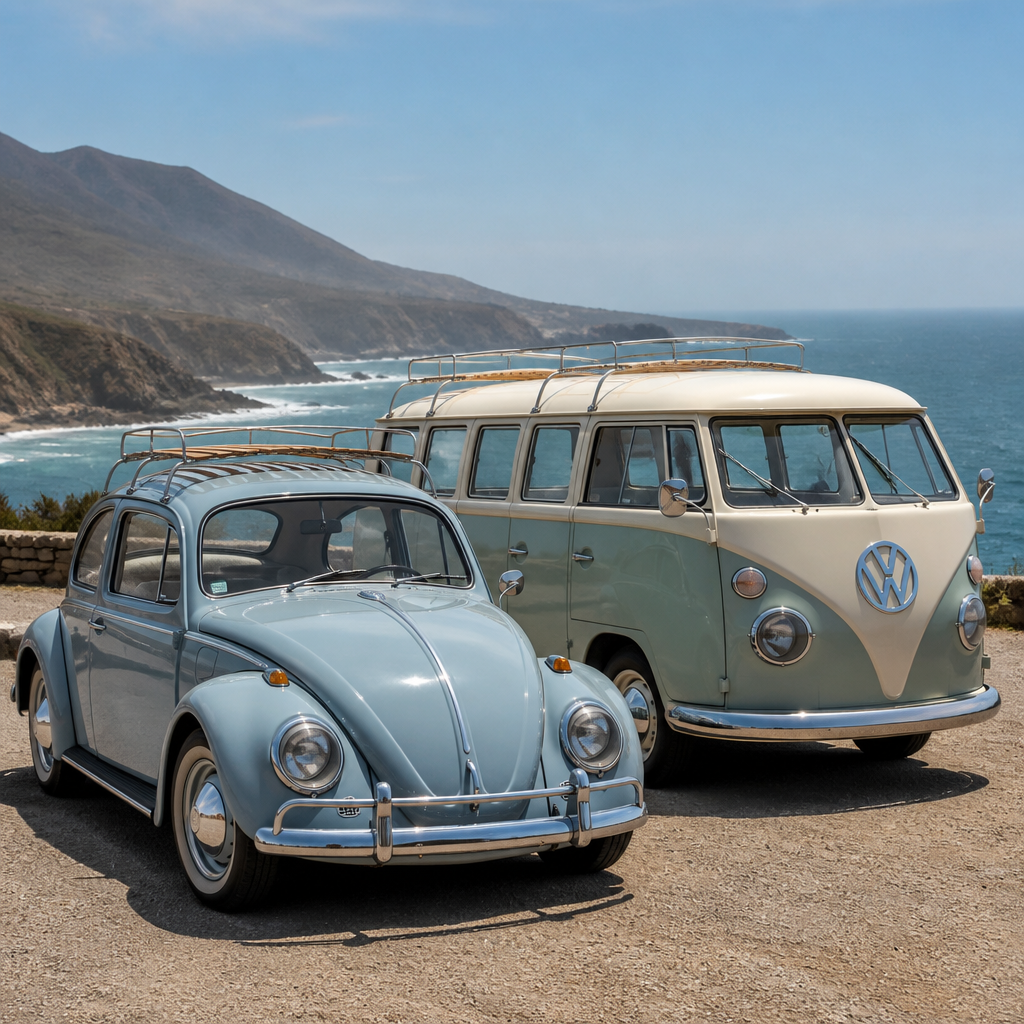
If the Beetle is the mechanical heart of Volkswagen classics, the Bus is the emotional center. Known variously as the Type 2, Transporter, Microbus, Kombi, or Camper depending on configuration and market, it used Beetle-derived running gear in a forward-control body that maximized space. The earliest T1 split-screen buses, introduced in 1950, are the most coveted. Their V-shaped nose, divided windshield, and versatile interiors created a form that was equally suited to commercial fleets, family use, and later leisure travel. The 1967 and earlier split buses command strong prices, especially Sambas with multiple skylight windows and deluxe trim.
The 1968-on T2 bay-window bus is more attainable and often more practical to drive. It offers better visibility, incremental safety improvements, and a wider supply of usable examples. Westfalia conversions deserve special attention because they sit at the intersection of classic car collecting and travel culture. Original camping interiors, folding tables, child cots, plaid upholstery, and pop-top roofs can significantly affect desirability. Buyers should inspect cargo floors, jack points, rocker panels, front valance sections, windshield surrounds, and battery trays carefully. Rust repair on a bus is usually more complex and more expensive than rust repair on a Beetle because of the vehicle’s size, panel structure, and demand for correct fit.
The Bus became iconic for reasons that go beyond nostalgia. It represented mobility with flexibility. Small businesses used panel vans for deliveries. Families used Kombis for holidays. Counterculture communities in the United States and Europe adopted Microbuses and campers for road travel and communal living. That layered history gives the Bus unusually broad appeal. It is both a commercial vehicle and a lifestyle artifact, which is rare among European classics.
Key Volkswagen classics every European car enthusiast should know
The Volkswagen classic world extends far beyond Beetles and buses. The Karmann Ghia, introduced in 1955, wrapped Beetle mechanicals in elegant bodywork styled by Carrozzeria Ghia and built by Karmann. It was never a true sports car, but it delivered style, low operating costs, and better exclusivity than a standard Beetle. Rust is its defining issue; nose damage and corroded lower body sections are common, and replacement metalwork often requires careful alignment. A sound Ghia nearly always costs less than restoring a poor one.
The Type 3 family, including the Notchback, Squareback, and Fastback, brought a more modern design language and better luggage packaging. These cars are often overlooked, which can make them compelling buys for enthusiasts who want something rarer at local events. Their fuel-injected versions also show how Volkswagen evolved beyond the earliest air-cooled template. The Type 4 411 and 412 models pushed further, while the 1970s 914, co-developed with Porsche, occupies a special space for buyers wanting Volkswagen lineage with mid-engine dynamics.
Performance-oriented collectors also watch the early Golf GTI, Scirocco, and even the Corrado, though these belong to a later front-engine, water-cooled era. They still matter on a European classics hub because they demonstrate Volkswagen’s transition from simple postwar people’s car builder to a brand shaping the hot hatch and modern enthusiast market.
| Model | Era | Why It Matters | Primary Buyer Consideration |
|---|---|---|---|
| Beetle Type 1 | 1940s–1970s core collector years | Foundational Volkswagen classic, huge parts support | Rust, originality, year-specific details |
| Type 2 Bus | 1950s–1970s | Cultural icon, camper and commercial versatility | Structural corrosion, interior completeness |
| Karmann Ghia | 1955–1974 | Italian styling on Volkswagen mechanicals | Body condition, repair quality |
| Type 3 | 1960s–1970s | Underrated alternative with practical packaging | Model-specific parts and fuel injection condition |
| Porsche 914 | 1969–1976 | Volkswagen-Porsche crossover with mid-engine layout | Rust, originality, four-cylinder versus six-cylinder values |
How Volkswagen fits into the broader European classics landscape
Volkswagen classics are best understood in comparison with other European classics. Against a Citroen 2CV, a Beetle feels more conservative but often more robustly engineered in drivetrain terms. Against a Fiat 500, it is larger, slower steering, and more substantial for touring. Against a Mini, it is less agile but mechanically simpler in several service areas. Against an Alfa Romeo Giulia or BMW 2002, it lacks outright performance but usually wins on entry cost and community support. This positioning explains why Volkswagen often becomes the starting point for collectors entering European classics before they move into more specialized marques.
It also serves as a bridge across national styles. The Karmann Ghia links German engineering to Italian design. Westfalia campers reflect German industrial practicality adapted to leisure use. The 914 blurs Volkswagen and Porsche identity. Because of these overlaps, Volkswagen pages often lead readers naturally to related articles on Porsche air-cooled models, Italian coachbuilding, French utility classics, German saloons, and 1970s touring culture. As a hub topic, Volkswagen is not merely a brand chapter. It is connective tissue across Europe’s classic car story.
Buying, restoring, and maintaining a classic Volkswagen
The best buying advice is simple: buy the most solid body you can afford. Mechanical parts for classic Volkswagens are plentiful, relatively inexpensive, and well documented. Structural rust, poor accident repair, and missing model-specific trim are far more dangerous to a budget. On Beetles, inspect heater channels, floor pan halves, frame head areas, rear cross members, and body mounting points. On buses, add outriggers, sills, front floor sections, and roof gutters to the checklist. Verify chassis numbers, engine codes, and market-correct features before paying a premium for rarity.
Restoration strategy depends on the car’s purpose. A concours restoration prioritizes factory paint codes, date-correct glass, proper fasteners, and original upholstery patterns. A driver restoration focuses on safe brakes, reliable charging, fresh fuel lines, rebuilt carburetion, and sensible upgrades such as radial tires or improved lighting. I generally advise new owners to separate cosmetic wants from reliability needs. A shiny Beetle with brittle fuel hose near a hot engine is not a smart classic. A scruffy bus with documented metalwork, compression numbers, and sorted brakes often is.
Maintenance remains one of Volkswagen’s strongest advantages. Valve adjustments, ignition timing, carburetor tuning, and brake servicing are straightforward for owners willing to learn. Trusted references include factory workshop manuals, Bentley Publishers manuals for many models, and respected suppliers such as Wolfsburg West, West Coast Metric, and CSP for certain parts categories. Still, not every reproduction part matches original quality. Careful sourcing matters, especially for rubber seals, chrome trim, and electrical components.
Values, originality, and what collectors should watch next
Volkswagen classic values vary sharply by rarity, condition, and documentation. Early split Beetles, 23-window Sambas, Hebmuller cabriolets, and low-mileage preserved examples sit at the top of the market. Middle-tier collector demand remains strong for honest oval-window Beetles, correctly restored Ghias, early Westfalias, and unusual Type 3 variants. Late-model Beetles and bay-window buses still provide accessible entry points, though the best examples have risen steadily as cheaper projects disappear.
Originality matters more today than it did twenty years ago. Period accessories can add charm, but heavily modified cars generally appeal to narrower audiences unless the modifications are historically important, as with Cal-Look builds or notable motorsport connections. Documentation, factory color combinations, and matching driveline components now influence values more consistently across auctions and private sales. The next area to watch is preservation-grade cars: unrestored Volkswagens with authentic finishes, known history, and minimal alteration are increasingly prized because they show how these cars actually lived.
Volkswagen classics remain one of the most rewarding entry points into European classic cars because they combine historical importance, mechanical accessibility, and unusually wide enthusiast support. The Beetle explains how simple engineering can shape global mobility. The Bus shows how one platform can become a van, camper, family hauler, and cultural symbol. Models such as the Karmann Ghia, Type 3, Type 4, and 914 broaden the story, connecting Volkswagen to design houses, Porsche collaboration, and changing postwar tastes. That range is exactly why Volkswagen deserves its place at the center of any European classics hub.
For buyers and readers, the practical lessons are clear. Learn the model families and their year-by-year differences. Prioritize body condition over easy mechanical fixes. Respect originality, but be realistic about usability and safety. Use established manuals, marque clubs, and specialist suppliers rather than guessing. Most importantly, choose the Volkswagen classic that matches how you want to enjoy it. A Beetle is ideal for simple ownership, a Karmann Ghia for style, a Type 3 for rarity, and a Bus for shared experiences on the road.
If you are building knowledge across classic car models and brands, start here and then explore the connected European classics that Volkswagen helps illuminate. Compare it with Porsche’s air-cooled lineage, Italian body design, French utility icons, and German sporting saloons. The better you understand Volkswagen, the better you understand Europe’s classic car landscape as a whole. Use this hub as your starting map, then narrow your search to the specific model, era, and ownership path that fits your goals.
Frequently Asked Questions
What makes Volkswagen classics so important in automotive history?
Volkswagen classics matter because they sit at the rare intersection of practical engineering, global popularity, and lasting cultural impact. Unlike many European classics that were expensive, exclusive, or technically intimidating, classic Volkswagens were designed for everyday people. That broad appeal helped models like the Beetle and the Type 2 Bus become some of the most recognizable vehicles ever built. They were not simply cars; they became symbols of mobility, affordability, and postwar optimism, and later took on entirely new identities through youth culture, travel culture, and the custom-car scene.
From an engineering standpoint, much of their significance comes from the air-cooled flat-four layout, rear-engine packaging, and a level of mechanical simplicity that made ownership approachable. The Beetle, for example, earned a reputation for durability and ease of maintenance, while the Bus transformed the same basic mechanical philosophy into a practical transporter, camper, and lifestyle vehicle. These vehicles were simple enough for owners to understand, repair, and personalize, which helped create one of the strongest enthusiast communities in the collector world.
Volkswagen classics also tell a broader story about industrial design and automotive evolution. The Beetle’s shape became iconic because it was instantly recognizable and fundamentally honest in its purpose. The Bus did the same in a completely different form, emphasizing utility and flexibility. Add in stylish derivatives like the Karmann Ghia, more refined families like the Type 3 and Type 4, and performance connections influenced by Porsche engineering, and the result is a classic lineup with unusual depth. That combination of accessibility, engineering identity, and cultural reach is what makes classic Volkswagens historically important far beyond their original price point.
Which models are usually considered the core Volkswagen classics?
When people refer to “classic Volkswagens,” they are most often talking about the air-cooled era, especially vehicles developed from the prewar concept roots through the 1970s. The centerpiece is the Volkswagen Beetle, known in many markets as the Type 1. It is the foundational model, the car that established Volkswagen’s global reputation and became one of the best-known automotive designs in history. Early split-window, oval-window, and later large-window Beetles all have their own following, with collectors often valuing originality, year-specific details, and regional variations.
Right alongside the Beetle is the Type 2 Bus, which includes Transporters, Kombis, Microbuses, Panel Vans, Pickups, and camper conversions. Enthusiasts often break these into major generations such as the Split Window and Bay Window models. The Bus has a different kind of appeal than the Beetle: it is tied to family travel, commercial use, surf culture, counterculture, and the modern van-life imagination. Because of that, it tends to attract collectors who appreciate both mechanical heritage and lifestyle history.
Beyond those two icons, the Karmann Ghia is another essential classic Volkswagen. It used Beetle-based mechanicals but wrapped them in elegant bodywork, giving buyers sports-car style with familiar VW simplicity. The Type 3 range, including the Notchback, Squareback, and Fastback, added more practicality and refinement while still remaining unmistakably air-cooled Volkswagens. The Type 4 family pushed further upmarket with larger dimensions, improved comfort, and more advanced engineering touches. Enthusiasts also pay close attention to performance-oriented variants and Porsche-linked developments, especially where engine design, tuning potential, and shared engineering philosophy overlap. In short, the core classic Volkswagen world is broader than just the Beetle and Bus, even if those two remain the most famous ambassadors.
Why are the Beetle and the Bus still the most iconic classic Volkswagens?
The Beetle and the Bus remain the defining Volkswagen classics because they achieved something very few vehicles ever do: they became universal symbols. The Beetle is instantly identifiable across generations and continents. Its rounded shape, compact proportions, and friendly visual character gave it a personality that people connected with emotionally. It was economical, dependable, and simple to keep on the road, which meant millions of owners formed personal memories around it. That emotional familiarity is a huge reason why the Beetle still dominates the classic VW conversation today.
The Type 2 Bus became iconic for different but equally powerful reasons. Where the Beetle represented personal mobility, the Bus represented shared experience. It could carry families, workers, cargo, campers, musicians, and adventurers. Over time it became associated with road trips, freedom, festivals, and alternative lifestyles, especially during the 1960s and 1970s. Even people who know little about automotive history can usually recognize a split-screen Bus immediately. Its shape is so distinctive that it has become a design language of its own.
Another reason these two models remain on top is the enormous ecosystem that formed around them. Parts availability, restoration knowledge, owner clubs, specialist workshops, and aftermarket support are all far stronger for the Beetle and Bus than for many lesser-known classics. That support keeps them visible and usable. They also work well as entry points into classic car ownership because their mechanical design is generally straightforward and their histories are well documented. In practical terms, cultural symbolism and maintainability reinforce each other. People continue to buy, restore, and drive Beetles and Buses because they are meaningful, but also because they are among the most approachable and community-supported classics in the world.
Are classic Volkswagens easy to own, maintain, and restore today?
Compared with many other European classics, vintage Volkswagens are often considered relatively approachable to own and maintain, but “easy” depends on the model, the condition of the vehicle, and the owner’s expectations. Their reputation for simplicity is well deserved. Air-cooled engines, straightforward mechanical layouts, and strong enthusiast documentation mean that basic servicing and many common repairs are easier to understand than on more complex classics. For hobbyists who enjoy hands-on work, that is a major part of the appeal.
However, simplicity should not be confused with effortless ownership. Age affects every classic car, and Volkswagens are no exception. Rust is often the biggest concern, particularly in floorpans, heater channels, battery trays, lower body sections, and structural areas on Buses. Poor previous restorations can create long-term problems that are far more expensive than routine mechanical work. Electrical systems, brake hydraulics, fuel components, seals, and suspension wear also need careful evaluation. A solid, honest car is usually a better investment than a cosmetically attractive example hiding corrosion or incorrect repairs.
One of the strongest advantages for classic Volkswagen ownership is the depth of the global support network. Reproduction parts, rebuilt components, technical manuals, online forums, and marque specialists are widely available, especially for Beetles and Type 2s. That said, not all replacement parts are equal in quality, and rarer models such as certain Type 3, Type 4, or year-specific trim variants may require more patience and expertise. The best ownership experience usually comes from buying the most complete and structurally sound car you can afford, learning the details of that model year, and working with specialists who understand original specifications. Done properly, classic Volkswagen ownership can be rewarding, affordable by classic-car standards, and much less intimidating than many people expect.
What should collectors and enthusiasts look for when buying a classic Volkswagen?
The first thing to look for is overall structural condition, because body and chassis repairs often determine whether a car is a good buy or a financial trap. On Beetles, buyers should closely inspect floorpans, heater channels, front frame head areas, spare-wheel wells, and signs of accident damage or poor welding. On Buses, attention should go to outriggers, jack points, rocker panels, cargo floors, wheel arches, front nose sections, and underbody structure. Cosmetic shine means very little if the underlying shell is compromised. Rust repair quality matters just as much as the presence of rust itself.
Originality is another major consideration, but it should be judged intelligently. Matching-numbers drivetrains, correct trim, proper upholstery patterns, and year-specific details can all add historical value, especially on earlier or rarer examples. At the same time, tasteful upgrades such as improved brakes, better ignition systems, or sympathetic engine work may make a car more usable without ruining its character. The key is understanding whether modifications were done professionally and whether original parts are included. Enthusiasts should also be aware that many Volkswagens have been mixed and matched over decades, so verifying chassis numbers, engine codes, production features, and model-year details is essential.
Finally, buyers should align the car with their intended use. A concours-minded collector may want a highly correct oval-window Beetle, early split-screen Bus, or carefully restored Karmann Ghia. A weekend driver may be better served by a later Beetle or Bay Window Bus with reliable mechanicals and fewer originality pressures. A performance enthusiast might focus on period-caliber tuning, Porsche-influenced engineering, or well-built hot street setups. In every case, documentation, specialist inspection, and a realistic budget for ongoing work are crucial. The best classic Volkswagen is not necessarily the rarest or most expensive one; it is the example that combines solid structure, honest history, mechanical integrity, and a clear fit with the owner’s goals.