Japanese classic cars occupy a unique place in automotive history because they combine engineering discipline, motorsport credibility, affordability, and cultural influence in ways few national car industries have matched. In this hub guide to the top 10 Japanese classic cars of all time, “classic” refers not only to age but to lasting significance: models that changed how enthusiasts, collectors, and manufacturers viewed performance, design, reliability, or tuning potential. After years of working around restorations, auction listings, import compliance files, and enthusiast builds, I have found that the Japanese cars with enduring value are rarely important for a single reason. They matter because they solved real engineering problems, created loyal communities, and still feel relevant decades later.
For buyers, restorers, and fans, Japanese classics matter for three practical reasons. First, they offer multiple entry points. Some are blue-chip collectibles, while others remain attainable project cars with strong parts support. Second, they represent milestones in major categories: sports coupes, rally homologation specials, lightweight roadsters, luxury performance sedans, and compact hatchbacks. Third, they connect directly to wider automotive trends, from overhead-cam engine development to turbocharging, four-wheel steering, advanced all-wheel drive, and the rise of factory-tunable platforms. This article serves as a central reference for Japanese classics, highlighting the ten models that best define the category and explaining why each deserves a place in the conversation.
Any serious list of top Japanese classic cars must balance cultural impact with technical achievement. That means looking beyond nostalgia and asking harder questions. Did the car introduce meaningful engineering? Did it prove itself in racing or rallying? Does it still influence modern vehicle design, collecting patterns, or tuner culture? Can parts still be sourced, and are ownership realities manageable? A model that looks good in photographs but lacks historical consequence is not enough. Conversely, a technically brilliant car with little enthusiast following may be important, but not truly iconic. The best Japanese classic cars meet both tests: they stand up to expert scrutiny and continue to inspire use, preservation, and debate.
The ten models below span several decades and philosophies, from elegant grand touring to stripped-down driver engagement. Together, they show how Japan moved from building competent transportation to creating machines that challenged Europe and America on equal terms. They also reflect the diversity within Japanese classics. A Datsun 240Z and a Toyota 2000GT pursued global prestige in different ways. A Honda S800 and a Mazda Cosmo showed willingness to experiment. A Skyline GT-R and a Lancer Evolution proved that competition development could shape road cars. If you want a reliable starting point for exploring Japanese classic cars, these are the essential names to know.
1. Toyota 2000GT: Japan’s First True Exotic
The Toyota 2000GT, built from 1967 to 1970, remains the benchmark for Japanese automotive prestige. Developed with Yamaha assistance, it used a 2.0-liter DOHC inline-six derived from Toyota’s M-series architecture but heavily reworked for performance. With around 150 horsepower, four-wheel disc brakes, a five-speed manual transmission, and a low-slung fastback body, the 2000GT was not merely good for a Japanese car. It was world-class by late-1960s standards. Production totaled only 351 units, which is a major reason values are now firmly in top-tier collector territory.
Its significance goes beyond rarity. The 2000GT proved Japan could produce a sophisticated halo car with precision engineering and compelling design. It set speed records, appeared in the Bond film You Only Live Twice, and gave Toyota credibility that helped future sports models gain global respect. In collecting terms, the 2000GT established the idea that a Japanese car could be museum-grade, auction headline material. That argument is no longer controversial because this car settled it decades ago.
2. Datsun 240Z: The Accessible Sports Car Revolution
When the Datsun 240Z debuted for 1970, it transformed Nissan’s image and changed the sports car market in the United States. Powered by the L24 2.4-liter inline-six with roughly 151 horsepower in early specification, the 240Z delivered strong straight-line performance, a usable cabin, handsome styling, and everyday reliability at a price that undercut many European rivals. Independent suspension, disc front brakes, and clean weight distribution made it more than a bargain. It was genuinely enjoyable to drive.
In practical terms, the 240Z created the blueprint for the mainstream Japanese enthusiast car: attractive, durable, tuneable, and widely exported. I still see it recommended as the gateway Japanese classic because it combines strong parts availability with a huge knowledge base. Rust is the major concern, especially in floors, frame rails, battery trays, hatch surrounds, and doglegs, but the restoration path is well understood. More importantly, the 240Z gave Japanese performance a global audience, and nearly every later Japanese sports coupe owes something to its success.
3. Nissan Skyline GT-R: Touring Car Legend
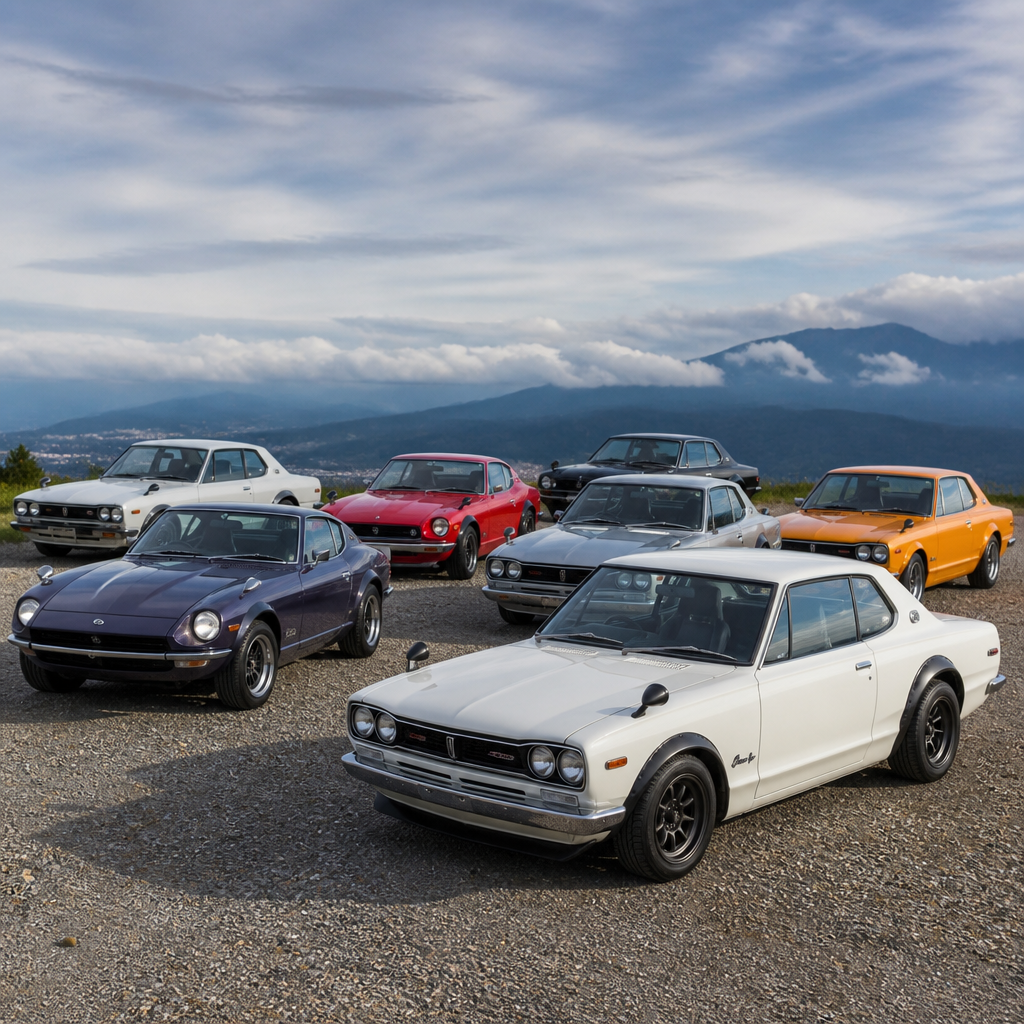
No list of top Japanese classic cars is complete without the Skyline GT-R, particularly the Hakosuka C10 and the later KPGC110 “Kenmeri” in early-era form, plus the R32 that revived the badge in 1989. The classic case starts with the C10 GT-R, which used the S20 2.0-liter DOHC inline-six derived from Prince racing development. It became famous for a remarkable string of touring car victories, cementing the GT-R as a machine built around competition, not image alone.
The R32 GT-R broadened that legend by pairing the RB26DETT twin-turbo six with ATTESA E-TS all-wheel drive and Super-HICAS four-wheel steering. The result was domination in Group A racing and the “Godzilla” nickname in Australia. From an ownership perspective, GT-R values and import legality vary by generation and market, but the historical through-line is clear: the Skyline GT-R established Japan as a leader in integrating motorsport-derived electronics and drivetrain sophistication into road cars without diluting driver appeal.
4. Mazda Cosmo Sport: Rotary Ambition Made Real
The Mazda Cosmo Sport, launched in 1967, is one of the most technically significant Japanese classics because it brought the rotary engine into credible road use. Mazda refined NSU-licensed Wankel concepts into the 10A twin-rotor unit, creating a compact, smooth, high-revving powerplant that gave the Cosmo a futuristic identity. Early Series I cars and later Series II versions differ in wheelbase, power, and detail engineering, but both represent extraordinary ambition for a comparatively small manufacturer.
The Cosmo matters because it showed Japan was willing not just to copy established formulas but to back unconventional engineering with production investment. Rotary ownership requires realism: apex seal concerns, specialist rebuild knowledge, and fuel consumption are part of the picture. Yet from a historical standpoint, the Cosmo opened the door to every important rotary Mazda that followed, including the RX-7 and Le Mans-winning 787B lineage. Its place in Japanese classic car history is secure because it changed the technological conversation.
5. Honda S800: Small Car, Serious Engineering
The Honda S800 is often underestimated by people who associate Japanese classics only with bigger six-cylinder coupes and turbo-era legends. Introduced in the mid-1960s, the S800 used a tiny high-revving four-cylinder engine with motorcycle DNA, producing impressive output for its size and delivering a character unlike contemporary British roadsters. Early versions used chain drive to the rear wheels before Honda adopted a more conventional setup, and the whole car reflected Honda’s engineering-first mentality.
What makes the S800 important is not raw power but proof of concept. Honda demonstrated that a lightweight, precision-built sports car could deliver excitement through revs, gearing, and responsiveness rather than displacement. In restoration circles, these cars reward originality because their mechanical charm is tied closely to unique engineering details. The S800 also foreshadowed Honda’s later reputation for extracting remarkable performance from small-displacement engines, a principle that defined everything from the S600 to the S2000.
6. Toyota Corolla AE86: The Lightweight Driver’s Car
The Toyota Corolla Levin and Sprinter Trueno AE86, sold in the 1980s, became icons because they preserved a simple formula just as the industry was moving toward front-wheel drive and heavier platforms. With rear-wheel drive, a rev-happy 4A-GE twin-cam engine, light weight, and straightforward chassis balance, the AE86 delivered accessible handling that rewarded technique over horsepower. That made it an ideal training ground for club racing, autocross, circuit driving, and later drifting culture.
Its popularity now rests on three overlapping realities: it is genuinely fun, highly tuneable, and culturally immortal. Manga and animation visibility amplified demand, but the car would not have lasted on image alone. In workshops, I have watched even modestly powered AE86 builds embarrass stronger cars on technical roads because the chassis communicates so clearly. Prices have climbed sharply, and many survivors are modified, repaired poorly, or affected by rust. Good original cars are scarce, which only strengthens the AE86’s status among Japanese classic cars.
| Model | Era | Core Strength | Main Ownership Watchpoint |
|---|---|---|---|
| Toyota 2000GT | 1967–1970 | Rarity and prestige | Cost and parts scarcity |
| Datsun 240Z | 1970–1973 | Balanced usability and style | Structural rust |
| Skyline GT-R | 1969 onward | Motorsport pedigree | High values and complexity |
| Mazda Cosmo Sport | 1967–1972 | Rotary innovation | Specialist engine care |
| Toyota AE86 | 1983–1987 | Lightweight handling | Modified examples and corrosion |
7. Mazda RX-7 FD3S: Rotary Performance at Its Peak
Among later Japanese classics, the third-generation Mazda RX-7, known as the FD3S, stands out for combining compact proportions, near-ideal balance, and a sequentially turbocharged 13B-REW rotary engine. Introduced in 1991, it produced strong performance in a package that felt lighter and more delicate than many rivals. The steering response, low seating position, and chassis fluidity still make the FD one of the sharpest driver’s cars Japan has built.
Ownership is more demanding than internet mythology suggests, but not impossible with proper standards. Heat management, vacuum line condition, compression testing, cooling system integrity, and evidence of competent tuning matter more than odometer readings alone. Poorly modified cars are common. Well-sorted examples, however, show exactly why the FD became a benchmark. It captured the final era when Japanese manufacturers built highly specialized performance cars with little compromise, and it remains essential in any serious Japanese classics hub.
8. Toyota Supra A80: Turbo Durability and Tuning Headroom
The fourth-generation Toyota Supra, chassis code A80, earned its place through engineering robustness and immense tuning potential. Produced from 1993, it paired aerodynamic styling with the 2JZ-GTE 3.0-liter twin-turbo inline-six, an engine renowned for a closed-deck iron block, stout bottom end, and ability to handle power increases when fuel, cooling, and engine management are addressed correctly. Even stock, the Supra offered serious performance, refined highway behavior, and strong braking.
Its collector status is shaped by both fact and folklore. Not every Supra becomes a four-digit-horsepower monster, and many modified examples suffer from shortcuts in fuel system design, turbo selection, or calibration. Still, the 2JZ reputation is deserved. The A80 became the definitive Japanese turbo coupe for a generation, helped by motorsport use and global media exposure. As values rise, originality matters more, especially on manual turbo cars, but the core reason the Supra endures is simple: it was overengineered where it counted.
9. Mitsubishi Lancer Evolution VI: Rally Technology for the Road
If the Skyline GT-R represents circuit dominance, the Mitsubishi Lancer Evolution represents rally-bred road performance at its most focused. While several Evolution generations could make this list, the Evolution VI is the clearest classic-era expression of the formula. Its turbocharged 4G63 engine, active yaw-influenced chassis behavior, sharp turn-in, and compact body gave drivers extraordinary point-to-point pace. Developed in the shadow of World Rally Championship competition, the Evo translated gravel-stage urgency into a street-legal sedan.
The reason the Evo matters historically is that it normalized advanced all-wheel-drive performance in a practical body style. Owners got four doors, real utility, and giant-killing speed. The tradeoff is that these cars reward disciplined maintenance. Transfer case condition, differential health, rust underneath, previous tuning quality, and signs of hard use must be checked carefully. A clean Evolution VI remains one of the purest examples of how homologation thinking improved production cars for ordinary enthusiasts.
10. Lexus LS400: The Luxury Disruptor
Some readers will question including the Lexus LS400 in a list dominated by sports cars, but that reaction misses how profoundly it changed the industry. Introduced in 1989, the LS400 arrived with the 1UZ-FE 4.0-liter V8, exceptional refinement, low noise vibration and harshness, and build quality that forced European luxury brands to respond. It did not become iconic through drifting, racing, or anime. It became iconic by resetting expectations for reliability, fit and finish, and long-distance comfort in a flagship sedan.
From a classic car perspective, the LS400 is increasingly significant because it marks Japan’s full arrival in the premium segment. The engineering discipline behind it was immense, and many examples still feel solid after decades if maintained properly. Common age-related concerns include suspension bushings, power steering leaks, instrument cluster issues, and deferred maintenance on neglected cars. Yet the broader point stands: a true hub for Japanese classic cars should include the machine that proved Japanese manufacturers could out-execute established luxury leaders on their own ground.
How to Use This Japanese Classics Hub
These ten cars define the category because each represents a different path to lasting significance: rarity, motorsport success, technical innovation, driver involvement, tuning potential, or market disruption. If you are choosing your first Japanese classic, start by deciding whether you value collectibility, mechanical simplicity, or driving character most. Then study model-specific buying guides, production differences, rust zones, drivetrain weaknesses, and parts ecosystems before shopping. That disciplined approach prevents expensive mistakes and makes ownership far more rewarding.
As a hub, this page should guide deeper research into Nissan Z cars, Skyline GT-R generations, rotary Mazdas, Honda’s early sports cars, homologation sedans, and landmark Toyotas. The central lesson is straightforward: the best Japanese classic cars were never important just because they were Japanese. They were important because they solved problems better, delivered performance more intelligently, or reached buyers more convincingly than rivals. Use this list as your shortlist, compare the ownership realities honestly, and then explore the model that fits your budget, skills, and goals.
Frequently Asked Questions
What makes a Japanese car a true classic rather than just an old used car?
A true Japanese classic stands out because its importance goes beyond age alone. In the context of the top 10 Japanese classic cars of all time, a model earns classic status when it leaves a lasting mark on automotive culture, engineering, motorsport, design, or the enthusiast market. That means a car is not considered classic simply because it is decades old; it becomes classic when people still talk about it, restore it, collect it, race it, or use it as a benchmark long after production ended.
Many Japanese classics also changed perceptions of what cars from Japan could be. Some proved that Japanese manufacturers could build world-class sports cars, while others demonstrated exceptional reliability, tunability, or value for money. Cars such as the Toyota 2000GT, Nissan Skyline GT-R, Mazda RX-7, Datsun 240Z, Honda NSX, and Toyota AE86 are remembered not only for their specifications but for how they influenced enthusiasts and rival automakers alike. Their appeal often comes from a blend of mechanical honesty, driver engagement, practical engineering, and a strong aftermarket legacy.
Another major factor is cultural staying power. A true classic continues to matter in car shows, auctions, restoration circles, motorsport history, and popular media. Japanese classics have benefited enormously from appearances in racing, anime, films, video games, and tuning culture, which helped them build loyal followings around the world. When a car remains desirable because it represents a meaningful chapter in automotive history, not just nostalgia, that is usually the clearest sign it deserves to be called a classic.
Why are Japanese classic cars so popular with enthusiasts and collectors worldwide?
Japanese classic cars are popular globally because they offer a combination that is unusually hard to find in one package: strong engineering, engaging performance, recognizable design, reliability, and broad cultural appeal. For many enthusiasts, these cars represent an era when manufacturers pursued lightweight construction, balanced chassis tuning, naturally aspirated character, and mechanical simplicity. That makes them rewarding to drive, easier to understand, and often more approachable to own than some European or American classics of the same period.
Collectors also appreciate the diversity within the Japanese classic car world. There are halo cars such as the Toyota 2000GT and Honda NSX, homologation icons like the Skyline GT-R and Lancer Evolution, affordable driver-focused legends like the AE86 and early MX-5 Miata, and rotary standouts such as the Mazda RX-7. This range means Japanese classics appeal to different budgets, tastes, and collecting goals. Some buyers want a blue-chip investment piece, while others want a usable weekend car with strong parts support and active communities.
Equally important is the emotional and cultural side. Japanese classics grew alongside motorsport success, street tuning scenes, magazine culture, and a generation of enthusiasts influenced by games and films. Cars that might once have been underestimated are now recognized as foundational to modern enthusiast culture. As values have risen and surviving unmodified examples have become harder to find, global demand has grown even stronger. In short, Japanese classic cars are popular because they are not just historically interesting; they remain relevant, enjoyable, and deeply influential today.
Which Japanese classic cars are usually considered the most important or influential?
While any top 10 list can vary depending on whether the focus is rarity, motorsport success, collector value, or grassroots enthusiasm, several models consistently appear because of their undeniable impact. The Toyota 2000GT is often treated as Japan’s first true world-class sports car, proving that Japanese design and engineering could compete on an international level. The Datsun 240Z is another landmark because it delivered style, performance, and everyday usability at a price that reshaped the sports car market, especially in the United States.
The Nissan Skyline GT-R, particularly the Hakosuka and later R32 generations, is central to Japanese performance history because of its racing pedigree and technical sophistication. The Mazda RX-7 deserves inclusion for keeping the rotary engine alive in enthusiast culture while also becoming one of the most recognizable Japanese sports cars ever built. The Honda NSX changed the supercar conversation by combining exotic performance with reliability, ergonomics, and usability that many rivals lacked. The Toyota Corolla AE86 remains hugely influential because of its lightweight rear-wheel-drive balance, motorsport roots, and almost unmatched status in drift and grassroots performance culture.
Other cars frequently named among the most important include the Toyota Supra, Mazda Cosmo, Nissan Fairlady Z family, Mitsubishi Lancer Evolution, Subaru Impreza WRX STI, and first-generation Mazda MX-5. The reason these cars matter is not just because they were fast or attractive, but because they shifted expectations. They introduced new audiences to Japanese performance, inspired tuning movements, dominated race series, or became symbols of an entire era. The most influential Japanese classics are the ones that still shape enthusiast conversations decades after they were launched.
Are Japanese classic cars still good to drive and own today?
Yes, many Japanese classic cars are still very enjoyable to drive and own, but the experience depends heavily on the model, condition, originality, and your expectations. One of the biggest strengths of many Japanese classics is that they were engineered with durability and user-friendliness in mind. Compared with some older classics from other markets, they can feel less temperamental and more practical in real-world use. Good visibility, sensible controls, compact dimensions, and dependable mechanical layouts often make them approachable even for owners who are new to vintage cars.
That said, age affects every classic. Rubber components harden, wiring can become brittle, rust may be hidden, and neglected modifications can create reliability issues. Many legendary Japanese cars were tuned, raced, or driven hard, so buying the right example matters just as much as choosing the right model. A well-preserved, properly maintained RX-7, Z-car, Skyline, or AE86 can be a deeply satisfying ownership experience, but a poorly restored or heavily abused example can quickly become expensive and frustrating.
Ownership is often helped by strong enthusiast communities and a wide knowledge base. Parts support is excellent for some models and more challenging for rarer halo cars. Cars like the NA Miata, older Z-cars, and certain Hondas benefit from broad aftermarket availability, while low-production cars may require specialist sourcing or international searches. If you approach ownership with realistic expectations, invest in pre-purchase inspection, and prioritize condition over hype, many Japanese classic cars remain among the most rewarding classics you can drive today. They offer analog feedback, authentic character, and a direct mechanical feel that modern cars rarely match.
What should buyers look for before purchasing a Japanese classic car?
The first thing a buyer should focus on is overall condition, especially rust, accident history, and mechanical integrity. Rust is often the single biggest threat to a Japanese classic because it can affect structural areas like sills, shock towers, floor pans, chassis rails, wheel arches, and suspension mounting points. A car with shiny paint but hidden corrosion can become far more expensive than a rough-looking car with a solid shell. It is also essential to check for signs of past collision damage, poor body repairs, mismatched panels, and uneven gaps, particularly on models that have lived hard lives in motorsport or tuning circles.
Second, buyers should evaluate originality and modification quality. Many of the most desirable Japanese classics have been modified over the years, and not all modifications are bad. In fact, period-correct upgrades can add appeal in some enthusiast segments. The problem comes when modifications are poorly installed, undocumented, or inconsistent with the car’s intended use. Engine swaps, turbo conversions, suspension changes, and electrical additions should be inspected carefully. A well-documented car with professional work and maintenance records is usually a safer purchase than a heavily altered example with an unclear history.
Third, consider long-term ownership realities such as parts availability, model-specific weak points, insurance, and market values. Rotary-powered cars may require specialized knowledge, high-performance turbo models can suffer from neglected maintenance, and rare homologation specials may involve difficult parts searches. It is wise to research chassis-specific issues before shopping, join owner forums or clubs, and have a specialist inspect the car before money changes hands. The best purchase is rarely the cheapest example; it is usually the most honest one. In the Japanese classic market, provenance, preservation, and mechanical health matter enormously, and they often determine whether ownership becomes a pleasure or a restoration project.