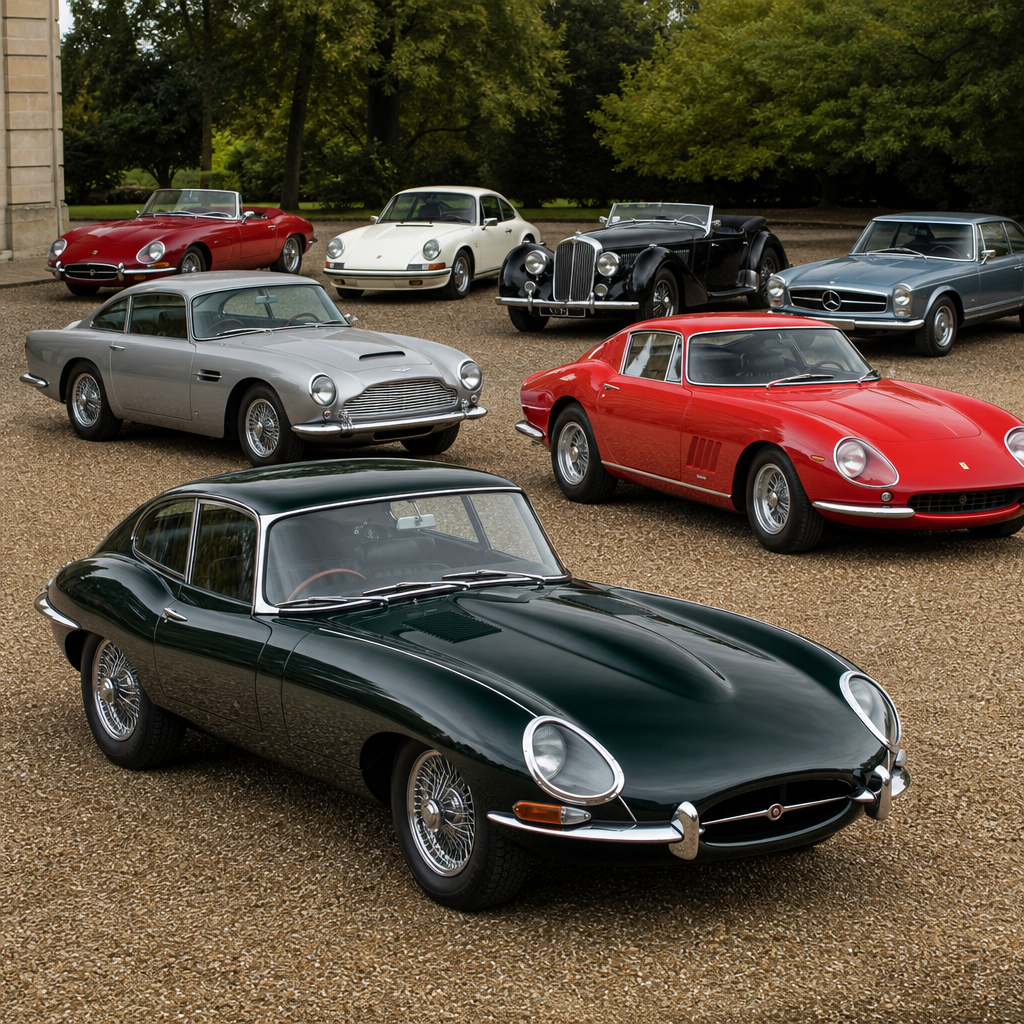
European classic cars define much of automotive history because they blend engineering, design, motorsport pedigree, and cultural influence in ways few other vehicles can match. In my experience researching auction results, judging restoration quality, and comparing factory specifications across decades, the best European classics are not simply old cars with chrome and charm. They are benchmark machines that changed how manufacturers built sports cars, grand tourers, luxury sedans, and affordable enthusiast models. A European classic car generally refers to a historically significant vehicle from brands such as Ferrari, Jaguar, Porsche, Mercedes-Benz, Aston Martin, Alfa Romeo, BMW, Citroen, or Volkswagen, usually built before the modern electronic era transformed driving feel and service complexity.
This category matters because these cars still shape today’s collector market, restoration industry, and enthusiast culture. When buyers search for the top European classic cars, they usually want direct answers to three questions: which models matter most, what makes them special, and which ones remain relevant to own, drive, or invest in. The models below answer those questions. They span Italy, Germany, Britain, and France, and they represent different ideals: beauty, speed, durability, innovation, and accessibility. Some were race-bred exotics; others brought excellence to ordinary drivers. Together, they form the backbone of any serious discussion about European classics and provide a practical hub for deeper reading on individual brands, body styles, and collector trends within the broader Classic Car Models & Brands landscape.
How the best European classic cars earn their place
The phrase top 10 European classic cars of all time should not be based on nostalgia alone. A serious ranking weighs several factors: historical significance, originality of engineering, design impact, motorsport success, production relevance, long-term desirability, and real-world ownership experience. I also consider whether a model created a template others copied. The Jaguar E-Type, for example, reset expectations for performance value in the 1960s. The Porsche 911 created a continuously evolving sports car formula that remains recognizable today. The Citroen DS proved that advanced suspension and aerodynamic thinking could transform mainstream motoring, not just expensive exotics.
Another useful filter is whether the car still communicates its virtues clearly to a modern driver. Some classics are important mainly on paper. The truly great European classics still feel distinct behind the wheel. Their steering, visibility, engine character, ride quality, and proportions explain their reputation immediately. That is why the list includes both glamorous halo cars and more attainable legends. A hub article should show the full spectrum of the European story rather than focusing only on auction-headline Ferraris.
Top 10 European classic cars at a glance
| Model | Country | Era | Why it matters |
|---|---|---|---|
| Jaguar E-Type | United Kingdom | 1961-1974 | Iconic styling and supercar performance for relatively accessible money |
| Porsche 911 | Germany | 1964-present, classic early era emphasized | Definitive rear-engine sports car with unmatched continuity |
| Mercedes-Benz 300SL Gullwing | Germany | 1954-1957 | Fuel injection pioneer and motorsport-derived engineering icon |
| Ferrari 250 GT SWB | Italy | 1959-1962 | Balanced road-race Ferrari with lasting collector prestige |
| Aston Martin DB5 | United Kingdom | 1963-1965 | Grand touring elegance with enduring cultural cachet |
| Alfa Romeo Spider Duetto | Italy | 1966 onward, early cars most collectible | Accessible Italian style and lively twin-cam character |
| Citroen DS | France | 1955-1975 | Hydropneumatic suspension and futuristic industrial design |
| BMW 2002 | Germany | 1968-1976 | Helped define the modern sports sedan and enthusiast compact |
| Volkswagen Beetle | Germany | 1938-2003 | Mass-mobility landmark with unmatched global cultural reach |
| Lancia Fulvia Coupe | Italy | 1965-1976 | Ingenious engineering and major rally credibility |
This list mixes absolute blue-chip collectibles with historically essential driver’s cars. That balance reflects how enthusiasts actually engage with the hobby. Not every important classic is a seven-figure machine. Some of the most influential European cars were built in meaningful numbers, entered family garages, and inspired later generations of designers and engineers.
British and German icons that defined performance
The Jaguar E-Type belongs near the top of any European classic car list because it combined race-informed engineering with sensational styling. Introduced in 1961, it used a monocoque center section with a tubular front subframe, disc brakes, independent rear suspension, and strong straight-line speed. Contemporary road tests recorded near-150 mph performance in ideal conditions, extraordinary for the time. Enzo Ferrari’s widely repeated praise of its beauty may be impossible to document exactly in every retelling, but the car’s reputation hardly needs embellishment. Even today, an early Series 1 roadster or fixed-head coupe delivers long-bonnet drama and a driving experience that feels alive rather than merely antique.
The Porsche 911 deserves inclusion not just because it survived, but because it never abandoned its core identity. Early air-cooled 911s from the 1960s and 1970s established the template: rear-mounted flat-six engine, compact 2+2 body, exceptional visibility, and steering accuracy that made skilled driving deeply rewarding. From the lightweight 911 S to the homologation-focused Carrera RS 2.7, the model proved that an unconventional layout could become a lasting advantage. I have found that collectors who initially chase styling often stay for the engineering logic. Parts support, specialist knowledge, and factory documentation are also better for classic 911s than for many rivals, which matters in real ownership.
The Mercedes-Benz 300SL Gullwing occupies a different space: less democratic, more technological. Based on the W194 race car, it featured mechanical direct fuel injection, a dry-sump-style tilted engine installation for a lower hood line, and the famous upward-opening doors forced by the high sills of its tubular spaceframe. It was fast, beautifully built, and uncompromising. Unlike later cars celebrated mainly for image, the 300SL earned its legend through objective innovation. Restoring one correctly is expensive, and its values place it beyond most enthusiasts, but in terms of engineering importance, it is untouchable among postwar European classics.
Italian masterpieces where design meets competition
Ferrari produced many immortal road cars, but the 250 GT Short Wheelbase stands out because it perfectly bridged grand touring and competition use. Built on a 2400 mm wheelbase and powered by Gioachino Colombo’s 3.0-liter V12, the SWB offered agility, tractability, and visual understatement compared with later Ferraris. It succeeded in GT racing and remains one of the purest expressions of the front-engine Ferrari formula. Collector demand is intense because the car is genuinely complete: mechanically significant, aesthetically resolved, and motorsport validated. When people talk about the golden era of Ferrari, this is one of the clearest reference points.
The Alfa Romeo Spider Duetto earns its place for a different reason: it democratized Italian romance. Introduced in 1966 with Pininfarina styling and Alfa’s advanced twin-cam four-cylinder engine, the Duetto gave buyers a responsive, elegant roadster without the prohibitive running costs of a Ferrari or Maserati. It also benefited from cultural visibility through film and export success, especially in the United States. Early “boat tail” examples are the most prized, but the broader Spider line matters because it kept classic Alfa character alive for decades. Light controls, eager revving, and a communicative chassis still make these cars deeply satisfying on real roads.
Lancia’s Fulvia Coupe is often overlooked outside knowledgeable circles, yet it belongs firmly in any top European classics discussion. Front-wheel drive, narrow-angle V4 engines, excellent braking, and sharp handling made it technically unusual and dynamically convincing. More importantly, the Fulvia built Lancia’s competition reputation with victories such as the 1972 International Championship for Manufacturers. It showed that clever engineering and disciplined weight management could beat more powerful opposition. For collectors today, the Fulvia remains appealing because it offers rarity, motorsport pedigree, and usability without the crushing cost attached to more famous Italian marques.
Grand tourers, practical legends, and engineering revolutions
The Aston Martin DB5 may be forever linked to James Bond, but reducing it to cinema misses the point. It refined the DB4 formula with a 4.0-liter straight-six, Superleggera construction, and an interior that defined 1960s British grand touring luxury. It was fast enough, handsome from every angle, and exclusive without becoming fragile artwork. Buyers still pay a premium for the DB5 because it combines prestige and usability better than many contemporaries. In the collector market, provenance and originality matter enormously, but even standard cars have a presence few grand tourers can match.
The BMW 2002 changed expectations for compact performance cars. Derived from the Neue Klasse sedans, it packed responsive chassis tuning, practical packaging, and lively four-cylinder power into a two-door shape that felt modern and rational. The 2002tii, with Kugelfischer mechanical fuel injection, is especially significant because it sharpened performance while preserving daily usability. In many ways, this car established the blueprint for the sport sedan and sporty compact segments that BMW later dominated. It remains one of the smartest entry points into European classic ownership because parts availability, club support, and mechanical simplicity are comparatively strong.
The Citroen DS was one of the boldest production cars ever sold in volume. Launched in 1955, it introduced hydropneumatic self-leveling suspension, powered controls, advanced aerodynamics, and a design language that looked decades ahead of its rivals. The DS was not a sports car, yet it transformed automotive thinking as radically as many race-bred machines. It offered ride quality and braking sophistication that made conventional family sedans seem obsolete. Ownership requires specialist knowledge, especially around hydraulic systems, but when maintained correctly, the DS demonstrates that true innovation in classic cars is not limited to speed.
No hub on European classic cars would be complete without the Volkswagen Beetle. It was never the fastest, rarest, or most luxurious car here, but it is one of the most consequential automobiles ever built. Ferdinand Porsche’s rear-engine, air-cooled concept evolved into a global product with enormous production volume and cultural reach. The Beetle’s simple mechanical layout, durability, and approachable maintenance created generations of enthusiasts. In the classic market, early split-window and oval-window cars carry the greatest historical cachet, but even later examples matter because they keep the entry barrier low. That accessibility is a core part of classic car culture.
What makes these European classics enduring buys today
The best European classic cars endure because they offer more than nostalgia. They have active parts networks, specialist restorers, factory archives, club communities, and clear identities in the market. That ecosystem determines whether a classic remains enjoyable or becomes an expensive static object. A Porsche 911 or BMW 2002 is easier to keep on the road than many obscure contemporaries because knowledge is abundant. A Citroen DS or Mercedes 300SL may require deeper expertise, but the specialist base is still strong enough to support proper preservation.
Values also reflect narrative clarity. Buyers understand what a DB5, E-Type, or Ferrari 250 GT SWB represents. That story supports demand, but condition, originality, and documentation remain decisive. Matching numbers, correct trim, period colors, service records, and known ownership history all influence price materially. The smartest approach is to buy the best example you can afford after an expert inspection, then use it enough to keep systems healthy. European classics deteriorate faster when neglected than when exercised thoughtfully.
If you are building knowledge within European classics, start with the model families on this list. They are the anchors for deeper exploration into British roadsters, German sports coupes, Italian GT cars, French innovations, and affordable air-cooled icons. Learn the production changes, common corrosion points, engine variants, and restoration costs before shopping. Then connect that research to other pages in the Classic Car Models & Brands topic so you can compare brands, eras, and ownership profiles with confidence. The reward is not just buying a collectible car. It is understanding why these machines became timeless, and choosing the one that fits how you want to drive, preserve, and participate in the classic car world.
Frequently Asked Questions
What makes a European car a true classic rather than just an old vehicle?
A true European classic is defined by influence, engineering significance, design integrity, and lasting desirability, not simply age. Many old cars survive, but only a smaller group genuinely changed the direction of the automotive industry or left a permanent mark on enthusiast culture. The strongest European classics introduced new performance standards, advanced technical ideas, elegant coachwork, or motorsport credibility that elevated them beyond their era. Cars such as the Jaguar E-Type, Porsche 911, Mercedes-Benz 300SL, and Ferrari 250 series are remembered because they set benchmarks that competitors chased for years.
Another major factor is how well a car represents its manufacturer’s identity and its historical moment. European classics often come from brands with deep racing heritage, innovative engineering departments, or design houses that shaped global taste. A classic Alfa Romeo, Aston Martin, BMW, Citroen, Mercedes-Benz, Porsche, or Ferrari usually tells a larger story about postwar recovery, luxury craftsmanship, grand touring culture, endurance racing, or the rise of the modern sports car. That narrative matters because collectors and historians value context as much as hardware.
Rarity can help, but rarity alone does not create greatness. Some of the most important European classics were produced in meaningful numbers and still became icons because they were attainable, visually distinctive, and mechanically memorable. Condition, originality, provenance, and restoration quality affect value, but the foundation is always significance. In practical terms, a true classic is a car that still commands respect decades later for what it did, what it represented, and how it continues to influence automotive design and collecting.
Why do European classic cars hold such an important place in automotive history?
European classic cars matter because Europe produced many of the defining templates for sports cars, grand tourers, luxury sedans, lightweight roadsters, and racing-derived performance machines. British manufacturers refined the open-top sports car formula, Italian companies elevated styling and emotion into an art form, German brands pushed engineering discipline and durability, and French automakers often introduced unconventional technical solutions that challenged the mainstream. When people discuss the shape of automotive history, European classics are present in nearly every major category.
They also occupy a central role because of motorsport. Le Mans, the Mille Miglia, Monte Carlo, Formula 1, touring car racing, and endurance competition all helped establish reputations that flowed directly into road-car demand. A European classic often carries a racing connection that gives it more than just aesthetic appeal. It may share an engine family with a competition car, use lightweight construction influenced by racing, or come from a brand that built its identity on proving speed and durability under pressure. That competition pedigree is one reason so many European classics feel culturally important even to people who are not collectors.
Just as important is the way these cars combined function and style. European classics were rarely designed as appliances. Even practical models often had a distinct character, steering feel, interior craftsmanship, or body shape that made them memorable. That combination of beauty, engineering, and emotional appeal is why they remain central in museums, auctions, restoration shops, and enthusiast conversations. They are not just transportation artifacts; they are milestones in design, technology, and cultural aspiration.
Which qualities usually put a car on a list of the top European classic cars of all time?
The best candidates usually excel in several categories at once: historical importance, design excellence, engineering innovation, driving experience, market reputation, and long-term cultural impact. Historical importance asks whether the car introduced something meaningful or represented a turning point for its brand or segment. Design excellence looks at whether the shape remains recognizable and admired decades later. Engineering innovation includes advances such as fuel injection, disc brakes, monocoque construction, aerodynamics, suspension development, or lightweight materials. The driving experience still matters because truly great classics tend to feel special even by modern standards.
Cultural impact is another major filter. Some cars become symbols of an era, appearing in films, magazines, racing stories, and collectors’ garages across generations. A model may have influenced poster culture, luxury tastes, or the public image of high performance. That is why vehicles like the Porsche 911, Mercedes-Benz 300SL Gullwing, Jaguar E-Type, Ferrari 250 GT, Lamborghini Miura, and Citroen DS are so often discussed. They were not only technically or visually impressive; they became reference points for what a sports car, exotic, or luxury innovation could be.
Collectors and experts also look at authenticity and survivability. A car that remains desirable because it can still be driven, serviced, restored, and documented has a stronger case than one remembered only in photographs. Finally, balance matters. The very best European classics usually do not rely on a single strength. They combine beauty, performance, heritage, and significance in a way that makes them enduring rather than merely fashionable.
Are the most valuable European classic cars always the best or most important?
No, market value and historical importance overlap, but they are not the same thing. Some European classics command enormous prices because they are extremely rare, tied to famous owners, or supported by intense brand prestige. Ferrari provides the clearest example: many historic Ferrari models are both genuinely important and exceptionally expensive. But there are also cars that matter enormously to automotive history without reaching the same price levels. The original Mini, Volkswagen Beetle, Citroen DS, or early BMW sport sedans may be more influential in practical terms than some higher-priced collectibles because they changed manufacturing philosophy, packaging, accessibility, or everyday performance expectations.
Value is shaped by auction trends, provenance, restoration quality, matching numbers, color combinations, body style, and collector demand at a specific moment. Importance, by contrast, is broader and more stable. A Mercedes-Benz 300SL, Porsche 911, or Jaguar E-Type earns its reputation because of engineering breakthroughs, design brilliance, and long-term impact, not merely because bidding is strong. Some less expensive classics are fantastic case studies in industrial design or social history, while some expensive models owe part of their value to scarcity and image rather than transformative innovation.
For enthusiasts, this distinction is useful. If the goal is understanding the top European classics of all time, the question should be what each car contributed to the automotive world, how it influenced later vehicles, and why it continues to be respected. Price can confirm desirability, but it should not be the only measure of greatness. The smartest way to evaluate these cars is to treat market value as one indicator among many, not the final verdict.
What should enthusiasts look for if they want to buy or restore a European classic car?
The first priority is choosing the right model for your budget, skill level, and intended use. European classics vary dramatically in complexity. A simple British roadster, an air-cooled Porsche, a hand-built Italian grand tourer, and a hydropneumatic French luxury car all present very different ownership experiences. Before buying, study parts availability, specialist support, known rust areas, mechanical weak points, originality standards, and current market values. It is far better to buy the best example you can afford than to rescue a severely compromised car unless you are prepared for substantial restoration costs and delays.
Condition and documentation are critical. Rust repair, poor bodywork, and incorrect restoration details can cost more than engine work, especially on cars with complex trim or handmade panels. Inspect the chassis, sills, floors, suspension mounting points, shut lines, paint depth, interior materials, and signs of previous accident damage. Verify matching numbers where relevant, review service records, and confirm whether major components are original or correctly replaced. On highly collectible European classics, provenance and authenticity can materially affect both value and long-term appeal.
Restoration quality matters just as much as purchase price. A beautiful repaint can hide mediocre metalwork, and a freshly trimmed interior can distract from neglected mechanical systems. If you are restoring rather than buying finished, decide early whether the goal is concours originality, sympathetic preservation, or a reliable driver-level rebuild. Each approach has different costs and standards. The best ownership outcomes usually come from realistic planning, expert inspections, and a willingness to be patient. European classics can be deeply rewarding, but they reward informed buyers who understand that craftsmanship, correctness, and maintenance discipline are every bit as important as badge prestige.