The Shelby Cobra stands as one of the clearest examples of how a simple engineering idea can become an enduring automotive legend. In its purest form, the Cobra combined a lightweight British roadster chassis from AC Cars with a large-displacement American V8, then refined that package for road use, endurance racing, and outright international competition. When enthusiasts talk about raw power and racing heritage, they are usually describing a machine exactly like this: compact, loud, fast, and developed with one purpose in mind, which was to beat more sophisticated rivals through superior power-to-weight efficiency.
Within the broader world of classic car models and brands, the Shelby Cobra is an essential hub topic because it connects nearly every major thread that defines iconic models. It links postwar sports-car design, small-volume manufacturing, transatlantic collaboration, homologation strategy, motorsport development, and the rise of American high-performance branding. It also serves as a gateway to related icons, including the Shelby Mustang, Ford GT40, AC Ace, and the big-block roadsters that shaped the modern replica market. Few cars sit at the center of so many important stories.
Defining the Cobra accurately matters because the name is often used loosely. Purists distinguish between the early small-block leaf-spring cars, commonly called the Mark I and Mark II; the coil-spring 427 cars, often called the Mark III; and competition derivatives such as the Cobra Daytona Coupe. They also separate original 1960s Shelby American cars from later continuation models and third-party replicas. That distinction is not trivia. It affects historical value, drivability, racing eligibility, insurance, and restoration standards.
I have worked around Cobras at auctions, track events, and restoration shops, and the same pattern always appears. People arrive expecting a crude muscle car in a tiny body, then leave appreciating how carefully engineered the best versions really were. Steering geometry, cooling management, chassis reinforcement, weight distribution, and brake choice all shaped whether a Cobra felt thrilling or terrifying. The mythology is justified, but the details explain why some Cobras won races while others merely made noise.
For readers exploring iconic car models, this article functions as a hub by covering the Cobra’s origin, major variants, motorsport record, engineering features, market significance, and ownership realities. It also answers the practical questions enthusiasts ask most often: what makes a real Shelby Cobra, which version matters most historically, why the 427 became famous, and how the model influenced performance cars that followed. Understanding those points makes the Cobra easier to place alongside Ferraris, Jaguars, Corvettes, and Porsches in any serious classic car conversation.
How the Shelby Cobra Was Created
The Cobra began with Carroll Shelby’s insight that a light chassis plus abundant torque could outperform heavier, more complex competitors. Shelby, a former racer who had won the 1959 24 Hours of Le Mans with Aston Martin, saw potential in the AC Ace after Bristol stopped supplying engines. At the same time, Ford wanted a competitive image car and had a new lightweight V8. Shelby brought the pieces together: AC Cars in Thames Ditton supplied bodies and chassis, Ford supplied engines, and Shelby American in California completed development and assembly.
The first production Cobras used the 260 cubic-inch Ford V8, soon replaced by the more effective 289. These early cars retained the Ace-derived ladder-frame layout and transverse leaf-spring suspension. They were narrow, relatively delicate-looking machines, but with far more power than the original chassis had ever been designed to handle. Shelby American strengthened critical areas, upgraded cooling, revised differential and brake components, and tuned the package for racing. The result was not simply an engine swap. It was a systematic transformation into a serious competition car.
What made the concept so effective was power-to-weight ratio. A small-block Cobra could weigh roughly 2,100 to 2,300 pounds depending on trim and race preparation. With 271 horsepower in street tune and significantly more in competition form, the car delivered acceleration on par with much more expensive European exotics. In period road tests, 0 to 60 mph times in the four-second range were possible under favorable conditions. On 1960s tires and brakes, that level of performance demanded respect.
Key Shelby Cobra Variants and Why They Matter
Not all Cobras are the same, and the differences define the model’s place in history. The small-block 289 cars are often the most balanced to drive. They have lighter front ends, more progressive responses, and stronger ties to the Cobra’s original racing success in production-based categories. The 427 cars dominate popular memory because of their widened bodies, massive tires, side-oiler big-block engines, and explosive straight-line performance. Yet the 427 was not just a bigger-engine Cobra. It rode on a substantially revised coil-spring chassis with larger tubing and improved suspension geometry.
| Variant | Engine | Chassis Traits | Why It Matters |
|---|---|---|---|
| 260 Cobra | Ford 260 V8 | Early leaf-spring AC-based chassis | Launch version that proved the concept |
| 289 Cobra | Ford 289 V8 | Leaf-spring chassis, lighter front end | Core competition model and best-balanced road car |
| 427 Cobra | Ford 427 side-oiler V8 | New coil-spring chassis, flared body | Ultimate street image and peak power reputation |
| 428 Cobra | Ford 428 FE V8 | Similar body to 427, often street-oriented | Common production big-block road car |
| Daytona Coupe | 289 competition V8 | Aerodynamic closed coupe body | Won the 1965 World Manufacturers’ title in GT |
The 260 Cobra matters historically more than dynamically because it established the formula. The 289 is the model many experienced drivers prefer because it communicates better on real roads. The 427, despite its name, was often sold with the less expensive 428 engine in street trim, a nuance many casual fans miss. True competition 427s are different animals entirely, with race-specific setups, stronger internals, and much higher values.
The Daytona Coupe deserves inclusion in any Cobra hub because it solved a problem the roadster could not. The open Cobra was fast but aerodynamically disadvantaged at high speed, especially against the Ferrari 250 GTO on long straights. Pete Brock’s streamlined coupe body transformed top-end performance. That development arc, from roadster to specialized GT weapon, shows how the Cobra family evolved from hot rod to championship-winning platform.
Racing Heritage: From SCCA Success to World Titles
The Shelby Cobra earned its status on track, not through advertising alone. In Sports Car Club of America competition, Cobras quickly became dominant, using brutal acceleration and stout durability to overwhelm Corvettes, Jaguars, and various European rivals. Drivers valued the car’s ability to put power down exiting corners and absorb the punishment of race weekends with comparatively straightforward servicing. That combination of speed and maintainability is why the Cobra became such a feared presence in American road racing.
Internationally, the challenge was Ferrari. Shelby American targeted FIA GT competition, where beating Maranello required not just horsepower but strategic development. Early roadsters were formidable on tighter circuits, yet they suffered from drag at very high speeds. The answer was the Daytona Coupe, which gave the Cobra program the aerodynamic efficiency it had been missing. In 1965, Shelby American captured the FIA World Manufacturers Championship for GT cars, ending Ferrari’s run. That achievement remains one of the defining victories in American motorsport history.
The Cobra’s racing record also matters because it influenced Ford’s broader performance ambitions. Experience gained through the Cobra program fed into the organization, logistics, and engineering mindset that later supported the GT40 effort. Shelby American proved it could build and campaign cars at an international level, manage rapid technical development, and translate racing success into a potent brand identity. The Cobra was the foundation of that reputation.
For anyone evaluating iconic models, this is the key point: the Cobra was not famous only because it was extreme. It became iconic because it converted a bold idea into documented wins against top-level opposition. Many cars are fast in folklore. The Cobra was fast in official results.
Engineering, Design, and the Driving Experience
The Shelby Cobra feels dramatic because its engineering leaves little distance between driver input and vehicle response. Sit low in the cabin, stretch toward the thin-rim steering wheel, and the long hood ahead makes the car feel mechanical rather than insulated. There is minimal sound deadening, limited weather protection, heavy pedal effort in many setups, and heat from the side pipes and engine bay. Every sensation is amplified, which is exactly why the Cobra remains such a compelling classic sports car.
Mechanically, the formula sounds simple, but execution was demanding. The chassis had to handle far more torque than the AC Ace originally carried. Cooling became a constant concern in race and street environments, especially in hotter climates or traffic. Brake fade could be an issue in poorly prepared cars, and suspension tuning determined whether the car felt planted or unruly. Original competition Cobras often used carefully chosen spring rates, alignment settings, oil coolers, and differential ratios matched to specific circuits. There was no single perfect setup.
The 289 cars generally reward smoothness and momentum. Their lighter nose gives them a more intuitive front-end bite, and they can feel surprisingly agile when properly sorted. The 427 cars deliver the headline experience most people imagine: immense torque, wider stance, and a sense that the chassis is barely containing the engine’s intent. A well-prepared coil-spring 427 is more sophisticated than its image suggests, but it is never tame. Even at moderate speed, it communicates force.
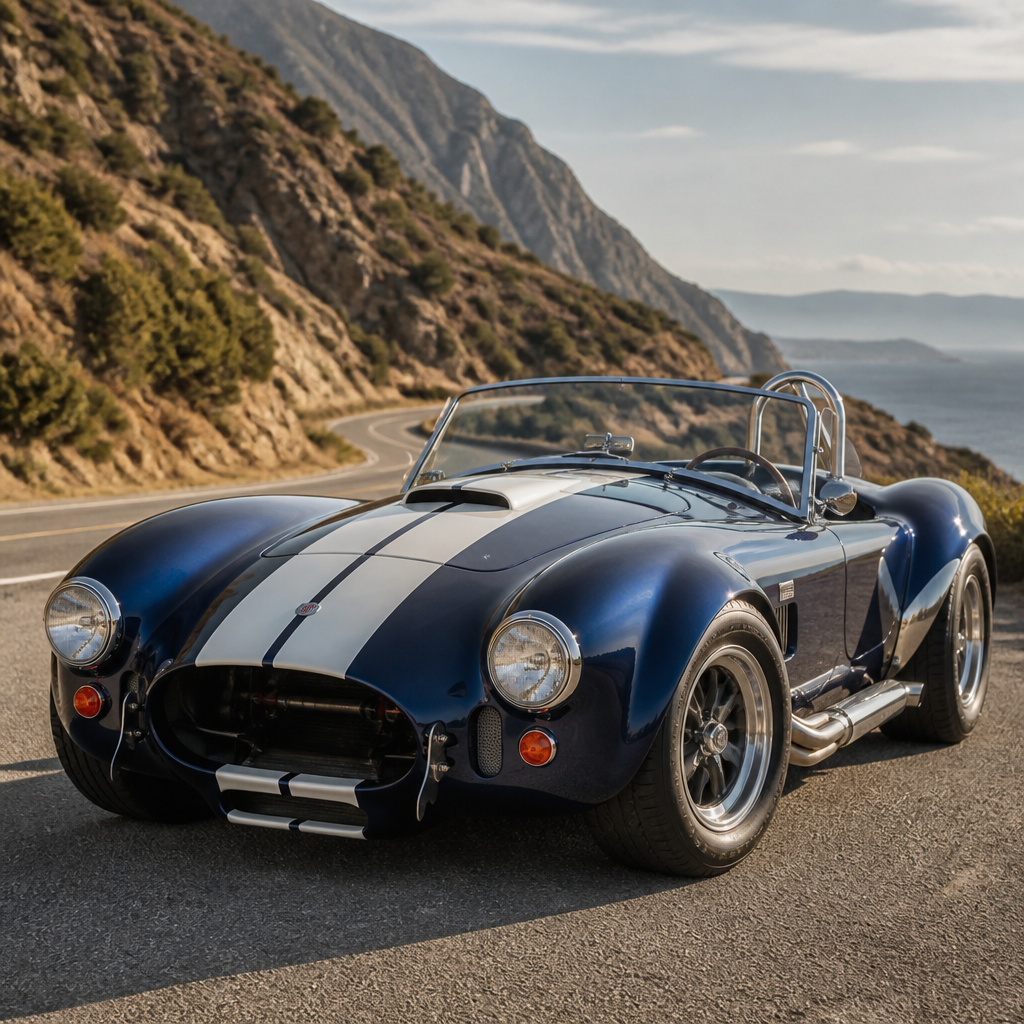
Design also played a role in the Cobra’s impact. The open roadster proportions are timeless: rounded fenders, cut-down doors, wide grille opening, and a cockpit pushed rearward. The flared big-block body is one of the most recognizable shapes in performance-car history. Unlike many cars whose beauty depends on ornament, the Cobra looks right because every major visual cue appears functional. The car projects purpose before it moves.
Original Cars, Continuations, and Replicas
One reason the Shelby Cobra remains constantly discussed is that it exists in several overlapping markets. Original 1960s Shelby American cars are blue-chip collectibles, often documented by chassis number, build history, period race use, and ownership chain. Because production numbers were low, authenticity is everything. Expert verification can involve Shelby American records, AC documentation, casting dates, body details, and known modifications from period competition use. Small discrepancies can affect value dramatically.
Continuation cars occupy a different category. These are later vehicles built with authorization and intended to reflect original specifications closely, though they are not 1960s production cars. For some buyers, continuation Cobras provide the look, sound, and a large portion of the experience without the financial risk of using a multimillion-dollar original. Replicas expand the field further. Companies such as Factory Five and Superformance have introduced Cobra-style cars to a broad enthusiast base, with varying approaches to chassis design, driveline options, and historical faithfulness.
This distinction matters for insurance, registration, resale, and collecting strategy. An original competition 289 or 427 Cobra can command prices in the millions at major auctions, especially with race provenance. A continuation car trades in a more specialized premium market. A well-built replica may deliver excellent performance and usability, but it should never be represented as an original Shelby. Buyers who understand that hierarchy make better decisions and avoid expensive mistakes.
Why the Shelby Cobra Still Matters Today
The Shelby Cobra remains relevant because it established a template that the performance world still follows: low mass, abundant torque, direct controls, and branding built on racing credibility. Modern analogies appear everywhere, from lightweight track-day specials to factory supercars marketed through heritage storytelling. Yet few modern cars match the Cobra’s elemental honesty. There are no driver aids to flatter the operator and no layers of software between decision and consequence.
As a hub within iconic classic car models, the Cobra opens productive paths for deeper study. It leads naturally to AC Cars and British coachbuilding, Carroll Shelby’s broader career, Ford performance history, FIA GT racing, 1960s American road racing, and the economics of collector authentication. It also provides an ideal comparison point for rival icons such as the Jaguar E-Type, Chevrolet Corvette Sting Ray, Porsche 904, Ferrari 250 series, and Sunbeam Tiger. Each reflects a different solution to the same postwar sports-car challenge.
The central lesson is straightforward. The Shelby Cobra became legendary because it united a clear engineering vision with proven competition success and unmistakable design. Whether you favor the balance of the 289, the violence of the 427, or the strategic brilliance of the Daytona Coupe, the car rewards close study. If you are building a serious understanding of classic car models and brands, start with the Cobra, then follow the connections it creates across the entire performance-car world.
Frequently Asked Questions
What made the Shelby Cobra such a revolutionary sports car?
The Shelby Cobra was revolutionary because it followed a deceptively simple formula and executed it with extraordinary effect: take a lightweight European-style sports car chassis and install a powerful American V8 engine. That combination produced a machine with an exceptional power-to-weight ratio, explosive acceleration, and a character unlike almost anything else on the road in its era. At a time when many sports cars emphasized finesse over brute force, the Cobra proved that compact dimensions and massive horsepower could coexist in a highly competitive package.
Its significance also came from how adaptable the platform was. The Cobra was not just a fast street car; it was developed into a serious competition machine capable of endurance racing and international GT battles. Carroll Shelby and his team refined the concept continuously, improving cooling, suspension, brakes, aerodynamics, and chassis strength as performance demands increased. That constant evolution helped transform the Cobra from an interesting hybrid into one of the defining performance cars of the 1960s.
Just as important was the car’s attitude. The Cobra felt raw, mechanical, and immediate in a way that made it unforgettable. It did not hide its performance behind luxury or isolation. Drivers experienced the heat, the sound, the vibration, and the force of the engine in a direct, almost visceral way. That authenticity is a major reason the Cobra still stands as a symbol of pure performance decades later.
How did the Shelby Cobra develop its racing heritage?
The Shelby Cobra earned its racing heritage by succeeding in exactly the environment that validates a performance car most strongly: real competition. Carroll Shelby’s vision was not limited to building an exciting roadster for the street. He wanted a car that could challenge established European manufacturers on the track, especially in GT racing. By combining AC Cars’ lightweight chassis with Ford V8 power, Shelby created a platform that had the straight-line speed to threaten nearly anything in its class.
As development progressed, the Cobra became increasingly specialized for racing. Early cars demonstrated the effectiveness of the basic concept, while later competition versions received substantial upgrades to cope with growing power and more demanding circuits. Wider fenders, improved tire capacity, strengthened frames, better cooling systems, and revised suspension setups helped the Cobra remain competitive. The most famous racing Cobras, including the 289 competition cars and the fearsome 427 variants, showed that the platform was not merely fast in theory but formidable in practice.
The Cobra’s reputation was cemented through its battles against major international rivals. It played an important role in American efforts to beat Europe’s best in GT competition and became closely associated with Ford’s broader racing ambitions during the 1960s. Whether in SCCA events, endurance racing, or global GT championships, the Cobra built its legend through performance under pressure. That is why its racing heritage is not just a marketing phrase; it is central to the car’s identity.
What is the difference between the small-block and big-block Shelby Cobra models?
The main difference between small-block and big-block Shelby Cobras lies in their engines, but the story goes much deeper than displacement alone. Early Cobras typically used small-block Ford V8s, including the 260 and later the 289. These cars are often praised for their balance, agility, and communicative driving manners. They were immensely quick, but they also tended to feel lighter and more nimble, making them especially effective on tight roads and technical race circuits.
The big-block Cobras, most famously the 427 models, were developed to handle far greater horsepower and torque. To accommodate that increase, Shelby and AC made major changes to the chassis and running gear. The frame was redesigned, suspension was revised, and the body was altered with wider fenders to fit larger tires. These were not simple engine swaps; they were more heavily engineered machines built to manage significantly more performance. The result was a car with immense acceleration and a more aggressive, intimidating personality.
In practical terms, enthusiasts often describe the small-block Cobra as the purist’s driver car and the big-block Cobra as the ultimate expression of the Cobra’s raw-force identity. That is a simplification, but it captures the general distinction well. The small-block cars are celebrated for responsiveness and racing balance, while the 427 Cobra has become iconic for its outrageous power, muscular stance, and almost mythical reputation. Both are essential to the Cobra story, but they deliver their thrills in slightly different ways.
Why is the Shelby Cobra still so desirable among collectors and enthusiasts?
The Shelby Cobra remains highly desirable because it occupies a rare place where historical importance, visual drama, mechanical simplicity, and driving excitement all meet. Many classic cars are beautiful, many are fast, and many have racing pedigree, but very few combine those qualities as completely as the Cobra. It represents a golden era of performance in which innovation happened quickly, personalities like Carroll Shelby shaped outcomes directly, and race cars still felt closely related to road cars.
Collectors are drawn to the Cobra because original examples are scarce, historically significant, and deeply tied to one of the most celebrated stories in motorsport and performance engineering. Provenance matters enormously in this world, and the Cobra has it in abundance. Even beyond auction values and rarity, the car carries enormous emotional appeal. Its shape is instantly recognizable, its sound is unforgettable, and its reputation has only grown with time.
Enthusiasts, meanwhile, appreciate that the Cobra still feels honest. It does not depend on electronic layers or modern isolation to create excitement. It offers a direct relationship between driver, engine, steering, brakes, and chassis. That purity makes it endlessly appealing, especially in an era when many high-performance cars are astonishingly capable but less mechanical in character. The Cobra’s desirability comes from more than nostalgia; it comes from the fact that its core experience remains compelling by any standard.
Is the Shelby Cobra more important as a road car or as a race car?
The best answer is that the Shelby Cobra matters profoundly as both, because its legend was built through the interaction between those two roles. As a road car, the Cobra became one of the most extreme and charismatic performance machines of its time. It delivered startling speed in a compact, open-top format and gave drivers an experience that felt thrillingly unfiltered. That alone would have been enough to secure a place in automotive history.
As a race car, however, the Cobra gained the credibility and stature that elevated it from an exciting sports car to a true icon. Competition proved the validity of its design philosophy. The victories, rivalries, and engineering developments tied to racing gave the Cobra a deeper narrative and greater significance. It was not simply a loud street machine; it was a machine sharpened and validated in battle.
What makes the Cobra so important is that it never existed entirely in one category. Its road-going versions carried the DNA of competition, and its racing versions remained recognizably linked to the production car. That overlap is a huge part of the appeal. The Cobra tells a story about how a bold, simple idea can succeed on public roads and on the world stage. In that sense, its identity as both road car and race car is exactly what makes it enduring.