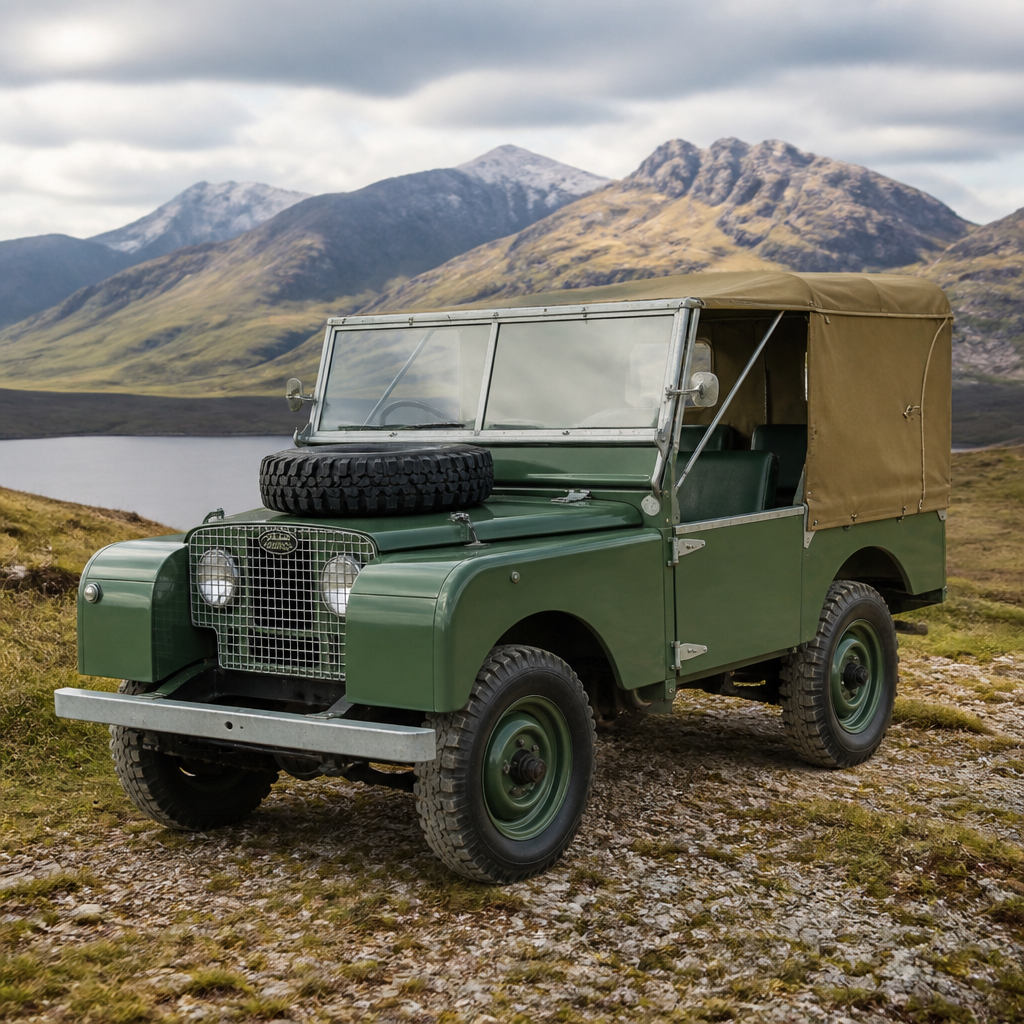
The Land Rover Series I is the vehicle that defined the modern four-wheel-drive utility machine and laid the foundation for one of the most recognizable automotive brands in the world. Introduced in 1948, it combined agricultural practicality, military-grade toughness, and simple engineering in a way few vehicles had managed before. For anyone exploring classic car models and brands, the Series I belongs at the center of the conversation because it shaped what an iconic off-road vehicle could be.
When enthusiasts call the Series I the original off-road legend, they are not relying on nostalgia alone. They are describing a machine that created a blueprint still visible in later Land Rover models, in rival 4x4s, and in today’s restored classics crossing auction blocks and green lanes alike. The name Series I refers to the first generation of Land Rover produced from 1948 to 1958, beginning with the 80-inch wheelbase model and evolving through 86-inch, 88-inch, 107-inch, and 109-inch versions. Key traits included aluminum body panels, box-section chassis construction, selectable four-wheel drive, short overhangs, and a design meant to be repaired with ordinary tools.
This model matters for more than heritage. It tells the story of postwar industrial recovery in Britain, of engineering shaped by material shortages, and of a vehicle built to serve farmers, explorers, tradespeople, and armed forces with equal competence. I have spent years studying and writing about classic utility vehicles, and the Series I consistently stands apart because it was never designed as a lifestyle product first. Its honesty is exactly why collectors, restorers, and historians value it so highly today. As a hub within Iconic Models, this article explains the Series I’s origins, major variants, engineering, cultural impact, buying considerations, and the legacy that connects it to the broader history of classic four-wheel-drive machines.
Origins: Why the Series I Was Built
The Series I emerged from a specific postwar need. Rover, known before World War II for refined passenger cars, faced a weakened civilian market and severe export pressure in late-1940s Britain. The company needed a durable product with international appeal, and chief designer Maurice Wilks found inspiration on his Anglesey farm, where he used a wartime Jeep as a work vehicle. That practical example sparked the idea for a British-built utility 4×4 that could operate as a tractor, a road vehicle, and a general-purpose machine.
Several design choices were direct responses to the period. Steel was rationed, so Rover used a lightweight aluminum-magnesium alloy often referred to by enthusiasts as Birmabright for the body panels. The chassis remained steel, but the corrosion-resistant aluminum skin became one of the model’s defining features. Early prototypes even featured a center steering position intended to simplify export production for left- and right-hand-drive markets, though production vehicles quickly adopted conventional layouts.
The first Land Rover debuted at the 1948 Amsterdam Motor Show. It was not presented as a luxury product or a sports utility vehicle. It was marketed as a tool. Power initially came from a 1.6-liter petrol engine derived from Rover car units, paired with a four-speed manual transmission and a dual-range transfer case. A power take-off option allowed the vehicle to run farm equipment, reinforcing its role as a mechanized helper rather than a recreational toy.
That positioning proved brilliant. Farmers appreciated its versatility, export buyers needed simple durable transport, and governments recognized its usefulness in rough terrain. Within a few years, Land Rover had become central to Rover’s business. In practical terms, the Series I saved the company, and in historical terms it launched a vehicle family that would eventually include the Defender and inspire generations of expedition and utility machines.
Design and Engineering: What Made It So Capable
The Series I earned its reputation through fundamentals that still define competent off-road design. It used body-on-frame construction with a rugged ladder chassis capable of twisting over uneven surfaces while supporting heavy loads. The short front and rear overhangs improved approach and departure angles, reducing the chance of body damage on banks, rocks, and ruts. Narrow bodywork helped it fit through farm gates, forest tracks, and mountain passes where wider vehicles struggled.
Mechanical simplicity was another advantage. The four-cylinder engine was easy to service, and the drivetrain was designed for durability over outright speed. Early 80-inch models used a permanent rear-wheel-drive setup with selectable front-wheel engagement in higher gears, while low range automatically drove all four wheels. Later developments refined usability, but the principle remained the same: straightforward hardware that could be trusted far from workshops.
Suspension consisted of leaf springs and live axles front and rear. By modern standards that setup delivers a firm ride and modest articulation compared with advanced coil-sprung designs, but it is robust, predictable, and repairable. On a loaded work vehicle crossing muddy fields or corrugated tracks, those qualities mattered more than comfort. Steering was slow, brakes required planning, and cabin ergonomics were basic, yet none of that was accidental. The Series I was engineered to survive work first.
Its compact dimensions also mattered. An 80-inch wheelbase gave the earliest version excellent maneuverability, while later longer-wheelbase models improved load carrying and passenger capacity. The combination of low gearing, light body panels, and simple driveline hardware allowed the Land Rover Series I to travel where ordinary road cars and many trucks could not. That capability explains why it became common on farms, in deserts, on safari routes, and in colonial service fleets across Africa, Australia, and Asia.
Key Variants and Production Evolution
No single Series I configuration tells the whole story because the model evolved significantly across its decade-long run. The original 1948 80-inch version is the most historically important. It established the silhouette, the flat body panels, the exposed hinges, and the upright greenhouse that became visual signatures. These earliest vehicles included distinctive features such as recessed headlights behind the grille and a utilitarian dashboard that prioritized function over finish.
As demand expanded, Rover adapted the platform for more uses. In 1950 the drivetrain changed to include a more conventional selectable four-wheel-drive system with a freewheel unit no longer used. In 1952 engine size increased to 2.0 liters, improving torque and making the vehicle more useful when loaded. Wheelbases grew as well, first to 86 and 107 inches, then later to 88 and 109 inches in 1954. These revisions allowed pickup, station wagon, canvas-top, and commercial body styles to serve different markets.
One especially notable branch was the Station Wagon developed with bodywork by Tickford in the early years, followed by more integrated factory wagons later. These vehicles hinted at the Land Rover’s future beyond pure labor. Another major milestone came in 1957 with the introduction of the 2.0-liter diesel engine, a landmark for buyers needing fuel economy and low-speed pulling power. While not fast, the diesel broadened the vehicle’s working appeal and foreshadowed Land Rover’s long association with compression-ignition engines.
| Variant | Years | Key Features | Why It Matters |
|---|---|---|---|
| 80-inch | 1948–1953 | 1.6L then 2.0L petrol, earliest styling, compact chassis | Purest original expression of the concept |
| 86-inch | 1954–1956 | Revised wheelbase, updated body proportions | Improved practicality while retaining agility |
| 107-inch | 1954–1956 | Long-wheelbase utility and wagon applications | Expanded commercial and passenger use |
| 88-inch | 1956–1958 | Short-wheelbase successor to 86-inch | Bridge to later Series models collectors know well |
| 109-inch | 1956–1958 | Long-wheelbase successor, more load space | Set the template for heavy-duty Land Rovers |
For collectors, these distinctions are more than trivia. Values, parts availability, and restoration difficulty vary substantially by wheelbase, engine, and body style. An early 80-inch with matching numbers and original details can command strong prices because of rarity and historical significance, while later Series I utilities may offer a more approachable path into ownership.
Global Impact and Cultural Status
The Series I became iconic because it worked in places where failure had real consequences. In the 1950s it served in agriculture, mining, military support, scientific fieldwork, infrastructure projects, and overland travel. Photographs from East African safaris, Australian stations, and remote British Commonwealth outposts frequently show a Land Rover carrying people, fuel, tools, livestock supplies, or radio gear. It was one of the few vehicles trusted to handle poor fuel, primitive roads, and harsh climates with limited backup.
That broad use created the model’s cultural authority. Unlike many classics whose fame comes mainly from racing wins or celebrity owners, the Series I earned status through work. It became associated with resilience, improvisation, and self-reliance. In that sense it shares space with icons such as the Jeep CJ, Toyota Land Cruiser, and Mercedes-Benz Unimog, but the Land Rover’s blend of compactness and civility gave it a unique role. It could plow a field in the morning, carry a family in the afternoon, and climb a muddy track at dusk.
Film, television, and expedition literature later reinforced that image. Conservation organizations, aid agencies, and geographic survey teams used Land Rovers so widely that the vehicle became visual shorthand for remote travel. For the classic car world, this matters because historical relevance drives long-term enthusiast interest. The Series I is not collectible merely because it is old. It is collectible because it changed transport in difficult terrain and helped define the identity of postwar British engineering abroad.
Owning, Restoring, and Buying a Series I Today
Buying a Land Rover Series I requires a different mindset than buying a classic sports car. Originality matters, but structural condition matters more. The aluminum body does not rust in the same way steel does, yet corrosion can still occur where dissimilar metals meet, and the steel chassis, bulkhead, outriggers, and suspension mounts are all critical inspection points. I always advise buyers to look first at the frame, firewall, and evidence of competent repairs before being distracted by paint or accessories.
Mechanical parts support is generally solid thanks to specialist suppliers and an active restoration community, but not all replacement parts are equal. Proper restorations balance authenticity with safety, often retaining period-correct appearance while updating hidden consumables such as brake lines, seals, wiring, and cooling components. Engine swaps and later transmission conversions exist, yet heavily modified examples may be less desirable to purist collectors unless the work is exceptionally well documented.
Driving one today is rewarding if expectations are realistic. A Series I is slow, noisy, and physically involving. Non-synchronized gearboxes on early examples require care, steering effort is substantial at low speed, and weather protection is modest. At the same time, the upright seating, excellent visibility, and mechanical honesty create an experience modern SUVs cannot replicate. Every vibration and lever movement reminds you that this machine was built for use, not insulation.
As a hub for Iconic Models within Classic Car Models and Brands, the Series I also serves as an ideal gateway to related topics. Readers interested in utility legends often continue to compare it with the Jeep CJ, Toyota Land Cruiser FJ series, early Range Rover, and Land Rover Series II and III. Understanding the Series I makes those later developments easier to judge because it established the original formula: simple engineering, modular body styles, field serviceability, and exceptional off-road geometry. If you are researching a purchase, planning a restoration, or mapping the history of classic four-wheel drives, start with the first Land Rover and follow the lineage outward.
The Land Rover Series I remains the original off-road legend because it did more than launch a successful model line. It defined a category, proved the commercial value of a versatile four-wheel-drive work vehicle, and created an instantly recognizable design language that still influences enthusiasts and manufacturers. Its importance rests on facts: postwar innovation, durable engineering, worldwide service, and a legacy strong enough to make even rough survivors historically meaningful.
For collectors, the appeal is clear. The Series I offers mechanical simplicity, direct historical significance, and a driving experience that feels purposeful rather than ornamental. For historians, it marks a turning point when utility design, export economics, and rural mobility intersected in one machine. For casual fans, it is the Land Rover in its most honest form: light, tough, and unmistakably built to go farther than the road.
If you are building knowledge around Classic Car Models and Brands, this is one iconic model worth studying in depth before any of its descendants. Learn the wheelbases, understand the drivetrain changes, inspect the chassis carefully, and view each variant in the context of how people actually used it. Then explore the related legends it influenced. The best way to appreciate the Land Rover Series I is simple: see one up close, read its details carefully, and trace how its ideas transformed the history of off-road vehicles.
Frequently Asked Questions
What made the Land Rover Series I so important in automotive history?
The Land Rover Series I is widely regarded as one of the most important vehicles in off-road and utility vehicle history because it helped define the template for the modern four-wheel-drive machine. When it debuted in 1948, it was not simply another rugged vehicle entering the market. It arrived with a clear purpose: to be tough, versatile, easy to repair, and capable of working in harsh environments where ordinary road cars could not survive. That combination of practical engineering and real-world durability gave it an identity that would influence decades of vehicle design.
Its historical importance also comes from timing. In the years following World War II, there was strong demand for vehicles that could serve farms, estates, military operations, and remote communities. The Series I answered that need with a simple ladder-frame chassis, four-wheel drive, high ground clearance, and bodywork made largely from aluminum alloy, which was both lightweight and useful in a period of steel shortages. It was built as a working tool first, and that honesty of design made it immediately valuable to buyers who needed reliability rather than luxury.
Perhaps most importantly, the Series I established the DNA of the Land Rover brand itself. Its upright shape, utilitarian cabin, strong off-road credentials, and reputation for go-anywhere capability became the foundation for generations of Land Rovers that followed. In many ways, the Series I did not just launch a model line. It created an entire category of iconic off-road vehicles that balanced agricultural usefulness, expedition potential, and mechanical simplicity in a way the market had rarely seen before.
Why was the Land Rover Series I designed the way it was?
The Series I was designed with function as the top priority, and every major element of the vehicle reflects that. Its creators wanted a machine that could perform multiple roles, especially in agriculture and industry, while also being robust enough for rough terrain and low-maintenance ownership. As a result, the design was intentionally straightforward. The body panels were flat and simple to manufacture, the mechanical layout was easy to access, and the driving position and cabin were focused more on utility than comfort. This was a vehicle built to work, not to impress with styling flourishes.
One of the most notable design choices was the use of aluminum alloy body panels. This decision was partly practical because postwar Britain faced steel shortages, but it also turned out to be a long-term advantage. Aluminum resisted corrosion better than conventional steel, which helped many examples survive far longer than other working vehicles of the same era. The Series I also featured a boxy shape that made sense for visibility, interior packaging, and ease of repair. Damaged panels could be replaced more easily than on vehicles with more complex bodywork.
The engineering philosophy was equally purposeful. The four-wheel-drive system, low-range gearing, and rugged chassis made it suitable for mud, ruts, hills, and unpaved tracks. Early versions even included features aimed at farm use, reinforcing the idea that this was a tractor alternative as much as a road-going vehicle. In short, the Series I looked and behaved the way it did because it was designed as a highly adaptable tool. Its now-iconic appearance is really the result of practical thinking, which is a big part of why enthusiasts still respect it so deeply today.
How capable was the Land Rover Series I off-road compared with other vehicles of its era?
For its time, the Land Rover Series I was exceptionally capable off-road. It was developed specifically to handle terrain that would defeat most passenger cars and many conventional utility vehicles of the late 1940s. Its four-wheel-drive system gave it traction where two-wheel-drive vehicles struggled, while its short overhangs, durable chassis, and relatively light body helped it negotiate uneven ground, muddy fields, loose surfaces, and steep inclines. It was not about speed or power in the modern sense. Its strength was controlled, dependable progress in places where mobility mattered most.
The low-range gearing was especially important because it allowed the vehicle to crawl over difficult terrain with more precision and less strain on the engine. That made it useful not only for off-road travel but also for towing, climbing, and agricultural tasks. The Series I earned a reputation for being able to reach remote areas with a level of consistency that made it attractive to explorers, military users, farmers, and utility services alike. In many parts of the world, it became the default answer to difficult geography.
Compared with other vehicles of its era, the Series I stood out because it combined rugged off-road ability with broad adaptability. Some vehicles were good in military settings, and others were useful on farms, but few offered the same blend of civilian practicality, field-serviceable engineering, and all-terrain performance. That balance is one reason it became legendary. It was not merely an off-road specialist. It was a machine people trusted to work every day in environments where failure could be costly or even dangerous.
What should collectors and classic car enthusiasts know about owning a Land Rover Series I today?
Owning a Land Rover Series I today is as much about preserving a piece of automotive history as it is about driving a classic vehicle. Enthusiasts should understand from the start that this is a machine from a very different era of motoring. It is mechanically simple, physically tough, and full of character, but it is not refined by modern standards. Steering can feel heavy, cabin comfort is minimal, performance is modest, and road manners are far more agricultural than those of later classics. For many owners, that is exactly the appeal. The Series I offers an authentic, mechanical driving experience that feels direct and honest.
From a restoration and maintenance standpoint, the news is generally encouraging, provided expectations are realistic. The straightforward engineering means many repairs are understandable for knowledgeable hobbyists, and specialist support for classic Land Rovers is strong in many markets. Parts availability can be better than newcomers expect, though originality matters greatly and certain correct early components can be expensive or difficult to source. Buyers should also pay close attention to chassis condition, bulkhead integrity, drivetrain wear, and the overall quality of any previous restoration work. Aluminum body panels resist rust, but that does not mean the entire vehicle is free from structural concerns.
Collectors should also know that provenance, specification, and originality can significantly affect desirability. Early examples, rare body styles, and well-documented restorations often attract stronger interest. Because the Series I is such an important vehicle in the Land Rover story, it enjoys broad admiration across both classic 4×4 circles and the wider collector car community. A well-kept example is not just a nostalgic curiosity. It is a cornerstone vehicle that represents the birth of a globally recognized off-road legacy.
How did the Land Rover Series I influence later Land Rover models and the wider SUV market?
The influence of the Land Rover Series I is enormous, both within its own brand and across the wider automotive world. Within Land Rover, it established the core formula that would guide the company for decades: durable construction, practical body design, strong off-road ability, and a clear sense of purpose. Later models in the Series line, the Defender’s ancestors, and even more premium Land Rover products all inherited something from that original vision. Whether it was the upright design language, the go-anywhere engineering mindset, or the idea that a vehicle could be both a work tool and an adventure machine, the Series I set the tone.
Its impact extended well beyond Land Rover itself. The Series I demonstrated that there was a serious market for civilian off-road vehicles that were not purely military leftovers and not merely stripped-down commercial machines. It helped prove that buyers valued versatility, field durability, and multi-role usefulness. That concept later evolved into the broader SUV and 4×4 market, where utility, lifestyle appeal, and rugged image became increasingly important. While modern SUVs often prioritize comfort and technology far more than the Series I ever did, the fundamental idea of a vehicle that blends everyday usefulness with off-road identity can be traced back to pioneers like this one.
That is why the Series I remains such a central model in discussions of classic car brands and influential automotive design. It did more than start a successful nameplate. It changed expectations. It showed that a vehicle could be simple yet iconic, hard-working yet beloved, and uncompromisingly practical while still capturing the imagination of generations of drivers and enthusiasts around the world.