Emissions laws for classic cars sit at the intersection of nostalgia, environmental regulation, and practical ownership, which is why they confuse more owners than almost any other part of registration and legal compliance. A classic car can be mechanically simple yet legally complicated, because the rules that govern tailpipe emissions, inspections, registration class, and limited-use exemptions often depend on age, weight, fuel system, model year, and where the vehicle is garaged. In day-to-day work with vintage vehicle owners, I have found that most problems do not start with the car itself. They start with assumptions: assuming a forty-year-old car is automatically exempt, assuming historic plates eliminate testing, or assuming a passing inspection in one state means legal operation in another. None of those assumptions is safe.
For owners, buyers, restorers, and collectors, understanding emissions laws for classic cars matters for three reasons. First, compliance protects registration status. A car that fails emissions requirements or is registered in the wrong category can be denied renewal, fined, or restricted from road use. Second, compliance affects restoration decisions. Engine swaps, carburetor changes, aftermarket ignition systems, and fuel injection conversions may improve drivability, but in some jurisdictions they also change what must be inspected or documented. Third, emissions rules affect value and usability. A highly original car with documentation of exemption eligibility may be easier to insure and register than a modified car with uncertain legal status.
Key terms need clear definitions. “Classic car” is not a universal legal category. Some states define “antique,” “historic,” “collector,” or “classic” by age thresholds such as twenty, twenty-five, or thirty years. “Emissions inspection” can mean a tailpipe test on a dynamometer, an onboard diagnostics check for newer vehicles, a visual inspection for required equipment, or a gas-cap and evaporative system check. “Registration and legal requirements” include title status, plate type, annual or biennial inspection, mileage limitations, county-specific testing, and documentation showing that a vehicle qualifies for an exemption. Once owners understand those terms, the rules become less mysterious and much easier to manage.
This hub article explains the full landscape of registration and legal requirements tied to emissions laws for classic cars. It covers how exemptions work, where owners get into trouble, how modifications change compliance, what records to keep, and how to plan before buying or moving a vehicle. If you own a Mustang, Beetle, 240Z, C10, or any other older vehicle, the central lesson is simple: age alone does not determine legality. The governing authority is always the specific state or local rule attached to your registration class and use pattern.
How Emissions Laws for Classic Cars Are Structured
Most emissions programs are built around public health standards, not collector culture. Federal law establishes baseline emissions requirements through the Clean Air Act, while states implement inspection and maintenance programs approved through environmental and transportation agencies. In practice, that means your classic car ownership experience is controlled mostly at the state level, with additional variation by county or metro area. Arizona, California, Pennsylvania, Texas, and Virginia all illustrate this patchwork. One may exempt vehicles over a certain age but still require safety inspection. Another may offer historic registration but prohibit commuting. Another may test only in pollution-control regions.
The important point is that registration category and emissions status are related but not identical. A 1974 coupe might be exempt from annual emissions testing in one state because of model year. The same car might still need a safety inspection, proof of insurance, and restricted-use historic plates. Conversely, a twenty-five-year-old vehicle in another state could qualify for a collector plate but still need emissions testing if it is registered for general transportation. I have seen owners accidentally choose standard registration for flexibility, then discover they must complete testing they expected to avoid.
Rules also distinguish between original configuration and altered vehicles. A stock engine bay with factory-style carburetion, air injection, catalytic converter equipment where applicable, and evaporative components is usually easier to classify. Once a car receives an engine swap, aftermarket EFI, deleted emissions hardware, or headers replacing smog manifolds, the owner may need to prove compliance under a different standard. In stricter states, the engine year, donor vehicle certification, and referee inspection process can become decisive.
Exemptions by Age, Plate Type, and Use
The most common question is straightforward: are classic cars exempt from emissions testing? Sometimes yes, but only under specific conditions. Exemptions generally fall into three buckets: age-based exemptions, registration-class exemptions, and use-based exemptions. Age-based exemptions rely on model year or vehicle age, such as rolling twenty-five-year exemptions or fixed-year cutoffs. Registration-class exemptions apply when a vehicle is titled and plated as historic, antique, or collector. Use-based exemptions depend on annual mileage limits, exhibition-only use, parade use, club events, maintenance drives, or occasional pleasure driving.
Owners should pay attention to the practical cost of each exemption. Historic or antique registration often lowers fees and avoids emissions testing, but it can limit ordinary transportation. If you want to drive your 1967 Camaro to work twice a week, a historic plate may conflict with the permitted-use language. If you use standard registration instead, you may gain flexibility but lose the emissions exemption. I regularly advise owners to read the plate application before restoration money is spent, because intended use should guide registration strategy from the start.
| Exemption Type | Typical Requirement | Main Benefit | Common Limitation |
|---|---|---|---|
| Age-based | Vehicle older than a defined model year or age threshold | No routine emissions test | Rules differ by state and county |
| Historic or antique registration | Special plate application and qualifying vehicle age | Reduced fees and frequent test exemption | Restricted road use |
| Low-mileage or exhibition use | Annual mileage cap or event-based driving | Allows legal preservation use | Documentation may be required |
| Geographic exemption | Vehicle registered outside testing counties | No local emissions inspection | Residence and garaging rules still apply |
Documentation is critical. Some states require a signed affidavit that the vehicle will be used only for exhibitions or limited hobby purposes. Others ask for odometer readings, photographs, or proof that the car carries collector insurance. If you cannot support your claimed exemption, renewal problems are likely. The safest approach is to keep plate applications, inspection receipts, insurance declarations, mileage logs, and any agency correspondence in one file.
State and Local Variation Owners Must Expect
No hub on registration and legal requirements is complete without stressing local variation. California is the best-known example because it has some of the strictest standards, including anti-tampering rules and detailed oversight for engine changes. A pre-1976 gasoline vehicle may fall outside the state smog-check program, but that does not make any modification legal. Newer classic-era cars remain subject to program rules, and the California Air Resources Board influences which aftermarket parts can legally be installed through executive order approvals. By contrast, some states exempt older vehicles entirely from emissions while still requiring annual safety inspections.
Urban areas can have different requirements than rural areas within the same state. Enhanced inspection regions may include metropolitan counties with air-quality concerns, while neighboring counties have no emissions program. This matters when an owner moves, stores a car, or keeps a second residence. Registration usually follows the principal garaging address, not simply personal preference. Trying to register outside a testing area without a legitimate basis creates unnecessary legal risk.
For that reason, every owner should verify rules directly with the department of motor vehicles, environmental agency, or authorized inspection program before purchase or registration renewal. Enthusiast forums are useful for leads, but they age quickly and often overlook county-level updates, waiver programs, and plate-specific restrictions. Official language, however dry, is the source that controls.
Modifications, Engine Swaps, and Equipment Rules
Modified classics create the hardest compliance questions. Many owners improve reliability with electronic ignition, fuel injection conversions, replacement carburetors, or crate engines. Some of these changes are effectively invisible in exempt states. In regulated jurisdictions, they can change the legal status of the car. The core issue is whether required emissions-control equipment has been removed, bypassed, or replaced with nonapproved parts. Required equipment may include catalytic converters, EGR valves, air pumps, evaporative canisters, thermostatic air cleaners, oxygen sensors, and closed-crankcase ventilation systems depending on year and specification.
Engine swaps demand special caution. In strict programs, the replacement engine may need to be the same year or newer than the chassis, come from an equal or more stringent emissions class, and retain all donor emissions equipment. This is why a V8-swapped classic that runs beautifully can still fail legal inspection. I have worked with owners who spent heavily on fabrication, only to discover that the missing evaporative controls or unapproved intake setup blocked registration.
That does not mean modifications are impossible. It means they should be planned backward from the applicable rule set. If your goal is full street legality in a state with active emissions enforcement, build around compliant parts, keep receipts, photograph the installation, and verify whether special certification or referee review is required. If your state offers a broad exemption for antique vehicles and your intended use is limited, the legal pathway may be simpler, but documenting the exemption still matters.
Inspections, Waivers, and What Happens When a Car Fails
Classic cars fail emissions-related compliance for several predictable reasons: the owner selected the wrong registration class, the vehicle was tested under the wrong standard, required equipment was visibly missing, the fuel system was poorly tuned, or the inspector was unfamiliar with older vehicles. A failed test is not always the end of the process. Some states offer waivers after documented repair spending, hardship extensions, or referee reviews when a vehicle is unusual, gray-market, or modified within the rules.
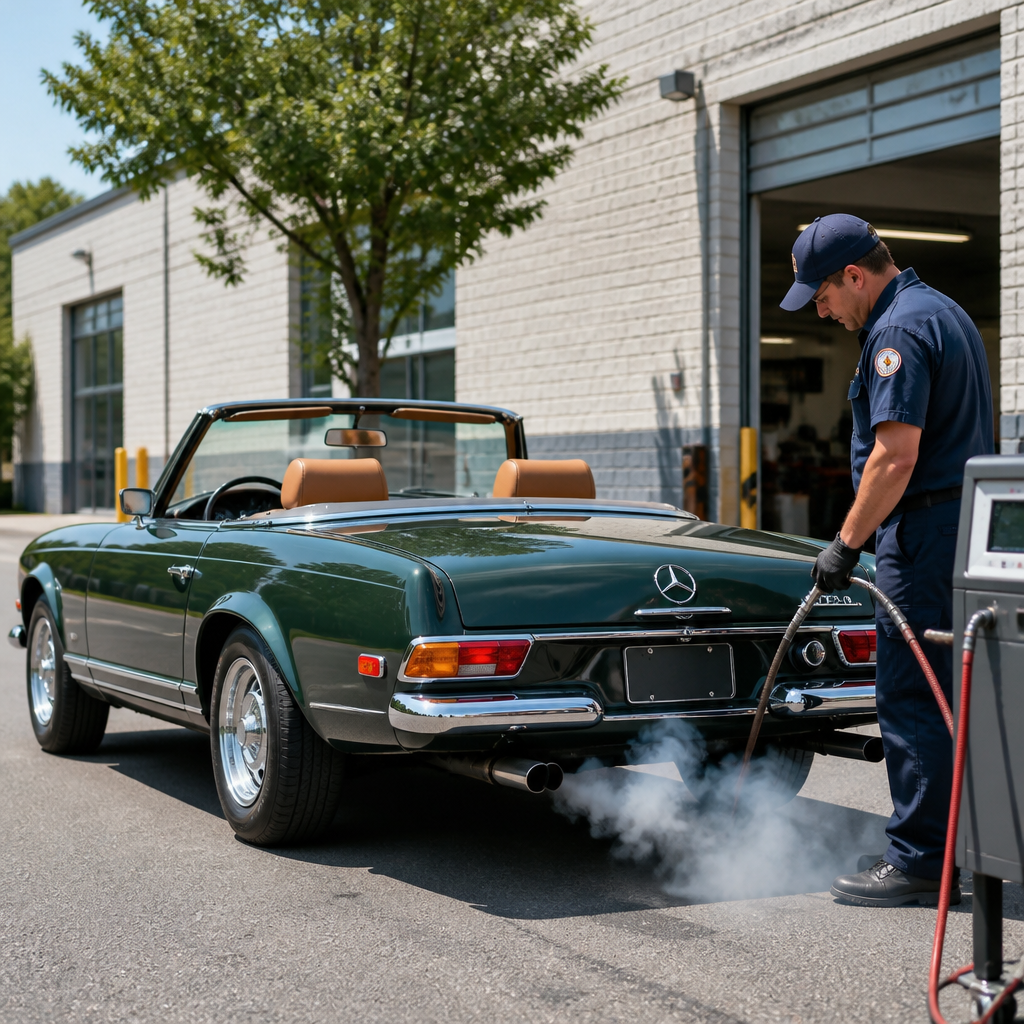
Preparation improves outcomes. Before inspection, verify the exact test type for that model year, confirm that the engine reaches operating temperature, check ignition timing, inspect vacuum lines, ensure there are no exhaust leaks ahead of the sampling point, and tune the carburetor or EFI system correctly. On vehicles old enough for visual inspection only, completeness and neatness of equipment installation matter as much as tailpipe numbers. I have seen cars fail not because they polluted excessively, but because an inspector could not verify that required devices were present or connected.
When a car fails, ask for the written reason and the regulatory basis. That information determines whether you need mechanical repair, paperwork correction, reclassification to a different registration category, or administrative review. Owners who respond systematically spend less and solve problems faster than those who start replacing parts at random.
Buying, Moving, and Recordkeeping for Long-Term Compliance
Many emissions disputes start at purchase. A seller may advertise a vehicle as “exempt,” but that claim is only meaningful in the seller’s jurisdiction and under the seller’s registration class. Before buying, confirm the title status, current registration type, plate restrictions, inspection history, and equipment configuration. If the car has been modified, ask for donor engine information, parts receipts, and any referee or compliance paperwork. A missing paper trail can turn a bargain into a registration headache.
Moving across state lines is another trigger for problems. The receiving state may impose different standards, require a VIN verification, or reject a registration category that existed elsewhere. Insurance carriers can also care about use classification, storage address, and annual mileage, which should align with the legal basis for the car’s registration. Consistency across title, registration, inspection, and insurance records reduces scrutiny and avoids accidental misrepresentation.
Good recordkeeping is the owner’s best defense. Keep copies of the title, registration renewals, emissions exemptions, inspection reports, parts invoices, build sheets, photographs of emissions equipment, odometer logs, and correspondence with agencies. These records help if rules change, if ownership is transferred, or if an inspector questions the vehicle’s status years after restoration. In practice, the owners who have the smoothest classic car ownership experience are rarely the luckiest. They are the ones who treat compliance as part of the hobby.
Emissions laws for classic cars are manageable once you stop treating “classic” as a blanket exemption and start treating registration and legal requirements as a system. The system has four moving parts: where the car is registered, how it is titled and plated, how it is used, and whether its mechanical configuration matches the rules attached to that use. Get those four parts aligned, and most compliance problems disappear before they start.
The practical takeaway is clear. Check your state and county rules, choose the registration class that matches how you really drive the car, document every exemption, and plan modifications around legal requirements instead of around assumptions. If you are building or buying a vintage vehicle, use this page as your hub for the wider classic car ownership process, then review related topics such as title transfers, historic plates, safety inspections, insurance classifications, and interstate registration. A little legal homework protects your investment, preserves road access, and lets you enjoy the car with confidence.
Frequently Asked Questions
Do classic cars have to pass emissions testing?
Sometimes, but not always. Whether a classic car must pass emissions testing depends on a combination of factors, including the vehicle’s model year, age, weight class, registration type, and the state, county, or city where it is registered or garaged. Many owners assume that once a vehicle becomes “classic” or “antique,” it is automatically exempt from emissions rules, but that is not universally true. Some states offer rolling exemptions based on age, such as exempting vehicles that are 25 years old or older. Others use a fixed model-year cutoff, which means only vehicles built before a certain year qualify. In some areas, emissions testing also applies only in certain metropolitan counties with air-quality programs, while rural areas may not require testing at all.
Registration class matters as well. A vehicle titled and registered as an antique, historic, or collector car may qualify for reduced inspection requirements or full emissions exemptions, but those registrations often come with limitations. Owners may be restricted to club events, parades, maintenance drives, exhibitions, and occasional leisure use rather than unrestricted daily transportation. If the same vehicle is registered under a standard passenger plate, it may be treated like any other car for inspection purposes. That distinction catches many owners off guard.
Another important point is that exemption from emissions testing does not necessarily mean exemption from all emissions laws. A state may waive periodic testing but still prohibit tampering with factory-installed emissions equipment if the vehicle was originally equipped with it. For example, removing catalytic converters, air pumps, evaporative controls, or other emissions components can still create legal issues, especially if the vehicle is later sold, retitled, or brought into a different inspection program. The safest approach is to verify the exact rules with the state motor vehicle agency and the local inspection authority before assuming a classic car is exempt.
What is the difference between antique, historic, and classic registration when it comes to emissions laws?
The terms “antique,” “historic,” and “classic” sound interchangeable in everyday conversation, but legally they often mean very different things. States define these categories in their own statutes, and those definitions directly affect whether a vehicle must undergo emissions testing. In one state, an “antique” vehicle may be any car over 25 years old. In another, the threshold could be 30 years, and “historic” might refer to vehicles preserved for exhibitions or educational use. Some states do not use the word “classic” as a legal registration category at all, even though owners use it informally.
From an emissions standpoint, special registration classes often bring some kind of exemption or reduced inspection burden. However, those benefits usually come with usage restrictions. A vehicle registered as historic might be exempt from annual emissions checks because the state assumes it will be driven sparingly. In exchange, the owner may be prohibited from using it as a commuter vehicle, for commercial activity, or for routine daily errands. If law enforcement or the DMV determines that the car is being used outside the allowed purpose, the owner could face registration problems, fines, or a requirement to re-register the car under standard plates and comply with normal inspection rules.
It is also common for owners to focus on the label and miss the practical effect. What matters most is not whether a car is “classic” in enthusiast culture, but how the state legally classifies the vehicle and what privileges and limitations come with that classification. Before choosing a registration type, owners should compare the emissions exemption, mileage limits if any, permitted uses, insurance requirements, and documentation rules. In many cases, the right registration choice depends on how the vehicle will actually be driven, not just its age or collector value.
If my classic car is exempt from testing, can I remove or ignore emissions equipment?
Usually, no. This is one of the most misunderstood areas of classic car ownership. A testing exemption and an equipment exemption are not always the same thing. A state may exempt an older vehicle from periodic smog checks, but that does not automatically authorize the removal or defeat of emissions systems that were originally installed by the manufacturer. Federal anti-tampering rules, state vehicle codes, and inspection standards can still matter, especially for vehicles from the emissions-control era of the late 1960s, 1970s, and beyond.
For example, if a classic car originally came with catalytic converters, exhaust gas recirculation components, evaporative emissions controls, air injection equipment, or other emissions hardware, removing those parts may create legal and practical complications even if no annual tailpipe test is required. The car could fail a safety or visual inspection where those are performed. It could become more difficult to register after moving to another state. It may also create issues during resale, particularly if the buyer lives in a stricter jurisdiction. In some cases, insurance claims or valuation disputes can become more complicated if the vehicle has been substantially altered from stock configuration.
There is also a mechanical and tuning side to this issue. Owners sometimes remove emissions components believing it will automatically improve performance or reliability, but that is not always true. On many classic vehicles, especially those designed around factory emissions systems, proper drivability depends on components working together as intended. A poorly planned removal can create vacuum leaks, hot-start problems, fuel smell, rough idle, and inconsistent carburetor tuning. If originality, legality, and long-term value matter, preserving or correctly restoring emissions equipment is often the smarter path. If modifications are being considered, they should be evaluated in light of both state law and the vehicle’s intended use.
How do emissions laws change if I move or register my classic car in another state?
Moving a classic car across state lines can change its legal status dramatically. Emissions laws are not uniform, and a vehicle that is fully compliant and exempt in one state may face inspections, paperwork, or equipment requirements in another. Some states use a rolling age exemption, while others rely on fixed model years. Some only test in certain counties, while others have broader programs. A car registered in a low-regulation area may suddenly become subject to visual inspections, readiness checks, or title-related verification if it is later registered in a stricter jurisdiction.
This becomes especially important when the car has been modified. A vehicle that had no problem under one state’s rules may face obstacles if emissions equipment has been removed, engine swaps have been performed, or fuel systems have been changed. Certain states look not only at the age of the chassis but also at the engine year, whether emissions components from the donor engine were retained, and whether the resulting combination meets specific swap guidelines. Owners who relocate often discover too late that “it was legal where I lived before” does not guarantee easy registration in a new state.
The best strategy is to research before the move or purchase, not after. Owners should review DMV rules, inspection requirements, emissions exemptions, county-specific programs, and any special procedures for collector or antique vehicles. It is also wise to keep records showing the vehicle’s model year, VIN, prior registration classification, restoration work, and any original or replacement emissions components. Good documentation can make inspections smoother and help resolve disputes over exemption eligibility. When buying a classic car from out of state, a pre-purchase legal check can be just as valuable as a mechanical inspection.
What should classic car owners do to stay compliant without giving up the enjoyment of driving their car?
The key is to treat emissions compliance as part of ownership planning rather than as an afterthought. Start by identifying the exact legal framework that applies to your vehicle: where it is garaged, how it is registered, what its model year is, whether it falls under a local emissions program, and whether any limited-use exemptions apply. Once you know the rules, you can make smarter decisions about registration class, insurance type, restoration choices, and how often and where you drive the car. Many compliance problems happen because owners rely on assumptions, club lore, or what was true years ago instead of checking current law.
Good recordkeeping is one of the simplest and most effective tools. Keep copies of registration documents, title records, inspection reports, mileage logs if your state imposes usage limits, and receipts for emissions-related repairs or restoration work. If your car qualifies for an antique or historic plate with restricted use, understand exactly what those restrictions mean in practice. Some states are lenient about occasional pleasure driving, while others are more specific. Knowing the line between allowed hobby use and disallowed daily operation can help avoid unpleasant surprises.
It also helps to think long term. Maintaining original emissions equipment where practical can preserve both legal flexibility and vehicle value. If modifications are necessary, choose reversible changes when possible and document everything clearly. Work with inspection stations, restoration shops, or marque specialists who understand older vehicles and the relevant local rules. That way, you can enjoy the car for what it is meant to be: a piece of motoring history that is still driven, appreciated, and responsibly owned. The goal is not to take the fun out of classic car ownership, but to make sure that nostalgia and compliance can coexist without expensive mistakes.