
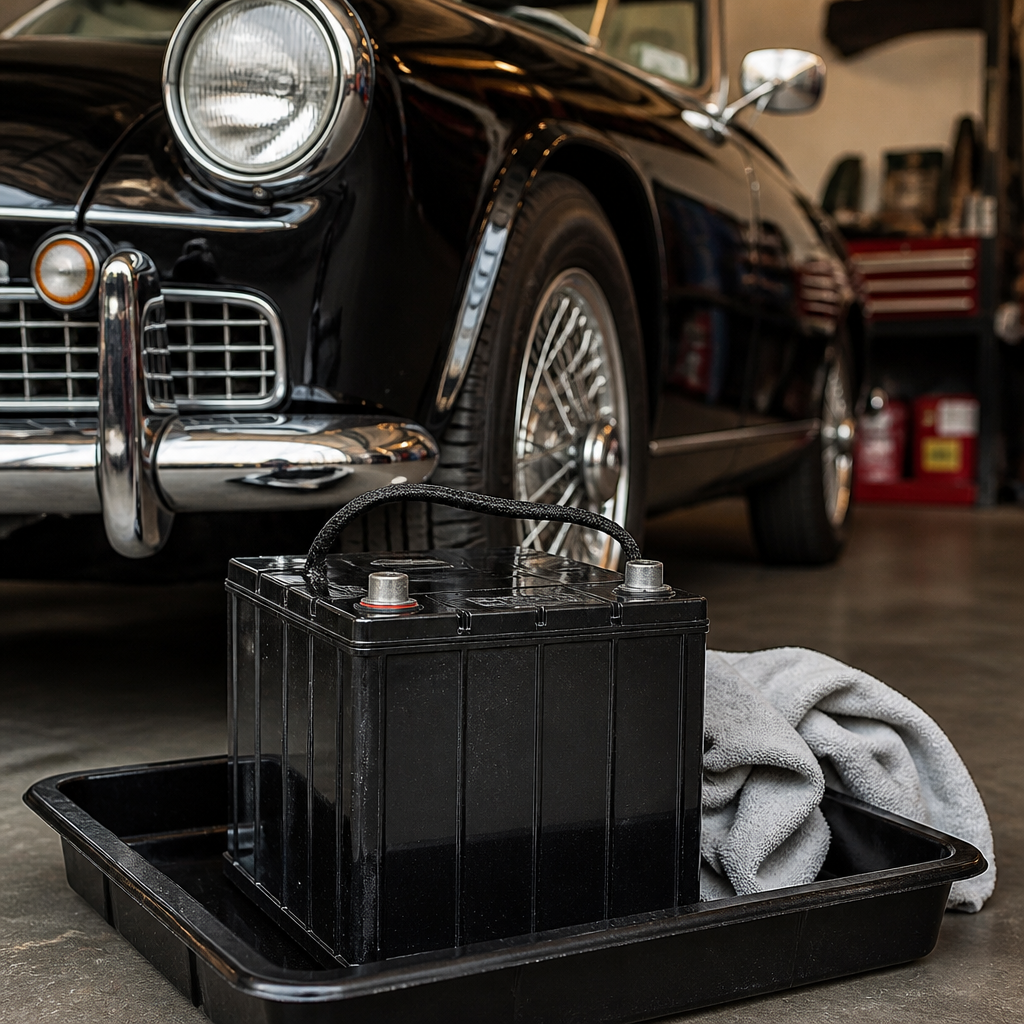
Battery storage tips for classic cars start with a simple truth: a healthy battery protects far more than your ability to crank the engine. In vintage vehicles, the battery supports electrical contacts, clocks, alarms, radios, ignition systems, and in many restored cars, sensitive aftermarket accessories that do not tolerate neglect. When I prepare a classic car for a month, a winter, or a long-term display, battery care is one of the first jobs I handle because poor storage habits create sulfation, corrosion, hard starts, and sometimes expensive electrical diagnosis later.
For classic car owners, storage and preservation means controlling the conditions that make old components deteriorate while keeping the car ready for safe recommissioning. Battery storage sits at the center of that work. A lead-acid battery, whether flooded, AGM, or gel, naturally self-discharges over time. If voltage drops too low, lead sulfate crystals harden on the plates and capacity is permanently reduced. Older cars are especially vulnerable because many have simpler charging systems, lower reserve electrical capacity, and wiring that may already have age-related resistance. A weak battery in a modern daily driver is inconvenient; in a carbureted, points-ignition classic, it can derail tuning, mask other faults, and shorten component life.
This article serves as a hub for battery storage within the broader storage and preservation side of classic car ownership. It explains how to choose the right storage method, when to disconnect the battery, when to use a maintainer, how temperature affects battery chemistry, what safety checks matter most, and how battery care connects to fuel stabilization, tire protection, moisture control, and seasonal recommissioning. If you understand these fundamentals, you can store a classic car more reliably, avoid unnecessary battery replacement, and reduce the risk of electrical problems that appear only after months of inactivity.
Why battery care matters during classic car storage
A classic car battery fails in storage for predictable reasons. The first is self-discharge, which affects all batteries. The second is parasitic draw, which may come from a clock, radio memory, alarm, tracking device, or hidden wiring fault. The third is environmental stress, especially heat, deep cold, and moisture. I have seen beautifully restored cars come out of winter storage with dead batteries not because the battery was old, but because the owner assumed occasional starts would keep it healthy. In practice, brief idling often does more harm than good. Unless the engine runs long enough for the generator or alternator to replace the starting load fully, the battery remains undercharged.
Battery care matters because low voltage creates secondary problems. Slow cranking increases starter heat. Weak ignition voltage produces hard starting and fouled plugs. Voltage instability can make owners misdiagnose carburetion when the real issue is electrical. On cars with mechanical voltage regulators or early alternators, charging performance may already be marginal at idle, so a battery that enters storage partially discharged is at a disadvantage from day one. Preservation is not just about keeping paint glossy and chrome dry; it is also about maintaining the battery in a narrow healthy range so the entire electrical system remains stable.
Choose the right battery strategy for your storage period
The best battery storage method depends on how long the car will sit and where it will be stored. For short storage, roughly two to four weeks, a fully charged battery in a car with no parasitic draw may need nothing more than a disconnect. For medium storage, one to six months, a quality smart maintainer is usually the most effective solution. For long-term storage, especially beyond six months, I recommend a full preparation routine: clean terminals, verify state of charge, disconnect or remove the battery if conditions are harsh, and use a maintainer compatible with the battery type.
Flooded lead-acid batteries are common in classic cars and tolerate storage well when kept charged and electrolyte levels are correct. AGM batteries self-discharge more slowly and handle vibration better, but still require voltage-appropriate maintenance. Gel batteries need even more charger compatibility because excessive voltage can damage them. Lithium batteries are less common in traditional classics and require dedicated battery management; they are not automatically better for preservation, especially in cold climates. The right strategy is the one that matches chemistry, ambient temperature, vehicle wiring condition, and the owner’s access to dependable power.
| Storage situation | Best battery approach | Why it works |
|---|---|---|
| 2 to 4 weeks, secure garage, no known draw | Fully charge and disconnect ground cable | Prevents slow drain without overcomplicating short storage |
| 1 to 6 months, power available | Use a smart maintainer matched to battery type | Keeps voltage in safe range and limits sulfation |
| Winter storage in cold climate | Charge fully, clean case, maintain or remove to conditioned space | A full battery resists freezing and stores more reliably |
| Long-term storage over 6 months | Inspect monthly, maintain charge, consider removal if environment is poor | Reduces corrosion, discharge risk, and unnoticed failure |
Use a smart battery maintainer, not a constant trickle charger
One of the most useful battery storage tips for classic cars is to stop using old-style constant trickle chargers unless you can monitor them carefully. A smart maintainer is designed to sense battery voltage, apply charge in stages, and switch to float or maintenance mode when the battery is full. Brands such as CTEK, Battery Tender, and NOCO have models widely used in collector car garages because they reduce overcharging risk. Overcharging a stored battery boils electrolyte out of flooded cells, accelerates plate damage, and can create acid mist that contributes to corrosion around the tray and hold-down hardware.
When I install a maintainer on a classic, I first confirm the charging profile suits the battery chemistry. A charger intended for AGM may not be ideal for gel, and a high-amperage shop charger is the wrong tool for months of unattended connection. Smart maintainers are not magic, though. They depend on clean connections, stable household power, and safe routing of leads. Extension cords, damp floors, and loose clips are avoidable weak points. If you cannot verify those basics, disconnecting the battery can be safer than leaving a questionable charging setup energized for an entire season.
Know when to disconnect or remove the battery
Disconnecting the battery is often the right move for classic cars with simple electrical systems, especially if the car will sit for more than a few weeks and you do not need a clock or security device powered. On most negative-ground cars, removing the ground cable first reduces shorting risk. On positive-ground classics, the same principle applies to the grounded terminal. Many owners also fit a battery disconnect switch, which is useful for storage, safety, and theft deterrence. A good switch can eliminate small drains and provides a fast shutdown point during maintenance.
Removing the battery completely makes sense when the storage area experiences temperature extremes, high humidity, or rodent activity, or when the tray area needs corrosion control. If you remove it, store the battery upright in a cool, dry, ventilated area and keep it on a nonconductive surface or sturdy shelf. Modern battery cases are not damaged by concrete the way older owners sometimes claim, but a clean, dry location still matters. Label the cables, protect the terminals, and record the battery’s resting voltage so you can track condition during storage rather than guessing months later.
Temperature, charging state, and sulfation explained simply
Temperature changes how well a battery survives storage. Heat is the biggest long-term enemy because it accelerates self-discharge and internal chemical breakdown. A battery stored in a hot garage through summer may lose charge much faster than one in a cool, stable environment. Cold weather reduces available cranking power, but a fully charged battery tolerates cold storage better than a discharged one. That is why I insist on charging the battery before winter layup instead of after the first failed spring start. A discharged battery can freeze at a much higher temperature than a fully charged battery.
Sulfation is the technical reason many stored batteries never recover. During discharge, lead sulfate forms on the plates as part of normal chemistry. If the battery is promptly recharged, much of that material converts back. If it remains undercharged, sulfate crystals harden and reduce active plate area. The battery may still show voltage, but capacity and starting performance fall off sharply. Some smart chargers include desulfation modes, and they can help with lightly neglected batteries, but they do not reverse severe plate damage. Prevention is far better than rescue: keep the battery clean, charged, and out of extreme heat.
Inspect cables, terminals, and the charging system before storage
Battery storage tips for classic cars are incomplete without wiring inspection. A battery can be perfect and still fail to perform if the cables, grounds, or charging system are compromised. Before storage, I check terminal tightness, look for swollen insulation, inspect ground straps, and verify that the battery tray is solid. Corrosion increases resistance, and resistance turns into slow cranking and inconsistent charging. On restored cars with reproduction harnesses, I also inspect routing and grommets because vibration and abrasion can create hidden drains or intermittent faults.
Charging system condition matters just as much. With the engine running, confirm generator or alternator output according to the vehicle’s service manual. Many classics should show roughly 13.8 to 14.4 volts with an alternator, though exact values vary by regulator design and temperature. A generator-equipped car may behave differently at idle and low speed. If the car is not charging correctly before storage, do not assume a maintainer will compensate for every weakness. Fix the underlying issue. Preservation works best when the battery, cables, regulator, and grounds are all treated as one system.
Integrate battery care with full storage and preservation practices
A hub article on storage and preservation must connect the battery to the rest of the car because these tasks affect one another. If you stabilize fuel but ignore battery voltage, spring recommissioning may still involve hard starts that dilute oil with fuel and strain the starter. If you maintain the battery but leave moisture trapped in the garage, corrosion can attack terminals, grounds, and fuse contacts. Proper storage means pairing battery maintenance with fuel stabilizer, clean oil, correct tire pressure, rodent prevention, breathable car covers when appropriate, and humidity control using ventilation or a dehumidifier.
I also recommend avoiding the habit of starting the car periodically just to let it idle. Unless you drive it long enough to bring engine oil, exhaust, and drivetrain up to full temperature, you add condensation and often remove more battery capacity than you restore. A better approach is a deliberate layup plan and a deliberate wake-up plan. During storage, inspect the battery monthly, verify maintainer status lights, and look for swelling, leaks, or corrosion. During recommissioning, reconnect carefully, check electrolyte in serviceable flooded batteries, and test voltage before the first crank. That routine prevents surprises and protects the broader preservation work you have invested in the car.
Common mistakes and the best next steps for owners
The most common battery storage mistakes are storing a battery partially discharged, using the wrong charger, ignoring parasitic draw, and assuming a battery is healthy because the headlights still work. Another frequent error is replacing the battery without cleaning the cable ends or checking charging voltage, which repeats the original problem. I have also seen owners leave maintainers connected to failing household outlets or worn extension cords, introducing a fire and reliability risk that defeats the point of preservation. Good battery care is methodical, not complicated: charge fully, match the maintainer to the battery, protect against drains, and inspect regularly.
The main benefit is reliability. A classic car that comes out of storage with a healthy battery starts easier, diagnoses more clearly, and suffers less electrical stress. As you build your classic car ownership routine, treat battery care as the anchor point for storage and preservation, then connect it to fuel, fluids, tires, climate control, and spring recommissioning. Create a checklist for your specific car, note battery type and voltage targets, and review it every storage season. That one habit will save money, reduce frustration, and help preserve the vehicle exactly as it deserves.
Frequently Asked Questions
Why is proper battery storage so important for a classic car?
Proper battery storage matters because the battery in a classic car does much more than start the engine. In vintage vehicles, it often supports clocks, memory functions, alarms, radios, ignition components, and sometimes carefully installed aftermarket electronics that can be more sensitive than original equipment. When a battery is neglected during storage, it can slowly discharge, develop sulfation on the internal plates, and lose both performance and lifespan. That can leave you with hard starting, weak ignition, inconsistent electrical behavior, and in some cases damage to surrounding components if the battery leaks or vents corrosive fumes.
Classic cars are especially vulnerable because many of them are not driven regularly enough to keep the battery fully charged. Older charging systems may also be less forgiving than modern setups, and parasitic draw from even a small accessory can drain a battery over time. A weak battery can create frustrating troubleshooting sessions that seem like ignition or wiring faults when the real problem is simply poor battery health. Good storage habits protect reliability, preserve the battery investment, and reduce the chance of corrosion in the engine bay or trunk-mounted battery area.
Should I disconnect the battery, remove it, or leave it installed during storage?
The right choice depends on how long the car will sit, where it is stored, and the condition of both the battery and the vehicle. For shorter storage periods, many owners leave the battery installed and connect a quality smart maintainer. This is often the most practical option if the storage area is dry, temperatures are reasonably stable, and you have safe access to power. A proper maintainer keeps the battery at an ideal state of charge without overcharging it, which is far better than simply letting the car sit and gradually discharge.
For longer-term storage, especially over winter or in an unheated building, removing the battery can be the safer and more controlled approach. Once removed, the battery can be cleaned, inspected, and stored in a cool, dry location away from open flame or extreme heat. This also eliminates the possibility of a slow electrical drain from the vehicle. If you do leave it installed, disconnecting the negative cable is a good step when a maintainer is not being used, as it helps reduce unwanted discharge. In all cases, the best practice is to start with a fully charged battery, clean terminals, secure connections, and a clear plan for maintaining charge throughout the storage period.
What is the best way to keep a classic car battery charged during winter or long-term storage?
The best method is to use a high-quality smart battery maintainer, sometimes called a float charger or tender, that is specifically designed to monitor battery condition and adjust charging automatically. This is very different from an old-style trickle charger, which can continue feeding current and overcharge the battery if left connected too long. A smart maintainer senses voltage, tops the battery up only when needed, and then shifts into a maintenance mode. That helps prevent sulfation while avoiding heat buildup and water loss in serviceable batteries.
Before connecting a maintainer, make sure the battery is fully charged and in good condition. Clean the case, inspect for cracks or swelling, and check the terminals for corrosion. If the battery has removable caps, verify electrolyte levels according to manufacturer guidance. Use the correct maintainer setting for the battery type, because flooded lead-acid, AGM, and gel batteries do not all want the same charging profile. During winter storage, do not rely on occasionally starting the car for a few minutes as a substitute for proper maintenance. Short run times rarely recharge the battery fully and can actually increase moisture and fuel dilution issues elsewhere in the vehicle. Consistent, gentle maintenance charging is the most dependable way to preserve battery health.
How can I prevent battery sulfation and corrosion while my classic car is in storage?
Sulfation and corrosion are two of the most common storage-related battery problems, and both are largely preventable with routine care. Sulfation happens when a battery remains partially discharged for too long, allowing lead sulfate crystals to harden on the plates. Over time, that reduces capacity and makes the battery harder to recharge. The simplest prevention is keeping the battery fully charged before storage and then maintaining that charge with a smart maintainer. Letting the battery sit discharged, even for a few weeks in cold conditions, can shorten its life considerably.
Corrosion is usually found on the terminals and cable ends, where it increases electrical resistance and creates poor connections. Before storage, disconnect the cables, clean the posts and terminals, and neutralize any corrosion carefully using an approved cleaner or a mild baking soda solution, taking care not to let contaminants enter the battery cells. Dry everything thoroughly, reassemble securely, and apply a light protective coating or terminal protectant if appropriate. Also inspect the battery tray and hold-down hardware because trapped acid residue can damage paint and metal. A clean, dry battery stored at full charge is far less likely to suffer the chemical and electrical problems that lead to failure.
How often should I check the battery on a classic car that is not being driven?
Even when a classic car is stored properly, the battery should not be ignored for months at a time. A good rule is to inspect it at least once a month, and more often if the car is stored in an area with large temperature swings or if you are not using a maintainer. During each check, confirm that the charger or maintainer is operating normally, the battery case is clean and dry, and there are no signs of swelling, leakage, loose cables, or terminal corrosion. If the battery is removable-cap type, inspect electrolyte levels periodically and top up only with distilled water when necessary and only according to the battery manufacturer’s recommendations.
If the battery is disconnected and stored off the car, check state of charge with a reliable voltmeter or battery tester and recharge before it drops too low. If the battery remains installed, look for signs of parasitic drain, especially if it seems to lose charge faster than expected. Small issues caught early are much easier to correct than a fully discharged battery in spring. Regular inspection also gives you a chance to protect nearby wiring, battery trays, and painted surfaces from any early corrosion. In practical terms, a few minutes of monthly attention can prevent replacement costs, starting problems, and a great deal of frustration when it is time to drive the car again.