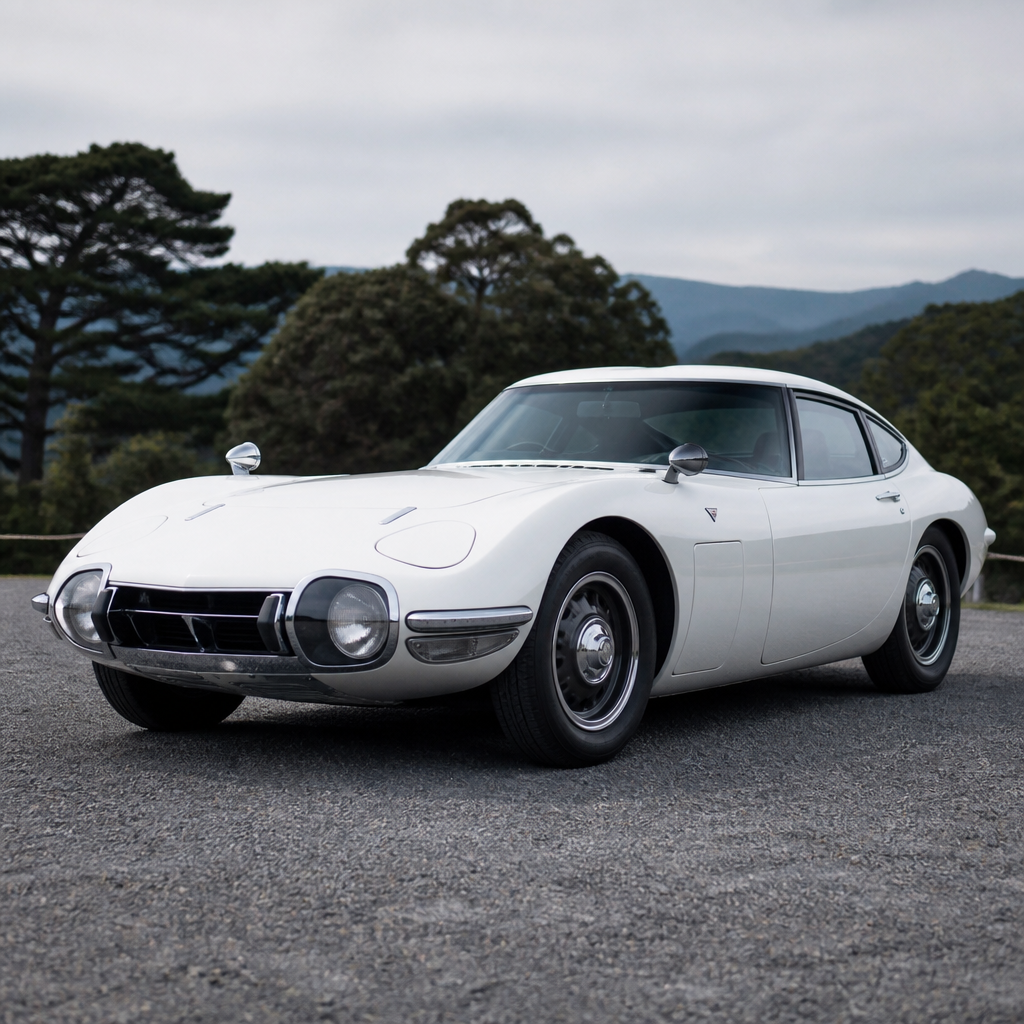
The Toyota 2000GT is widely recognized as Japan’s first supercar, and that label is not nostalgia or marketing shorthand. It reflects a machine that combined advanced engineering, limited production, motorsport credibility, and design influence at a level no earlier Japanese road car had achieved. Introduced in the second half of the 1960s, the 2000GT changed how the global industry viewed Toyota and how enthusiasts viewed Japanese performance. For a sub-pillar on iconic models, it is a natural hub because nearly every later Japanese halo car, from the Nissan GT-R to the Lexus LFA, exists in a landscape the 2000GT helped create.
To understand why the Toyota 2000GT matters, it helps to define the terms around it. An iconic model is not simply a car that sells well or looks attractive. It is a vehicle that shifts expectations, creates a recognizable design language, and remains culturally relevant long after production ends. A supercar is also more than a fast coupe. In period terms, it meant exclusivity, sophisticated mechanical specification, race or speed-record legitimacy, and a price that placed the car above mainstream performance machines. The 2000GT met those tests in a way no previous Japanese production car had done.
I keep returning to the 2000GT when mapping classic model lineages because it functions as a bridge between several histories at once: postwar Japanese industrial growth, grand touring design, motorsport technology transfer, and collector-car mythology. Its story includes Yamaha’s engineering role, a jewel-like 2.0-liter inline-six, a backbone chassis, four-wheel disc brakes, and a cabin finished with unusual attention to detail. It also includes James Bond, endurance testing, and a production total so low that surviving examples are now blue-chip collectibles. That combination makes it essential not just as a single famous car, but as a central reference point for the broader category of iconic classic models.
This hub article covers the Toyota 2000GT comprehensively while also showing why it connects to related discussions across classic car models and brands. If you are exploring landmark sports cars, Japanese classics, limited-production coupes, or the origins of Toyota performance heritage, the 2000GT is the right place to start. It answers the basic question of what made the car special, but it also explains the deeper issue: why one elegant fastback from the 1960s still defines credibility, ambition, and engineering seriousness for an entire nation’s automotive legacy.
Origins: Why Toyota Built the 2000GT
The Toyota 2000GT emerged at a moment when Japan’s car industry needed a statement vehicle. By the mid-1960s, Toyota had already proved it could build dependable family cars, but dependability alone did not earn international prestige. European brands dominated the idea of the refined high-performance grand tourer, and American brands dominated image through size, power, and racing. Toyota needed a car that signaled technical maturity. The 2000GT became that statement, demonstrating that Japanese manufacturers could build not only practical transportation, but also a world-class enthusiast machine.
Development involved Yamaha, whose engineering and prototype work were crucial. Yamaha had experience with precision manufacturing and had worked on performance-oriented projects, making it a strong partner for a low-volume specialty car. The collaboration gave Toyota access to craftsmanship and engineering bandwidth that suited an ambitious halo model. From the beginning, this was not intended to be a mass-market coupe. It was conceived as a limited, technically advanced car designed to reshape perception, and in that sense it succeeded before most buyers had even seen one in person.
Engineering and Design That Set It Apart
The 2000GT’s specification explains why historians call it a supercar. Power came from a 2.0-liter DOHC inline-six derived from Toyota’s M-family engine architecture but extensively reworked with Yamaha-developed cylinder head technology. Output is commonly cited around 150 horsepower, impressive for a naturally aspirated 2.0-liter road engine in the 1960s. More important than the raw number was the character: smooth revving, mechanically sophisticated, and matched to a five-speed manual gearbox at a time when many competitors still relied on four speeds. That drivetrain gave the car a distinctly international level of refinement.
The chassis was equally significant. Toyota used a backbone-style frame with a low-slung body that helped achieve dramatic proportions and a low center of gravity. Independent front suspension, sophisticated rear suspension layout, and standard four-wheel disc brakes added to the car’s credibility. Magnesium wheels were used on some cars, and the steering and seating position gave the 2000GT a focused, driver-centric feel. In my experience studying period test reports, what stands out is not just praise for style, but repeated surprise that the car drove with the composure expected from established European GT makers.
Design played an enormous role in the 2000GT’s impact. The long hood, short rear deck, faired-in headlamp covers, delicate greenhouse, and muscular rear haunches created one of the most balanced sports car shapes of the era. Comparisons to the Jaguar E-Type appear often, but the Toyota was not a copy. It had its own visual discipline, especially in the roofline and cabin proportions. Inside, the rosewood dashboard, clear instrumentation, and precise switchgear gave the car a crafted feel unusual for Japanese automobiles of the period. It looked expensive because it was expensive to make.
| Feature | Toyota 2000GT Significance | Why It Mattered in the 1960s |
|---|---|---|
| 2.0-liter DOHC inline-six | High-revving, advanced engine for a Japanese road car | Showed Japan could build refined performance powertrains |
| Five-speed manual | Closer gear spacing and grand touring flexibility | Placed the car above many mainstream sports coupes |
| Four-wheel disc brakes | Strong, fade-resistant stopping power | Aligned the car with serious European performance standards |
| Low-production hand-finished build | Exclusive halo positioning | Created prestige rather than volume |
| Distinctive fastback styling | Instant recognition and lasting collector appeal | Made the car a design icon, not just a technical exercise |
Performance, Records, and Competition Credibility
A true halo car needs proof beyond brochures, and Toyota pursued that proof aggressively. Period road tests generally placed top speed around 135 mph, with 0 to 60 mph in roughly 8 to 10 seconds depending on source, setup, and test conditions. Those numbers may look modest now, but context matters. In the late 1960s, they placed the 2000GT in serious company, especially for a 2.0-liter car from a country not yet known for elite sports cars. It was quick, stable, and technically convincing in an era when credibility was earned through measured results.
Toyota also used endurance and speed records to validate the car. In 1966, specially prepared 2000GTs set multiple international speed and endurance records at Yatabe test track. Record runs included sustained high-speed driving over long distances, which highlighted not just performance but reliability. That mattered because European exotics were often admired but not always trusted mechanically. Toyota’s message was subtle but powerful: here was a car that could deliver advanced engineering without fragility. In modern branding language, the 2000GT fused aspiration with dependability decades before that combination became a Japanese industry trademark.
Competition activity further strengthened the model’s image. The 2000GT appeared in touring and sports car events, including domestic racing in Japan, where it demonstrated handling balance and stamina. It was not a mass-produced racer like later homologation specials, but its motorsport presence signaled intent. For enthusiasts building a mental map of iconic models, that matters because history tends to reward cars that prove themselves under pressure. The 2000GT’s record work and competition exposure gave it substance that reached far beyond show-stand glamour.
Cultural Impact and the James Bond Effect
The Toyota 2000GT would still matter without popular culture, but film exposure amplified its legend. Its most famous screen role came in the 1967 James Bond film You Only Live Twice. Because Sean Connery was too tall to fit comfortably in the production coupe, Toyota created two open-top versions for filming. Those cars were not production convertibles, yet they became central to the model’s public image. Bond association instantly linked the 2000GT to sophistication, speed, and international cool at a time when cinematic placement could reshape a model’s global identity.
That appearance mattered especially outside Japan, where many buyers and journalists had limited exposure to Japanese specialty cars. The film presented the 2000GT not as an industrial curiosity, but as an object worthy of the same glamorous framing given to European exotics. In practical terms, very few people would ever see one on the road because production was tiny. Cinema solved that scarcity problem by making the car visible to millions. The result was a cultural footprint far larger than the production run would normally allow.
Within Japan, the 2000GT became a symbol of national confidence. It arrived during a period of expanding export ambition and growing technological pride. For younger enthusiasts, it showed that domestic brands did not need to imitate foreign performance culture from a distance; they could contribute to it directly. That is why the 2000GT remains central in museum displays, collector conversations, and retrospectives on Japanese design. It was not just a successful model. It was a declaration that Japanese automotive excellence could be aspirational, elegant, and globally respected.
Production Numbers, Rarity, and Collector Value
The Toyota 2000GT was never meant to be common. Production is generally cited at 351 units built between 1967 and 1970, though experts sometimes note minor record variations depending on prototypes and special versions. That total alone guarantees rarity, but scarcity is only part of the value story. The car was expensive when new, reportedly priced in some markets above contemporaries like the Porsche 911 and near larger-displacement European prestige machines. In commercial terms, it was a difficult sell. In historical terms, that pricing proved Toyota was serious about positioning the car at the top of the market.
Today, the collector market treats the 2000GT as a cornerstone Japanese classic. Auction results have reached well above one million dollars for strong examples, with exceptional provenance pushing values much higher. That valuation reflects several forces working together: limited supply, strong design, historical firsts, and cross-market demand from Japanese car collectors, traditional European sports car buyers, and museums. Restoration is specialized because trim, body details, and mechanical components are rare, and originality matters enormously. As with any elite collectible, documentation, chassis identity, and period-correct specification have direct financial consequences.
Rarity also changes how the car is discussed. Many classics become famous because people grew up around them. The 2000GT became famous despite very few people ever seeing one. That kind of fame usually belongs only to genuinely transformative models. When a low-volume car earns broad recognition across generations and continents, it has moved beyond scarcity into symbolism. The 2000GT symbolizes the moment Japanese performance stopped asking for validation and started commanding it.
Legacy Among Iconic Models and Brands
As a hub within classic car models and brands, the 2000GT connects naturally to several other iconic model stories. It sits alongside the Jaguar E-Type, Porsche 911, Chevrolet Corvette, and Mercedes-Benz 300SL as a car that distilled national ambition into one defining shape. Within Japanese brand history, it is the spiritual ancestor of the Datsun 240Z, Mazda Cosmo, Acura NSX, Nissan Skyline GT-R, Toyota Supra, and Lexus LFA. Those cars differ in layout, price, and era, but each benefited from a world in which the 2000GT had already established that a Japanese flagship performance car could earn global reverence.
Its legacy inside Toyota is especially important. The company has produced many beloved sports cars, from the Sports 800 to the Celica, MR2, Supra, 86, and GR models, yet the 2000GT remains the emotional summit. It represents a kind of uncompromised engineering ambition that large manufacturers rarely pursue unless they want to make a statement. That is why the model appears so often in discussions about brand halo strategy, design heritage, and the commercial value of prestige projects. Even when such cars do not generate major profit directly, they reshape perception across the lineup.
The main lesson is simple. The Toyota 2000GT became Japan’s first supercar because it united beauty, engineering sophistication, competition credibility, and cultural reach in one exceptionally rare package. It proved that a Japanese brand could build a collector-grade grand tourer equal in ambition to Europe’s best, and it gave Toyota a performance legacy that still informs the brand’s image today.
For readers exploring iconic models under the broader classic car models and brands topic, the 2000GT is more than a standalone legend. It is a gateway to related stories about Japanese sports cars, limited-production classics, motorsport-derived road cars, and the way one model can change an entire country’s automotive reputation. If you are building your understanding of classic icons, start with the Toyota 2000GT, then follow the lineage it inspired across decades of performance design and engineering.
Frequently Asked Questions
Why is the Toyota 2000GT considered Japan’s first supercar?
The Toyota 2000GT is considered Japan’s first supercar because it was the first Japanese production car to bring together the full set of qualities associated with that label: advanced engineering, striking and original styling, serious performance, exclusivity, and international prestige. Before the 2000GT, Japan had produced capable and interesting sports cars, but none projected the same level of technical sophistication and ambition. The 2000GT featured a lightweight, low-slung grand touring layout, a high-revving 2.0-liter inline-six, four-wheel independent suspension, front disc brakes, and a finely crafted interior that rivaled respected European rivals of the era.
Just as important, the 2000GT was not simply fast for a Japanese car; it was designed to stand on the world stage. Its proportions, road manners, and engineering discipline made critics and enthusiasts outside Japan take notice. It proved that a Japanese manufacturer could build a performance machine that was not derivative, cheap, or purely domestic in outlook. In that sense, the “supercar” title reflects more than numbers alone. It recognizes the 2000GT as a landmark car that transformed global perceptions of Japanese performance and established a new benchmark for what Japan’s auto industry could achieve.
What made the Toyota 2000GT so advanced for its time?
The 2000GT stood out in the late 1960s because it combined multiple advanced features into a cohesive, high-performance package. At its heart was a 2.0-liter inline-six engine developed with Yamaha’s input, featuring dual overhead camshafts and triple carburetors in many versions. That setup gave the car a smooth, eager character and a level of sophistication that was rare even among established sports car makers. The engine was paired with a five-speed manual transmission, which added to the car’s grand touring credibility and made it more versatile at speed than many contemporaries.
The chassis and suspension were equally impressive. The 2000GT used four-wheel independent suspension, which helped deliver a more composed and precise driving experience than the live-axle layouts still common in many sports cars of the period. Front disc brakes improved stopping performance, while the low overall height and carefully balanced proportions contributed to both aerodynamics and handling. Inside, the car featured a driver-focused cockpit with quality materials and a level of finish that reinforced its premium intent. What made the 2000GT truly advanced was not any single feature in isolation, but how thoroughly Toyota engineered the entire car to compete with top-tier international sports coupes rather than merely satisfy domestic expectations.
How rare is the Toyota 2000GT, and why does that matter today?
The Toyota 2000GT is exceptionally rare, with production generally cited at around 350 units. That limited output matters for several reasons. First, it reflects the car’s original purpose. The 2000GT was never intended to be a mass-market model. It was a halo car, built to demonstrate Toyota’s engineering capability and reshape its image. Low production also meant high costs, specialized assembly, and a level of craftsmanship that separated it from mainstream offerings. In other words, rarity was part of the car’s identity from the start, not just a byproduct of age.
Today, that scarcity greatly enhances the 2000GT’s significance among collectors and historians. Surviving examples are prized not only because they are hard to find, but because they represent a pivotal moment in automotive history. The car sits at the intersection of Japanese industrial ambition, 1960s sports car culture, and design evolution. Its rarity also means each example carries substantial historical value, especially when preserved in original condition. As a result, the 2000GT has become one of the most collectible Japanese cars ever built, and its limited production is a major reason it commands such reverence and strong market values.
Did the Toyota 2000GT have any real motorsport credibility?
Yes, the Toyota 2000GT had genuine motorsport credibility, and that credibility was important to its reputation. Toyota used the model to demonstrate that the car’s engineering was more than showroom theater. The 2000GT achieved success in competition and endurance testing, helping validate its performance, reliability, and high-speed capability. In the 1960s, motorsport and speed trials carried tremendous weight in shaping public opinion, especially for manufacturers seeking international respect. By performing strongly in these arenas, the 2000GT showed that it could back up its elegant looks with real substance.
That competition presence mattered because it reinforced the car’s role as a serious driver’s machine rather than a styling exercise. For a Japanese manufacturer at the time, proving performance in demanding environments was especially significant. It helped counter assumptions that Japan excelled only at economical, practical vehicles. The 2000GT’s motorsport and endurance achievements added legitimacy to Toyota’s performance ambitions and gave the model a credibility that enthusiasts still value today. Its racing and speed-record story is one of the reasons the car remains central to discussions about the birth of world-class Japanese sports cars.
What is the Toyota 2000GT’s legacy in automotive history?
The Toyota 2000GT’s legacy is much larger than its production numbers suggest. It changed how the world viewed Toyota by proving the company could build a sophisticated, aspirational, and globally relevant performance car. More broadly, it changed how enthusiasts and the industry viewed Japan. The 2000GT helped establish the idea that Japanese automakers could produce vehicles defined not just by reliability and value, but by beauty, engineering finesse, and emotional appeal. That shift laid cultural groundwork for many later icons from Toyota, Nissan, Honda, Mazda, and others.
The car’s influence also extends into design and brand identity. Its long hood, compact cabin, fastback profile, and low roofline gave it a timeless elegance that continues to inspire admiration decades later. It showed that Japanese performance could have its own visual language rather than simply imitate European templates. Historically, the 2000GT stands as a turning point: a car that announced Japan’s arrival in the upper tier of enthusiast automobiles. That is why it remains such a celebrated model today. It was not merely an early sports car from Japan; it was the car that redefined the possibilities of Japanese automotive excellence on a global stage.