Braking systems in classic cars explained begins with a simple truth: nothing affects safety, drivability, and ownership confidence more than the ability to slow a vintage vehicle predictably. In the classic car world, “braking system” means far more than the brake pedal and shoes. It includes hydraulic circuits, wheel cylinders or calipers, master cylinders, drums or rotors, friction materials, hoses, hard lines, hardware, parking brake linkages, wheel bearings, tires, and even suspension geometry that influences stopping stability. I have inspected and driven classics ranging from prewar mechanical-brake cars to 1970s disc-brake coupes, and the lesson is always the same. Original design matters, condition matters more, and thoughtful upgrades only help when they are matched to the rest of the car.
For owners under the broader classic car ownership umbrella, driving and safety tips start here because braking is the foundation for every other decision on the road. Acceleration is optional; stopping is not. A well-tuned engine can make a car enjoyable, but compromised brakes can make it dangerous even at neighborhood speeds. Many classics were engineered around narrower tires, lower average traffic speeds, and shorter periods of seasonal use. Modern drivers often expect one-finger pedal effort and straight, drama-free panic stops from machines designed in an era when longer following distances and more deliberate inputs were normal. Understanding those differences helps owners set realistic expectations, maintain authenticity where appropriate, and identify upgrades that preserve character without compromising safety.
This hub article covers the major braking system types found in classic cars, the common failure points that appear after decades of storage and intermittent use, inspection routines that should precede regular driving, and practical strategies for safer operation in modern traffic. It also serves as a guide for the supporting articles that typically sit beneath a driving and safety section, including brake fluid choices, drum brake adjustment, disc brake conversion planning, tire selection, emergency stopping technique, and storage recommissioning checklists. If you own, shop for, restore, or drive an older vehicle, mastering brake fundamentals is one of the highest-value skills you can develop.
How classic car braking systems work
Most classic cars on the road today use one of three braking layouts: four-wheel drums, front discs with rear drums, or four-wheel discs on higher-performance later models. Earlier vehicles may use mechanical linkages rather than hydraulic pressure, but hydraulic systems became dominant because they equalize force more consistently and simplify packaging. In a hydraulic system, pressing the brake pedal moves a pushrod into the master cylinder. That motion pressurizes brake fluid, which transmits force through steel lines and flexible rubber hoses to wheel cylinders in drum brakes or calipers in disc brakes. Friction material then clamps or expands against a rotating surface, converting motion into heat.
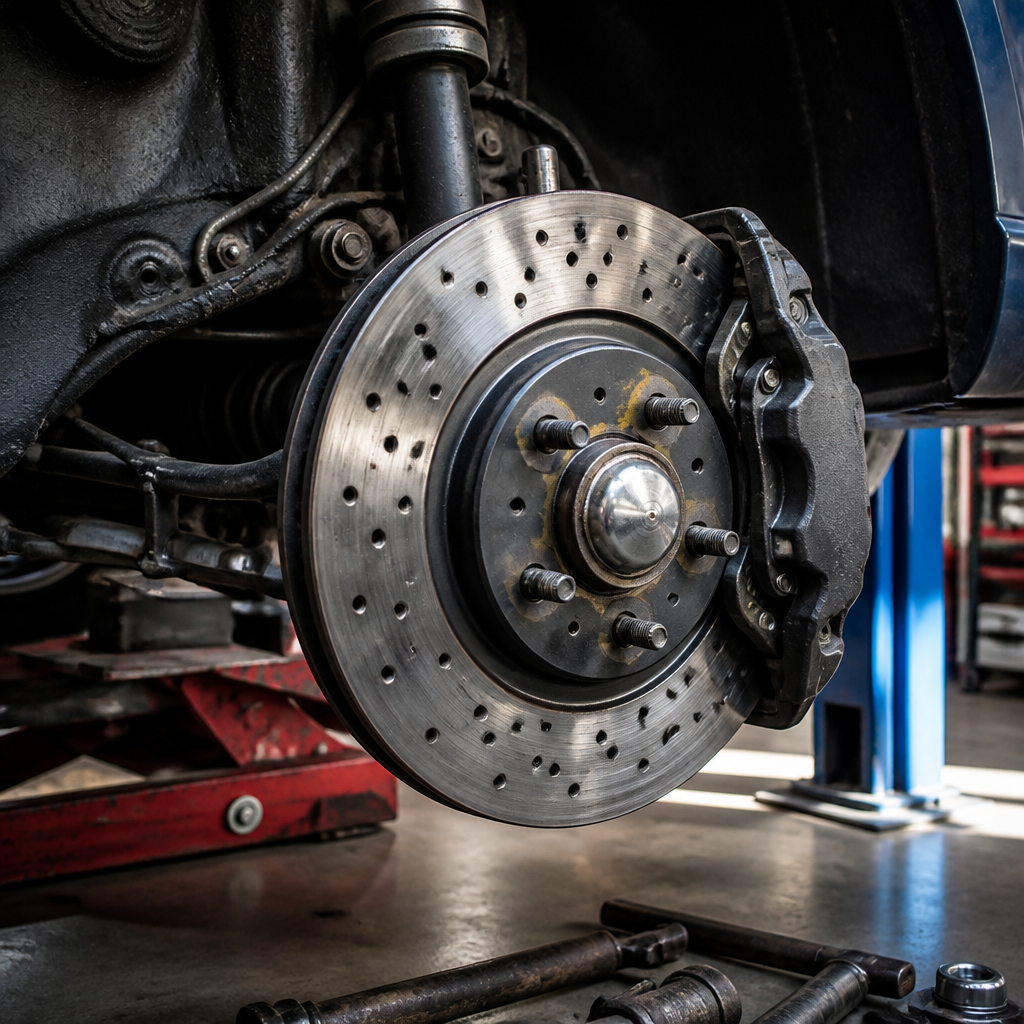
Drum brakes are common on 1940s, 1950s, and many 1960s classics. They package the braking surface inside a drum and often benefit from a self-energizing effect, meaning the leading shoe is pulled into the drum as it rotates. That design can produce strong braking for modest pedal effort, but it also creates sensitivity to adjustment, fade, and contamination. Disc brakes, which became more common in American and European cars during the 1960s and 1970s, place pads on either side of a rotor. They shed heat and water more effectively, recover faster after repeated stops, and generally maintain straighter braking under heavy use. However, they typically require higher hydraulic pressure and, in many cars, a vacuum booster to provide acceptable pedal effort.
Single-circuit master cylinders were once standard. They route pressure through one hydraulic circuit, so one major leak can remove nearly all service braking. Dual-circuit systems, mandated in the United States beginning with the 1967 model year under Federal Motor Vehicle Safety Standard developments, divide the system front-to-rear or diagonally. If one circuit fails, some braking remains. That does not make a car fail-safe, but it materially reduces risk. When I evaluate any classic intended for road use, a single-circuit brake system is one of the first things I discuss with the owner, because it affects both maintenance priority and driving style.
Common problems found in classic car brakes
Age damages brake systems even when mileage is low. Brake fluid is hygroscopic in most conventional formulations, which means it absorbs moisture from the air. Water contamination lowers boiling point and promotes internal corrosion in master cylinders, wheel cylinders, calipers, and steel lines. A car that sat untouched in a dry garage for twenty years may still have seized wheel cylinders or pitted caliper bores. Rubber components also degrade with time. Flex hoses can swell internally and act like one-way valves, allowing pressure to apply a brake but not release it cleanly. Seals harden, dust boots crack, and old friction material can separate from its backing.
Drum systems add their own list of age-related issues. Shoe adjustment goes out of spec, anchor points wear, return springs lose tension, and hardware kits are often reused when they should not be. A classic that pulls to one side during braking may have contaminated linings from a leaking axle seal, mismatched shoe material, or one wheel cylinder sticking. Disc systems are not immune. Caliper slides corrode, pistons seize, rotor thickness variation creates pedal pulsation, and cheap replacement pads can transform a good design into a noisy, low-friction setup.
Brake performance complaints are not always caused by the brakes alone. Worn steering components, incorrect tire pressures, old bias-ply tires, loose wheel bearings, misalignment, and tired shocks all influence stopping stability. I have driven vintage sedans with freshly rebuilt drums that still felt alarming in emergency stops because the front shocks were weak and the rear tires had hardened with age. Owners often chase pedal feel before correcting chassis problems that actually determine how composed the car remains when weight transfers forward.
| Issue | Typical Cause | What the Driver Notices | Best First Check |
|---|---|---|---|
| Soft or sinking pedal | Air in lines, internal master cylinder bypass, external leak | Long pedal travel, poor confidence at stops | Inspect fluid level, wheel cylinders, hoses, and master cylinder for leaks |
| Pulling to one side | Sticking wheel cylinder or caliper, contaminated lining, uneven adjustment | Car darts left or right under braking | Compare shoe wear, drum condition, hose function, and tire pressures |
| Brake fade | Overheated drums or pads, low boiling-point fluid | Pedal effort rises while stopping power falls | Review driving conditions, fluid age, friction material, and drum or rotor sizing |
| Locked wheel after stop | Collapsed hose, seized cylinder, parking brake linkage issue | Car resists moving, smells hot | Check hose restriction, hardware return action, and cable release |
Inspection and maintenance priorities for safer driving
A proper brake inspection on a classic car should be systematic and conservative. Start with service records, because brake work done ten years ago is not current if the car has been sitting. Check fluid condition first. Dark fluid does not automatically mean failure, but it does indicate oxidation and contamination. Pull all four wheels if the car uses drums or if caliper condition is unknown. Measure lining thickness, inspect drums for scoring and out-of-round wear, verify rotor thickness against specifications, and replace hardware that has lost tension. On drum systems, confirm that the adjusters move freely and that the shoes are installed in the correct leading and trailing positions. That mistake is more common than many owners realize and can badly affect braking balance.
Steel brake lines deserve close attention, especially where clips trap moisture or road debris. Surface rust is common; deep scaling, wetness, or swelling under coating is not acceptable. Flexible hoses should be treated as age-limited service items. Even if they look presentable externally, internal delamination can cause intermittent drag that mimics other faults. Wheel bearings should be cleaned, inspected, and adjusted whenever front drums or serviceable hubs are removed. Excessive bearing play can feel like pedal inconsistency and can accelerate rotor or drum runout.
Fluid selection matters. Most classics designed for glycol-based fluid should continue using DOT 3 or DOT 4 unless the entire system has been rebuilt and a switch is made deliberately. Silicone DOT 5 does not absorb water and can protect paint, but it also behaves differently, can trap air more readily, and is not appropriate for every application. It should never be mixed with glycol fluids. For many regularly driven classics, high-quality DOT 4 changed on schedule is the practical choice. The maintenance interval I recommend for driven cars is usually every two years, sooner for vehicles exposed to heat or humidity.
Drum brakes versus disc brakes in real-world use
Owners often ask whether drum brakes are unsafe. The accurate answer is no, provided they are properly designed, correctly adjusted, and used within their limits. Millions of cars stopped effectively on four-wheel drums for decades. The problem is not that drum brakes cannot work. The problem is that their performance degrades faster when neglected, overheated, or contaminated, and modern traffic leaves less margin for inconsistency. In ordinary cruising, a healthy drum system can be perfectly acceptable. On mountain descents, repeated high-speed stops, or aggressive urban driving, discs usually provide better heat management, shorter recovery time, and more predictable straight-line behavior.
Converting to front discs can be worthwhile, but only when the conversion is engineered as a system. That means correct master cylinder bore sizing, pedal ratio, residual pressure valve strategy, proportioning, wheel fitment, and booster compatibility. I have seen expensive disc conversions perform worse than stock drums because the installer mismatched caliper volume to the master cylinder or used poor-quality brackets that altered pad sweep. For a numbers-matching show car, restoring the original brakes to factory specification may be the better route. For a frequently driven restomod, a well-developed disc package from a reputable supplier can materially improve confidence.
The most important principle is balance. Stronger front brakes without appropriate rear contribution can lengthen stops. A booster that creates an over-assisted, grabby pedal can make low-traction conditions harder to manage. Wider modern radial tires may improve grip, but they also change steering feel and can expose weakness in suspension bushings. Every braking decision on a classic car should be made with the entire vehicle in mind.
Driving and safety tips every classic car owner should follow
Safe classic car driving starts before the key turns. Perform a brief walkaround, confirm pedal feel before entering traffic, and test the brakes at low speed after any period of storage. Increase following distance beyond what you would use in a modern car, especially in wet weather or downhill traffic. Many classics lack anti-lock braking systems, electronic brake-force distribution, and modern crash protection, so the safest strategy is to avoid emergency situations early. Scan farther ahead, leave escape space at intersections, and brake sooner, straighter, and more progressively than you might in a new vehicle.
Downshifting can help manage speed on grades, but it should supplement the brakes, not replace them. Repeated hard braking in a drum-brake car builds heat quickly, so use terrain and spacing to your advantage. If the pedal suddenly feels different, do not assume the problem will clear itself. Pull over safely and inspect. A minor fluid leak or dragging shoe can become a complete loss of braking faster than many owners expect. Carrying a small emergency kit with brake fluid, a flashlight, gloves, and a wheel chock is sensible for touring events.
Finally, build your ownership plan around preventive work rather than visible failure. The best classic car safety upgrades are often invisible: new hoses, correctly flared lines, rebuilt cylinders, quality friction materials, fresh tires, and aligned suspension. If your current brake system is unknown, make that your next project. Strong brakes protect the car, the occupants, and everyone sharing the road. Start with a thorough inspection, fix the fundamentals, and then explore model-specific guides that deepen each topic in this classic car ownership safety hub.
Frequently Asked Questions
What makes braking systems in classic cars different from those in modern vehicles?
Classic car braking systems are usually simpler in design, but they demand more attention from the owner because they were engineered in a different era of driving expectations, road speeds, tire technology, and safety standards. Many vintage vehicles use four-wheel drum brakes, single-reservoir master cylinders, manual brake operation without power assist, and narrower bias-ply tires. By contrast, modern vehicles typically rely on front disc brakes, dual-circuit hydraulic systems, vacuum or electronic brake assist, proportioning valves, anti-lock braking systems, and tires that provide far more grip.
That difference matters because a classic car’s stopping ability is influenced by the entire vehicle, not just the pedal or brake shoes. Brake balance, hydraulic pressure, suspension condition, steering play, wheel bearings, tire compound, and chassis geometry all affect how confidently the car slows down. A vehicle with perfectly rebuilt drum brakes may still feel nervous or require a longer stopping distance if the tires are old, the front end is out of alignment, or the suspension allows excessive dive.
Another important distinction is heat management. Drum brakes, which are common on classics, can work very well when properly adjusted and maintained, but they generally dissipate heat less effectively than disc brakes. Under repeated hard braking, they are more susceptible to fade, pulling, or changes in pedal feel. That does not automatically make them unsafe; it simply means the driver must understand the system’s limits and keep it in proper condition.
In practical terms, classic brakes reward maintenance and mechanical sympathy. They often require periodic adjustment, inspection for fluid leaks, checking hose condition, monitoring shoe wear, and making sure hardware such as return springs and self-adjusters are functioning correctly. When properly sorted, a classic braking system can be predictable, confidence-inspiring, and entirely appropriate for the vehicle’s intended use. The key is understanding that “good brakes” on a classic car mean a complete, balanced system working as designed.
Are drum brakes on classic cars safe, or should they always be upgraded to disc brakes?
Drum brakes on classic cars can be safe and effective when they are in correct working order, properly adjusted, and matched to the way the vehicle is used. There is a common assumption that drum brakes are automatically inadequate, but that is too simplistic. For normal cruising, parade duty, weekend back-road driving, and period-correct restoration, a properly rebuilt drum brake system can provide smooth, dependable braking. Many classic cars spent decades in service with drum brakes because, within the expectations of their time, they worked well enough when maintained.
That said, drum brakes do have limitations. They are more prone to heat buildup during repeated stops, especially on long descents or in modern traffic where speeds are higher and stopping events can be more aggressive. As temperature rises, braking performance may decline, a condition known as brake fade. Drums can also be more sensitive to adjustment, contamination from leaking axle seals or wheel cylinders, and uneven operation from worn hardware. If one side grabs more than the other, the car may pull during braking.
Whether to upgrade to front discs or keep drums depends on the car’s purpose, originality goals, and the owner’s expectations. If the vehicle is driven frequently in heavy traffic, used on highways, fitted with more powerful engines, or expected to stop repeatedly from higher speeds, a well-engineered disc conversion may improve consistency and confidence. However, not every conversion kit is automatically better than a restored factory system. Poorly matched components, incorrect master cylinder sizing, improper pedal ratio, or lack of a proportioning valve can create new problems such as excessive pedal effort, premature rear lockup, or a spongy feel.
The best approach is to evaluate the existing system honestly. If originality matters and the drums are in good condition, with quality friction materials, true drums, fresh hydraulics, and proper adjustment, keeping them is entirely reasonable. If your driving pattern places demands beyond what the original setup comfortably handles, a carefully planned disc conversion may be worthwhile. Safety comes less from the label “drum” or “disc” and more from system condition, component quality, setup accuracy, and realistic driving habits.
What are the most common brake problems in classic cars, and what symptoms should owners watch for?
Classic cars commonly develop brake issues related to age, moisture, corrosion, infrequent use, and deteriorated rubber parts. One of the most frequent problems is hydraulic leakage. Brake fluid attracts moisture over time, which can corrode internal surfaces in the master cylinder, wheel cylinders, calipers, and steel lines. Seals harden with age, hoses crack internally or externally, and leaks can appear even on cars that are driven only occasionally. Symptoms include a sinking pedal, loss of fluid in the reservoir, wetness around backing plates or calipers, and reduced stopping power.
Another common issue is brake pull, where the car veers to one side during braking. This can be caused by contaminated shoes or pads, a seized wheel cylinder or caliper, uneven adjustment, collapsed flexible hoses, grease or brake fluid on the friction surfaces, or mechanical issues such as loose suspension parts. Pulling should never be ignored, because it indicates unequal braking force at the wheels and can make emergency stops unpredictable.
Owners should also watch for pedal feel changes. A spongy pedal usually suggests air in the hydraulic system, deteriorated hoses expanding under pressure, or fluid that has absorbed excessive moisture. A very hard pedal can indicate poor power assist function on equipped cars, binding mechanical components, or an incorrectly matched brake conversion. A low pedal may point to shoe adjustment issues on drum systems, while a pedal that slowly sinks under steady pressure often suggests internal bypassing in the master cylinder.
Noises and smells are also valuable clues. Grinding can mean the friction material is worn down, while squealing may indicate glazing, vibration, or poor contact surfaces. A burning smell after braking may point to dragging shoes, a sticking caliper, or a parking brake that is not fully releasing. If a wheel feels significantly hotter than the others after a short drive, that corner should be inspected immediately.
Finally, remember that braking complaints are not always caused by the brakes alone. Worn wheel bearings, badly aged tires, incorrect tire pressures, front-end looseness, weak shocks, and poor alignment can all mimic or worsen brake issues. In classic cars, diagnosis works best when the vehicle is treated as a complete system rather than a collection of unrelated parts.
How often should a classic car’s braking system be inspected and maintained?
A classic car’s braking system should be inspected more frequently than many owners expect, especially because age and storage conditions can be just as damaging as mileage. Even a car driven only a few hundred miles per year should receive a routine brake inspection at least annually. Vehicles that are driven regularly, stored in humid conditions, or used on longer trips benefit from checks before and after the driving season, as well as a quick inspection before any major outing.
At a minimum, owners should monitor brake fluid level and condition, look for leaks at the master cylinder, wheel cylinders, calipers, hoses, and hard lines, inspect pad or shoe wear, and verify that the pedal feel is consistent. Drum brake systems should also be checked for proper adjustment, because excessive clearance between the shoes and drum can produce a low pedal and delayed brake response. Parking brake operation deserves attention too, since cables and linkages can seize or fall out of adjustment over time.
Brake fluid service is especially important. Because conventional brake fluid absorbs moisture, it should be replaced periodically even if the car is not driven much. Moisture contamination lowers the fluid’s boiling point and promotes internal corrosion in expensive hydraulic parts. A regular flush interval helps protect the entire system and is one of the best preventive maintenance steps a classic owner can take.
Rubber components deserve close scrutiny. Flexible hoses may look acceptable on the outside while deteriorating internally, restricting fluid flow and causing brakes to drag or release slowly. Rubber seals in wheel cylinders, calipers, and master cylinders also age with time, not just use. If the service history is unknown, replacing old hoses and rebuilding or replacing suspect hydraulic components is often wiser than waiting for failure.
In short, brake maintenance on a classic car should be proactive, not reactive. These systems rarely improve with neglect, and small issues can quickly become major safety concerns. Regular inspections, quality parts, and prompt correction of even minor symptoms are what keep a vintage vehicle safe, enjoyable, and trustworthy on the road.
What should owners consider before restoring or upgrading a classic car braking system?
Before restoring or upgrading a classic car braking system, owners should first define the goal of the vehicle. Is it a concours-correct restoration, a weekend cruiser, a touring car, or a modified restomod expected to keep up with modern traffic? The answer shapes every brake decision. A factory-style rebuild may be ideal for originality and authenticity, while a car used for frequent highway driving or mountain roads may benefit from selective upgrades such as front discs, a dual-reservoir master cylinder, or improved friction materials.
It is also essential to think in terms of the complete system rather than a single component. Installing larger brakes without addressing master cylinder bore size, pedal ratio, wheel and tire grip, suspension condition, or brake bias can lead to disappointing or even