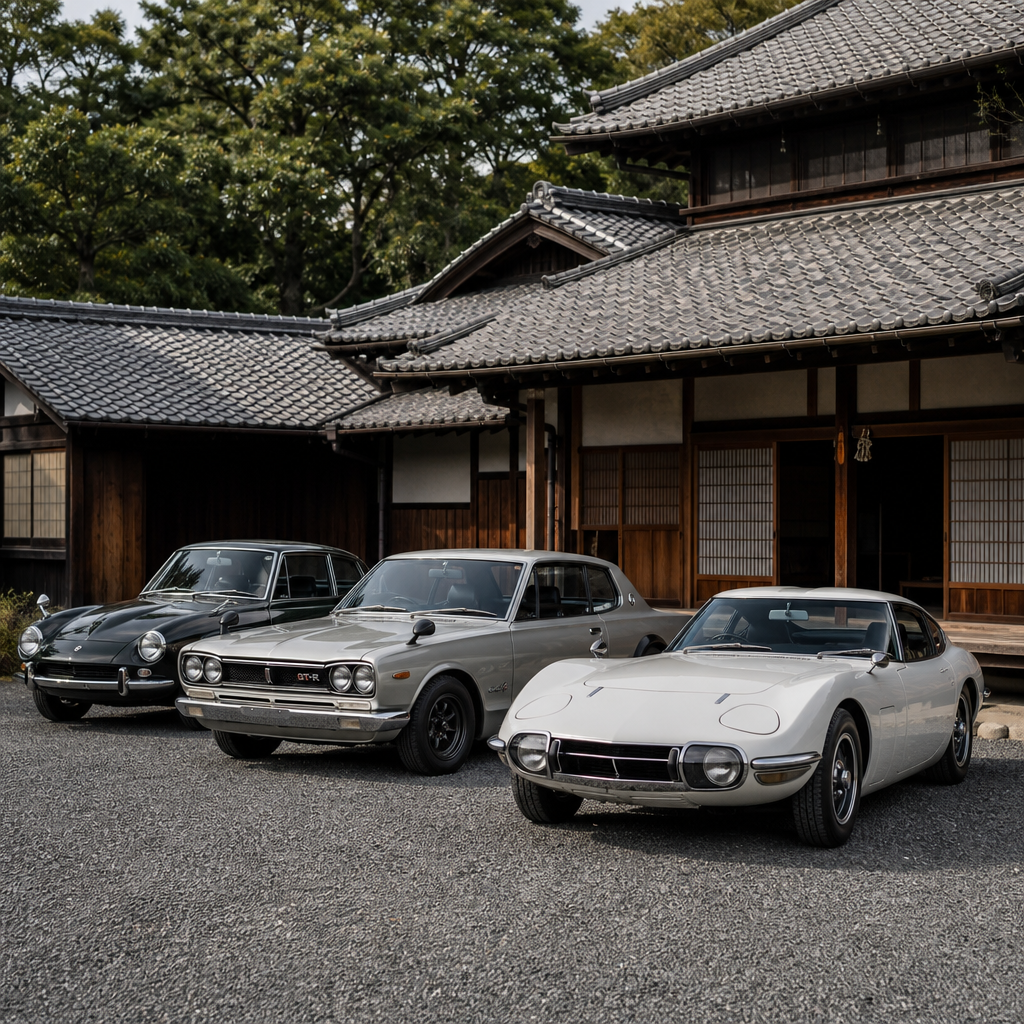
Japanese classic cars occupy a unique place in automotive history because they combine engineering discipline, motorsport ambition, everyday reliability, and a design language that evolved rapidly from imitation to global influence. In practical terms, “Japanese classics” usually refers to collector vehicles built from the 1950s through the 1990s by brands such as Toyota, Nissan, Honda, Mazda, Mitsubishi, Subaru, Isuzu, and Suzuki, though some enthusiasts now include early 2000s halo models as modern classics. I have worked with collectors, auction listings, restoration shops, and enthusiast registries long enough to see one pattern repeat: people may arrive for the nostalgia, but they stay for the depth. This category matters because it captures Japan’s postwar industrial rise, the globalization of performance culture, and the shift from simple transportation to technically sophisticated machines that still feel usable today. Unlike many European classics that demand specialist ownership from day one, many Japanese collector cars introduced millions of drivers to the classic hobby through approachable maintenance, strong parts interchange, and active enthusiast communities. That accessibility helped create a wide, durable market.
The history of Japanese classic cars is also the history of how domestic manufacturers answered changing economic conditions, fuel crises, racing rules, safety regulations, and export opportunities. Early postwar models were small and pragmatic, often shaped by licensing agreements and tax structures that rewarded compact dimensions and low displacement. By the late 1960s and 1970s, companies were producing stylish coupes, family sedans, and sports cars with overhead-cam engines, disc brakes, and increasingly refined suspension systems. In the 1980s and 1990s, Japanese automakers became benchmarks for quality control and powertrain innovation, producing icons such as the Toyota 2000GT, Nissan Fairlady Z, Mazda RX-7, Honda NSX, and GT-R lineage. For anyone researching Japanese classics, the key questions are straightforward: what defines the era, which models mattered most, why values differ, and how should buyers think about originality, restoration, and long-term ownership. This hub answers those questions while providing a clear framework for understanding the major brands, milestones, and market forces that shaped Japanese classic cars.
Postwar Origins and the Foundations of Japanese Classics
Japan’s automotive industry emerged from wartime devastation into a highly constrained domestic market. Fuel was expensive, roads were inconsistent, and consumer purchasing power was limited. Government policy favored efficient, compact vehicles, while licensing and technology-sharing agreements helped domestic firms accelerate development. In this period, manufacturers learned production discipline before they chased prestige. Toyota built durable sedans and utility vehicles; Nissan expanded passenger-car production under the Datsun name; Prince developed advanced engineering that would later feed into Nissan’s Skyline program; and Subaru, Suzuki, and others worked within the realities of kei-class regulation. These early cars are historically important not because they were glamorous, but because they established the engineering culture that later produced globally respected classics.
One overlooked factor is how taxation shaped design. Japan’s vehicle tax and inspection systems encouraged compact dimensions and smaller-displacement engines, which pushed engineers to extract efficiency from limited hardware. That pressure sharpened expertise in light weight, packaging, and mechanical simplicity. The Toyota Land Cruiser, originally developed as a rugged utility machine, became a durable export success. The Datsun Bluebird and similar sedans showed how Japanese companies could build practical, efficient family cars in high volume. By the 1960s, the industry had moved beyond basic mobility. Better metallurgy, more sophisticated engine architecture, and improved manufacturing quality opened the door to cars with personality. This was the transition point where a transportation industry became a source of collectible machines.
The 1960s: Style, Speed, and Global Recognition
The 1960s transformed Japanese cars from local necessities into credible international products. Rising incomes, improving infrastructure, and expanding exports encouraged manufacturers to build cars that competed on more than price. This decade produced several landmark models. The Toyota 2000GT, introduced in 1967, is the clearest example of Japan announcing itself as a serious sports-car nation. Developed with Yamaha assistance, it used a 2.0-liter DOHC inline-six, sophisticated suspension, and elegant proportions that rivaled contemporary European grand tourers. Production remained extremely limited, which is why the 2000GT now commands blue-chip collector status. Its significance goes beyond rarity: it proved Japanese engineering could deliver performance, refinement, and design prestige at the highest level.
Nissan took a broader-market path with the Fairlady roadsters and then the Fairlady Z. The earlier roadsters built credibility, while the launch of the S30-series Z in 1969 changed the global sports-car market. Affordable, stylish, and mechanically robust, the 240Z offered independent rear suspension, an eager inline-six, and everyday usability that many British roadsters could not match consistently. At the same time, Prince and later Nissan advanced the Skyline line, culminating in the 1969 Skyline 2000 GT-R, known as the Hakosuka. With its S20 DOHC engine and touring-car success, the GT-R created a motorsport bloodline that still shapes collector demand. By the end of the decade, Japanese classic cars were no longer curiosities. They were respected products with distinct identities.
The 1970s: Oil Shocks, Emissions, and the Rise of the Everyday Icon
The 1970s were shaped by two conflicting realities: tightening emissions and safety standards on one side, and booming demand for efficient, reliable transportation on the other. Japanese manufacturers responded better than many rivals. Models such as the Toyota Corolla, Datsun 510, and Honda Civic earned trust because they were economical without feeling disposable. The Datsun 510 in particular deserves its reputation. Its simple, balanced layout, independent rear suspension, and tunable four-cylinder engines made it successful in competition and beloved by private owners. In plain terms, it was the kind of car people could commute in during the week and autocross on the weekend. That dual-purpose character remains central to Japanese classic appeal.
Performance did not disappear during the fuel-crisis era; it adapted. Mazda committed to the rotary engine and produced the RX series, eventually establishing a technical identity no other major manufacturer could fully claim. Toyota expanded the Celica and Corolla performance families, while Nissan continued developing the Z-car across multiple generations. Mitsubishi’s Lancer and Galant programs built rally credibility, and Isuzu created coupes that today are recognized for Giugiaro styling and limited production. During this decade, Japanese cars also became dominant in the minds of practical buyers overseas. That matters to collectors because survivor rates often rose when owners viewed these cars as dependable assets worth maintaining. Many 1970s Japanese classics were used heavily, but the best-preserved examples now attract strong interest because they represent the point where reliability itself became a collectible virtue.
The 1980s and 1990s: Technology, Tuning, and Collector Icons
By the 1980s, Japanese automakers had become global benchmarks for quality, and their classic cars reflected growing technical confidence. Fuel injection spread, turbocharging matured, multi-valve cylinder heads became common, and computer-controlled engine management improved drivability and emissions compliance. This was the era when enthusiast identities crystallized. Toyota offered the AE86 Corolla Levin and Sprinter Trueno, a lightweight rear-wheel-drive platform that became legendary in grassroots motorsport. Nissan refined the Z and Skyline lines, with the R32 GT-R of 1989 redefining all-wheel-drive performance through the ATTESA E-TS system and RB26DETT engine. Mazda built the FC and FD RX-7, pairing low mass with rotary power and balanced chassis tuning. Honda delivered the CR-X, Prelude, and ultimately the aluminum-intensive NSX, a supercar engineered with remarkable ergonomics and reliability.
These cars matter not only because they were fast, but because they integrated engineering sophistication into production vehicles ordinary enthusiasts could actually buy. The boom years of the Japanese domestic market also encouraged ambitious low-volume projects, homologation specials, and trim-level complexity that today fascinate historians and restorers. Factory documentation, option codes, and market-specific differences often determine value. A Japanese-market Silvia, an export 240SX, and a homologation GT-R variant may look related, yet their desirability diverges sharply based on drivetrain, production numbers, and motorsport connection. I regularly advise buyers to study chassis codes before studying paint colors. In Japanese classics, nomenclature is not trivia; it is the map. Understanding codes like S30, KGC10, AE86, NA1, FC3S, and BNR32 is essential to understanding rarity, parts compatibility, and provenance.
Brands and Models That Define the Japanese Classics Hub
Any serious overview of Japanese classic cars should organize the subject by model families because collectors usually search by lineage rather than by generic era labels. Toyota’s essential classics include the 2000GT, Land Cruiser FJ40, early Crown, Celica, first- and second-generation Supra, and AE86 Corolla. Nissan’s core classics include the Datsun 510, Fairlady roadsters, S30 Z, Skyline GT-R family, and Silvia/180SX lineage. Mazda centers on the Cosmo, rotary RX models, and the MX-5 Miata, which, although newer than traditional classics, already functions as a gateway collector car. Honda’s key entries are the S600 and S800, Civic CVCC, CR-X, Integra Type R, and NSX. Mitsubishi, Subaru, Isuzu, and Suzuki contribute crucial depth through rally-bred sedans, kei performance cars, and niche coupes that reward informed buyers.
| Brand | Key Classic Models | Why They Matter |
|---|---|---|
| Toyota | 2000GT, FJ40, Celica, Supra, AE86 | Broad collector appeal spanning luxury, utility, and tuning culture |
| Nissan/Datsun | 510, 240Z, Hakosuka GT-R, R32 GT-R, Silvia | Strong motorsport heritage and global enthusiast demand |
| Mazda | Cosmo, RX-3, RX-7, MX-5 | Rotary innovation and balanced chassis engineering |
| Honda | S800, Civic CVCC, CR-X, Integra Type R, NSX | High-revving engines, packaging efficiency, and usable performance |
| Mitsubishi/Subaru/Isuzu/Suzuki | Lancer Evolution precursors, Leone, 117 Coupe, Cappuccino | Rally roots, niche desirability, and collectible rarity |
As a hub for Japanese classics, these lineages create natural paths for deeper research into sports cars, off-roaders, luxury sedans, homologation specials, and kei cars. They also reveal an important truth: there is no single Japanese classic formula. Some models win on rarity, others on racing history, and many on community support. A pristine 2000GT sits in a different market universe than a well-used Toyota pickup or a modified RX-7, yet all belong in the same historical conversation because they reflect the same industrial ecosystem. For collectors and researchers, the best approach is to compare a model’s engineering significance, production volume, export footprint, and enthusiast support before making assumptions based on brand prestige alone.
Restoration, Values, and How Collectors Evaluate Japanese Classics
Japanese classic car values have risen because demand broadened from niche enthusiasts to global collectors, auction houses, and younger buyers seeking analog driving experiences. Yet value is still uneven. Originality matters greatly in rare halo cars such as the Toyota 2000GT, Nissan Hakosuka GT-R, and Honda NSX-R, where factory-correct finishes, matching numbers, and documented ownership can move pricing dramatically. In more common segments, condition and rust control often matter more than absolute originality because these cars were frequently modified. The biggest restoration issue across many Japanese classics is corrosion. Sills, shock towers, floor pans, hatch areas, and rear arches are common problem zones, especially on cars from humid climates or regions with road salt. Mechanical components are often easier to rebuild than hidden body damage.
Parts support varies by brand and model. Toyota and Nissan often benefit from strong aftermarket and heritage programs, while rarer Isuzu or early Prince components may require specialist sourcing, owner networks, or parts-car strategies. Buyers should also consider import legality, emissions rules, and authenticity documentation. The 25-year import rule in the United States changed the market by opening access to Japanese domestic models once unavailable there, increasing demand for right-hand-drive Skylines, kei sports cars, and limited trims. Still, not every imported car is automatically collectible. The best purchases combine historical relevance, honest condition, verifiable chassis identity, and a supportable parts pathway. If you are building a Japanese classics shortlist, start with the model’s story, inspect for rust, decode the chassis, confirm originality where it matters, and buy the best example you can afford. That discipline usually beats speculative shopping.
The history of Japanese classic cars is ultimately a story of rapid industrial learning turned into cultural legacy. In a few decades, Japan’s automakers moved from producing compact necessities for a recovering domestic market to building some of the world’s most respected sports cars, sedans, off-roaders, and enthusiast machines. Along the way they answered real consumer needs—fuel economy, reliability, affordability, and usability—while also proving they could lead in design, motorsport, and engineering innovation. That combination explains why Japanese classics remain so compelling today. They are not valued only for rarity or nostalgia. They are valued because many of them still make sense on the road, in the workshop, and in a modern collection.
For readers using this page as a hub within classic car models and brands, the next step is to explore each lineage in detail: Z-cars, Skylines, rotary Mazdas, Toyota performance coupes, Honda halo models, Land Cruisers, and overlooked niche classics from smaller marques. The deeper you go, the more connections you will see between tax policy, racing homologation, export strategy, and enthusiast culture. Start with the model family that interests you most, learn the chassis codes, compare original specifications, and study market trends before buying or restoring. Japanese classic cars reward careful research with unusually rich ownership experiences. Use this hub as your foundation, then follow the individual model histories to build sharper judgment and a better collection.
Frequently Asked Questions
What defines a Japanese classic car, and which eras are most important in its history?
A Japanese classic car is generally understood as a vehicle built by a Japanese manufacturer that has historical, cultural, engineering, or collector significance. In most conversations, the term covers cars produced from the 1950s through the 1990s, though the boundaries are flexible. Early postwar models matter because they show how Japan rebuilt its industrial base and moved from licensed designs and practical transportation toward original engineering. By the 1960s, companies such as Toyota, Nissan, Honda, Mazda, Isuzu, and Suzuki were producing more distinctive vehicles, while the 1970s introduced broader export success and proved that Japanese cars could be economical, durable, and increasingly sophisticated. The 1980s and 1990s are especially important because they produced many of the enthusiast favorites now considered icons, including performance coupes, homologation specials, rotary sports cars, rally-inspired sedans, and technically ambitious grand tourers.
What makes Japanese classics unique is that their history is not just about styling or rarity. It is also about disciplined manufacturing, motorsport development, and a strong connection to everyday usability. Unlike some classics that were admired mainly as weekend toys from the beginning, many Japanese classics earned their reputation by being reliable commuter cars first and enthusiast machines second. That combination helps explain why the category is so broad. It includes everything from compact kei cars and humble family sedans to machines like the Toyota 2000GT, Nissan Skyline GT-R, Datsun 240Z, Honda S800, Mazda Cosmo, and Acura NSX. Today, some collectors also extend the definition into the early 2000s to include halo cars that carried the analog spirit of the 1990s into a new era, but the historical core of Japanese classic cars remains rooted in the decades when Japan transformed from an imitator into a global trendsetter.
Why did Japanese classic cars become so influential around the world?
Japanese classic cars became globally influential because they arrived at the intersection of affordability, dependability, and increasingly advanced engineering. In export markets, especially the United States, Europe, and Australia, Japanese manufacturers built trust by offering vehicles that were easier to own, more fuel efficient, and often better equipped than many rivals at similar price points. During the oil crises of the 1970s, this advantage became even more visible. Buyers who may have first chosen Japanese cars for practical reasons soon discovered that the same companies were also producing engaging sports cars, refined coupes, and innovative performance models. That gradual shift in perception is one of the most important chapters in the history of Japanese classic cars.
Influence also came from motorsport and technology. Nissan’s Skyline GT-R established an image of circuit dominance, Mazda used the rotary engine to create a distinct identity, Subaru and Mitsubishi turned rally success into road-car legend, and Honda developed a reputation for high-revving engines and precision engineering. Toyota and Datsun, meanwhile, built an enormous base of loyal customers through durability and then expanded their enthusiast appeal with cars like the 2000GT, Celica, Corolla Levin, Supra, and 240Z. Over time, Japanese design also matured from conservative forms into a confident language of sharp coupes, aerodynamic hatchbacks, muscular wide-body homologation cars, and clean, minimalist sports cars. In other words, Japanese classics became influential not because of one single breakthrough, but because an entire industry proved it could excel at mass-market quality, technical innovation, and enthusiast credibility all at once.
Which Japanese classic cars are considered the most historically significant?
Several models stand out because they changed how the world viewed Japanese automobiles. The Toyota 2000GT is one of the most historically significant because it demonstrated that Japan could build a world-class sports car with beauty, exclusivity, and engineering sophistication. The Datsun 240Z is equally important for a different reason: it made the affordable sports car formula wildly successful on a global scale and gave enthusiasts European-style excitement with Japanese reliability. The Nissan Skyline GT-R, particularly early generations and the later R32, R33, and R34 lineage, became a symbol of performance development and racing success. Honda’s S-series roadsters and later the NSX showed two sides of the company’s talent, from lightweight, high-revving enthusiasm to supercar-level usability and precision.
Mazda’s rotary-powered cars, especially the Cosmo and RX-7, are also essential to the story because they represent Japan’s willingness to pursue unconventional engineering. Toyota’s Corolla and Celica families deserve recognition for their mainstream and enthusiast importance alike, while the Supra became one of the defining grand touring performance cars of the 1980s and 1990s. In rally history, the Subaru Impreza WRX and Mitsubishi Lancer Evolution occupy an almost mythic place, even though some examples stretch the traditional definition of “classic” depending on age. It is also worth mentioning less obvious but highly significant vehicles such as the Prince Skyline, early Toyota Crown, Isuzu 117 Coupe, Honda Civic, Suzuki Cappuccino, and various kei cars that show how broad the Japanese classic landscape really is. Historical significance can mean rarity, motorsport success, export impact, technical innovation, or cultural staying power, and the strongest Japanese classics often combine several of those qualities at once.
How did motorsport shape the development of Japanese classic cars?
Motorsport played a major role in shaping Japanese classic cars because racing and rallying gave manufacturers a proving ground for engines, suspensions, aerodynamics, drivetrains, and brand identity. In the 1960s and 1970s, participation in domestic and international competition helped Japanese automakers move beyond simple transportation and into performance credibility. Cars such as the Skyline GT-R built their reputation on race victories, while endurance racing and touring car competition pushed companies to refine reliability under stress. This mattered because Japanese brands were not just trying to sell fast cars; they were trying to prove to the world that their engineering could perform at the highest level.
By the 1980s and 1990s, the motorsport connection became even more direct. Homologation rules encouraged the creation of road cars that shared important traits with competition machines, which is why so many Japanese classics from this period feel unusually focused and technical. Turbocharging, all-wheel drive, advanced engine management, lightweight construction, and more sophisticated suspension tuning all benefited from racing and rally development. The Nissan GT-R’s all-wheel-drive and twin-turbo reputation, the Subaru Impreza WRX and Mitsubishi Lancer Evolution’s rally-bred character, and even Mazda’s persistence with the rotary all reflect this dynamic. Honda’s engineering culture, while often expressed through naturally aspirated precision, was equally influenced by competition. For enthusiasts today, that heritage is a big part of the appeal. These cars are not admired only because they look good or have become collectible; they are admired because they carry the DNA of a period when Japanese manufacturers used motorsport to sharpen their road cars and build legends that still resonate decades later.
Why are Japanese classic cars so collectible today, and what should enthusiasts look for?
Japanese classic cars are highly collectible today because they occupy a rare sweet spot between nostalgia, usability, and historical importance. Many enthusiasts who grew up in the 1980s, 1990s, and early 2000s now have the means to buy the cars they admired in magazines, games, films, and motorsport coverage. At the same time, these vehicles represent a golden age of analog engineering: manual transmissions, communicative steering, relatively lightweight construction, and engines with strong mechanical character. Unlike some collector cars that demand constant compromise, many Japanese classics are still pleasant to drive, reasonably serviceable, and supported by active enthusiast communities. That combination has pushed values upward, especially for unmodified examples, limited-production variants, and homologation models with documented provenance.
For buyers and collectors, condition and originality matter enormously. Rust is often one of the biggest concerns, particularly on cars from the 1970s through the 1990s. A complete service history, matching numbers where relevant, and evidence of careful ownership can be more important than low mileage alone. Modifications are common in the Japanese classic world, and while period-correct upgrades may appeal to some enthusiasts, the market often rewards cars that remain close to factory specification. It is also wise to understand regional differences, because a model sold as a Datsun in one market may have different trim, equipment, or engine specifications than its Japanese-domestic-market counterpart. Ultimately, the best Japanese classics are collectible not just because they are old, but because they tell the story of an industry that reshaped global car culture through innovation, motorsport ambition, reliability, and a design evolution that went from modest beginnings to worldwide influence.