Mazda classic cars occupy a distinctive place in Japanese classics because the brand paired compact packaging, lightweight engineering, and relentless experimentation with one technology most rivals avoided: the rotary engine. In the collector market, Mazda is often introduced through halo cars like the Cosmo, RX-7, or R100, yet the full story is broader. It includes family sedans, coupes, roadsters, homologation specials, and practical models that quietly shaped Japan’s postwar automotive rise. For anyone exploring classic car models and brands, Mazda deserves close attention because it links innovation to usability in a way few manufacturers matched.
When enthusiasts say Mazda classic cars, they usually mean vehicles built from the 1960s through the 1990s that represent the company’s design identity, engineering milestones, and motorsport credibility. Japanese classics refers to collectible vehicles from Japan that have historical value, strong enthusiast support, and growing recognition worldwide. Within that field, Mazda stands apart for two reasons. First, it invested heavily in the Wankel rotary engine, a compact internal combustion design that uses a triangular rotor instead of pistons. Second, it repeatedly built driver-focused cars with excellent balance, low weight, and mechanical simplicity. Those traits make classic Mazda ownership appealing to collectors who want engagement rather than just nostalgia.
I have worked around vintage Japanese cars long enough to see Mazda appreciation change from niche enthusiasm to mainstream demand. Ten years ago, many buyers overlooked first-generation RX-7s, early Capellas, and even rotary sedans because parts knowledge was thin and market attention centered on Nissan Z cars, Toyota Supras, and early Skylines. Today, auction houses, specialist importers, and restoration shops treat significant Mazda models as serious classics. Values have risen, but more importantly, respect has deepened. Owners now understand that Mazda’s old cars are not simply alternatives to better-known rivals. They are often the most inventive choices in the room.
This hub page covers Japanese classics through the Mazda lens: the key eras, the most important models, the rotary story, what makes these cars collectible, and what buyers should know before ownership. If you are building a shortlist of collectible Japanese cars, researching a classic RX-7, or comparing brands within the broader Japanese classics category, this guide will help you identify where Mazda fits and why its best cars continue to matter.
The Mazda Difference in Japanese Classics
Mazda emerged from Hiroshima with a personality unlike Toyota, Nissan, or Honda. Where Toyota emphasized scale and dependability, and Nissan often leaned into performance through conventional six-cylinder and turbocharged platforms, Mazda made engineering curiosity part of its brand identity. That mattered in the 1960s and 1970s, when Japan’s domestic industry was still defining itself. Mazda licensed the NSU-developed rotary concept, then committed extraordinary resources to making it viable for mass production. The result was not one experimental model but an entire family of rotary-powered cars, from coupes to sedans to pickup-adjacent commercial vehicles in some markets.
For collectors, the Mazda difference shows up in driving feel. Many classic Mazdas are lighter than comparable contemporaries, and they communicate clearly through the steering, shifter, and chassis. Even base piston-engine cars such as early Familia, Capella, and 323 derivatives often feel eager rather than inert. Rotary models add a smooth, free-revving character that no piston engine duplicates. The power delivery is linear, the packaging is compact, and the engine note is unmistakable. That combination created a brand identity around innovation, balance, and mechanical charm.
Mazda also matters because it broadened access to performance. The company did not reserve excitement for expensive flagship cars. A buyer could encounter the brand’s engineering values in approachable models sold at realistic prices. That democratizing effect is part of why so many enthusiasts entered Japanese classics through Mazda ownership. First-generation RX-7s, for example, were attainable for years, easy to understand mechanically, and rewarding on road or track. The same pattern applies to later Miatas, though those sit at the younger edge of classic status in many markets.
Rotary Power: Why Mazda Bet on the Wankel
The rotary engine is the center of any serious discussion about Mazda classic cars. A Wankel engine replaces reciprocating pistons with one or more rotors spinning inside an epitrochoid-shaped housing. This allows fewer moving parts than a comparable piston engine, compact external dimensions, high specific output, and a smooth revving nature. In practice, however, early rotary development was difficult. Apex seal wear, heat management, oil consumption, emissions compliance, and fuel economy all posed major obstacles. Most manufacturers explored the concept, then walked away. Mazda stayed.
That persistence produced some of the most memorable Japanese classics ever made. The company’s engineering teams refined materials, sealing, lubrication, and combustion behavior year after year. While rotary engines never became mainstream in the same way as piston engines, Mazda proved they could be reliable and usable when maintained correctly. Owners who understand warm-up discipline, oil metering, cooling system condition, and compression testing tend to have much better experiences than buyers who treat a rotary like a generic four-cylinder.
Rotary power matters historically because it gave Mazda a global identity. Without it, the brand might be remembered mainly for competent small cars. With it, Mazda became the manufacturer willing to do the improbable. That image culminated in the 1991 Le Mans victory of the four-rotor 787B, still the only Japanese manufacturer to win outright at Le Mans with a non-piston engine. Even if your interest is primarily road cars, that motorsport success reinforced the credibility of rotary engineering and elevated every classic RX model in the public imagination.
Foundational Mazda Classics Every Enthusiast Should Know
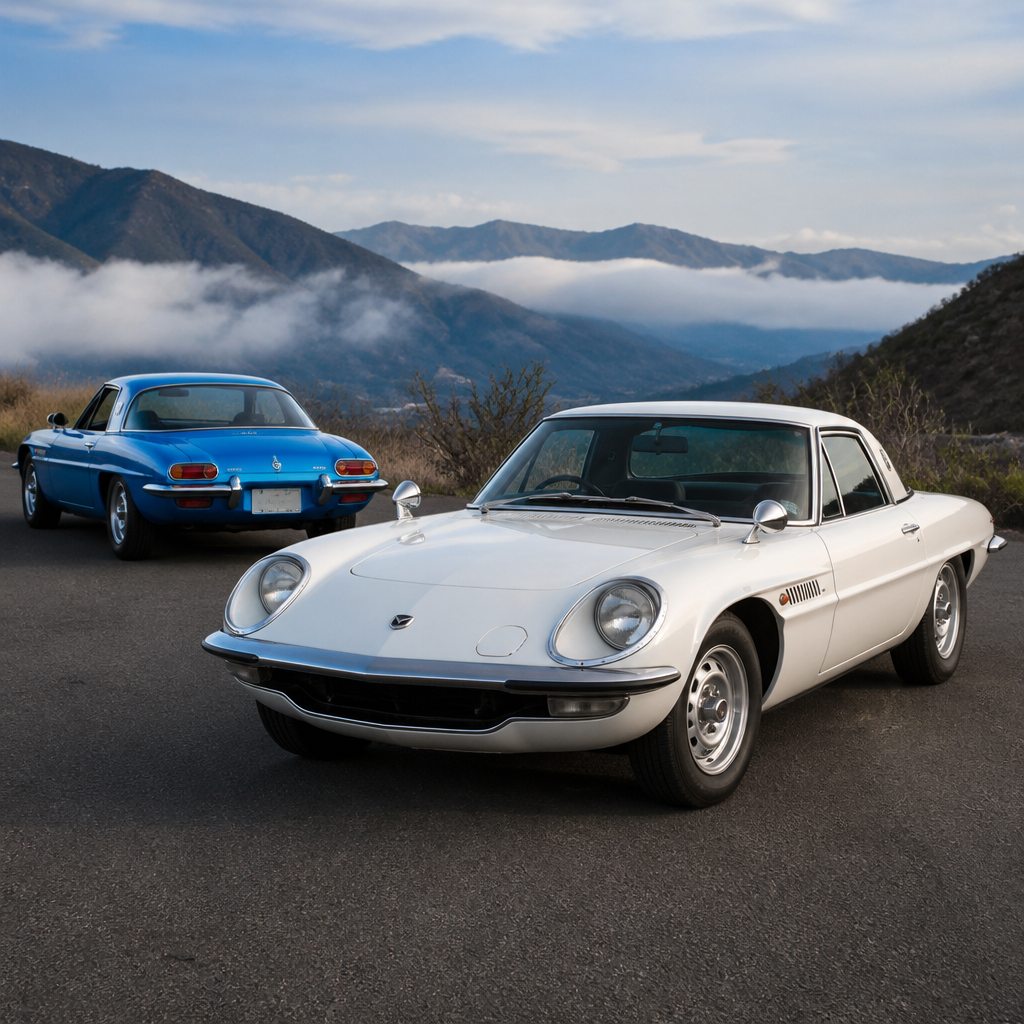
The earliest cornerstone is the Mazda Cosmo Sport, also known as the 110S, launched in 1967. It was not the first rotary car ever sold, but it was the model that announced Mazda’s seriousness. Low, elegant, and technically ambitious, the Cosmo used a twin-rotor engine and established themes that would echo through later sports cars: compact power, futuristic styling, and an emphasis on engineering distinction. Genuine Cosmos are rare and expensive, but they remain essential to understanding Mazda history.
The Familia Rotary Coupe and the R100 brought rotary performance to a broader audience. In export markets, these cars helped demonstrate that small Japanese coupes could be both stylish and genuinely quick for their class. The Capella Rotary and related RE models continued that spread, showing Mazda’s willingness to put unconventional technology into practical body styles. Then came the RX series, where the naming convention became globally recognized.
The RX-2, RX-3, and RX-4 are among the most important Japanese classics of the 1970s. The RX-3 in particular gained a strong motorsport reputation in touring car racing and drag racing. Light weight and a tune-friendly rotary made it formidable, and surviving examples now command serious money. The first-generation RX-7, introduced for 1978, is the model that most effectively distilled Mazda’s philosophy into a package the world embraced. It had near-ideal proportions, sharp steering, low mass, and enough practicality to function as a real car rather than a weekend ornament.
The second-generation FC RX-7 moved upscale with independent rear suspension and available turbocharging, while the third-generation FD RX-7 became a landmark Japanese performance car thanks to sequential twin turbos, exquisite proportions, and one of the best chassis calibrations of the 1990s. Alongside these, the Mazda Roadster, sold globally as the MX-5 Miata from 1989, revived the affordable lightweight roadster. It did not use a rotary, but it embodied the same Mazda values and is now inseparable from any complete view of Japanese classics.
Key Mazda Classic Models at a Glance
| Model | Years | Why It Matters | Collector Notes |
|---|---|---|---|
| Cosmo Sport 110S | 1967-1972 | Early halo rotary sports car; technical statement | Rare, expensive, historically critical |
| R100/Familia Rotary Coupe | Late 1960s-early 1970s | Brought rotary performance to smaller coupes | Strong enthusiast appeal; rust is a major issue |
| RX-3 | 1971-1978 | Motorsport icon with lightweight rotary platform | Values have climbed sharply for authentic cars |
| SA/FB RX-7 | 1978-1985 | Defining affordable rotary sports car | Best entry point for many buyers |
| FC RX-7 | 1985-1992 | More refined chassis; turbo options | Condition varies widely; modifications are common |
| FD RX-7 | 1992-2002 | High point of rotary road-car performance | Expensive, rewarding, maintenance-sensitive |
| NA MX-5 Miata | 1989-1997 | Revived the lightweight roadster formula | Huge support network; buy the cleanest shell |
How Mazda Compared with Other Japanese Classic Brands
Within Japanese classics, Mazda competes for attention with Toyota, Nissan, Honda, Datsun, Isuzu, and Subaru. Toyota generally offers the broadest market support and the highest mainstream recognition. Nissan and Datsun dominate certain performance segments through the Z lineage, Skyline GT-Rs, and competition pedigree. Honda earns admiration for engineering precision, especially in later-era classics. Mazda’s comparative strength is different: it offers the clearest blend of unconventional engineering and approachable driver engagement.
For example, a Datsun 240Z is a superb grand-touring sports car with strong six-cylinder torque and timeless styling. A first-generation RX-7, by contrast, feels lighter on its feet, more compact, and more unusual under the hood. An AE86 Corolla is beloved for balance and tuner culture, but an FC or FD RX-7 provides a more exotic powertrain and a higher ceiling for engineering interest. A Honda S800 or first-generation CRX shows ingenuity, yet Mazda repeatedly applied its ideas across more segments and over a longer period.
This is why Mazda works so well as a hub within Japanese classics. The brand intersects with nearly every subtheme collectors care about: postwar industrial growth, sports-car design, motorsport, export success, lightweight engineering, and technological risk. Studying Mazda gives readers a framework for understanding Japanese classics more broadly, because the company constantly responded to the same market forces as its rivals while choosing a remarkably individual path.
What to Check Before Buying a Classic Mazda
The first rule is to buy condition and documentation before specification. Rust remains the single most important issue on many Mazda classics, especially 1970s and 1980s cars. Check sills, arches, floorpans, hatch areas, strut towers, battery trays, and windshield surrounds. On RX-7s, pay attention to previous accident repair because many cars were driven hard, modified, or neglected when values were low. A clean shell can save tens of thousands compared with restoring severe corrosion.
On rotary cars, always perform a proper rotary compression test using the correct equipment and interpretation. Standard piston-engine compression methods are not enough. Healthy numbers, consistency across faces, easy hot starting, stable idle, and documented rebuild work matter. Ask about cooling system maintenance, oil choice, ignition components, and whether the fuel system has been modernized safely for today’s fuels. Flooding, hard starts, and overheating should never be dismissed as normal rotary behavior.
Parts support is better than many newcomers expect, but it varies by model. RX-7 and Miata communities are especially strong, with specialist suppliers, forums, and restoration knowledge spread across North America, Japan, the UK, and Australia. Rarer cars such as the Cosmo, RX-3, and certain rotary sedans require patience, international sourcing, and sometimes fabrication. Originality also affects value. Period modifications can be culturally interesting, but collector premiums usually favor rust-free, numbers-matching, correctly trimmed examples.
Why Mazda Classics Keep Gaining Respect
Mazda classic cars keep gaining respect because they answer a modern collector’s biggest question: what feels special at sane speeds? Many high-value classics now deliver performance that can only be fully appreciated on a track or in brief moments on public roads. A good classic Mazda feels alive at ordinary speeds. Steering feedback, low mass, short gearing, and communicative chassis tuning make even modest-output cars engaging. That is a major reason the Miata became a benchmark and why early RX-7s are still so beloved.
There is also growing recognition that Japanese classics are no longer secondary to European and American collector cars. Auction results, museum displays, and specialist restoration businesses all show the shift. Mazda benefits because its cars represent both Japanese industrial confidence and genuine technical originality. The rotary story is not marketing spin; it is a documented engineering commitment that produced distinctive road cars and historic racing success.
For collectors, the benefit is clear. Mazda offers multiple entry points into Japanese classics, from accessible driver cars to blue-chip rarities. Start with the best example you can verify, learn the maintenance needs of the specific model, and use this hub as a foundation for deeper research into individual cars and related Japanese classics across the category. If you want a classic car that combines innovation, personality, and real driver reward, put Mazda at the top of your list today.
Frequently Asked Questions
What makes Mazda classic cars stand out among other Japanese classics?
Mazda classic cars stand out because the company developed a personality that was both practical and daring at the same time. While many postwar automakers focused mainly on dependable transportation, Mazda built a reputation around compact engineering, low vehicle weight, responsive handling, and a willingness to experiment with ideas that larger rivals often considered too risky. That spirit is most closely associated with the rotary engine, but it also shows up in the brand’s broader approach to design and packaging. Mazda repeatedly found ways to make small cars feel lively, engaging, and technologically ambitious.
Another reason Mazda occupies a distinctive position in the collector world is that its history is not limited to one or two famous models. The Cosmo helped establish the company’s engineering credibility, the RX-7 became a global performance icon, and the R100 introduced rotary power to a wider audience, but Mazda’s classic-era identity also includes sedans, coupes, family cars, utility-minded models, and open-top sports cars. Cars such as the Familia, Capella, Luce, Savanna, and early Roadster each contributed to the brand’s image in different ways. This gives Mazda a broader historical footprint than many casual enthusiasts initially realize.
Collectors also appreciate that Mazda classics often deliver an unusually direct driving experience. Even non-rotary models benefited from lightweight construction and straightforward mechanical layouts, which can make them rewarding to own and drive today. In short, Mazda classics matter not just because they were different, but because they consistently combined innovation, usability, and driver involvement in a way that helped shape the identity of Japanese enthusiast cars.
Why is the rotary engine so important to Mazda’s classic car legacy?
The rotary engine is central to Mazda’s classic car legacy because it became the company’s defining technical signature. While the Wankel rotary concept attracted global interest in the 1960s, most manufacturers that explored it eventually stepped away due to challenges involving durability, emissions, fuel consumption, and real-world development costs. Mazda did the opposite. It committed enormous engineering effort to refining the design and built much of its performance image around making the rotary practical, reliable enough for production use, and exciting on the road.
From a historical standpoint, this commitment gave Mazda a rare identity in the automotive world. The rotary was compact, smooth, and capable of producing strong power for its size, which suited Mazda’s preference for smaller, lighter vehicles. That allowed the company to create cars with distinctive proportions and excellent weight balance. It also gave Mazda models a character that felt different from conventional piston-engine rivals. Rotary-powered classics are known for their high-revving nature, smooth delivery, and unmistakable sound, all of which contribute heavily to their enthusiast appeal today.
Just as importantly, the rotary became a symbol of Mazda’s willingness to innovate when it had every reason to play it safe. For a smaller Japanese manufacturer competing in a crowded postwar market, using the rotary was not just an engineering choice; it was a strategic statement. Cars like the Cosmo Sport, Familia Rotary Coupe, RX-2, RX-3, RX-4, and first-generation RX-7 proved that Mazda could turn unconventional technology into a full product family. That achievement is why the rotary is not simply one chapter in Mazda history. It is the thread that ties together the brand’s most memorable classic-era achievements.
Which Mazda classic cars are the most important for collectors and enthusiasts?
The most important Mazda classic cars usually include the Cosmo Sport, R100, RX-3, RX-7, and key variants of the Familia, Capella, Luce, and MX-5 Miata lineage, depending on how broadly a collector defines “classic.” The Cosmo Sport is especially significant because it was one of the earliest and most technically ambitious rotary-powered production cars. It represents Mazda’s determination to prove the rotary engine could succeed in the real world, and for that reason it is often treated as a cornerstone model in the brand’s history.
The R100 is another major milestone because it helped bring rotary performance to a broader market in a more compact and accessible package. The RX-2, RX-3, and RX-4 are also highly respected, especially among enthusiasts who value the era when Mazda’s rotary cars built a strong reputation in both domestic and export markets. Among these, the RX-3 often receives special attention because of its motorsport associations, compact dimensions, and strong enthusiast following. Well-preserved or correctly restored examples have become especially desirable.
The first-generation RX-7 remains one of the most important Mazda classics overall because it translated the rotary idea into a well-balanced, widely admired sports car that achieved global success. It helped define Mazda for an entire generation of enthusiasts. Beyond the obvious halo cars, many collectors now pay greater attention to models that once sat in the background, including non-rotary Familia and Capella variants, luxury-oriented Luce models, and early utility or family platforms that reflect Mazda’s role in Japan’s industrial rise. These cars may not always command the same spotlight, but they are increasingly valued for their historical depth and rarity. For enthusiasts, the “most important” Mazda classics are no longer just the headline rotary performance models; they include the wider range of vehicles that reveal how diverse and ambitious the company really was.
Are Mazda classic cars reliable to own today, especially rotary-powered models?
Mazda classic cars can be rewarding to own today, but reliability depends heavily on the specific model, the quality of maintenance over time, and whether the car has been restored or modified properly. Non-rotary Mazda classics are often relatively straightforward by vintage car standards, especially when compared with more exotic contemporaries. Their lighter construction and simpler mechanical layouts can make them approachable for owners who want a usable classic. Parts support varies by market and model, but there is often good enthusiast knowledge available, especially for better-known platforms.
Rotary-powered classics require more careful consideration. The rotary engine has unique strengths, but it also has unique service needs. Proper tuning, cooling-system health, correct oiling practices, and regular attention to seals and wear points are essential. A well-maintained rotary car can be enjoyable and surprisingly smooth, but neglected examples can become expensive quickly. Compression condition is particularly important when evaluating a rotary-powered Mazda, and buyers should prioritize documentation, specialist inspections, and evidence of knowledgeable ownership. An inexpensive rotary classic can easily become a costly project if its mechanical condition is uncertain.
That said, the rotary’s reputation is sometimes oversimplified. These engines are not inherently impossible to live with; they simply reward informed ownership more than casual neglect. Many long-term enthusiasts consider that part of the appeal. If a buyer understands the platform, sources the right expertise, and chooses a car with a solid history, a rotary Mazda classic can be a deeply satisfying ownership experience. The key is to approach the purchase with the same seriousness one would give any specialized classic car: buy the best example available, verify the work that has been done, and respect the engineering that makes the car special.
Why are Mazda classic cars becoming more desirable in the collector market?
Mazda classic cars are becoming more desirable because collectors increasingly value vehicles with clear engineering identity, strong historical narratives, and engaging driving manners. Mazda offers all three. The brand’s classics are tied to one of the boldest technical commitments in postwar automotive history through the rotary engine, yet they also reflect broader themes such as Japan’s industrial growth, export expansion, motorsport ambition, and the development of lightweight enthusiast cars. As the collector market matures, buyers are looking beyond the most obvious blue-chip Japanese models and recognizing Mazda’s deeper contribution.
Scarcity is another factor. Many early Mazda models were used hard, modified, raced, or simply lost over time, especially the more affordable rotary coupes and sedans that once served as entry-level enthusiast cars. As surviving examples become rarer, originality and documentation matter more, and strong cars naturally attract greater attention. This is especially true for early rotary models, homologation-linked variants, and market-specific cars that were never built in large numbers. Even practical or previously overlooked Mazda classics are now benefiting from renewed appreciation because they help tell a fuller story about the brand.
There is also a generational element at work. Enthusiasts who grew up with the RX-7, later rotary Mazdas, or the lightweight philosophy behind the Miata are now looking backward into the brand’s earlier history. That curiosity often starts with halo cars and then expands into the broader lineup. As a result, Mazda classics are no longer seen merely as niche alternatives; they are increasingly recognized as essential parts of the Japanese classic landscape. Their rise in desirability reflects not just market fashion, but a more sophisticated understanding of how innovation, motorsport credibility, and accessible driver appeal helped Mazda earn its place among the most interesting classic car makers from Japan.