Concept cars have shaped classic car design more profoundly than most enthusiasts realize. A concept car is a manufacturer-built prototype created to test styling, engineering, packaging, or market direction before those ideas reach production. In the classic era, especially from the 1930s through the 1970s, concept and rare show cars were not just styling exercises for auto shows; they were rolling laboratories that introduced tailfins, wraparound windshields, pillarless hardtops, hidden headlamps, fastback rooflines, new dashboard layouts, and even safety ideas that later defined mainstream models. When I study classic car lineage, I start with the prototypes because production cars almost always make more sense once you see the experiments that came first.
This matters because collectors, restorers, and historians often evaluate classics only by badge, engine, and production numbers. That misses the deeper story. Many of the most recognizable themes in American, European, and Italian classics were previewed years earlier on low-volume dream cars, motor show specials, and coachbuilt studies. Harley Earl’s GM Motorama program, Ghia-bodied Chrysler show cars, Bertone and Pininfarina design studies, and advanced safety concepts from Mercedes-Benz all influenced what buyers later saw in dealerships. Understanding concept cars helps explain why a 1959 Cadillac looks the way it does, why a Jaguar E-type feels so futuristic for 1961, and why certain rare cars command such scholarly attention. It also provides a practical map for exploring the wider “Concept & Rare Cars” branch of classic car history.
As a hub topic, concept and rare cars includes several overlapping categories. Concept cars are prototypes built to preview future ideas. Dream cars are often dramatic showpieces meant to generate publicity rather than immediate production. Rare cars can include one-offs, homologation specials, coachbuilt variants, low-production halo cars, and limited experimental runs. Some concepts directly became production models with only minor changes; others influenced design language indirectly across a whole brand. The key question is not whether a specific prototype reached assembly lines unchanged. The real question is which themes survived. In my experience, that is where the value lies for both serious research and practical collecting decisions.
How concept cars became the design engine of the classic era
The modern concept car tradition matured in the United States during the late 1930s and expanded after World War II. Harley Earl’s Buick Y-Job, developed in 1938, is widely considered one of the first true concept cars. It introduced flush door handles, hidden lighting elements, a lower beltline, and a long, sleek stance that previewed postwar American styling. Y-Job was never intended for production as shown, yet it established a method that every major manufacturer eventually used: reveal advanced ideas publicly, measure reaction, then filter selected elements into production tooling. That formula became especially powerful once auto shows and touring exhibitions turned prototypes into mass-media events.
GM’s Motorama in the 1950s industrialized this process. Cars such as the Le Sabre, Firebird series, and XP-series Corvettes demonstrated jet-age motifs, wraparound glass, two-tone interiors, and dramatic body sculpting. Not every feature was practical. Turbine inspiration and aircraft-like canopies often remained fantasy. Yet the visual vocabulary spread everywhere. Production Oldsmobiles, Buicks, Chevrolets, and Cadillacs adopted stronger fins, lower rooflines, panoramic windshields, and more theatrical dashboards. This pattern repeated globally. In Italy, coachbuilders used salon cars to test proportions and details for Alfa Romeo, Lancia, Fiat, Ferrari, and Lamborghini. In Britain, concept thinking was less theatrical but equally important in aerodynamics, lightweight construction, and GT packaging.
For classic car design, concept cars mattered in four specific ways. First, they accelerated change by compressing years of experimentation into a single rolling prototype. Second, they let manufacturers test public appetite for bold styling without committing to expensive production dies. Third, they gave designers freedom from engineering constraints, which often generated forms later adapted in toned-down ways. Fourth, they created halo effects. Even buyers who never saw the concept in person absorbed its influence through magazine covers, brochures, and dealership messaging. By the time a production car arrived, the public had already been taught what “modern” looked like.
American dream cars and the birth of showroom drama
No country used concept cars more effectively to influence classic design than the United States in the 1950s. Harley Earl and later Bill Mitchell understood that styling sold cars in a market where annual model changes mattered. The 1951 GM Le Sabre is a textbook example. Built as a personal testbed for Earl, it featured a wraparound windshield, cut-down doors, integrated bumpers, and a sharp, jet-inspired profile. Within a few years, wraparound glass and lower, wider proportions spread across GM lines. The Le Sabre did not become a production model, but its themes became production normality.
Cadillac’s tailfin evolution also demonstrates concept-to-classic influence clearly. The 1948 Cadillac fin inspiration is often linked to the Lockheed P-38, but show cars amplified the idea and made it marketable. Through a sequence of dream cars and exhibition models, fins became taller, crisper, and more integrated with rear lamp treatment. By 1959, Cadillac had turned an experimental gesture into the defining symbol of late-1950s American luxury. Collectors discussing those production Cadillacs are really discussing a concept-led design escalation.
Chrysler’s collaboration with Ghia produced another stream of influential classics. The K-310, D’Elegance, Firearrow series, and Falcon were not high-volume previews in a direct sense, but they refined Virgil Exner’s “Forward Look.” Long hoods, restrained fins, strong shoulder lines, and elegant proportions moved from these limited show and specialty cars into Chrysler, DeSoto, Dodge, and Plymouth production ranges for 1955 and beyond. In practical terms, the Ghia cars helped Chrysler break from conservative postwar styling and establish one of Detroit’s most cohesive design revolutions.
| Concept car | Debut year | Key design idea | Classic production influence |
|---|---|---|---|
| Buick Y-Job | 1938 | Low profile, flush details, hidden lighting | Postwar American streamlining and cleaner body sides |
| GM Le Sabre | 1951 | Wraparound windshield, jet-age body themes | 1950s GM glass and proportion trends |
| Chrysler D’Elegance | 1953 | Formal yet sleek GT proportions | Virgil Exner’s Forward Look across Chrysler brands |
| Lincoln Futura | 1955 | Twin-canopy drama, sculpted flanks | Late-1950s Ford design theater and custom culture |
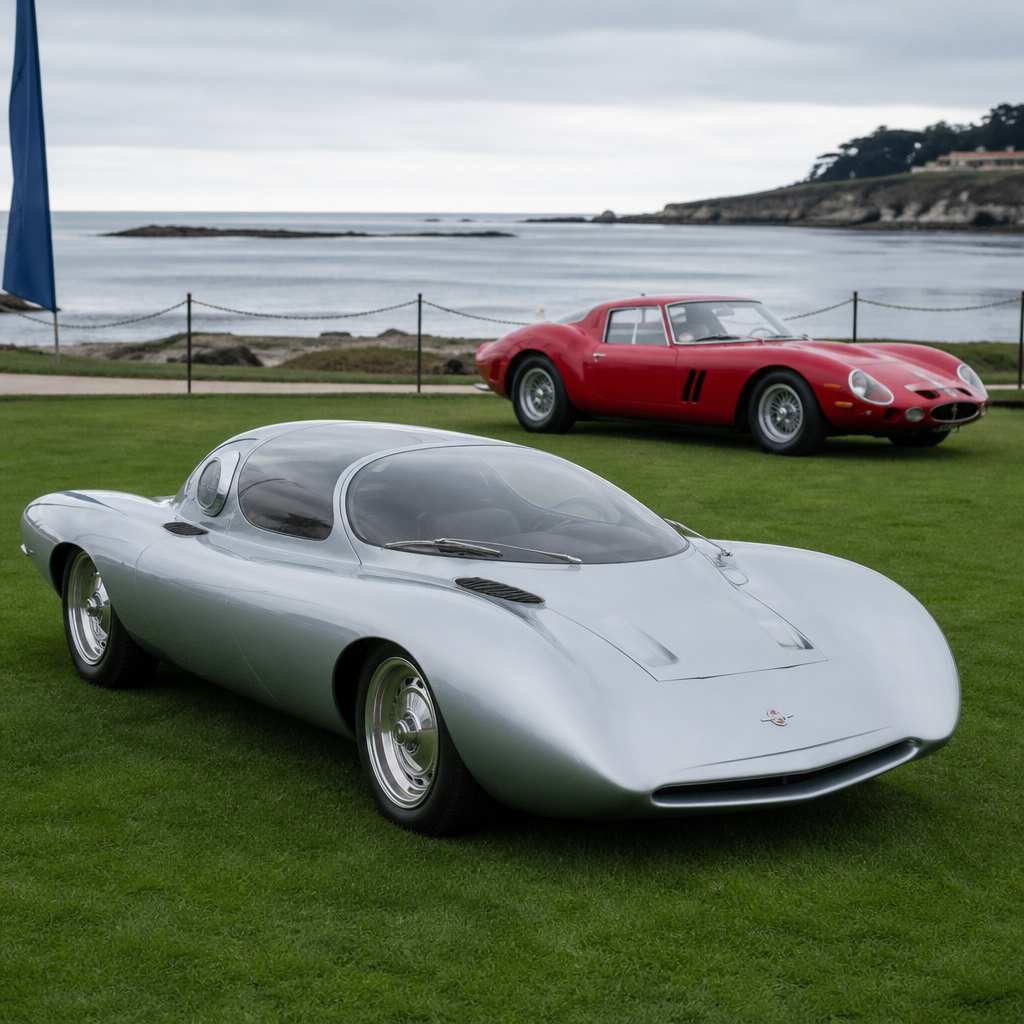
| XP-87 Corvette Stingray Racer | 1959 | Sharp fender peaks and tapered fastback form | 1963 Corvette Sting Ray production styling |
The Lincoln Futura deserves mention not because it generated a direct production twin-canopy Lincoln, but because it showed how concept spectacle could shape brand identity and custom imagination. Its exaggerated nose, dramatic rear haunches, and advanced trim treatment filtered into late-1950s Ford Motor Company styling language and later gained a second life as the Batmobile. Rare cars often matter this way: even when they do not become production templates, they reframe what designers, customers, and aftermarket builders consider possible.
European and Italian concept studies that reshaped the grand tourer
European concept cars tended to influence classic design through proportion, aerodynamics, and coachbuilding technique rather than annual gimmickry. In Italy, Pininfarina, Bertone, Touring, Zagato, and Ghia used motor show cars to refine the grand touring formula. The Alfa Romeo BAT series, designed by Franco Scaglione for Bertone in the 1950s, is one of the clearest examples. BAT 5, BAT 7, and BAT 9 explored aerodynamic forms with dramatic tail treatment, enclosed wheels, and flowing body surfacing. These exact shapes did not enter series production, but they advanced understanding of drag reduction and visual motion. Later Alfa Romeos and many Italian coupes adopted cleaner noses, tighter greenhouses, and tapered rear bodies that owed something to these experiments.
The Jaguar E-type also fits the concept-influence story even though it was not launched as a show-car fantasy. Its lineage runs through the D-type and E1A experimental work, where Malcolm Sayer’s aerodynamic thinking and lightweight competition packaging were refined. What made the E-type feel revolutionary in 1961 was not a sudden leap; it was years of prototype learning translated into a road car. Long bonnet, cabin set back, covered-headlamp purity, and race-derived efficiency came from concept-level experimentation. For classic design history, this is crucial: some of the most influential “concept cars” were engineering and styling development mules that never toured auto shows.
Ferrari and Lamborghini relied heavily on this Italian studio ecosystem. Bertone’s Lamborghini Marzal and later the Alfa Carabo established wedge cues, scissor-door experimentation, slim frontal area, and strong geometric surfacing that defined late-1960s and 1970s exotic design. The Marzal’s glazed cabin and crisp lines were not production practical, yet they prepared audiences for the Espada’s futuristic presence. The Carabo’s low wedge directly informed the visual language that reached the Lamborghini Countach and many subsequent supercars. When enthusiasts admire wedge-era classics, they are admiring a concept vocabulary that was tested publicly before it became collectible reality.
From styling fantasy to production metal: features that actually migrated
The best way to judge concept-car influence is to track specific features, not just general inspiration. Hidden headlamps moved from luxury and show-car experimentation into mainstream classics such as the 1963 Corvette Sting Ray and multiple late-1960s GT cars. Wraparound windshields, first dramatic on dream cars, became common across 1950s American sedans and coupes. Pillarless hardtop profiles, which delivered the sleek look of a convertible with fixed-roof practicality, were championed in show circuits before becoming a key selling point in Detroit. Fastback rooflines previewed on concepts later appeared on production Mustangs, Barracudas, and numerous European GTs.
Interiors changed as well. Concepts introduced full-width instrument panels, integrated center consoles, aircraft-inspired switchgear, and more expressive color-and-trim combinations. While some of these designs were toned down for safety, cost, or manufacturability, they changed customer expectations. By the early 1960s, buyers wanted cars that felt modern inside, not just outside. I have seen this firsthand when comparing unrestored production dashboards with earlier show-car photography; details once considered radical often become familiar surprisingly quickly.
Safety concepts deserve more credit in classic design discussions. Mercedes-Benz experimental vehicles and research programs in the 1960s explored crumple-zone thinking, steering-column safety, interior padding, and visibility improvements. Not all of these began as glamorous concept cars, but the prototype process shaped the look and layout of later classics. Higher seating reference points, slimmer pillars where possible, better mirror placement, and more rational controls came from systematic experimentation. A concept car’s influence, therefore, can be functional as much as visual.
Rare cars as design bridges, collector signals, and research gateways
Rare cars sit beside concept cars because they often serve as the bridge between prototype and production. Homologation specials such as the Lancia Stratos HF Stradale or Ford GT40 road variants show how competition-driven design entered limited road use before influencing broader market taste. Coachbuilt one-offs commissioned by wealthy clients often previewed trim treatments, roof shapes, or luxury packaging later normalized by larger brands. Even dealer-show specials and low-run halo cars can reveal where a marque was heading.
For collectors, these cars are important signals. If you want to understand a brand’s future direction at any point in the classic era, look at its rarest public-facing machines. They condense the ambitions of executives, designers, and engineers into a form that can be studied. This hub naturally connects to deeper articles on dream cars, homologation models, coachbuilt Ferraris, one-off Cadillacs, rare Mopars, and experimental European GTs because each subgroup explains a different route by which design ideas traveled. Some ideas moved through motor shows, some through racing, some through artisan coachbuilders, and some through internal engineering programs. Together, they explain why classic car design evolved so quickly and so memorably.
Why concept-car history improves restoration, valuation, and appreciation
Studying concept cars changes how you evaluate classics today. In restoration, it helps identify which production details were central to a model’s original design story and which were compromises added for cost or regulation. In valuation, it clarifies why certain first-year or transitional models attract stronger interest: they often sit closest to the original concept intent. In judging and scholarship, it provides evidence for factory color choices, trim themes, wheel designs, and body-side treatments that otherwise seem arbitrary.
The larger benefit is sharper appreciation. Classic cars did not emerge fully formed. They were filtered through concept studies, rare prototypes, race cars, and coachbuilt experiments before the public ever bought them. When you trace those threads, familiar production models become richer and more coherent. That is the purpose of this “Concept & Rare Cars” hub within classic car models and brands: to show how ideas moved from show stand to street, from one-off to icon, and from speculative design to enduring automotive heritage. Explore the related marque and model articles with that lens, and the entire classic car world becomes easier to read, compare, and enjoy.
Frequently Asked Questions
What is a concept car, and how did concept cars influence classic car design?
A concept car is a prototype or experimental vehicle built by an automaker to explore new ideas in styling, engineering, interior packaging, safety, or market positioning before those ideas are committed to mass production. In the classic era, particularly from the 1930s through the 1970s, concept cars played an outsized role because they gave manufacturers a public stage to test bold ideas without the expense and risk of full-scale production. These vehicles often appeared at major auto shows, traveling exhibitions, and corporate events, where they helped gauge public reaction and build excitement around a brand’s future direction.
Their influence on classic car design was profound because many features people now associate with iconic vintage automobiles first appeared on one-off show cars. Designers used concepts to experiment with dramatic tailfins, wraparound windshields, low-slung rooflines, hidden headlights, pillarless hardtops, panoramic glass, two-tone paint themes, and jet-age dashboards. Even when a concept itself never entered production, its most practical and popular elements frequently filtered into mainstream models within a few years. In that sense, concept cars acted as design laboratories that shaped the look, feel, and technology of classic cars long before those features became familiar on public roads.
Which design features debuted on concept cars before becoming common on classic production cars?
Many of the most recognizable features of mid-century American and European classics were previewed on concept or show cars before appearing on showroom vehicles. Tailfins are one of the best-known examples. While they reached their visual peak on 1950s production cars, the idea was amplified and refined through a series of futuristic concepts that drew inspiration from aircraft styling. Likewise, wraparound windshields, which became a signature of many 1950s cars, were first used to create a dramatic, modern look on experimental vehicles where practicality was secondary to impact.
Other features followed a similar path. Hidden or concealed headlights, for instance, appeared on advanced design studies before becoming a hallmark of certain luxury and performance classics. Pillarless hardtops, which gave production cars a sleek open-air profile when the windows were down, were also foreshadowed by styling prototypes that emphasized elegance and uninterrupted side glass. Interiors were equally affected: concept cars introduced more sculptural dashboards, aircraft-inspired controls, bucket seating, center consoles, and improved driver-focused layouts. While not every concept innovation survived unchanged, these vehicles clearly established the visual vocabulary that classic car designers would adapt into production-ready form.
Why were concept cars especially important during the 1930s through the 1970s?
The period from the 1930s through the 1970s was a uniquely fertile era for concept car influence because the automotive industry was rapidly evolving in both technology and consumer expectations. During these decades, automakers were not only competing on reliability and affordability but also on style, prestige, and innovation. Public auto shows became major cultural events, and concept cars gave manufacturers an opportunity to present themselves as forward-thinking leaders. In a time when annual styling changes mattered deeply, a striking concept could shape public taste and prepare buyers for the next wave of production vehicles.
This era also saw enormous shifts in materials, manufacturing methods, and design philosophy. Streamlining in the 1930s, postwar optimism in the late 1940s and 1950s, and the space-age influence of the 1960s all encouraged designers to think beyond current production constraints. Concept cars became the ideal outlet for that experimentation. They allowed automakers to test ideas in body construction, cabin visibility, chassis layout, and luxury features without committing to immediate volume production. As a result, many styling and engineering cues that defined classic cars were first proven, refined, or popularized in these imaginative prototypes.
Did concept cars influence only appearance, or did they also affect engineering and usability?
Concept cars absolutely influenced more than appearance. While their dramatic styling often receives the most attention, many were built to investigate engineering solutions, driver ergonomics, passenger comfort, and future manufacturing possibilities. For example, concept vehicles were frequently used to test new body proportions, visibility improvements, innovative door layouts, integrated bumpers, advanced lighting arrangements, and cabin configurations that improved both convenience and safety. In some cases, they previewed entirely new approaches to vehicle packaging by altering wheelbase proportions, seating positions, or storage placement.
Usability was often part of the equation, even when a concept appeared theatrical. A wraparound windshield was not just visually futuristic; it also suggested improved outward visibility. A pillarless hardtop was not only elegant; it changed the sense of openness inside the cabin. Hidden headlights improved front-end styling while also demonstrating new mechanical solutions. Even dashboard layouts seen on concept cars often foreshadowed clearer instrument placement and more driver-centered controls in later classics. So while some ideas remained too expensive or complex for immediate production, concept cars helped manufacturers bridge the gap between imagination and practical design, influencing how classic cars worked as well as how they looked.
Can you name a few notable concept cars that left a lasting mark on classic car design?
Several concept cars stand out for their lasting influence on classic automotive styling. The Buick Y-Job, introduced in the late 1930s, is often considered one of the earliest true concept cars and had a major impact on production design. It showcased elements such as hidden headlights, a low and sleek profile, and a degree of integrated styling that helped shape postwar American luxury cars. Another important example is the series of Harley Earl-era General Motors dream cars, which brought dramatic fin development, wraparound glass, and jet-inspired themes into the public eye and directly influenced the styling language of 1950s GM vehicles.
Cars like the Lincoln Futura also left a strong visual legacy, demonstrating how extreme show car design could influence both production styling and broader automotive imagination. Chrysler’s turbine-era concepts and Ghia-bodied dream cars explored futuristic forms, refined proportions, and advanced interiors that echoed through later production models. Even when these vehicles were never mass-produced, their details migrated into more practical designs across multiple brands. That is what makes concept cars so important in the history of classic automobiles: they were not isolated curiosities, but creative test beds that helped define the shapes, features, and design ambitions enthusiasts now celebrate as timeless.