The Volkswagen Beetle is the world’s most recognizable car because its shape, story, and cultural reach are instantly understood across generations. Few automobiles have crossed so many borders, classes, and eras while remaining visually familiar. In the broader world of classic car models and brands, the Beetle stands as a hub topic for understanding what makes an iconic model endure. It combines mass production, simple engineering, emotional design, and extraordinary longevity in a single machine that millions of people have owned, repaired, raced, restored, or simply remembered.
When collectors and historians call a car iconic, they usually mean more than sales success. An iconic model has a silhouette people can identify without a badge, a reputation that extends beyond enthusiasts, and a role in social history. The Beetle checks every box. Its rounded fenders, separate headlamps, sloping rear deck, and cheerful stance are known worldwide. It also matters because it helped define affordable motoring in the twentieth century and became a touchstone for discussions about industrial design, postwar manufacturing, and automotive branding.
From my own work around restored classics, few cars generate recognition as quickly as a Beetle arriving at a local show. Children know it from films and cartoons, older owners recall family road trips, and mechanics respect how much can be done with basic tools. That mix of affection and mechanical accessibility is rare. This article explores why the Volkswagen Beetle became such a powerful reference point within iconic models, how it evolved, what made it technically distinctive, and why it remains a practical gateway into classic car ownership.
Understanding the Beetle also helps readers navigate the wider “Iconic Models” landscape. It shares useful comparison points with the Ford Model T, Mini, Citroen 2CV, Porsche 911, Fiat 500, and Ford Mustang, yet it occupies its own category. Those vehicles each represent a turning point in design or mobility. The Beetle did something even harder: it stayed relevant for decades with a core concept that changed only gradually. That continuity is exactly why it remains central to any serious discussion of classic car models and brands.
Origins: How the Beetle Became a Global Symbol
The Beetle began in 1930s Germany as a people’s car concept built around straightforward goals: carry a small family, use little fuel, and remain affordable to maintain. The political origins are complex and cannot be separated from the period, but the car’s later global identity was largely shaped after the Second World War. Under British supervision at the Wolfsburg factory, production resumed, and the Type 1 developed into one of the defining industrial success stories of the postwar era.
What made the early Beetle unusual was not just its mission but its engineering layout. While many mainstream cars used front engines and rear-wheel drive through a long propshaft, the Beetle used a rear-mounted, air-cooled flat-four engine. That configuration reduced complexity, improved traction in poor weather, and removed the need for a conventional radiator. In practice, owners benefited from a compact package and fewer cooling-system failures, though the design also brought limits in cabin heating efficiency and high-speed stability in early forms.
Volkswagen steadily refined the Beetle rather than reinventing it. This discipline built trust. Buyers in Europe, Latin America, North America, Africa, and later Asia saw a car that looked familiar and behaved predictably. It became common as family transport, taxi fleet work, student transport, beach car base vehicle, and motorsport platform. Once a model serves all those roles successfully, recognition becomes self-reinforcing. The Beetle was no longer just a German car; it was a global object with local stories attached to it.
Design Language: Why the Shape Is Instantly Recognizable
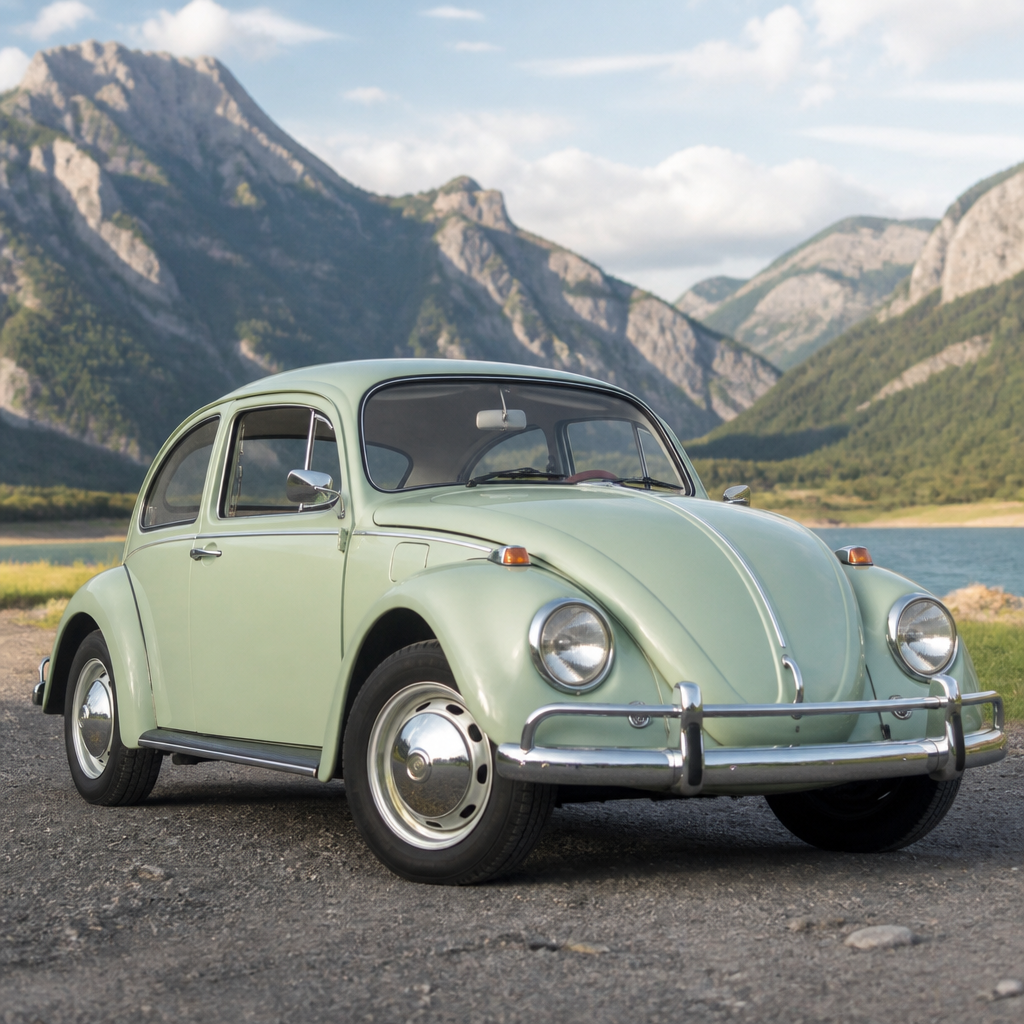
The Beetle’s silhouette is its strongest asset. The roof forms a near continuous arc from windshield to rear deck, creating a profile unlike three-box sedans. Separate rounded wings, upright circular headlamps, and compact overhangs give the car a friendly visual character. Designers often discuss proportion, and the Beetle proves how strongly proportion drives recognition. Even when trim, bumpers, glass size, and lighting changed over the decades, the essential outline stayed intact.
That consistency created one of the clearest visual identities in automotive history. Many successful cars become hard to recognize across generations because manufacturers chase fashion. Volkswagen did the opposite for most of the Beetle’s life. Small updates, such as larger rear windows, revised bumpers, improved dashboards, and better seats, kept the car usable without weakening its identity. The result was a model that could sit in a 1950s street scene or a 1990s scene and still appear unquestionably itself.
Color and customization also played a role. Owners painted Beetles in period pastels, bright solid tones, rally liveries, Baja conversions, and movie-themed schemes. Yet even heavily modified cars still read as Beetles at a glance. That is the ultimate test of iconic design. Compare that to many other classics that lose identity once altered. The Beetle’s architecture is so strong that chopped roofs, widened fenders, dune buggy derivatives, and lowered stances usually amplify recognition rather than erase it.
Engineering Simplicity and Everyday Durability
The Beetle’s reputation was built as much in garages and driveways as in showrooms. Its air-cooled engine, torsion-bar suspension, and generally straightforward mechanical layout made it approachable for owners and independent workshops. Valve adjustments, ignition servicing, carburetor tuning, clutch work, and even engine removal could be performed with ordinary tools and clear manuals. That serviceability matters in the history of iconic models because it turns ownership from passive consumption into participation.
In real use, simplicity translated into resilience. The flat-four could tolerate hard use if maintained correctly, and the platform chassis allowed body-off restoration work that remains practical today. Parts availability has long been one of the Beetle’s biggest strengths. Suppliers across Europe, the United States, Brazil, and Mexico continue to support restoration and routine maintenance. For a classic hub article, that point matters: recognition alone does not keep a model alive; parts networks, specialist knowledge, and active clubs do.
There were tradeoffs. Air-cooled engines are noisier than many water-cooled contemporaries. Cabin heating could be weak or inconsistent, especially in colder climates if heat exchangers or ducting were tired. Swing-axle handling on earlier cars demanded respect near the limit, and crash protection reflected the standards of its era rather than modern expectations. Still, the Beetle succeeded because buyers understood the exchange. They accepted a little noise and modest performance in return for economy, reliability, and ease of repair.
| Attribute | Volkswagen Beetle Strength | Practical Limitation |
|---|---|---|
| Air-cooled engine | Fewer cooling components, simple maintenance | More noise, less efficient heating |
| Rear-engine layout | Good traction, compact packaging | Different handling balance than front-engine cars |
| Parts support | Extensive global aftermarket and club knowledge | Quality varies between reproduction suppliers |
| Body-on-platform construction | Restoration friendly, flexible for customization | Rust can affect body and floorpan separately |
Key Beetle Eras Collectors Should Know
Not all Beetles are the same, and understanding the main eras helps buyers, restorers, and readers exploring iconic models. Early split-window and oval-window cars are especially prized for their purity and scarcity. These models capture the Beetle before later safety, comfort, and export-market revisions changed the details. Their values are often higher, and restoration standards tend to be stricter because collectors care deeply about correct trim, engine components, semaphores, and interior materials.
Cars from the late 1950s through the mid 1960s are often seen as the sweet spot between classic appearance and practical usability. They retain much of the early aesthetic while benefiting from improved electrical systems, more power, and better day-to-day drivability. The 1967 model year is especially notable in many markets because it bundled a distinct mix of old and new features, making it one of the most sought-after single-year Beetles among enthusiasts.
Later Beetles from the late 1960s and 1970s introduced features such as larger glass areas, revised suspension, stronger engines, and improved safety equipment. Super Beetle variants added front-end revisions and more luggage space, making them practical entry points into ownership. Production then continued in countries including Brazil and Mexico long after many assumed the car had ended. The final Mexican-built examples closed an extraordinary manufacturing run, confirming the Beetle as one of the longest-lived automotive designs ever produced.
The Beetle in Popular Culture, Motorsport, and Media
The Beetle became more than transport because it was repeatedly absorbed into culture. Advertising played a decisive role. Volkswagen’s mid-century campaigns, especially those built around plain language and minimal design, are still studied in marketing courses. They framed the Beetle as honest, rational, and quietly different in an age when many rivals sold chrome, size, and annual novelty. That positioning gave the car a personality that owners could identify with: sensible, unpretentious, and confident.
Film and television expanded that identity. The best-known example is Herbie, the racing Beetle character introduced in Disney films, which turned the car’s friendly shape into narrative shorthand for charm and determination. Beyond fiction, the Beetle appeared in campus life, counterculture imagery, surf scenes, road-trip photography, and urban commuting worldwide. By the 1960s and 1970s, it could symbolize thrift, anti-excess sentiment, or youthful independence, depending on context. Few cars have communicated so many meanings without changing their basic form.
Motorsport added another layer. While not designed as an out-and-out sports car, the Beetle proved adaptable in rallying, autocross, circuit club racing, and off-road competition. Baja Bugs became especially important because they showed how durable the platform was when modified with raised suspension, cut fenders, skid protection, and stronger tires. This versatility matters when assessing iconic status. The Beetle was not locked into one use case. It could be a commuter, race car, beach car, or family heirloom.
Buying, Restoring, and Living With a Classic Beetle Today
For readers using this page as a hub within classic car models and brands, the Beetle is one of the safest starting points in the iconic models category. It offers wide parts support, active communities, and a large knowledge base. If you are buying one, rust should be your first concern. Check heater channels, floorpans, battery tray areas, spare-wheel wells, lower body sections, and suspension mounting points. Mechanical issues are usually easier and cheaper to solve than serious structural corrosion.
Originality affects value, but it should be judged carefully. Matching-numbers examples, correct paint codes, period upholstery, and market-specific trim increase desirability, especially on early cars. However, a well-sorted driver with sensible upgrades can deliver a better ownership experience than an incomplete restoration candidate. Common upgrades include front disc brakes, improved seat belts, electronic ignition, and better tires. Done properly, these changes make the car safer and more usable without destroying its character.
Living with a Beetle requires realistic expectations. It is happiest on secondary roads, city routes, and relaxed touring rather than sustained modern motorway speeds. It rewards preventive maintenance: regular valve checks, ignition inspection, fuel-line replacement, and rust prevention are non-negotiable. The upside is that ownership teaches mechanical literacy. Many enthusiasts I have worked with started with a Beetle because it allowed them to understand the fundamentals of timing, fueling, suspension, and electrical diagnosis without overwhelming complexity.
Why the Beetle Leads Any Conversation About Iconic Models
In a sub-pillar on iconic models, the Volkswagen Beetle deserves hub status because it connects nearly every major theme in classic car history. It shows how design consistency builds recognition, how simple engineering extends a model’s life, and how culture can elevate a machine into a symbol. It also serves as a useful bridge to related topics: affordable classics, air-cooled engineering, postwar manufacturing, restoration basics, collectible trim variations, and automotive advertising history.
Other famous cars may exceed the Beetle in speed, luxury, rarity, or technical ambition. Very few exceed it in universal recognition. The Beetle succeeded across continents because it was understandable. People knew what it was for, how it looked, and often how to keep it running. That clarity made it approachable in a way many classics are not. It remains one of the rare vehicles that can interest historians, collectors, designers, mechanics, and first-time classic buyers at the same time.
The key takeaway is simple: the Volkswagen Beetle became the world’s most recognizable car by combining a distinct shape, durable engineering, and a cultural footprint that no single market controlled. If you are exploring classic car models and brands, start here, then branch into related iconic models for comparison. Study the eras, inspect condition carefully, and learn the ownership tradeoffs honestly. Do that, and the Beetle will not just look familiar; it will reveal why true automotive icons last.
Frequently Asked Questions
Why is the Volkswagen Beetle considered the world’s most recognizable car?
The Volkswagen Beetle is widely considered the world’s most recognizable car because its silhouette is instantly identifiable, even to people who know very little about automobiles. The rounded roofline, curved fenders, compact proportions, and friendly front-end appearance created a shape that stood apart from nearly every other production car of its era. Unlike many vehicles that changed dramatically from decade to decade, the Beetle kept its core visual identity for generations, allowing it to become deeply fixed in global popular memory.
Its recognition also comes from reach. The Beetle was not just sold in one market or tied to one social class. It appeared in Europe, North America, Latin America, Asia, and beyond, serving as affordable transportation for families, students, workers, enthusiasts, and collectors. That kind of worldwide presence gave it a rare cultural universality. People encountered the Beetle on city streets, in rural communities, in films, in advertisements, and eventually at classic car shows, which reinforced its familiarity across age groups.
Just as important, the Beetle developed an emotional identity that many cars never achieve. It was often described as charming, simple, dependable, and approachable. That personality made it more than a machine; it became a symbol. When a car can be recognized by shape alone and remembered by story, it moves from successful product to lasting icon. That is exactly what happened with the Volkswagen Beetle.
What made the Volkswagen Beetle so important in automotive history?
The Beetle occupies a major place in automotive history because it brought together mass production, mechanical simplicity, and extraordinary durability in a way that reshaped personal transportation for millions of people. It was designed to be practical, economical, and accessible, and over time it proved that a compact car could become a global phenomenon. Its production numbers alone place it in elite company, but its real historical importance goes beyond volume.
From an engineering standpoint, the Beetle became famous for its air-cooled rear-mounted engine and straightforward construction. That layout gave it a distinctive character and made it relatively easy to maintain compared with many other vehicles. Owners often appreciated that the car could be understood, repaired, and kept on the road without highly specialized equipment. This mechanical honesty helped build trust and loyalty, especially in markets where affordability and serviceability mattered as much as style.
The Beetle also demonstrated how a car could remain relevant through changing eras. It lived through postwar recovery, the expansion of consumer car ownership, the rise of youth culture, and the growth of collector communities. Few models have remained so visually and culturally consistent while surviving for so long in production. For historians and enthusiasts, the Beetle is not just a successful model; it is a key reference point for understanding how certain classic car models become enduring symbols of design, function, and identity.
How did the Volkswagen Beetle become such a strong cultural icon?
The Beetle became a cultural icon because it connected with people on levels that extended far beyond transportation. Its design looked approachable rather than intimidating, and that gave it a personality audiences could easily project onto. In popular culture, it often appeared as cheerful, trustworthy, unconventional, or even rebellious, depending on the era and context. That flexibility helped it appeal to very different groups while still feeling unmistakably like the same car.
Film, advertising, and music all played major roles in expanding the Beetle’s image. It was featured in widely seen entertainment and became associated with memorable stories and characters, which made it familiar even to non-drivers. Advertising also helped elevate the Beetle’s reputation by presenting it with wit, confidence, and honesty. Rather than pretending to be something glamorous or extravagant, the Beetle was often marketed as practical, smart, and authentic. That message resonated strongly, especially in times when consumers were increasingly skeptical of excess.
Its cultural status was strengthened by its adaptability. The Beetle could be a first car, a student car, a family car, a counterculture symbol, a restoration project, or a collectible classic. Very few vehicles can move through so many identities without losing their essence. Because the Beetle was both common and beloved, simple and symbolic, it achieved a rare kind of cultural permanence that still shapes how people think about iconic automobiles today.
What design and engineering features helped the Beetle endure for so long?
One of the Beetle’s greatest strengths was the way its design and engineering worked together in a clear, memorable package. Visually, the car avoided short-lived styling trends. Its rounded, unified shape was functional, efficient for its time, and emotionally appealing. Because it did not rely on ornament or fashion-heavy details, it aged more gracefully than many competitors. That timelessness is a major reason the Beetle remained recognizable and relevant over such a long production life.
Mechanically, the Beetle earned respect for its simplicity. The air-cooled engine, rear-engine layout, durable chassis, and straightforward components gave it a reputation for being rugged and practical. Owners around the world valued the fact that the car was relatively easy to service and that its design could tolerate a wide range of driving conditions. In many regions, that usability mattered more than high performance or luxury. The Beetle succeeded because it consistently delivered basic transportation in a dependable and understandable form.
Its endurance was also helped by continuity. Volkswagen refined the Beetle over time without abandoning the formula that made it successful. That meant improvements could be introduced while preserving the look and feel people already loved. In the larger conversation about why certain classic car brands and models remain influential, the Beetle is a perfect example of disciplined evolution. It stayed familiar while becoming better, and that balance is one of the hardest achievements in automotive design.
Why does the Volkswagen Beetle still matter to collectors and enthusiasts today?
The Beetle still matters because it represents a rare intersection of history, accessibility, and emotional appeal. Many classic cars are admired but difficult to own due to cost, complexity, or rarity. The Beetle has traditionally offered a more approachable entry point into classic car ownership. Enthusiasts appreciate that it carries enormous historical significance while remaining, in many cases, easier to maintain and enjoy than more exotic collector vehicles. That makes it especially important in introducing new generations to the classic car world.
Collectors are also drawn to the Beetle because it tells a larger story than most individual models. It speaks to global manufacturing, changing social attitudes, postwar mobility, and the power of industrial design to create affection. Owning or restoring a Beetle often feels like participating in a shared cultural memory. The car is simple enough to understand mechanically, yet rich enough in background and symbolism to reward serious study. That combination gives it unusual depth in the collector market.
Finally, the Beetle remains relevant because iconic design does not fade easily. Even in a modern automotive landscape filled with advanced technology and radically different vehicle shapes, the Beetle still communicates something immediate and human. It reminds enthusiasts that a car does not need extreme power or luxury to become legendary. Sometimes enduring greatness comes from consistency, character, and the ability to mean something personal to millions of people. That is why the Volkswagen Beetle continues to matter as both a collectible and a benchmark of automotive identity.